A single misplaced line of code recently bricked a chip. The mask set alone cost $10 million. The six-month delay to re-fabricate it wiped out an estimated 30–50% of the product's lifetime revenue. The bug? A race condition in an AI-generated arbitration module — a subtle mismatch between how the code simulated and how the actual silicon behaved. It passed every test. It compiled without error. And it was completely, catastrophically wrong.
This is the crisis at the heart of AI-assisted chip design. The semiconductor industry is racing to use Large Language Models — the same technology behind ChatGPT — to write the hardware description code that becomes physical silicon. The productivity gains are real. But so is the risk: LLMs don't understand circuits. They predict text. And when a text prediction error occurs in software, you push a patch. When it occurs in hardware, you eat a $10 million loss and start over.
Our team at Veriprajna has spent years studying exactly where and why these AI tools break down — and building something fundamentally different. We call the approach neuro-symbolic AI: pairing the creative generation of language models with the mathematical proof capabilities of formal verification. Not AI that guesses. AI that proves.
The $10 Million Bug That AI Tools Can't Catch
The chip failure we described above wasn't hypothetical. A design team used an advanced LLM workflow to build a custom RISC-V accelerator. The AI generated an arbitration module for a high-speed memory interface. The code looked flawless — clean simulation runs, no lint warnings, standard regression tests all green.
Six months and one fabrication cycle later, the chip deadlocked under a rare combination of thermal throttling and high-bandwidth traffic. The root cause was a confusion between two types of variable assignments in Verilog (the language used to describe chip hardware). In software terms, imagine writing a = b; b = a; and expecting it to swap two values. In sequential software, that works. In hardware, where everything executes simultaneously, it creates a race — and the outcome becomes unpredictable.
A chip that passes every simulation can still fail in silicon. Simulation tests scenarios you imagine. It can't test the ones you don't.
The "Wrapper" AI tools dominating the market today — essentially ChatGPT with a hardware-specific prompt — have no mechanism to catch this. They check syntax. They don't check physics.
Why Chip Bugs Cost 10,000x More Than Software Bugs
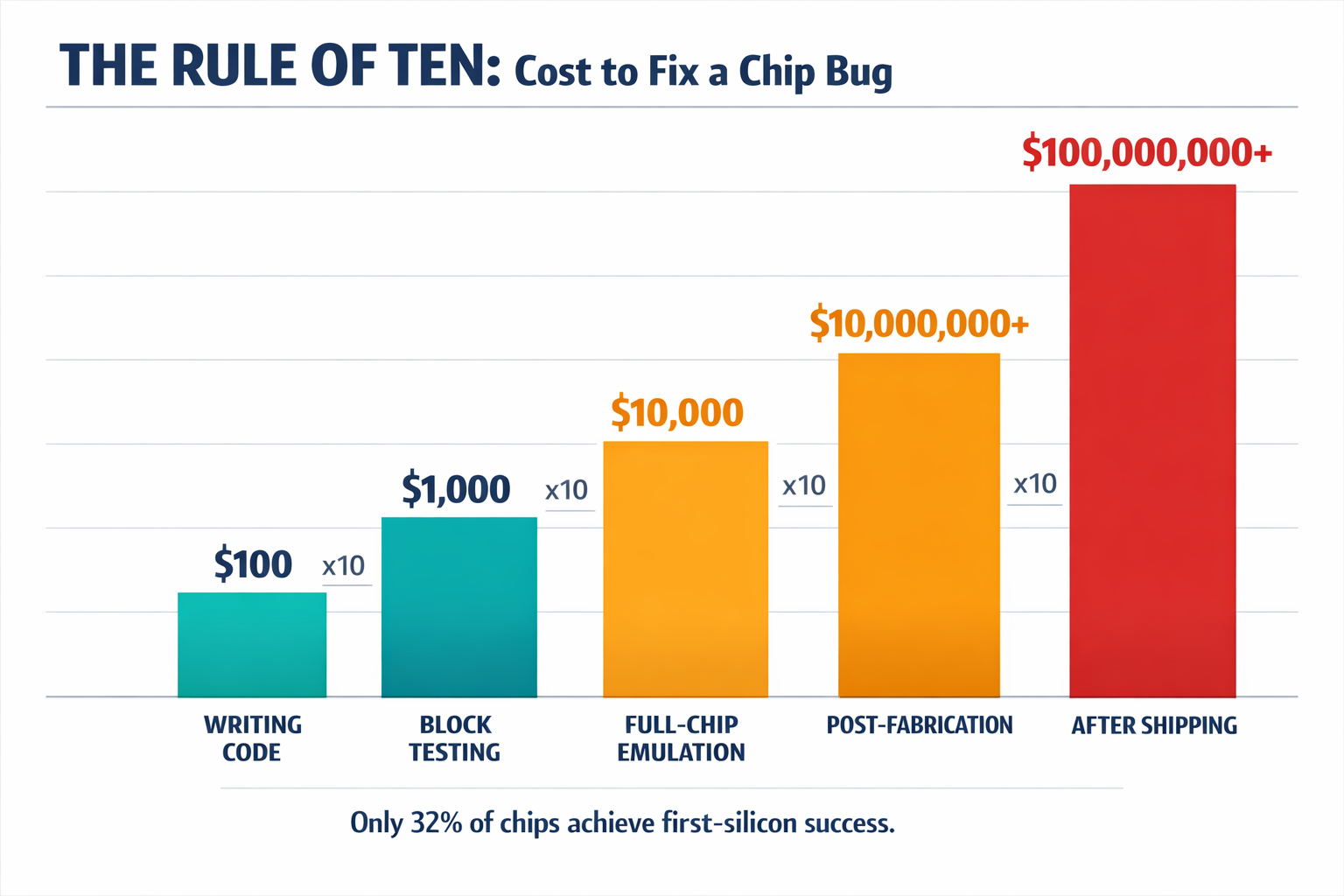
The semiconductor industry operates under a brutal economic principle called the Rule of Ten: the cost to fix a bug multiplies by 10x at every stage of the design process.
Catch it while writing the code: ~$100
Catch it during block-level testing: ~$1,000
Catch it during full-chip emulation: ~$10,000
Catch it after fabrication, in the lab: ~$10,000,000+
Catch it after shipping to customers: ~$100,000,000+ (recalls, lawsuits, brand destruction)
At advanced manufacturing nodes — 5 nanometers and below — a single mask set costs $10–20 million. That's the price of admission just to fabricate one version of a chip. Industry data shows that only 32% of chip designs achieve first-silicon success. The other 68% require at least one respin, and the leading cause is functional logic errors — precisely the kind of mistakes LLMs introduce when they hallucinate protocol behavior or misunderstand concurrency.
A six-month respin delay doesn't just cost the mask set. In markets like AI accelerators, where product generations last roughly 18 months, losing six months can erode 50% of a product's total lifetime profit. For a company targeting $100 million in revenue, that's a $50 million hit — five times the mask cost.
We explored these economics in depth in our interactive analysis of neuro-symbolic AI for hardware verification.
LLMs Think Like Programmers. Chips Don't Work Like Programs.
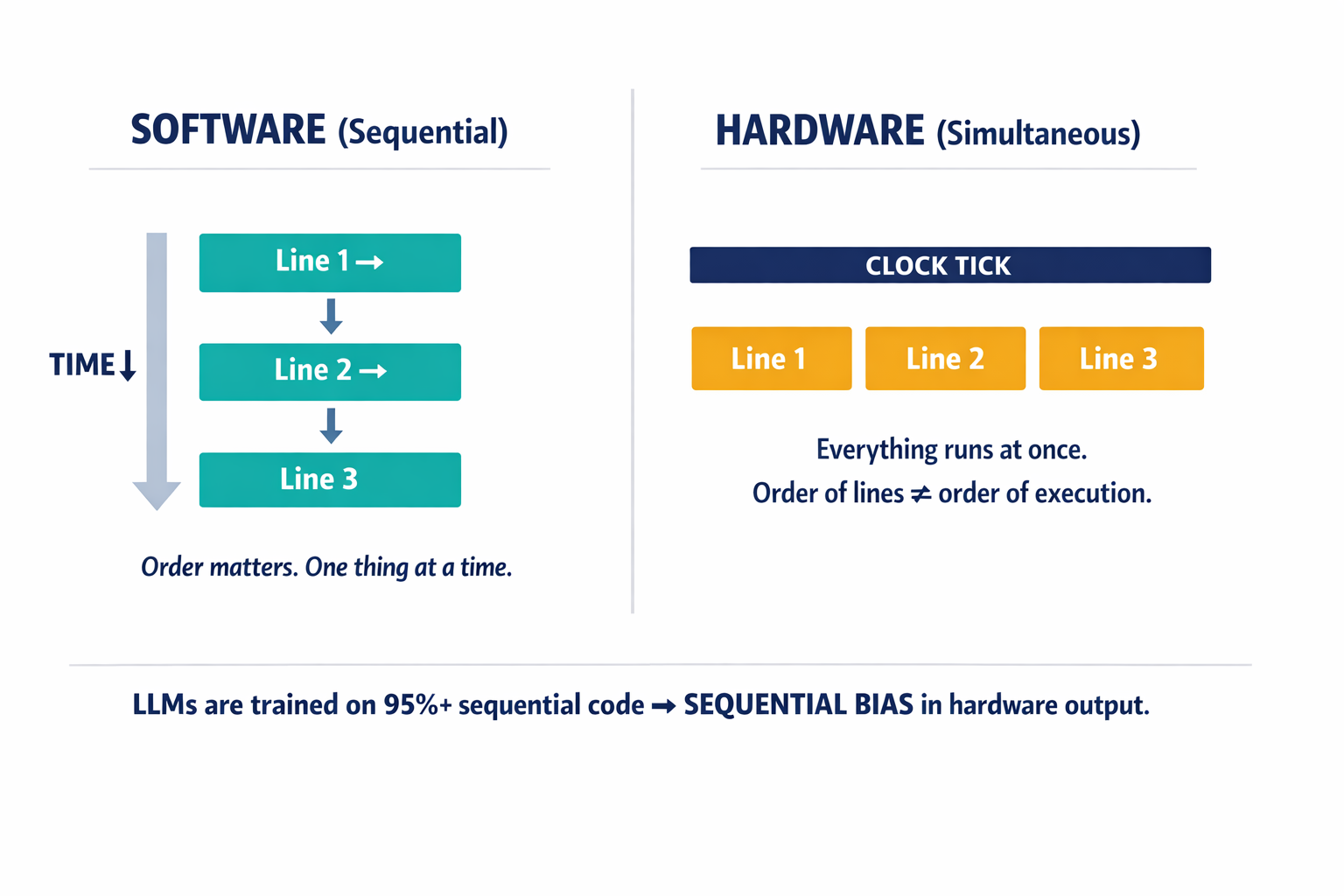
Why do language models — capable of passing the bar exam and writing functional software — fail so badly at chip design? The answer is deceptively simple: they were trained on the wrong kind of code.
The vast majority of an LLM's training data consists of sequential programming languages — Python, Java, C++. Line 1 runs, then line 2, then line 3. The state of the program is defined by the order of operations.
Hardware description languages like Verilog work the opposite way. Every block of logic executes simultaneously and continuously, like thousands of machines running in parallel. The order of lines in the source file often has zero relationship to the order of execution in the actual chip.
This creates what we call sequential bias. The LLM writes hardware as if it were software. It uses the wrong type of assignment. It assumes operations happen one after another. The resulting code compiles perfectly — and builds a chip that behaves unpredictably.
LLMs don't "understand" circuit topology. They predict the next likely word based on patterns in their training data. When that prediction is wrong in software, you get a bug report. When it's wrong in hardware, you get a paperweight.
The training data problem compounds this. High-quality, open-source Verilog code is orders of magnitude scarcer than Python or JavaScript. Much of what exists on GitHub consists of student projects and abandoned prototypes that don't follow industrial standards. When commercial LLMs generate synthetic Verilog to fill this gap, they risk a phenomenon called model collapse — the AI reinforcing its own errors in a feedback loop.
The Bugs That Hide From Every Test
The most dangerous hardware bugs aren't the obvious ones. They're the ones that are, in our team's terminology, "simulation-resistant" — invisible to every standard test, only surfacing in real silicon under rare conditions.
The pipeline hazard no one tested for. Picture a RISC-V processor with a standard five-stage pipeline. An LLM generates the forwarding logic — the circuitry that passes data between pipeline stages to keep things moving fast. It handles common cases correctly. But when a memory load instruction is immediately followed by a dependent arithmetic instruction, and an external interrupt arrives at exactly the same nanosecond, the stall signal and the forward signal race each other. The processor reads stale data. Two plus two equals something random. No standard test suite would inject an interrupt at that precise nanosecond during that precise instruction sequence.
The clock domain crossing that doesn't exist in simulation. Modern chips run different sections at different speeds — a 2GHz processor core talking to a 400MHz peripheral bus. When a signal crosses between these clock domains without proper synchronization, the receiving circuit can enter a "metastable" state — electrically, it's neither a zero nor a one. This corrupts everything downstream. LLMs see signal names. They don't see clock domains. They routinely connect signals directly across domains, skipping the required synchronization hardware. Simulation without detailed timing models won't flag it. The fabricated chip will fail.
These aren't edge cases. They're the primary reason 68% of chips need a respin.
From Testing to Proving: How Formal Verification Changes the Game
Traditional chip verification works like test-driving a car around the block a thousand times. If the brakes don't fail, you assume they're safe. But what if they only fail when it's raining, at exactly 60 mph, with the radio on a specific frequency? You'd never know.
Formal verification doesn't test scenarios. It converts the entire design into a mathematical formula and proves — exhaustively, across every possible input combination — whether a given property holds or not.
At the core of this approach are tools called SMT solvers (Satisfiability Modulo Theories) — mathematical engines like Microsoft's Z3 that can explore the complete state space of a chip design. Give the solver a property like "the grant signal must always follow a request within five clock cycles," and it will either:
Prove it's impossible to violate — mathematically, under any combination of inputs and internal states
Find a specific counterexample — the exact sequence of events that breaks the design
This isn't sampling. It's exhaustive proof. The solver checks all 2^N possible states, where N can be in the thousands. If it says the design is correct, it is correct — not probably, not statistically, but mathematically.
The catch? Writing the formal properties — the "contract" that defines correct behavior — has historically been painstakingly difficult. It requires specialized engineers who are scarce and expensive. Which is exactly where AI becomes genuinely useful.
The "Formal Sandwich": How We Combine AI Creativity with Mathematical Proof
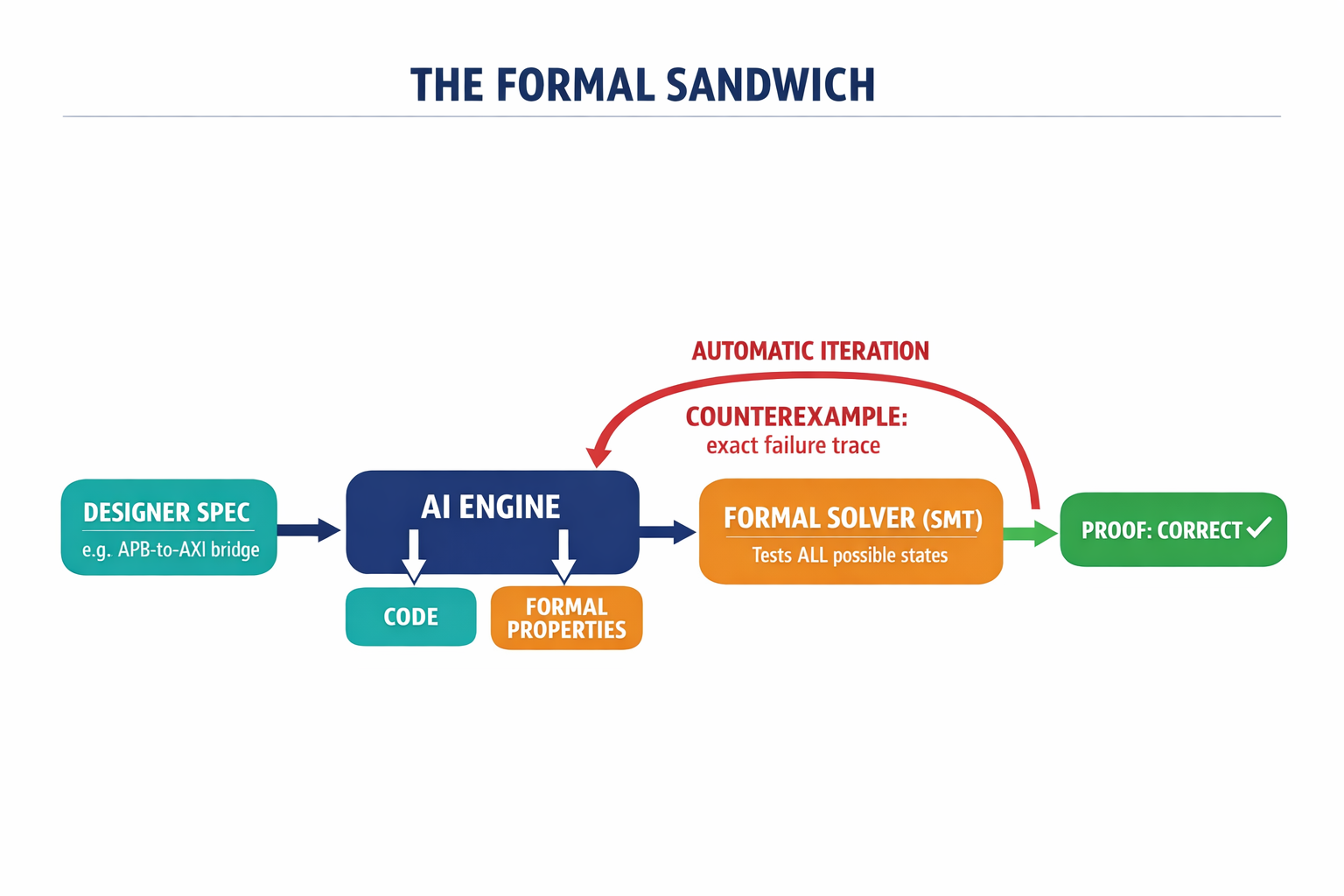
Our approach at Veriprajna isn't to replace AI in chip design. It's to make AI trustworthy by surrounding it with mathematical proof — a workflow we call the Formal Sandwich.
When a designer provides a specification — say, "design a bridge between APB and AXI bus protocols" — our system doesn't just generate code. It generates two things simultaneously: the hardware implementation and a set of formal properties that define what "correct" means for that design. Think of it as writing both the essay and the grading rubric at the same time.
Then the formal verification engine takes over, playing adversary. It tries every possible way to break the generated code against the generated properties. If it finds a violation, it produces a precise counterexample trace — not a vague error message, but the exact sequence of clock cycles and signal values that triggers the failure.
What happens next is the key innovation: that counterexample gets fed back into the AI as a new prompt. "Your design failed. Here's exactly how. Fix it." The AI analyzes the trace, identifies the flaw, and rewrites the code. This loop repeats automatically until the formal solver can prove no violation exists.
We don't ask the AI to be perfect on the first try. We give it a mathematical adversary that won't let it be wrong on the last try.
To keep this computationally feasible for large designs, we use abstraction techniques — verifying critical control logic in full while treating large memory blocks as simplified "black boxes," breaking complex paths into independently verifiable segments, and using mathematical symmetry to prove a property once and extend it across identical channels.
For the full technical methodology behind this approach, see our detailed research on semiconductor AI and hardware correctness.
Real Bugs in Real Chips: What Formal Methods Actually Find
This isn't theoretical. Formal verification has already uncovered bugs in some of the most scrutinized open-source chip designs in the world.
The Ibex RISC-V core — used in Google's OpenTitan security chip — had a bug where a debug request arriving at a specific cycle during a branch instruction could cause the core to deadlock or execute the wrong instruction. Formal verification by the team at Axiomise found it. Standard simulation had missed it.
The PULP platform, another widely-used open-source RISC-V ecosystem, contained a bug where its AXI interconnect could starve a connected device indefinitely under a specific pattern of handshake signals. This was a "liveness" failure — the system didn't crash, it just stopped making progress. No directed test would think to look for it.
When our system generates a RISC-V load-store unit, it automatically produces formal properties covering interface compliance ("once you assert a request, hold it until acknowledged"), data integrity ("data read from an address matches the last data written there"), and forward progress ("every request eventually gets a response"). These aren't afterthoughts bolted on after coding. They're generated alongside the code and enforced before a single transistor is committed to silicon.
What About the Computational Cost?
A fair objection: if formal verification is so powerful, why isn't everyone already using it? The answer is that historically, it required deep specialist expertise and significant compute time. The "state space explosion" — the exponential growth in possible states as designs get larger — made it impractical for full-chip verification.
Our approach sidesteps this in two ways. First, AI handles the hardest part — writing the formal properties — which has always been the bottleneck. Second, our abstraction techniques decompose large designs into formally tractable pieces. We're not trying to formally verify an entire system-on-chip in one pass. We're formally verifying the generated logic blocks where AI hallucination risk is highest, at the point where bugs cost $100 to fix instead of $10 million.
The computational cost of running formal solvers during design is real. But compared to a single respin — $10 million in masks, six months of delay, potentially $50 million in lost revenue — it's not even a rounding error.
What This Means for Chip Design Teams
The semiconductor industry is at an inflection point. AI-assisted design is coming whether the verification infrastructure is ready or not. The question isn't whether to use AI — it's whether to use AI with or without a mathematical safety net.
Three things we believe chip design leaders should be thinking about now:
Velocity without verification is liability. Any tool that helps engineers write hardware code faster without proportionally improving verification rigor is accelerating the injection of expensive bugs. Ask your EDA vendors not just how fast their AI generates code, but how it proves that code is correct.
The Rule of Ten is not optional. Every dollar spent on formal verification during design saves potentially $10,000–$100,000 in post-silicon debug. The economics are not subtle.
"First-time-right" silicon is a financial strategy, not just an engineering goal. At $10–20 million per mask set and 18-month product cycles, the margin for error has effectively reached zero. The companies that thrive in the angstrom era will be the ones that treat verification as a first-class concern, not a phase that happens after design.
The question is no longer "Can AI design chips?" It's "Can we afford to let AI design chips without proof?"
We'd welcome hearing how your teams are navigating the intersection of AI productivity and hardware reliability. The conversation matters — because the stakes are measured in silicon, not software patches.