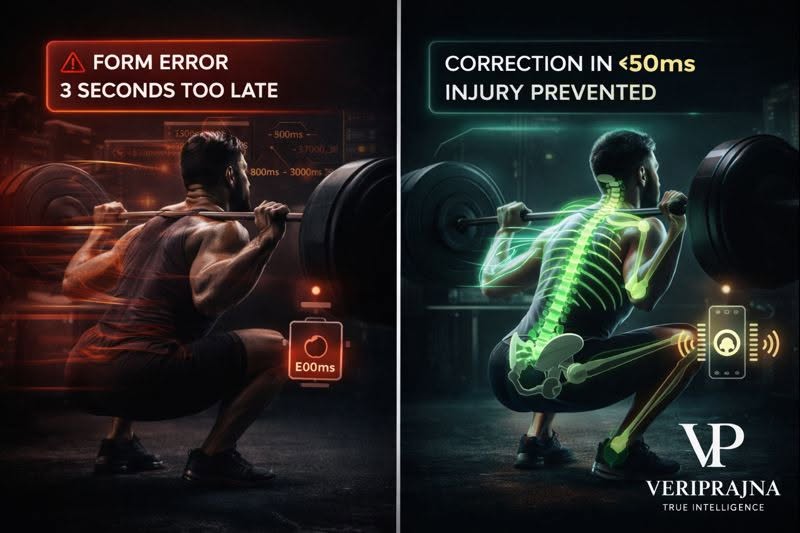
What if your AI fitness coach is reacting seconds too late—and putting users at risk instead of protecting them?
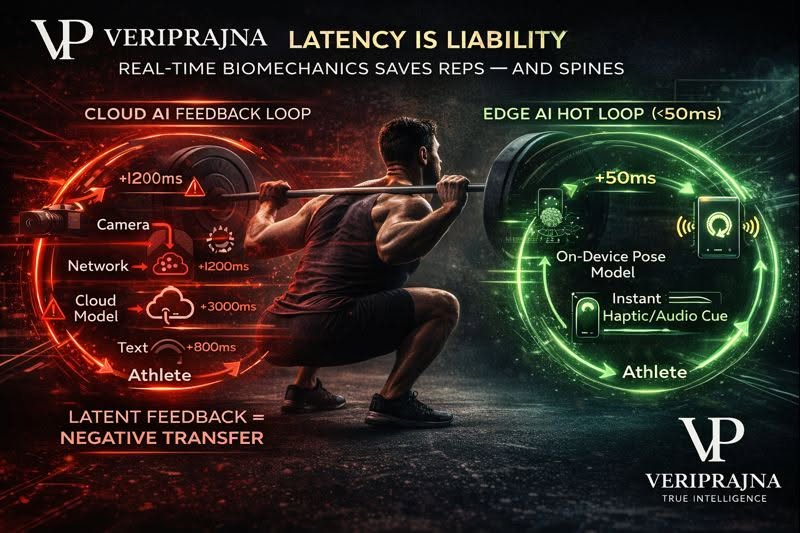
In the race to build “AI-powered” fitness experiences, the industry has embraced cloud-based multimodal models as real-time coaches. But biomechanics doesn’t care about hype. When form breaks down under load, 800 milliseconds isn’t a delay — it’s a liability.
In our latest whitepaper, The Latency Gap, we expose a critical flaw in today’s AI fitness architectures:
👉 Cloud-first AI cannot deliver safe, concurrent feedback for human movement.
👉 Delayed cues create negative motor learning, cognitive interference, and increased injury risk.
👉 What’s marketed as “real-time” is often biomechanically dangerous.
At VeriPrajna, we take a hard engineering stance. Real-time spotting demands sub-50ms feedback loops, on-device inference, and architectures that respect human reaction time—not server queues. Edge AI isn’t just faster; it’s safer, more scalable, privacy-first, and economically viable for enterprise-grade products.
This whitepaper breaks down:
• Why cloud latency fails the biomechanics test
• The true cost and scalability trap of AI “wrappers”
• How Edge AI enables professional-grade, real-time coaching
• A hybrid Edge–Cloud model that balances safety with intelligence
If you’re building AI in fitness, health, or human performance, this isn’t optional reading—it’s foundational.
📄 Read the whitepaper to understand why latency is the new liability (link shared in comments)
📩 Talk to our experts: [email protected]
💬 WhatsApp us: +91 92170 59957
Is your product just watching movement—or truly spotting it?
#EdgeAI #FitnessTech #HealthTech #RealTimeAI #EnterpriseAI