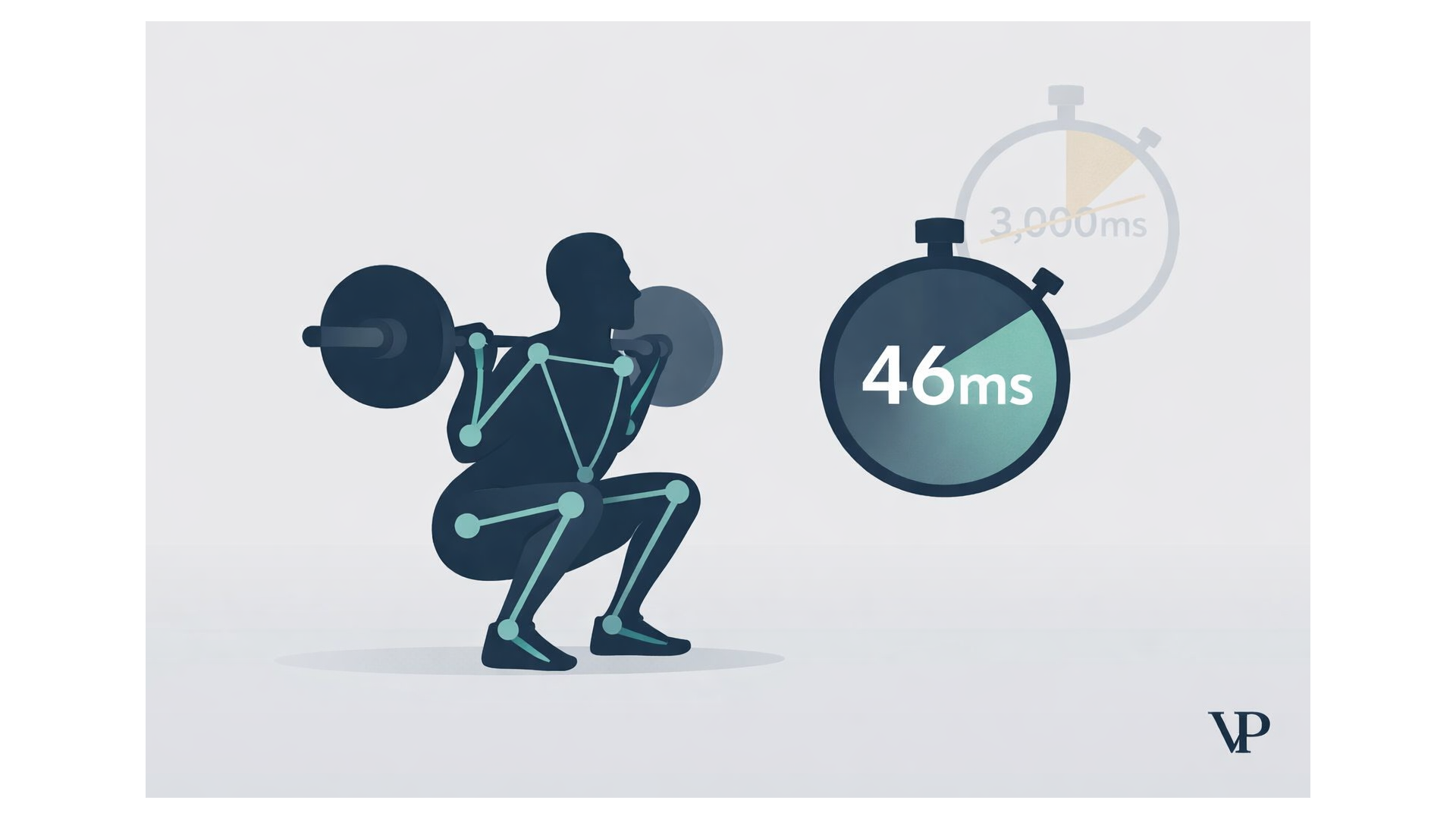
Picture this: you're deep in a heavy back squat, your lumbar spine starts to round under load, and your AI coach finally pipes up with "Keep your chest up" — three seconds after the danger has passed. By then, you're already driving up out of the hole with a compromised spine. That correction didn't help you. It confused you. And if you were unlucky, it arrived while you were executing the next rep perfectly, training your brain to associate good form with a warning signal.
This is the latency gap — the delay between a dangerous movement and the AI's response — and it's the dirty secret of every fitness app built on cloud-based AI. I've spent the past year studying this problem, and what my team found genuinely alarmed me: the architecture most "AI fitness" startups are using isn't just inefficient. It's biomechanically dangerous.
The 200-Millisecond Budget Nobody Talks About
Most people assume AI coaching is a software problem. Get a smarter model, write better prompts, and the corrections get better. But the real constraint isn't intelligence — it's physics.
When you're under a barbell, your body runs two systems simultaneously: one that planned the movement before you started, and one that adjusts in real-time based on what you feel and see. An AI coach plugs into that second system — the reactive one. And that system has a hard deadline.
Elite athletes can perceive a visual cue and initiate a motor correction in 150 to 250 milliseconds. Auditory and haptic cues (a buzz on your wrist, a beep in your ear) can trigger responses in 25 to 100 milliseconds. That's the entire window. If the AI's feedback arrives after roughly 200ms, it's too late to influence the current phase of the movement.
Now consider the timing of a squat. The descent takes about 1.5 to 2 seconds. The transition at the bottom — that critical "bounce" where your spine is most vulnerable — lasts less than 200 milliseconds. If your form breaks at the midpoint of the descent and the AI needs three seconds to respond, the correction arrives while you're already standing back up. The moment has passed. The damage, if any, is done.
A collision warning that goes off three seconds after the crash is technically accurate and completely useless.
What Happens When Corrections Arrive Late
This is where it gets worse than useless. In motor learning research, the timing of feedback matters as much as its accuracy. There are three categories: concurrent (during the movement), immediate terminal (right after), and delayed (minutes or hours later).
Cloud-based AI coaches fall into a category my team started calling "latent feedback" — corrections that arrive 2 to 5 seconds after the event. During a continuous set of exercises, that means the feedback for Rep 1 shows up while you're performing Rep 2.
The result is something called negative transfer. Your brain hears "Keep your chest up" while you're executing a perfect rep, so it unconsciously links the warning to your correct form. You overcorrect on Rep 3. Your form actually degrades because of the coaching.
I didn't fully appreciate how serious this was until I read the research on the "11+" injury prevention program, which found that neurocognitive distractors — anything that steals processing power from your brain during physical exertion — actively increase injury risk. A lagging AI coach isn't just unhelpful. It's a neurocognitive distractor strapped to your workout. It steals the mental bandwidth you need for balance, breathing, and intra-abdominal pressure.
We explored this feedback timing problem in depth in our interactive analysis, which walks through the biomechanics step by step.
Inside the 3-Second Delay
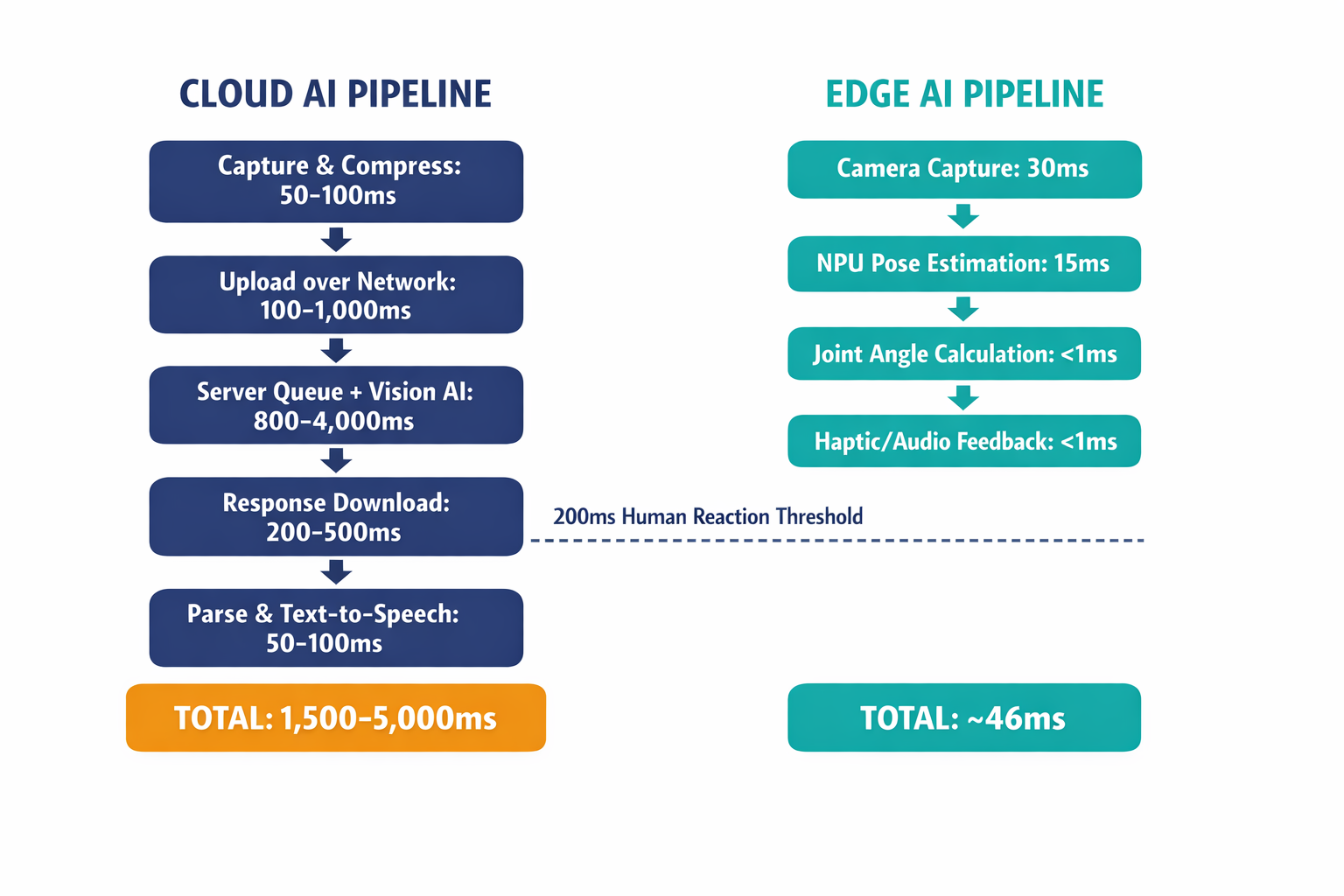
To understand why cloud AI is so slow for this use case, you need to follow a single video frame on its journey. When a fitness app sends your squat footage to GPT-4o or AWS Rekognition, that frame goes through a gauntlet:
The phone captures and compresses the image (50–100ms). Then it uploads that image over whatever network is available (100–1,000ms). Gyms are notoriously terrible RF environments — basements, metal frames, congested Wi-Fi. Once the image reaches the cloud, it enters a processing queue. Vision analysis on large multimodal models like GPT-4o typically takes 800ms to 4 seconds depending on server load. The response streams back to your phone (200–500ms). The app parses it and converts text to speech (50–100ms).
Total round trip in a best-case scenario with fast Wi-Fi: about 1.5 seconds. In a real gym: 3 to 5 seconds.
And that's for a single frame. For safety-critical spotting, you need at least 10 frames per second. At GPT-4o's vision pricing of roughly $0.001 per image, that's 600 frames per minute — $36 per hour of coaching. No consumer will pay that, so developers throttle the frame rate to once every 5 or 10 seconds. Which means the app isn't really watching you at all. It's glancing at you occasionally.
$36 per hour to analyze your squat form. And it still arrives three seconds late.
The Case for Thinking on the Phone
When I first saw the latency numbers side by side, I had one of those moments where the answer feels obvious in hindsight. The phone in your pocket has a specialized chip — a Neural Processing Unit, or NPU — designed specifically for the kind of math that powers computer vision. Apple's Neural Engine, Qualcomm's Hexagon processor. These chips exist. They're already in your phone. They're just sitting there during your workout.
Edge AI means running the pose estimation model directly on the phone instead of sending video to the cloud. The difference is staggering:
Camera captures a frame: 30ms
NPU runs pose estimation: 15ms
App calculates joint angles: under 1ms
Feedback triggers (haptic buzz or audio cue): under 1ms
Total: about 46 milliseconds. That's well under the 200ms threshold for human reaction time. The AI literally sees your form break before you're consciously aware of it.
The models that make this possible — BlazePose, MoveNet, YOLOv11-Pose — are open-source and purpose-built for mobile devices. BlazePose, which my team recommends for dedicated fitness applications, tracks 33 skeletal keypoints including detailed hand and foot landmarks. It estimates depth in three dimensions, which means it can detect when your knee caves inward during a lunge — something a 2D model would miss entirely because the leg just looks "shorter" from the camera's perspective.
Smooth Data Without Slow Data
One problem I underestimated early on: raw skeleton data from neural networks is noisy. Keypoints jitter frame-to-frame even when you're standing still. If you calculate knee angle directly from raw data, you might get readings bouncing between 85° and 92° while the person hasn't moved at all.
The obvious fix — averaging the last several frames — reintroduces latency. Average the last 10 frames at 30 frames per second and you're showing the user a ghost of their movement from 333 milliseconds ago. We just fought to get under 50ms, and naive smoothing would blow the budget immediately.
The solution is an algorithm called the 1€ Filter (pronounced "one euro"), originally developed for VR gaming and cursor tracking. It's elegant because it adapts based on speed. When you're holding a plank and barely moving, it smooths aggressively — the skeleton looks rock-solid, no jitter. The instant you drop into a squat, it backs off the smoothing to near zero, prioritizing responsiveness over polish.
The 1€ Filter smooths when you're still and tracks when you're fast — exactly what a spotter needs to do.
There's another critical safety layer: confidence gating. Pose estimation models assign a confidence score to each keypoint. If your arm blocks the camera's view of your hip, that hip keypoint's confidence drops. Instead of guessing the angle and giving potentially dangerous advice, the system stops analysis and tells you to adjust your camera. Failing safely is more important than appearing smart.
Why This Is an Existential Choice for Fitness Startups
The economics of cloud vs. edge aren't just different — they're inverted.
Cloud architectures punish success. Every squat, every rep, every second of analysis triggers a billable API event. If your app goes viral and gains 100,000 users overnight, your infrastructure bill spikes immediately — potentially before monetization catches up. With 50,000 monthly active users each doing 10 sessions per month, estimated cloud API costs run to roughly $250,000 per month. Over three years, that's north of $5 million.
Edge architecture flips this completely. Once the app is downloaded, all the compute happens on the user's own phone. The cost to analyze one million squats is the same as the cost to analyze one: zero. The heavy investment is upfront — optimizing models for mobile NPUs, building the signal processing pipeline — but after that, scaling is essentially free. Our three-year cost estimate for the same 50,000-user scenario: around $200,000 total.
And there's a privacy dividend that compounds the advantage. Cloud-based analysis means your workout video leaves your phone and travels to a remote server. Under regulations like Illinois's Biometric Information Privacy Act (BIPA) and Europe's GDPR, body movement data qualifies as biometric information — heavily regulated, lawsuit-prone territory. Edge processing keeps video frames in the phone's memory, processed and discarded instantly, never written to disk or transmitted anywhere. An app that works in airplane mode is an app that proves it isn't surveilling you.
For the full technical methodology behind these calculations — including thermal management, model quantization, and the complete latency math — see our detailed research.
But What About the Smart Coaching Part?
This is the objection I hear most: "If everything runs on the phone, where does the intelligence come from? Where's the personalized programming, the conversational coaching, the long-term trend analysis?"
Fair question. The answer isn't edge or cloud — it's both, doing different jobs.
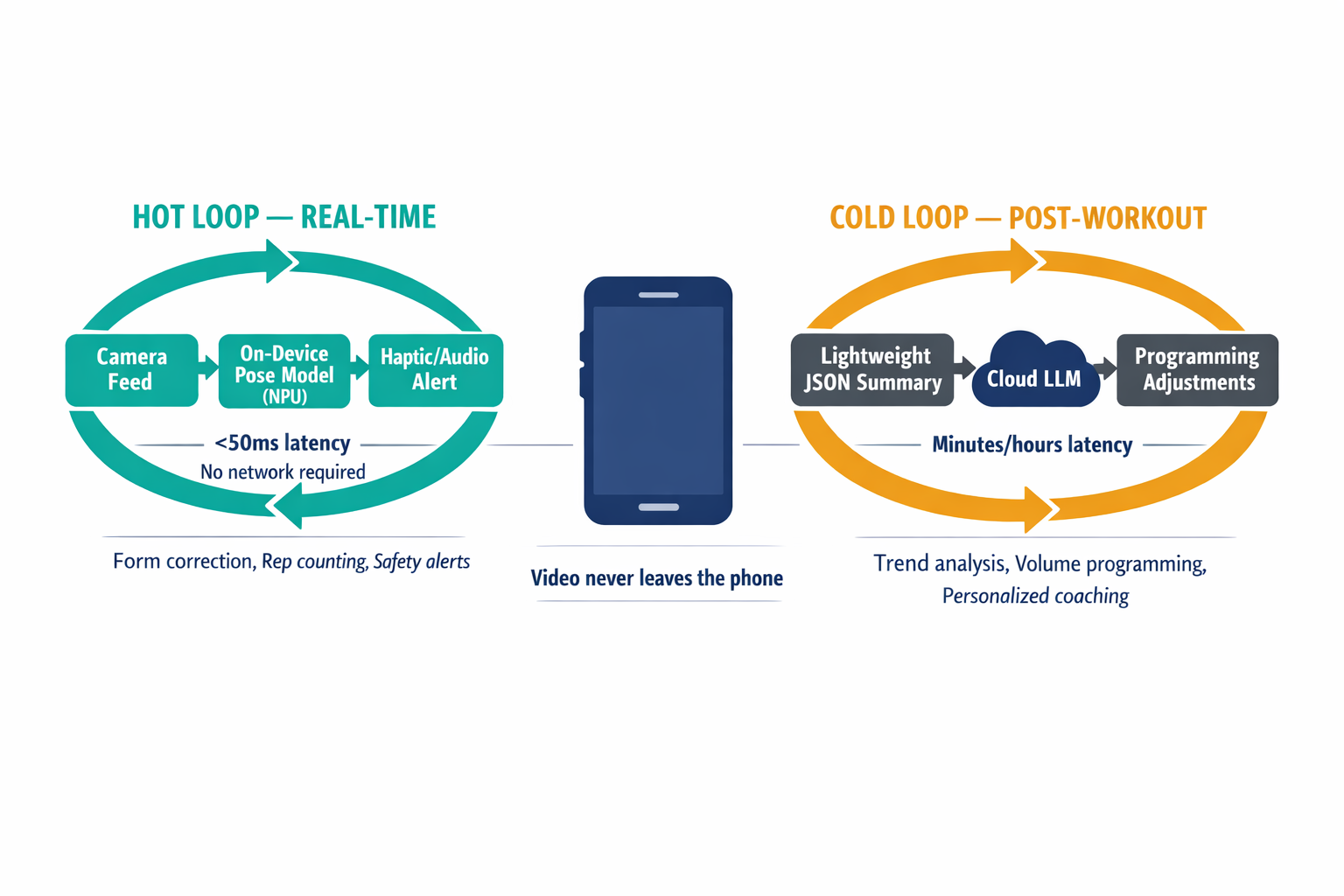
We think about it as two loops. The hot loop runs on the phone: real-time safety, form correction, rep counting, haptic alerts. Latency under 50 milliseconds. No network required.
The cold loop runs in the cloud, but it never touches your video. After your workout, the app sends lightweight data — a small JSON file that says something like "Set 3: average depth 88°, spine angle 168°, form breakdown correlated with reps 7-10." An LLM processes this metadata and comes back with: "Your form consistently degrades in the last third of your sets. Let's reduce volume by two reps next week and see if that holds."
The real-time spotter doesn't need to be a philosopher. It needs to be fast. The long-term coach doesn't need to be fast. It needs to be thoughtful. Forcing one system to do both jobs is how we ended up with $36-per-hour coaching that arrives too late to matter.
What This Means If You're Building in Fitness Tech
If you're a founder, product manager, or engineer working on AI fitness, the question to ask yourself is blunt: is your app watching a video, or spotting the user?
If the answer involves sending frames to a cloud API for real-time feedback, the physics don't work. Not because the models aren't smart enough — they are — but because the speed of light and the realities of cellular networks impose a floor on latency that no amount of prompt engineering can fix. 800 milliseconds is an eternity in biomechanics.
The path forward is clear: purpose-built pose estimation models running on the neural processing hardware that's already in your users' pockets, with cloud intelligence reserved for the problems that actually benefit from it.
I'd genuinely love to hear from others working on this problem. If you've found creative solutions to the latency challenge, or if you disagree with the edge-first approach, I want to know. The stakes — people's spines, shoulders, and knees — are too high for any of us to get this wrong alone.