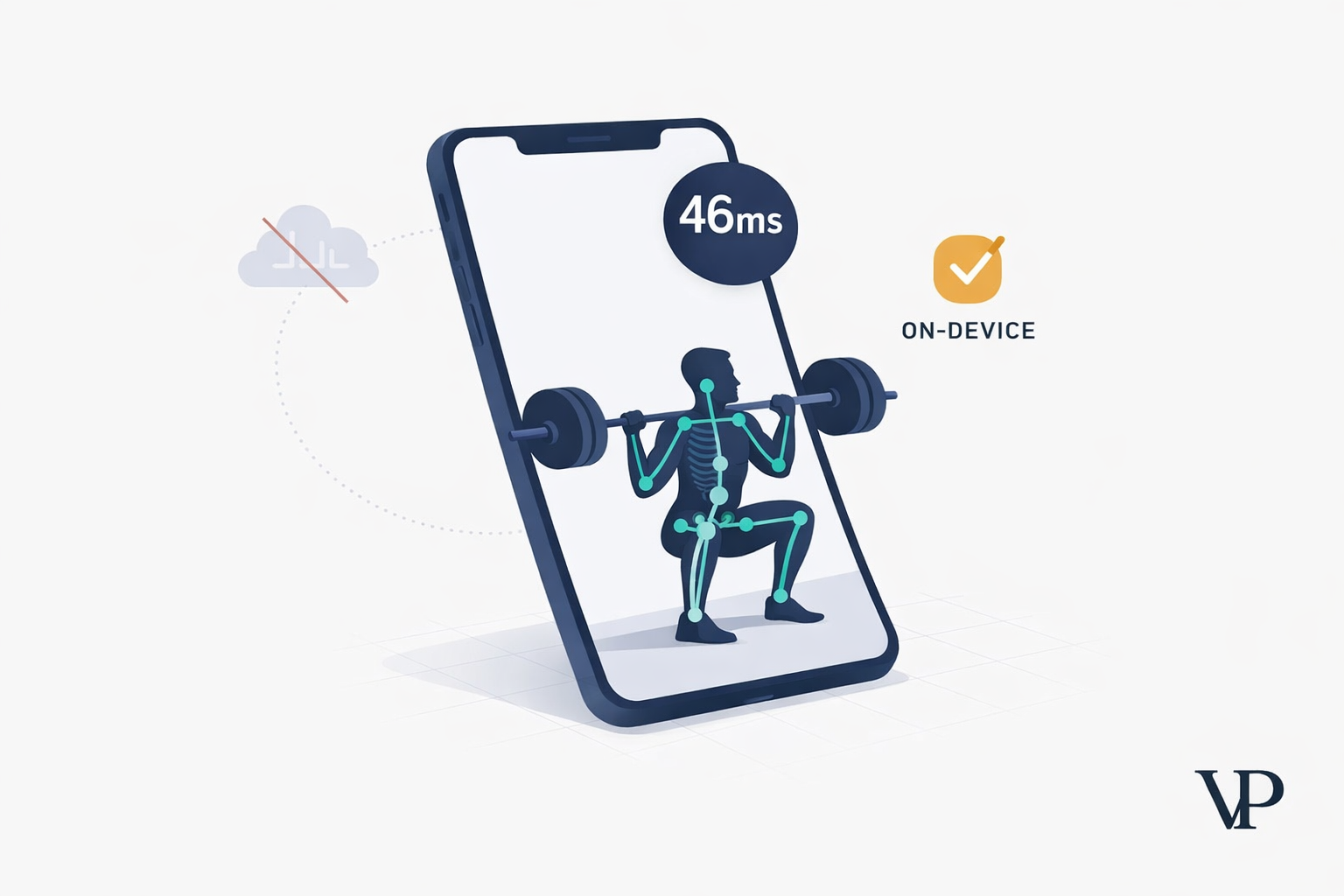
Imagine you're at the bottom of a heavy squat. Your lower back starts rounding under load — the exact moment where disc injuries happen. Your AI coach, the one that promised "real-time form correction," finally speaks up: "Keep your chest up."
But you're already standing. The dangerous part of the rep ended three seconds ago.
This isn't a hypothetical. It's the reality of nearly every AI fitness application built on cloud-based large language models today. And our research into what we call the latency gap — the delay between a dangerous movement and the AI's correction — reveals that this isn't just a bad user experience. It's a biomechanical hazard that makes injuries more likely, not less.
The 200-Millisecond Budget Nobody Talks About
The human body operates on tight timelines during exercise. When you're under a loaded barbell, your nervous system is processing balance, pressure, and leverage simultaneously. The window to correct a failing rep — to re-engage your back muscles before your spine flexes dangerously — is measured in milliseconds.
Research on motor control shows that humans need 150 to 250 milliseconds to perceive a visual cue and initiate a physical correction. For sound or vibration cues, that drops to 25 to 100 milliseconds.
This creates a hard engineering constraint that most fitness AI companies ignore: any coaching system with more than roughly 200 milliseconds of total delay — from camera capturing the movement to the user receiving a correction — misses the window entirely. The feedback arrives after the dangerous moment has passed.
A correction that arrives after the movement is coaching. A correction that arrives during the movement is spotting. Only one of those prevents injuries.
Consider the biomechanics of a squat. The descent lasts about 1.5 to 2 seconds. The transition at the bottom — where spinal forces peak — is often less than 200 milliseconds. If an AI takes 800 milliseconds to 3 seconds to respond, it's not spotting the athlete. It's narrating a replay.
Late Corrections Don't Just Miss — They Make Things Worse
This is the part that genuinely surprised our team. We assumed that late feedback would simply be useless. The motor learning research tells a darker story.
When a correction arrives 2 to 5 seconds after the error, something called negative transfer occurs. During a continuous set of exercises, a 3-second delay means the feedback for Rep 1 arrives while the user is performing Rep 2. The brain hears "Keep your chest up" and associates it with whatever the body is currently doing — even if the current rep has perfect form.
The athlete then overcorrects on Rep 3, altering their technique based on a correction that was never meant for that movement. Motor learning research confirms that mistimed feedback interferes with the brain's own error-detection system, creating dependency on external cues while simultaneously making those cues unreliable.
It gets worse under load. During a heavy lift, the athlete's cognitive resources are maxed out — managing intra-abdominal pressure, balance, and leverage. A late audio cue acts as a neurocognitive distractor, effectively stealing processing power from the athlete's motor coordination. Research on the "11+" injury prevention program specifically identifies this kind of cognitive interference as a factor that increases injury risk.
We explored this biomechanical analysis in depth in our interactive research, including the specific spinal mechanics that make delayed feedback dangerous.
Why Cloud AI Can't Fix This with Better Servers
The instinct is to think faster servers or better models will close the gap. They won't. The latency is structural.
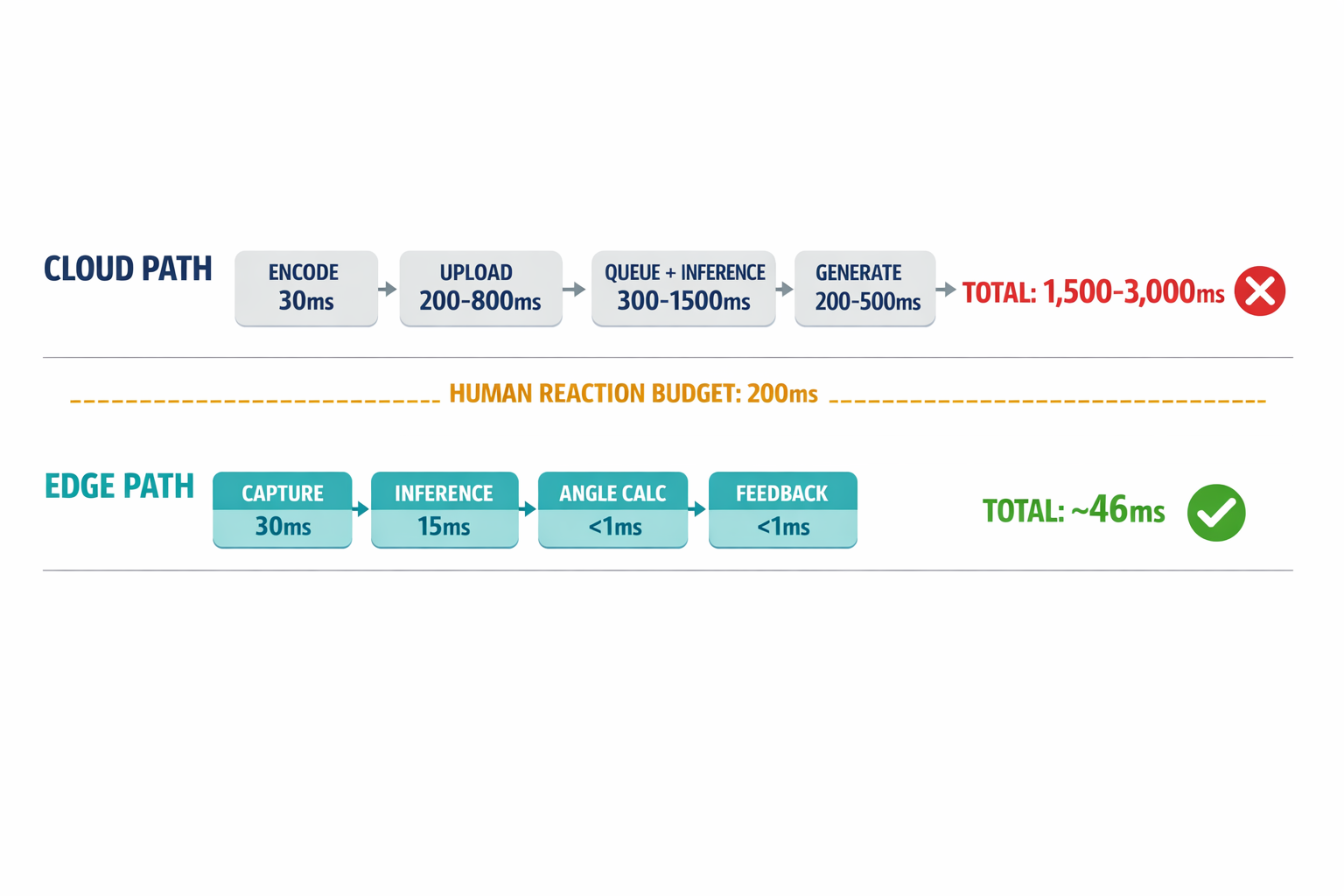
When a fitness app sends a video frame to a cloud model like GPT-4o Vision or Gemini for analysis, that frame takes a journey with at least five stops: encoding and compression on the phone, uploading over the network, waiting in a server queue for inference, generating a text response, and transmitting it back to the device for audio playback.
We broke down the numbers for each stage. Even in a best-case scenario — fast Wi-Fi, low server load — the total round trip is roughly 1.5 seconds. In a real gym environment (basement locations, congested Wi-Fi, concrete walls that block signals), it stretches to 3 to 5 seconds.
No amount of model optimization fixes the physics of network transmission. The speed of light through fiber optic cable is fast, but it's not faster than the 200-millisecond budget that human biomechanics demands.
Asking a cloud API to spot a squat is like asking a car's collision warning system to alert the driver three seconds after the crash.
The $36-Per-Hour Problem
Even if you could somehow solve the latency, the economics are devastating.
Cloud vision models charge per image analyzed. For safety-critical form correction, you need at minimum 10 frames per second — anything less and you'll miss the exact moment form breaks down. At GPT-4o Vision's pricing of roughly $0.001 per image, that works out to:
600 frames per minute × $0.001 = $0.60 per minute
$36 per hour per user
No consumer will pay $36 an hour for an automated gym partner. So developers do the only thing they can: they throttle the frame rate to once every 5 or 10 seconds. This saves money but destroys the product's ability to catch dangerous form breakdowns. You end up with an app that checks your form twice per set — roughly as useful as asking a friend who glances up from their phone occasionally.
For a startup with 50,000 monthly active users doing 10 sessions each, our analysis estimates cloud compute costs alone at roughly $250,000 per month. Scale to success and you scale to bankruptcy.
Edge AI: Moving Intelligence to the Phone
The solution isn't a better cloud. It's no cloud — at least not for the real-time safety layer.
Modern smartphones contain specialized chips called Neural Processing Units (NPUs) — the Apple Neural Engine, Qualcomm's Hexagon processor — designed specifically for the kind of math that powers computer vision. These chips can run pose estimation models directly on the device, analyzing the camera feed without ever sending data to a server.
We evaluated three leading models for on-device pose estimation: BlazePose (from Google's MediaPipe), MoveNet (via TensorFlow Lite), and YOLOv11-Pose. Each has strengths, but BlazePose stood out for fitness applications because it tracks 33 body landmarks (compared to the standard 17) and estimates depth — meaning it can detect when a knee collapses inward during a lunge, not just that the leg appears shorter on a flat image.
The total latency for an edge-based system — from camera capturing a frame to the user receiving a haptic vibration or audio cue — breaks down to roughly:
Camera capture: 30ms
On-device inference: 15ms
Angle calculation and logic: under 1ms
Feedback trigger: under 1ms
Total: approximately 46 milliseconds. That's well inside the 200ms human reaction window. The AI effectively sees and reacts faster than the athlete can register that something went wrong.
And the cost per analysis? Zero. The compute runs on the user's own hardware. Serving one million squats costs the same as serving one.
Solving the Jitter Problem Without Reintroducing Delay
Raw skeleton data from neural networks isn't clean. Keypoints — the dots that represent joints — tend to vibrate frame to frame, even when the person is standing still. If you calculate a knee angle from noisy data, it might jump from 90° to 85° to 92° in three consecutive frames, triggering false alerts.
The obvious fix — averaging the last several frames — reintroduces latency. Average the last 10 frames at 30 frames per second and you're showing the user a ghost of their movement from 333 milliseconds ago. That defeats the entire purpose.
Our implementation uses the 1€ (OneEuro) Filter, an algorithm originally developed for VR gaming and cursor tracking. It works by adapting to speed: when the user holds a plank (low movement), it smooths aggressively, eliminating jitter. When they drop into a squat (fast movement), it backs off the smoothing to preserve responsiveness. The result is a skeleton that looks stable during holds and tracks instantly during dynamic movements — without adding meaningful delay.
We also implement confidence-based safety gates. When a body landmark is partially hidden — say an arm blocks the camera's view of the hip — the model's confidence score drops. Rather than guessing the angle and potentially giving dangerous advice, the system pauses analysis and prompts the user to adjust their camera. For a safety-critical application, admitting uncertainty is more important than maintaining the illusion of omniscience.
For the full technical methodology behind our signal processing and model selection, see our detailed research.
Privacy as an Architectural Consequence
There's a benefit to edge processing that has nothing to do with speed or cost: your workout video never leaves your phone.
Cloud-based fitness AI requires streaming video of your body to remote servers. That video constitutes biometric data under laws like Illinois's BIPA (Biometric Information Privacy Act) and Europe's GDPR — both of which impose strict consent requirements and have generated massive class-action settlements for companies that mishandled such data.
With edge processing, video frames are analyzed in the device's memory and discarded immediately. They're never written to storage, never transmitted, never stored on a server. An app that works in airplane mode provides tangible proof to the user that nobody is watching.
The most private data architecture is the one where the data never leaves.
This isn't just a legal advantage. It's a trust advantage. And in a market where users are increasingly wary of apps that demand camera access, it's a competitive one.
What About Long-Term Coaching and Personalization?
The obvious objection: if everything runs on the phone, how do you get the intelligent, conversational coaching that large language models excel at? How does the AI learn that your form breaks down in set four and suggest adjusting your training volume?
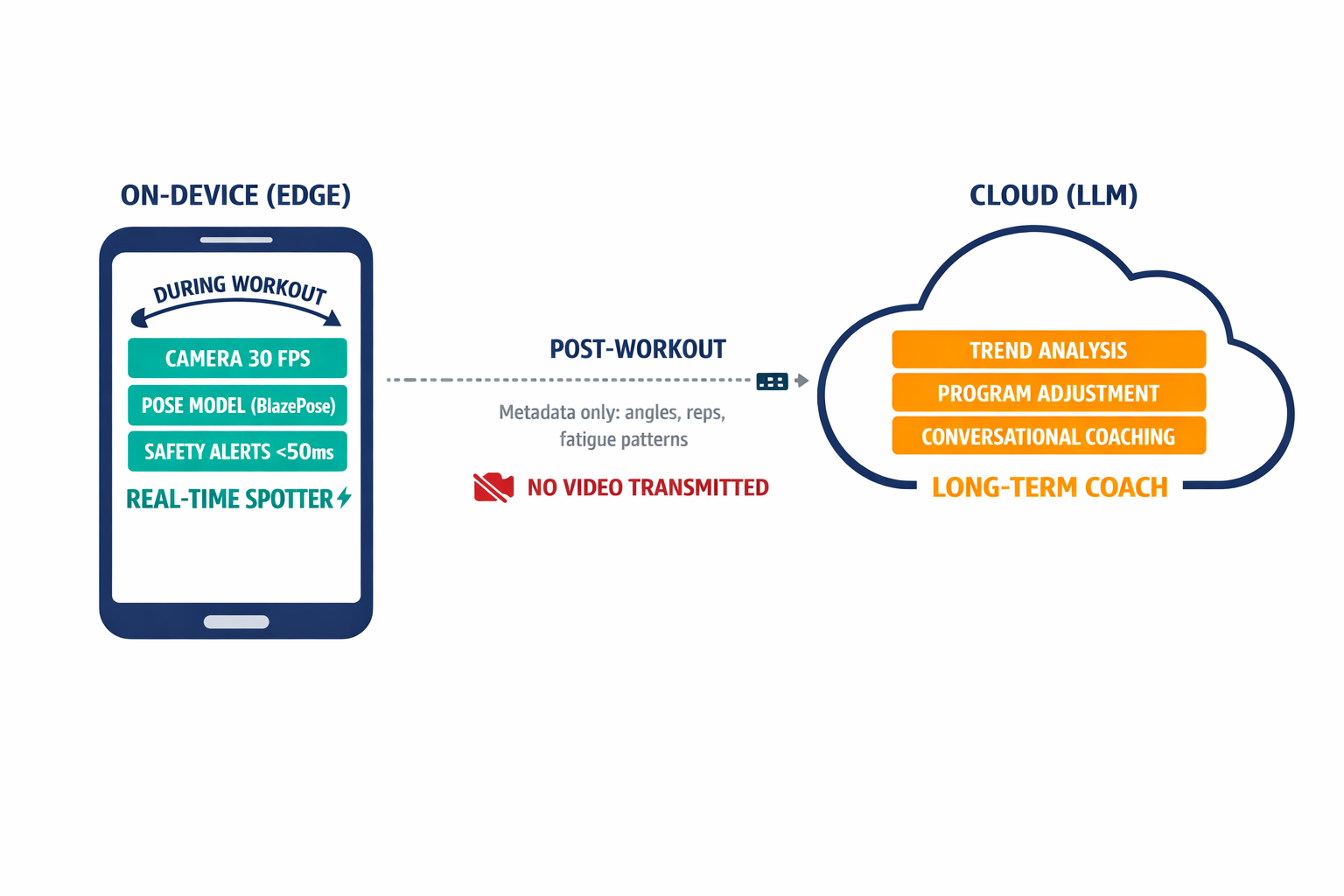
This is where a hybrid architecture becomes essential. The real-time safety layer — the spotter — runs entirely on device, at 30+ frames per second, with sub-50ms feedback. That's non-negotiable. But after the workout, the app can send lightweight summary data to a cloud model: not video, but compact metadata like "Set 3: average depth 92°, spine angle deviated at rep 7, fatigue pattern detected."
A large language model can then analyze trends across weeks of training, adjust programming, and answer conversational questions like "Why does my back round on heavy sets?" This combines the rich reasoning of cloud AI with the safety and speed of edge processing — without ever sending a single frame of video off the device.
Does Edge AI Work on Older Phones?
Mostly yes, with graceful degradation. MoveNet's "Lightning" variant runs at 50+ frames per second even on older hardware. BlazePose uses a clever two-step architecture — a heavier model locates the person on the first frame, then a lightweight tracker follows movement on subsequent frames, keeping speeds above 30 FPS on mid-range devices.
Battery drain is a real concern, but it's manageable. Our approach uses adaptive frame rates (dropping to 1 FPS during rest periods), model quantization (shrinking model size by 4x with negligible accuracy loss), and thermal monitoring that proactively switches to lighter models before the phone's operating system forces a hard slowdown. Counterintuitively, local processing can be more energy-efficient than cloud processing, because the cellular radio — which consumes enormous power when transmitting data — stays off.
What This Means If You're Building in Fitness Tech
The fitness AI market is flooded with apps that wrap cloud APIs and call themselves "AI personal trainers." The marketing sounds impressive. The architecture is fundamentally broken for the one job that matters most: keeping the user safe during the movement, not after it.
Three things to consider:
If your product claims real-time form correction, measure your actual end-to-end latency. Not the model's inference time — the full journey from camera frame to user feedback. If it's over 200ms, it's not real-time in any biomechanically meaningful sense.
If your cost per user scales with their usage, your economics are inverted. The most engaged users — the ones who train daily — become your most expensive customers. Edge processing flips this: your best users cost you nothing extra.
If your architecture requires video to leave the device, you're carrying legal risk that will only grow as biometric privacy laws expand globally.
The question isn't whether your AI can analyze a squat. It's whether it can analyze the squat fast enough to matter.
We built our approach around a simple conviction: the physics of human movement and the physics of network transmission are fundamentally incompatible for safety-critical applications. The intelligence has to live where the movement happens — on the device, in the user's hands, at the speed of their muscles.
If you're working on fitness technology, rehabilitation tools, or any application where AI needs to respond to human movement in real time, we'd welcome the conversation about what edge-first architecture looks like in practice.