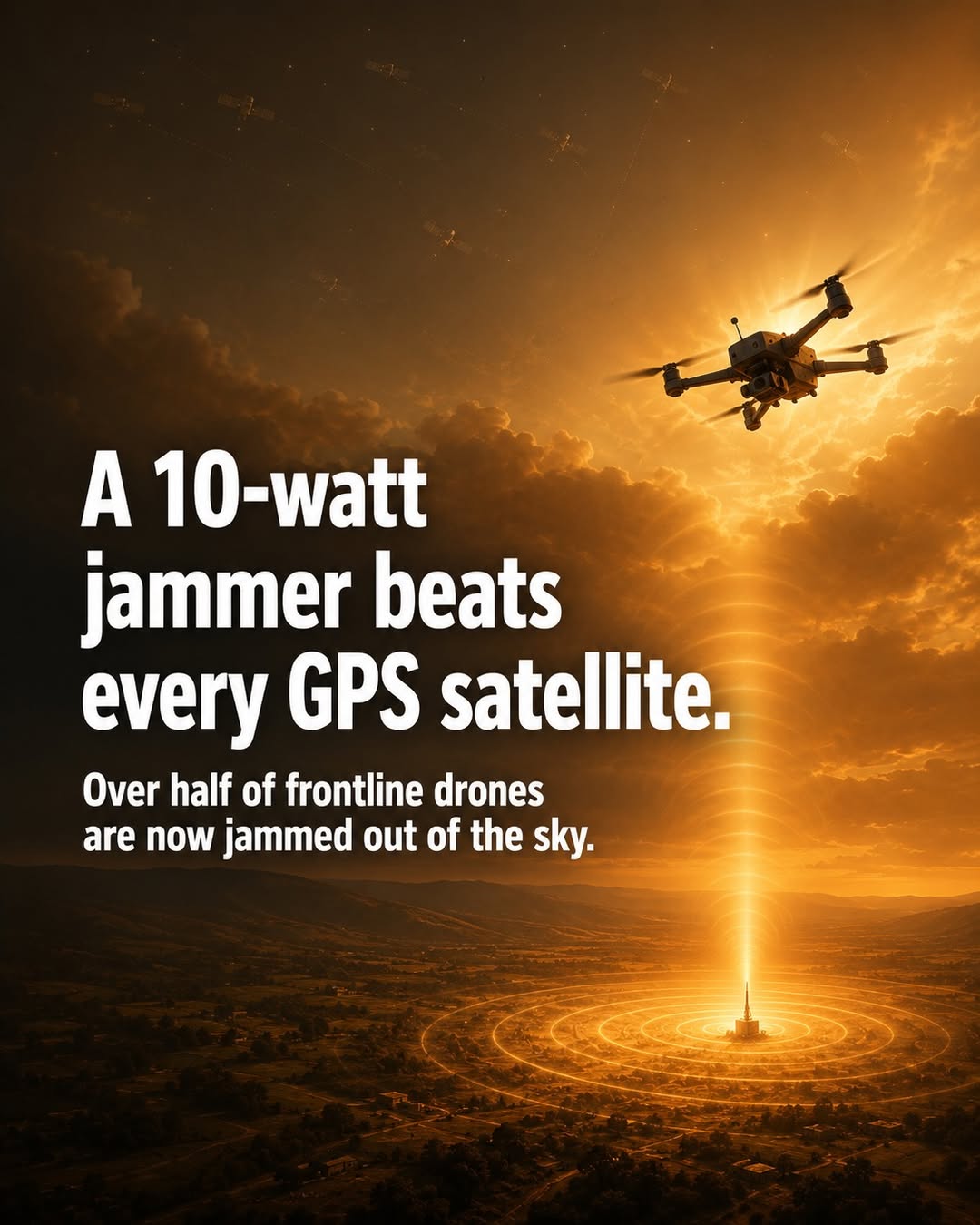
A 10-watt jammer a few kilometers away can beat the entire GPS satellite constellation. That's not a chip defect — it's physics.
By the time a GPS signal reaches a drone, it carries the power of a 25-watt bulb seen from 10,000 miles away. A ground jammer is a million times closer, and the receiver locks onto whatever's loudest. The satellites lose.
This isn't theoretical. Over half of Ukraine's FPV drones are now downed by jamming, and pilots up front fly with no GPS receiver at all — the denial is constant, and Russian R-330Zh "Zhitel" systems blanket 30+ kilometers.
Procurement is catching up. In December 2025 the FCC blocked new authorizations for every foreign-made drone. Last March the U.S. Army ordered 2,500 Skydio X10D in under 72 hours — nothing else in the cleared inventory flies through a contested electromagnetic environment.
The fix isn't a better antenna. It's letting the drone navigate by what it sees: Visual Inertial Odometry and edge AI that fuse cameras and IMU so the airframe knows where it is when satellites and radio links are gone.
That's our team's work — calibrating that stack onto airframes you already own, instead of buying a $200K caged inspection drone or replacing the fleet. The wedge: 12-24 months of VIO/SLAM engineering condensed into a delivered, flight-tested payload.
If you fly drones in defense, mining, or inspection — when GPS drops, does your airframe still know where it is, or does it just come home?
#BlueUAS #DroneAutonomy #EdgeAI