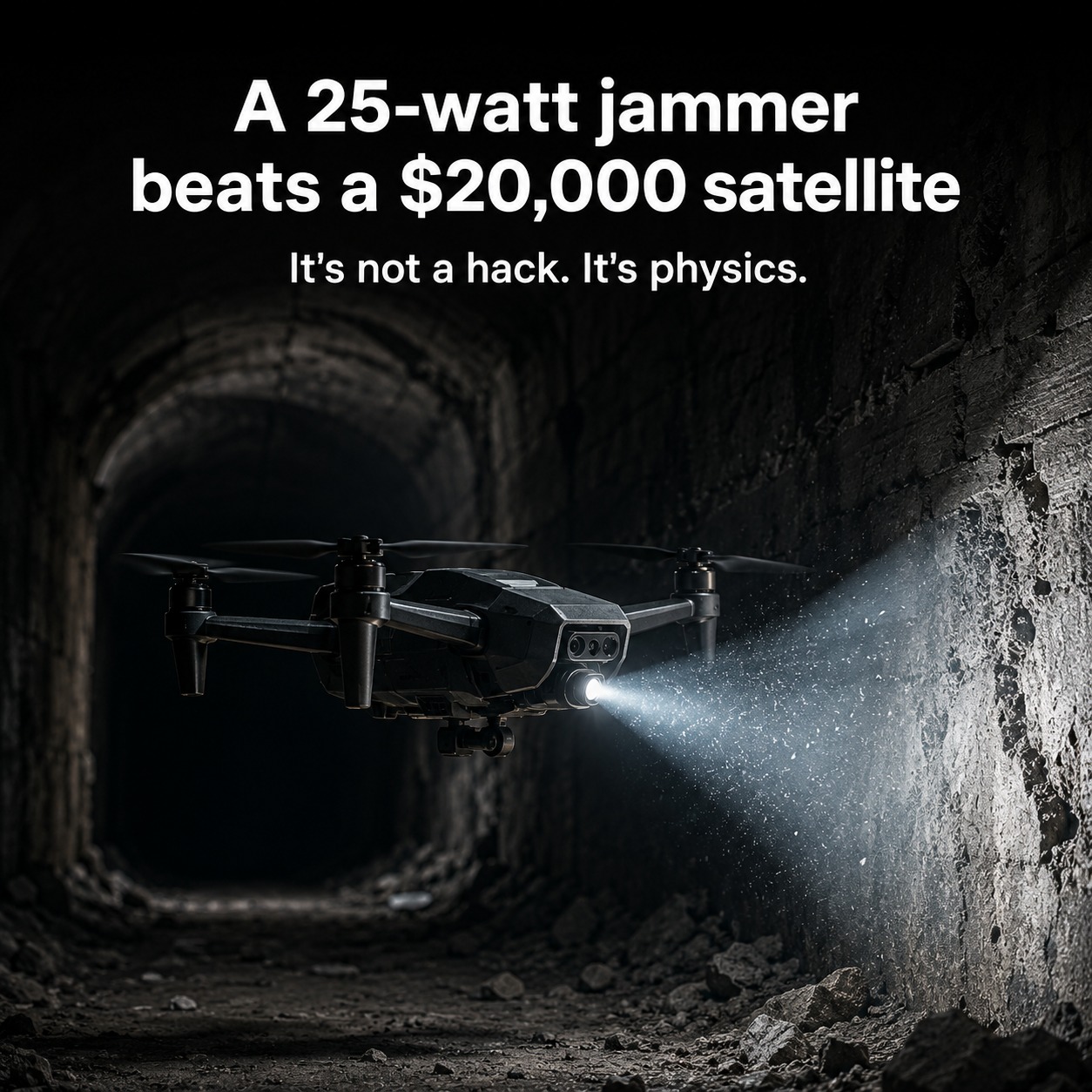
A 25-watt jammer beats a $20,000 GPS satellite. That's not a hack — it's the inverse-square law.
A GPS signal travels 20,200 km from orbit and lands with about the power of a 25-watt bulb seen from 10,000 miles away. A jammer sitting a few kilometers from your drone is, in path-loss terms, a million times closer. The receiver locks onto whatever is loudest in band — so it locks onto the jammer. No GPS chip is immune to this. It is physics, not a defect.
That is why GPS denial stopped being a battlefield curiosity and became a procurement problem. Russian R-330Zh "Zhitel" systems throw 30+ km blackout bubbles across the Ukrainian front, where over 50% of FPV drones are lost to electronic warfare. Front-line operators build airframes with no GPS receiver at all — they stopped assuming satellites would be there.
Then December 2025: the FCC added every foreign-made drone and critical component to its Covered List, going well past the DJI/Autel mandate Congress had given it. New equipment authorizations blocked. Three months later the Army spent $52M on 2,500 Skydio X10D units — bid to award in under 72 hours — because the cleared inventory of GPS-denied-capable platforms is tiny and the demand is enormous.
The fix is not a better antenna. It is Visual Inertial Odometry: fuse the camera and the IMU so the drone localizes from what it sees, not from satellites. Run the VIO loop and semantic SLAM on a Jetson Orin NX — SuperPoint frontend, TensorRT INT8 to fit both at frame rate — and an existing Blue UAS frame holds position with no satellite and no radio link. The same physics that grounds a $200K Elios 3 in a tunnel is what we solve in software: retrofit GPS-denied capability onto the airframes you already own, instead of buying a new fleet at $10K–$50K a unit.
Save this if you are sizing a GPS-denied autonomy build. What blocks your fleet first — jamming, the FCC list, or tunnels?
#GPSDenied #DroneAutonomy #BlueUAS #EdgeAI #DefenseTech