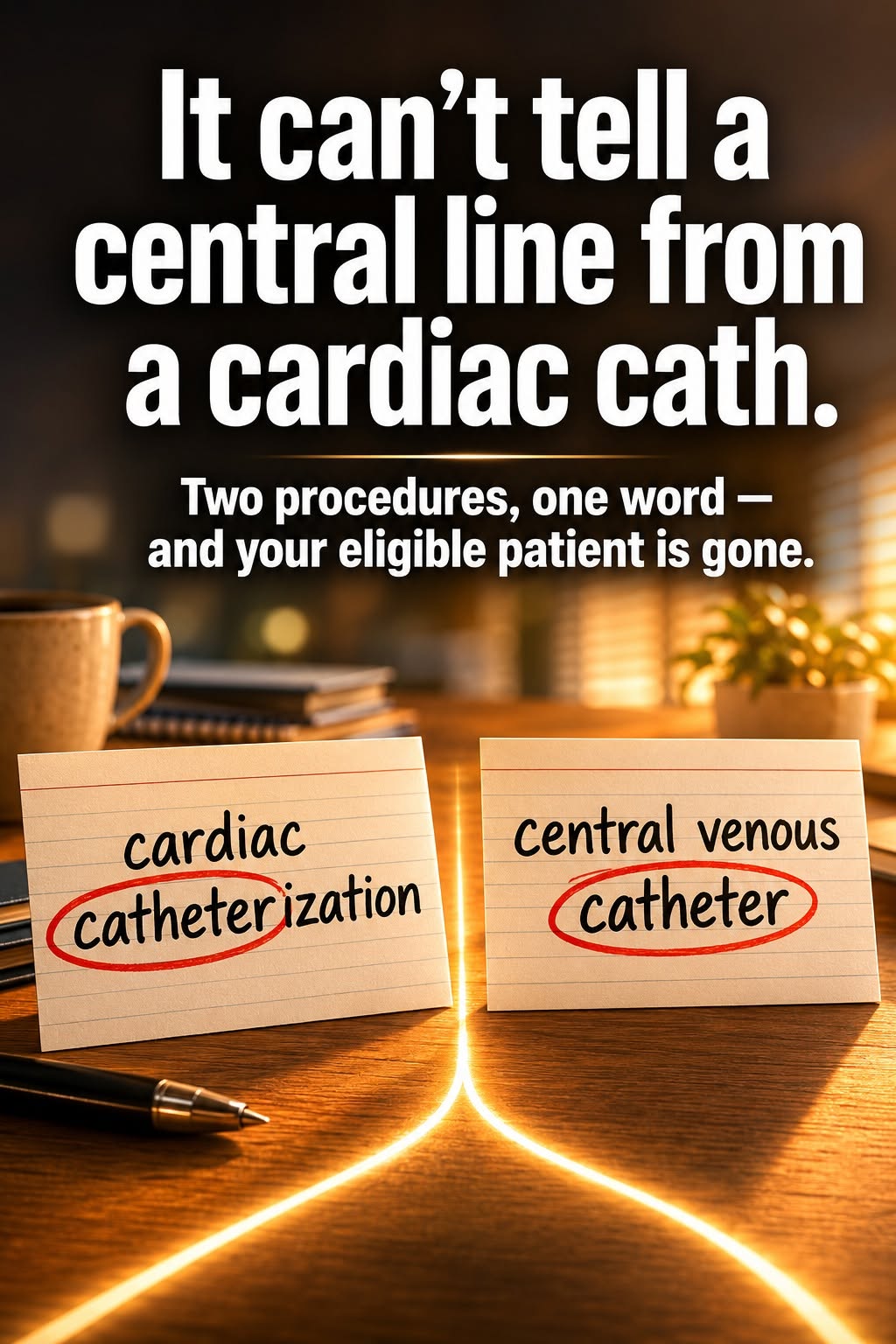
Your AI patient-matcher just dropped an eligible trial candidate — because it can't tell a central line from a cardiac cath.
Here's the exact error, and it isn't rare. A Phase III anticoagulant trial excludes anyone with a "cardiac catheterization." A patient's chart notes a "central venous catheter." Generic AI sees "catheter," scores it near the cardiac terms, and flags the patient ineligible. Two different procedures. One eligible patient, gone.
The fix isn't a smarter prompt. It's grounding the match in medical structure instead of word proximity. In SNOMED-CT, cardiac catheterization (SCTID 41976001) lives under "procedure on heart"; central venous catheterization (SCTID 392230005) under "catheterization of vein." Different branches entirely. A system that reasons over concept IDs, not token similarity, keeps the patient.
Now multiply that across 27+ criteria per protocol, many with nested "unless/except" clauses, over dozens of trials — a systematic eligibility leak no prompt engineering closes.
The stakes: 80% of trials miss enrollment timelines, and one day of delay can cost $800K in lost sales. The bottleneck usually isn't patient supply. It's matching precision.
So we build matching that maps each criterion to ontology concepts with deterministic logic — the reproducible audit trail regulators require.
If you run recruitment: how many "ineligible" patients does your team re-screen by hand because nobody trusts the first pass?
#ClinicalTrials #HealthcareAI