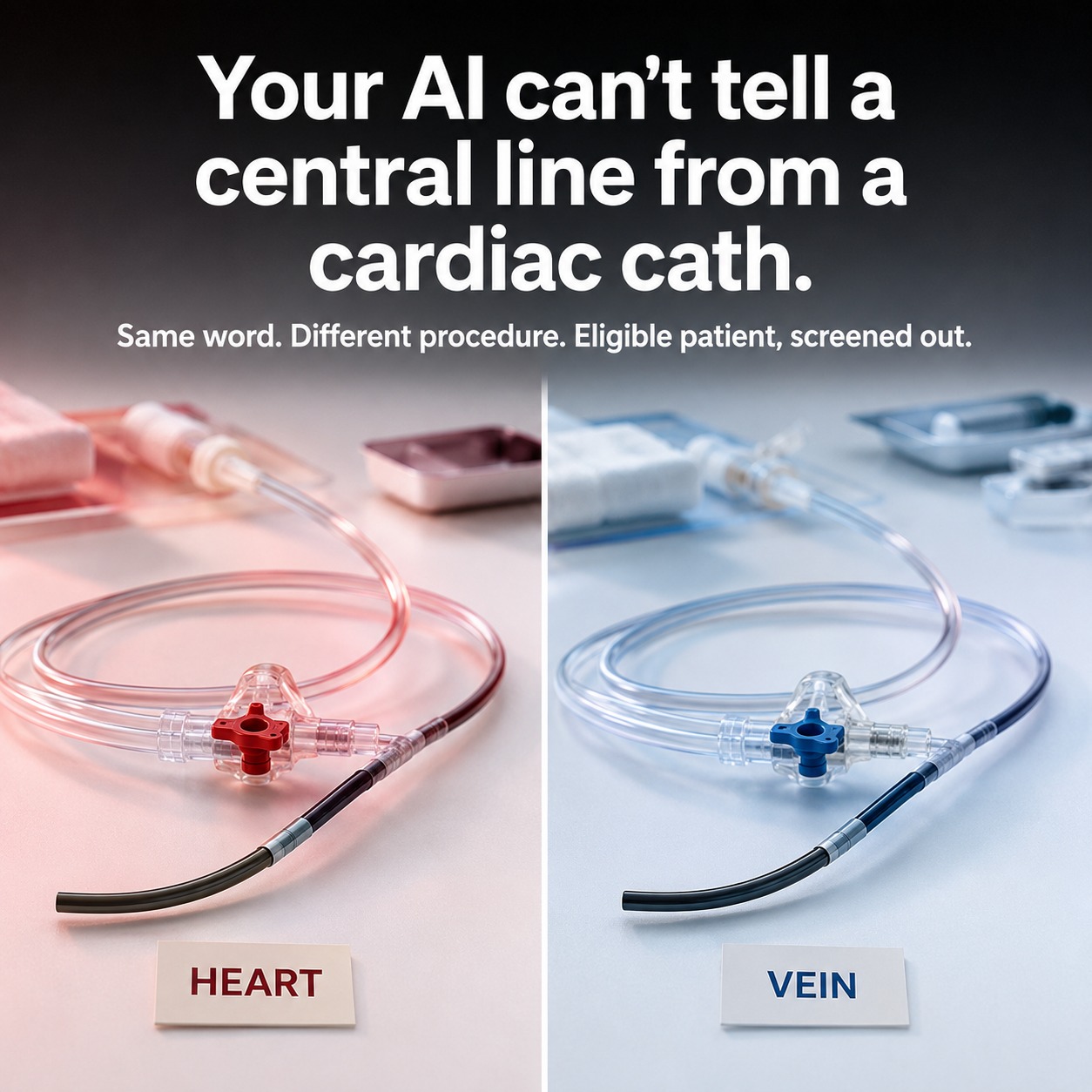
Your AI flagged an eligible patient as ineligible because it can't tell a central line from a cardiac cath.
Here's the error, exactly as it happens. A Phase III anticoagulant trial excludes anyone with a "cardiac catheterization." A patient's chart notes a "central venous catheter placement" — done in the ICU for IV access. Generic AI sees "catheter," sees "venous," sees cardiovascular terms nearby, scores a high similarity, and drops the patient.
But these are different procedures. In SNOMED-CT, cardiac catheterization (41976001) lives under "Procedure on heart." Central venous catheterization (392230005) lives under "Catheterization of vein." Different branches entirely. The patient was eligible the whole time.
This isn't an edge case. It's a whole class of errors where procedures share vocabulary but differ medically — and published evaluations confirm AI models make this exact mistake. Multiply it across 27+ eligibility criteria per protocol, then across dozens of trials, and you get a systematic eligibility leak no amount of prompt engineering closes.
The cost isn't abstract. 80% of clinical trials miss their enrollment timelines. Every day of delay can burn up to $800K in lost sales, and each screen failure runs about $1,200. The bottleneck was never patient supply. It's matching precision.
The ontology-driven systems we build reason about medical concepts instead of matching words. They map every term to a SNOMED-CT concept, parse the "unless / except" clauses LLMs fumble, and produce a deterministic, reproducible audit trail — the kind a regulator can actually inspect.
If you run recruitment for a pharma sponsor, CRO, or academic medical center, save this for your next vendor evaluation. Then ask one question: can your matcher tell 41976001 from 392230005, every single time?
#ClinicalTrials #PatientRecruitment #ClinicalResearch #HealthcareAI #ClinicalAI