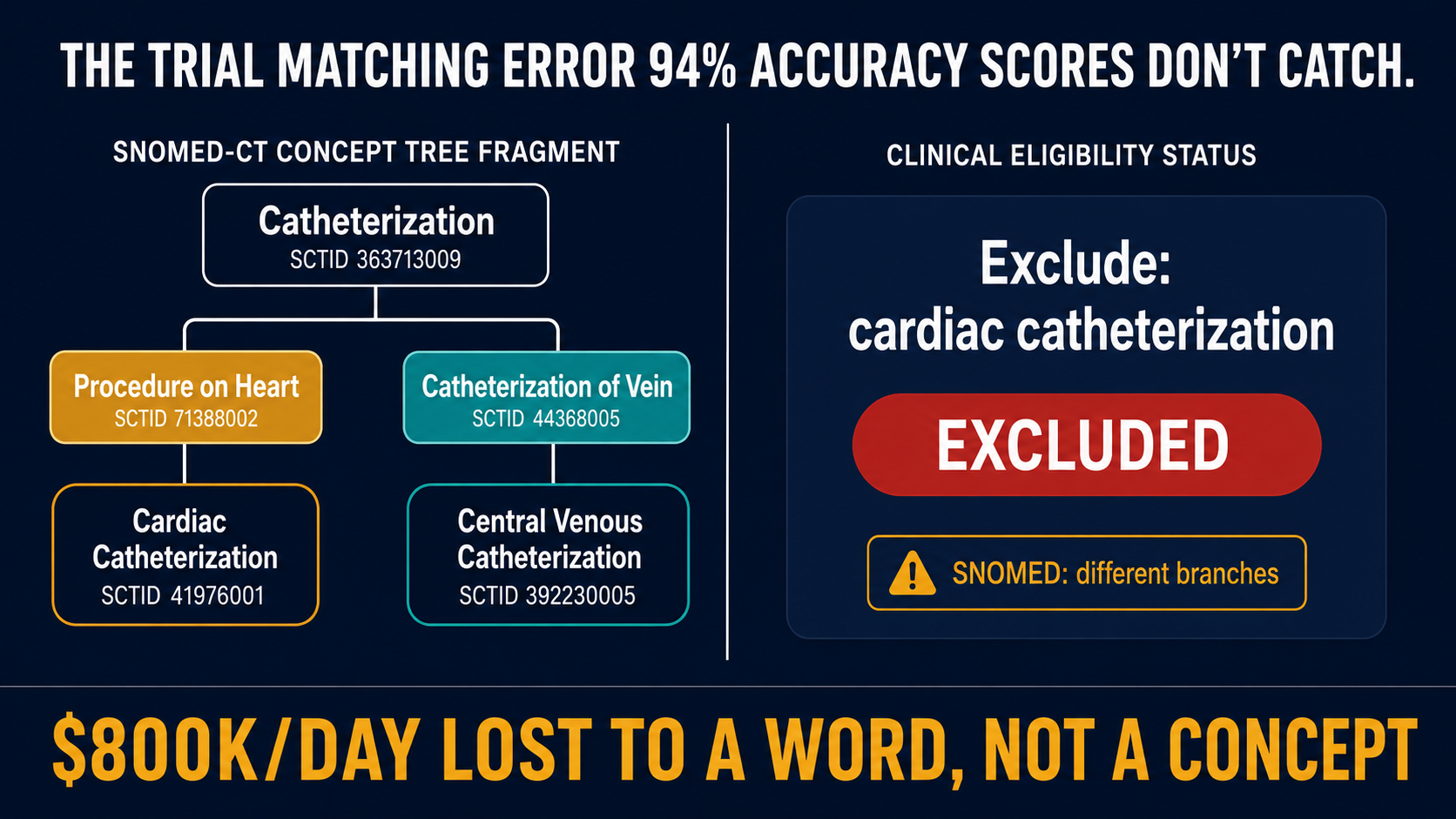
The number that keeps circulating in clinical trial AI benchmarks is 94%. Tempus's Patient Query agent hit 94.39% accuracy across 196 evaluation queries after acquiring Deep 6 AI, and that figure is real — it represents a genuine improvement over keyword search for straightforward protocols. The 5.6% that number doesn't account for isn't random noise. It's a systematic error class: the same kinds of criteria failing consistently, across every patient who matches the pattern. On a high-volume screening pipeline, systematic errors don't average out. They compound.
The error class driving most of that gap isn't about data volume or query phrasing. It's about how medical concepts relate to each other inside a hierarchy, and what happens when a matching system doesn't know the hierarchy exists.
The Catheter Confusion No Prompt Engineering Fixes
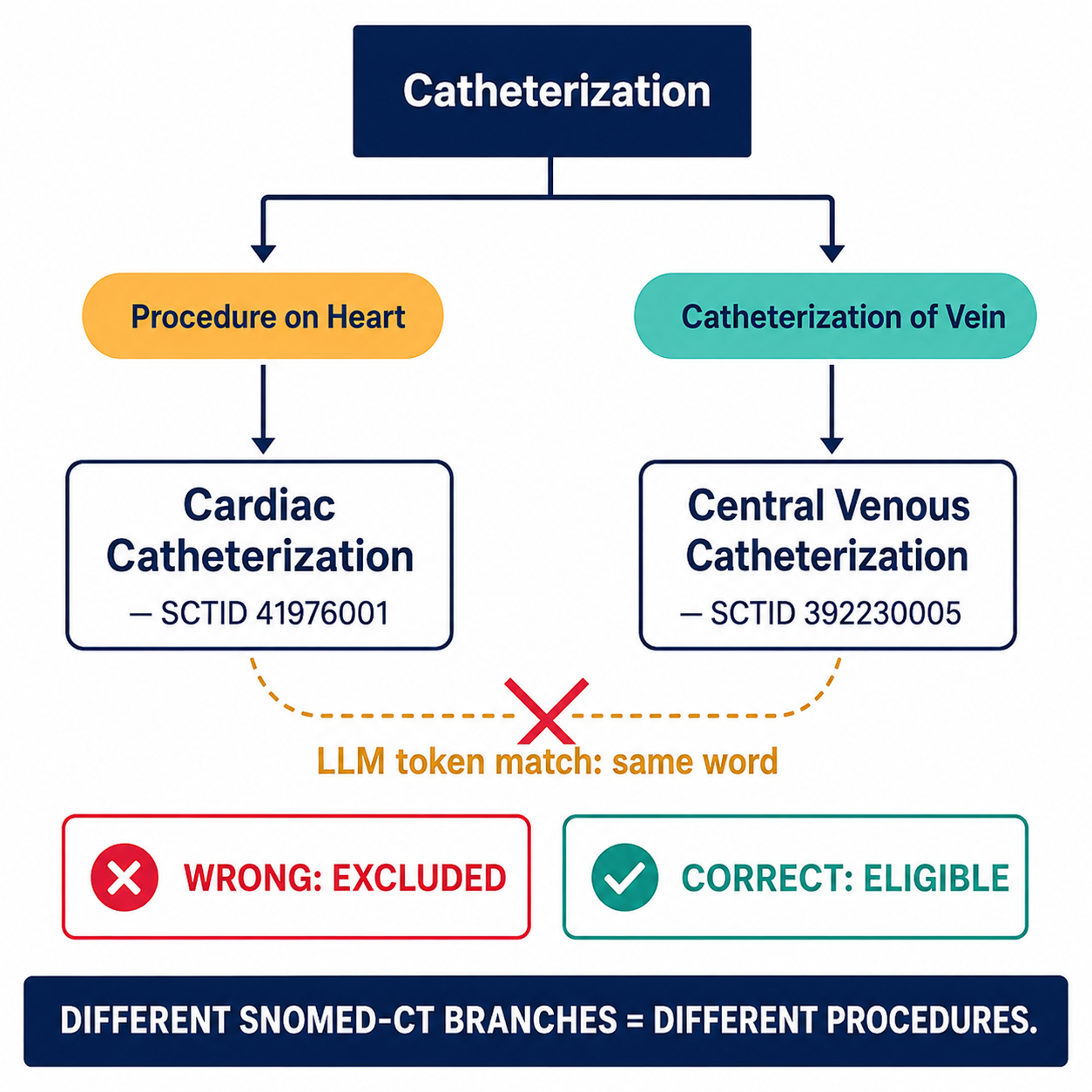
A Phase III anticoagulant trial excludes patients with cardiac catheterization in their history. A patient's chart contains a note about central venous catheter placement, performed in the ICU for IV medication access.
Both use the word "catheter." Both appear near cardiovascular terms. Token similarity and vector proximity score them as closely related — the LLM-based matcher flags the patient ineligible. An eligible patient is lost.
SNOMED-CT makes the distinction automatic: cardiac catheterization (SCTID 41976001) falls under "Procedure on heart." Central venous catheterization (SCTID 392230005) sits under "Catheterization of vein." They are on different branches of the ontology graph, different concept families, different hierarchical paths. A system that traverses the hierarchy finds no overlap. A language model processes tokens, sees catheter-heart-venous proximity, and returns a match.
Published evaluations confirm AI models make this exact class of error in clinical settings (Fierce Biotech, 2025). It isn't a sandboxing anomaly — it's a systematic eligibility leak that scales with how many protocol criteria involve procedures, conditions, or medications that share surface vocabulary across different concept families. The error class doesn't shrink as models improve at language. It requires a system architecture that reasons about concept hierarchies, not one that's better at predicting which words appear near which other words.
Why Protocol Complexity Makes This Worse
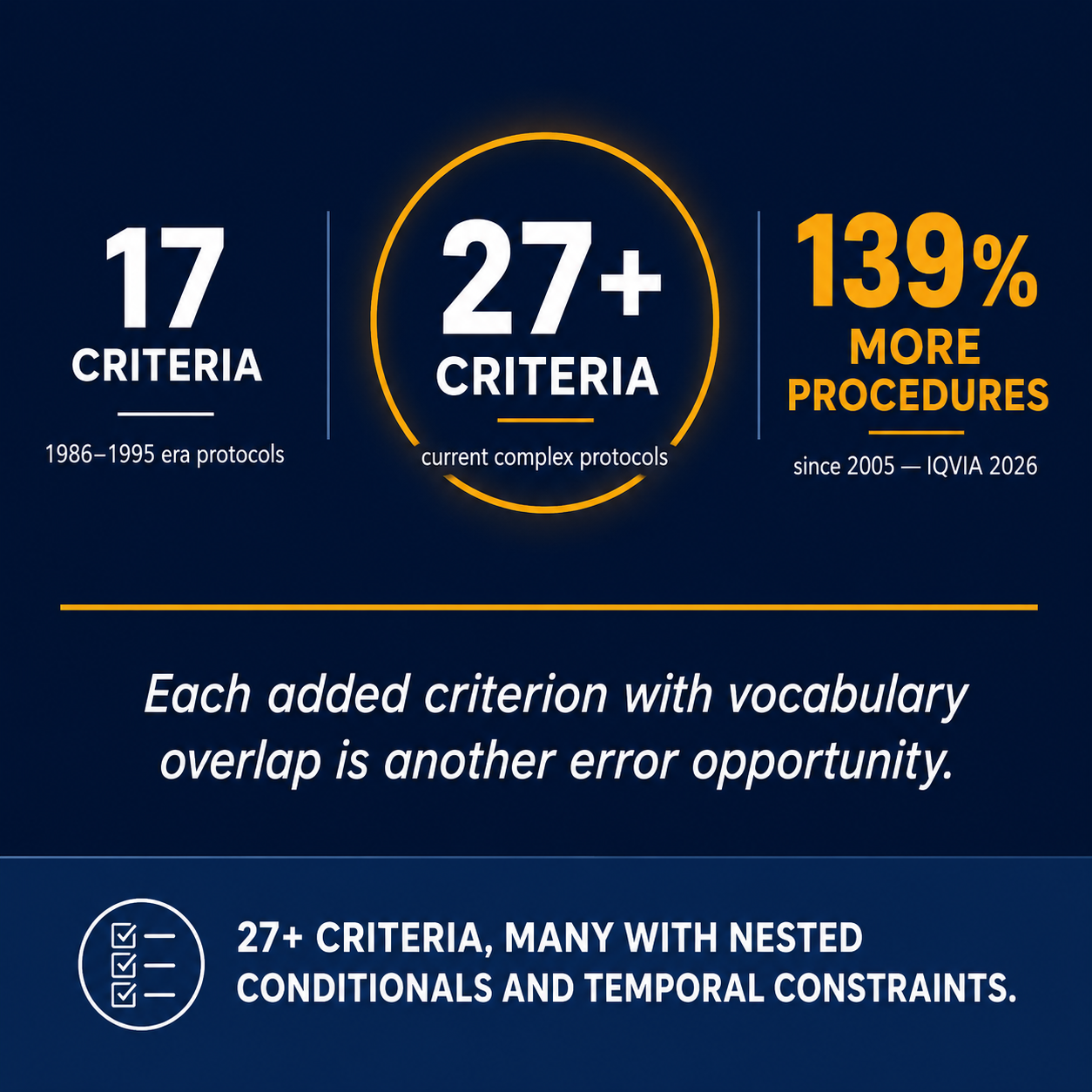
Since 2005, clinical trial procedures increased 139%, endpoints rose 214%, and data collection points surged 600% (IQVIA, 2026). The median number of eligibility criteria for complex oncology trials is now 27 — up from 17 in the 1986-1995 era — with many containing nested conditionals and temporal constraints that standard NLP wasn't designed to evaluate.
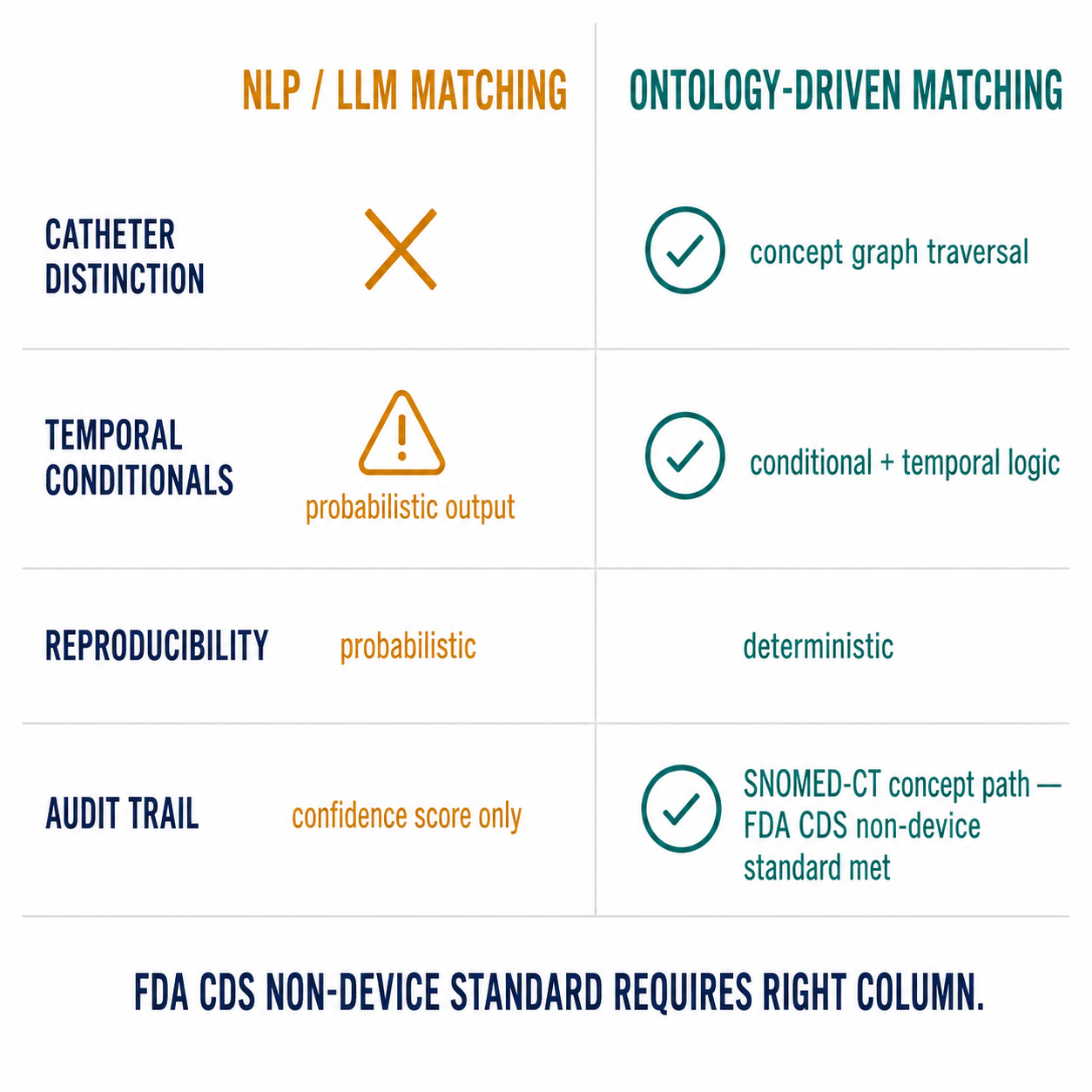
A criterion like "exclude patients with hypertension unless well-controlled on stable medication for 3+ months" requires both conditional parsing — the "unless" logic — and temporal reasoning over a specific window. Run the same patient through an LLM-based matcher twice with slightly different context windows and you may get different outputs. Clinical trials require 100% reproducible audit trails. Regulators reviewing inclusion and exclusion decisions need to trace the exact reasoning path for each patient, not a confidence interval.
The mismatch between protocol complexity and current model architecture isn't a temporary limitation. It's a design constraint that the vendor landscape has benchmarked around rather than resolved.
Where the Major Platforms Break Down
The 2026 vendor landscape represents real investment. Tempus now covers 750+ provider sites after acquiring Deep 6 AI, tracking toward ~$1.6B in revenue; IQVIA launched IQVIA.ai in March 2026, combining 250 million patient records with NVIDIA's NeMo stack in a unified agentic platform; ConcertAI's Accelerated Clinical Trials platform, launched at SCOPE in February, claims 10-20 month timeline reductions.
What each of these platforms shares is a common structural constraint: NLP or LLM-based matching over proprietary data networks.
Network perimeter is where that constraint surfaces most clearly. Tempus's matching precision is real inside the Tempus network; outside it, the patient data isn't accessible. IQVIA went broad — 250 million records combined with NVIDIA's NeMo stack in a unified agentic platform — but data breadth doesn't resolve depth failures at the unstructured-note layer, which is exactly where catheter-class errors consistently live.
For protocols that fall outside the platform's typical therapeutic-area focus, the limits are different but just as real. ConcertAI's ACT is new enough that production depth at scale is still being established. Medidata and TriNetX occupy narrower niches — Rave EDC's AI matching is a feature within a larger CTMS; TriNetX's federated network is designed for cohort feasibility, not per-patient eligibility evaluation against complex inclusion/exclusion logic.
The gap isn't in ambition or investment. Every platform is building toward AI-assisted trial matching. The gap is in what happens at criteria that require hierarchy traversal, and the platforms aren't all advertising where that boundary sits.
The Signal at the Site Level
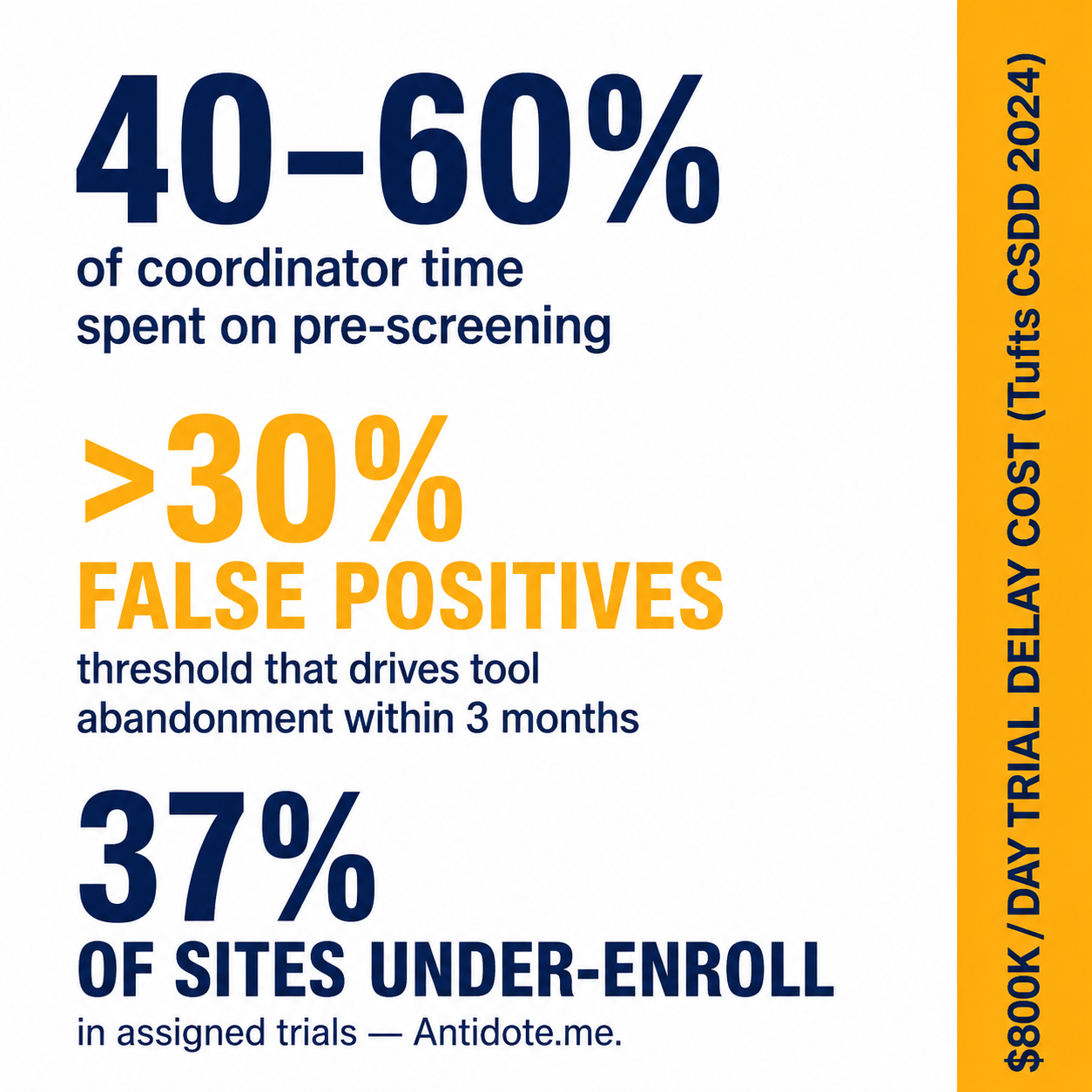
The clearest operational indicator that current tooling isn't solving the matching problem is what's happening to site coordinators. They're now managing five to six studies simultaneously, spending 40-60% of their time on pre-screening work that intelligent matching was supposed to automate. When false-positive rates run above 30% — flagging ineligible patients as eligible — coordinators abandon the tool within three months. Thirty-seven percent of trial sites under-enroll in the trials they're assigned; 11% enroll no one.
This isn't an adoption or training problem. A coordinator who reviews a match list where roughly one in three flagged patients turns out ineligible on manual review learns quickly that the tool creates work rather than removing it. The false-positive rate is where the catheter-class errors show up in practice — not in benchmark evaluations run against simple criteria, but in production, on the protocols where it matters most.
$800K per day in lost prescription sales per day of trial delay (Tufts CSDD, 2024). At $1,200 per screen failure on average (Antidote.me, 2025), high false-positive rates compound into the kind of delay math that escalates to the CFO before anyone's looked at the matching logs.
What Ontology-Driven Matching Changes
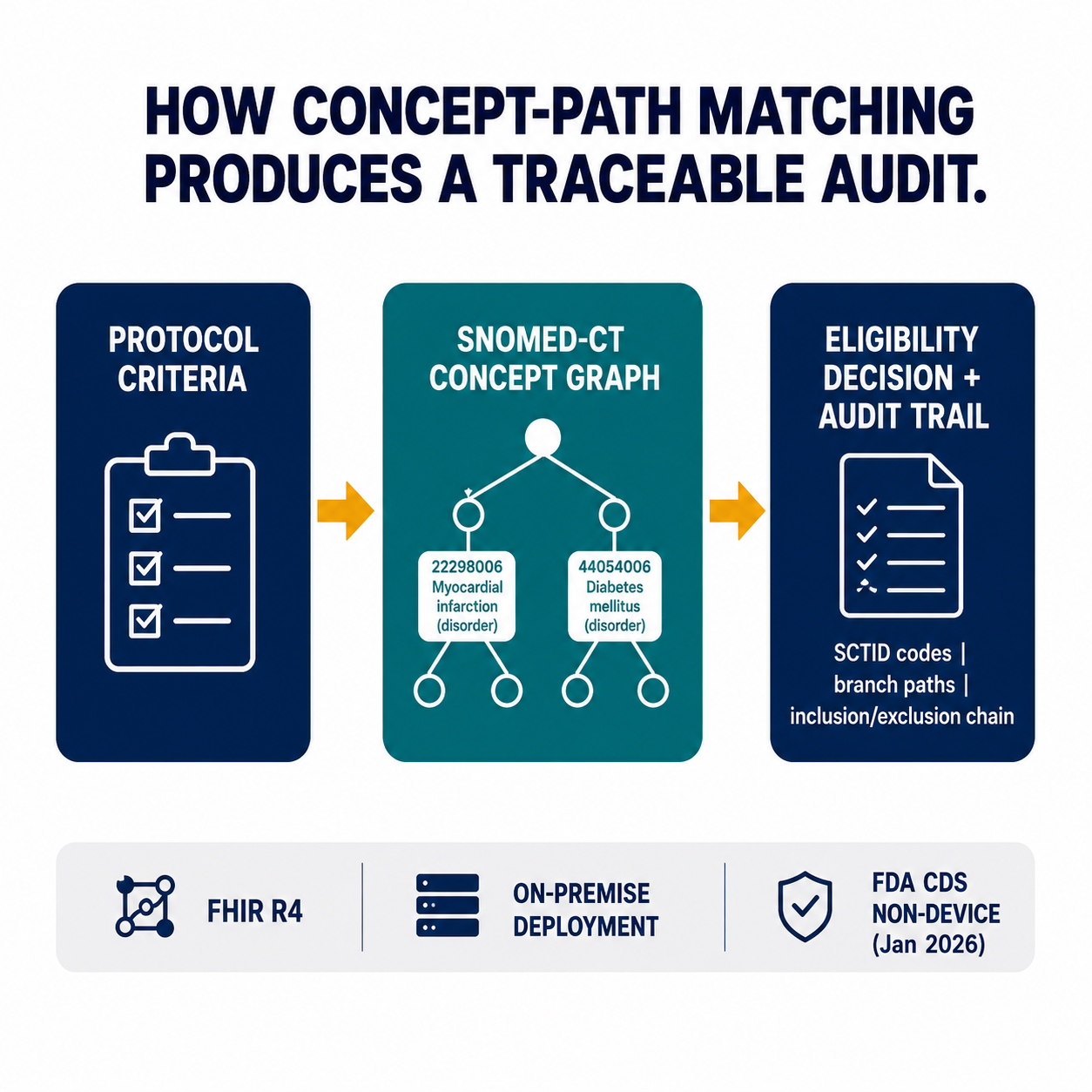
The system Veriprajna built for Clinical Trial Recruitment AI works at the concept layer, not the token layer. It maps protocol criteria and patient chart data against the SNOMED-CT concept graph, traversing hierarchical relationships to determine eligibility — not word proximity. The catheter-class distinction is handled by the ontology, not by prompt design.
For each patient, the matching output includes the specific SNOMED-CT concept IDs evaluated, the branch paths compared, and the inclusion or exclusion decision with the full reasoning chain. That's the audit trail the FDA's updated CDS guidance (January 2026) requires for matching functions to qualify as non-device clinical decision support — the classification that keeps the system outside device-regulation territory. A probabilistic confidence score doesn't satisfy that standard; a traceable concept-path audit does.
The system deploys on-premise, inside the institution's firewall, via FHIR R4. That architecture choice addresses two operational constraints simultaneously. It bypasses the 6-12 month Epic App Orchard security review process by running natively within the institution's own infrastructure. And it keeps patient data within the institution's environment — consistent with the HIPAA Security Rule updates proposed in January 2025 — without requiring cloud transfer for the matching computation.
For sponsors running amendment-heavy protocols, the ontology-based logic layer updates differently than a retrained NLP model. Adding a new biomarker criterion or refining a temporal constraint is a logic update with automatic versioning in the audit trail, not a retraining cycle. The average protocol amendment now takes 260 days to implement across the industry (Applied Clinical Trials, 2025); on-premise ontology systems shouldn't be the bottleneck in that timeline.
A Diagnostic Question
If your team is evaluating clinical trial matching technology, one question cuts through the platform comparisons: ask what happens when a patient's chart contains central venous catheterization and the protocol excludes cardiac catheterization — or vice versa.
The answer reveals whether the system reasons about medical concepts or reasons about words. Most coordinators at complex-protocol sites have encountered this error class in practice, usually in a case that got escalated, reviewed manually, and resolved two weeks after the initial exclusion. That two-week window is recoverable individually. A systemic version of the same error across a high-volume screening pipeline is the $800K/day problem accumulating in matching logs nobody is auditing regularly.
We'd genuinely like to hear how pharma sponsors and CROs are approaching protocol complexity in their matching architecture — particularly in therapeutic areas where biomarker-driven eligibility criteria don't resolve to keyword matching. The organizations that have solved this for one therapeutic area tend to have design decisions worth sharing with the rest of the field.