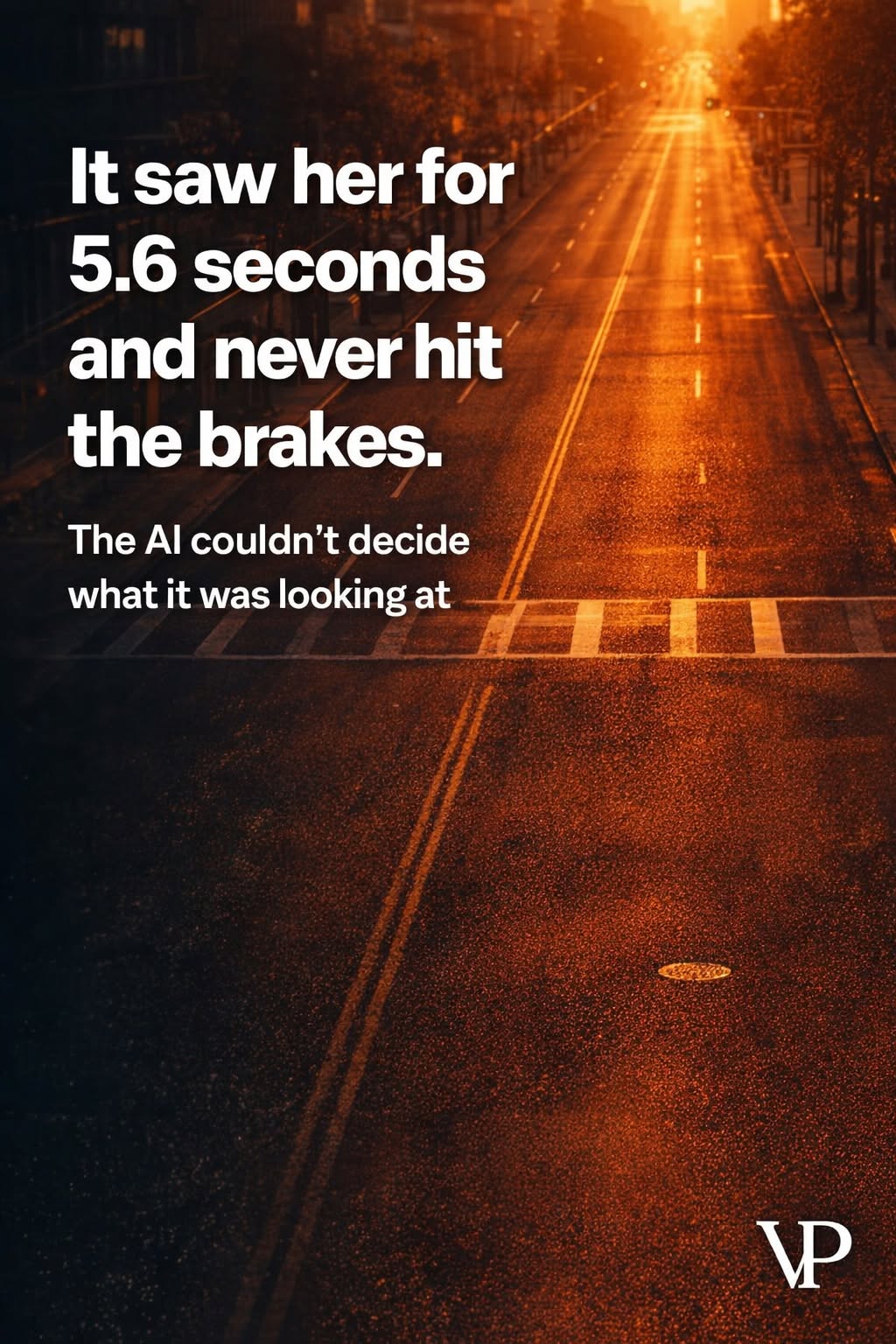
5.6 seconds. That's how long a self-driving car had to stop before it killed a pedestrian.
It never did.
Not because the sensors failed. Not because the brakes broke. Because the software couldn't decide what it was looking at.
Our team studied the NTSB findings from the 2018 Uber crash in Tempe, and what we found still stops us cold. The car's AI kept changing its mind about what was in the road. First "unknown object." Then "vehicle." Then "bicycle." Every time it switched labels, it reset its predictions from scratch.
The car saw something. It just couldn't hold onto what it saw long enough to act.
And here's what made it worse. The engineering team had turned off the factory collision avoidance system to give the experimental software full control.
They traded a proven safety net for an unfinished one.
This pattern keeps showing up. The Cruise robotaxi that dragged a pedestrian because it misread the impact type. Tesla FSD vehicles running red lights in NHTSA investigations. Waymo cars gridlocking entire intersections during a power outage.
These aren't random glitches. They're what happens when we build safety-critical systems on "probably right" instead of "provably right."
Our new whitepaper breaks down exactly where the architecture breaks in each case and what a verification-first approach looks like in practice.
Honest question for this community: when a self-driving car makes a mistake, who should be held responsible? The software engineers? The company? The passenger who chose the ride?
#AutonomousVehicles #AISafety #DeepAI