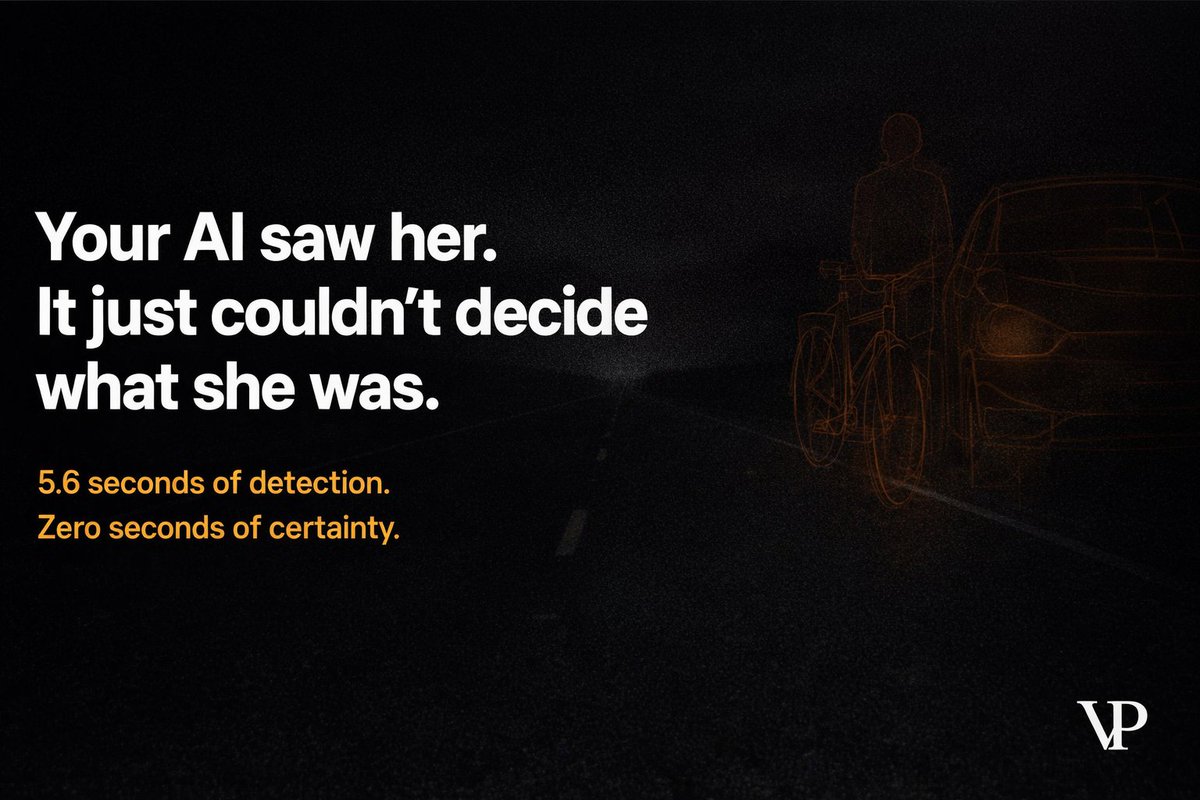
- Uber's self-driving car saw the pedestrian 5.6 seconds before it killed her.
It had 378 feet of space to stop.
The AI couldn't decide if she was a person, a vehicle, or a bicycle — so it did nothing.
This is what "stochastic AI" looks like in the real world. 🧵 - Every time Uber's system reclassified that pedestrian, it reset her predicted path.
Person → vehicle → bicycle → unknown.
Each label change = trajectory reset. The AI treated every frame like a new problem. No memory. No object permanence. Just rolling the dice at 43 mph. - It gets worse.
Uber disabled the Volvo's factory collision avoidance to give the experimental AI full control.
They removed the deterministic safety net to avoid "erratic behavior."
The system that could have saved a life was turned off for a smoother ride. - Cruise made the same category of error — but after impact.
Their robotaxi hit a pedestrian, stopped, then dragged her 20 feet.
Why? The AI misclassified a frontal run-over as a side impact. It "forgot" the human under the car and pulled over per protocol. - Tesla's FSD? 40+ NHTSA investigations.
18 complaints of running red lights. Wrong-way lane entries. A fatal crash during sun glare on wet asphalt.
"Vision-only" means when the camera saturates, the entire safety stack saturates with it. No redundancy. No fallback. - Even Waymo — the industry's safety leader — hit a wall.
During an LA power outage, dozens of robotaxis gridlocked at dark intersections. They couldn't coordinate. Remote assistance was overwhelmed.
Autonomy designed for solo agents breaks when the fleet meets chaos. - The pattern across all four: probabilistic perception treated as deterministic truth.
These systems don't "know" what they see. They guess. And when the guess is wrong, there's no formal constraint stopping a fatal decision.
That's the architecture problem. - The fix isn't better guessing. It's formal verification.
SMT solvers like Marabou can mathematically prove a neural network will never output an unsafe command within defined conditions.
Not "tested on 10,000 scenarios." Proven across all possible inputs. - Pair that with Occupancy Networks — 3D voxel grids that track whether space is occupied, regardless of classification.
Can't decide if it's a person or bike? Doesn't matter. The space is occupied. Brake.
This would have prevented the Uber crash. - We built our consulting practice on this thesis:
The era of "ship fast, patch later" cannot extend to systems that move 4,000 lbs of steel at highway speed.
Safety-critical AI demands deterministic assurance, not probabilistic hope. - Where do you draw the line between "good enough" testing and formal proof for autonomous systems? Should regulators mandate mathematical verification before deployment? #AutonomousVehicles #AISafety
- We wrote the full technical analysis — Uber, Cruise, Tesla, Waymo failures and the engineering path forward.
https://veriprajna.com/whitepapers/stochastic-models-deterministic-assurance-safety-critical-ai