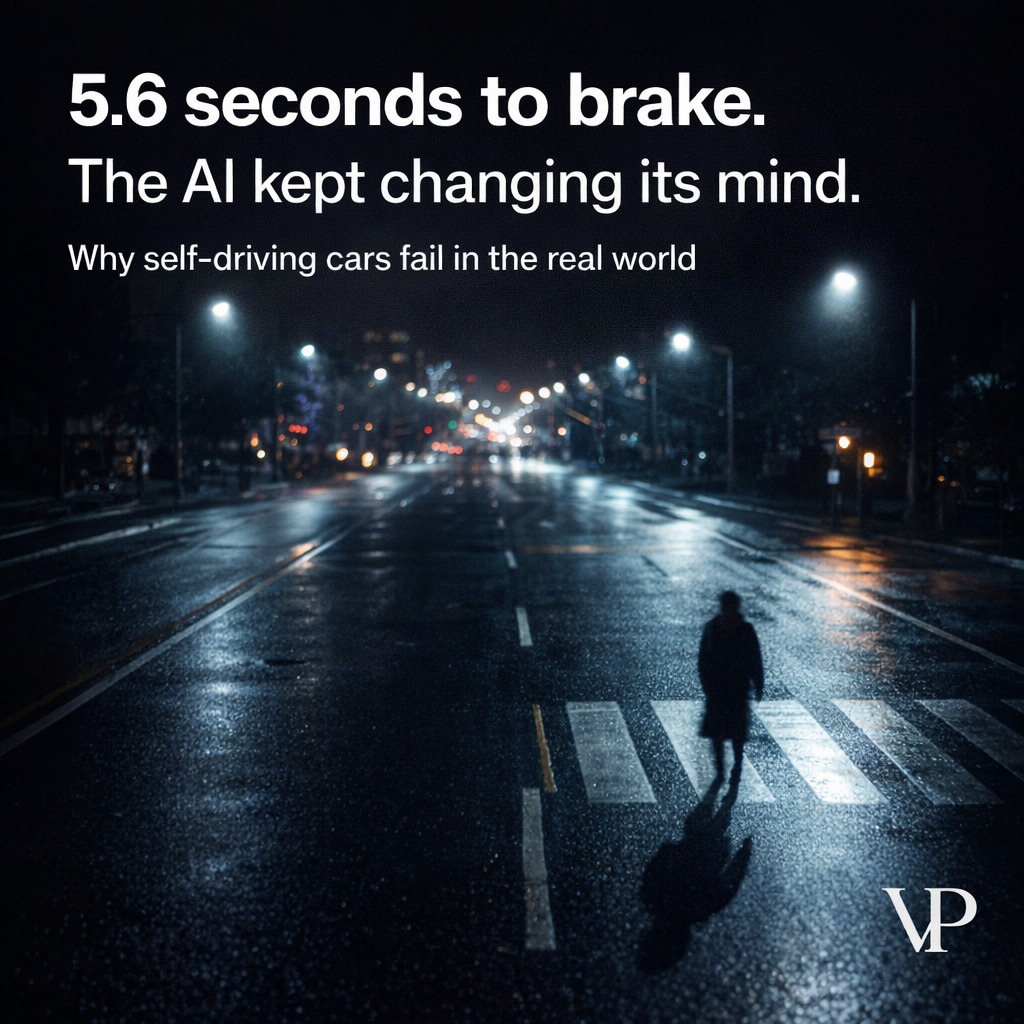
The self-driving car saw the pedestrian 5.6 seconds before impact. It still couldn't stop in time.
Not because the sensors failed.
Because the AI kept changing its mind.
Our latest whitepaper breaks down what actually goes wrong when autonomous systems enter the real world — and why "good enough" AI becomes dangerous AI at highway speed.
Here's what the data reveals:
→ One system reclassified a pedestrian as a vehicle, then a bicycle, then back again — resetting its predictions each time until braking was physically impossible
→ Another robotaxi hit a pedestrian, stopped, then dragged her 20 feet because its software misread the collision type and tried to pull over
→ A vision-only fleet faces 40+ federal investigations for running red lights and entering oncoming traffic
These aren't software bugs. They're architectural problems.
The gap between "works in a demo" and "works on a public road at night in fog" is where people get hurt.
Our research lays out a three-part engineering framework:
1. Perception systems that track occupied space — not just labels — so the AI knows something is there even when it can't classify what
2. Mathematical verification that proves a safety system will never output a dangerous command under defined conditions
3. Fleet coordination protocols that prevent autonomous vehicles from deadlocking each other when infrastructure fails
The era of shipping probabilistic models into safety-critical environments without formal proof is ending. Regulatory standards like SOTIF and ISO/PAS 8800 are making verification mandatory, not optional.
Save this if you work in autonomous systems, AI safety, or enterprise risk — this framework matters more every quarter.
What's the biggest gap you see between AI demos and real-world deployment? 👇
#SafetyCriticalAI #AutonomousVehicleSafety #FormalVerification #AIengineering #DeepAISystems