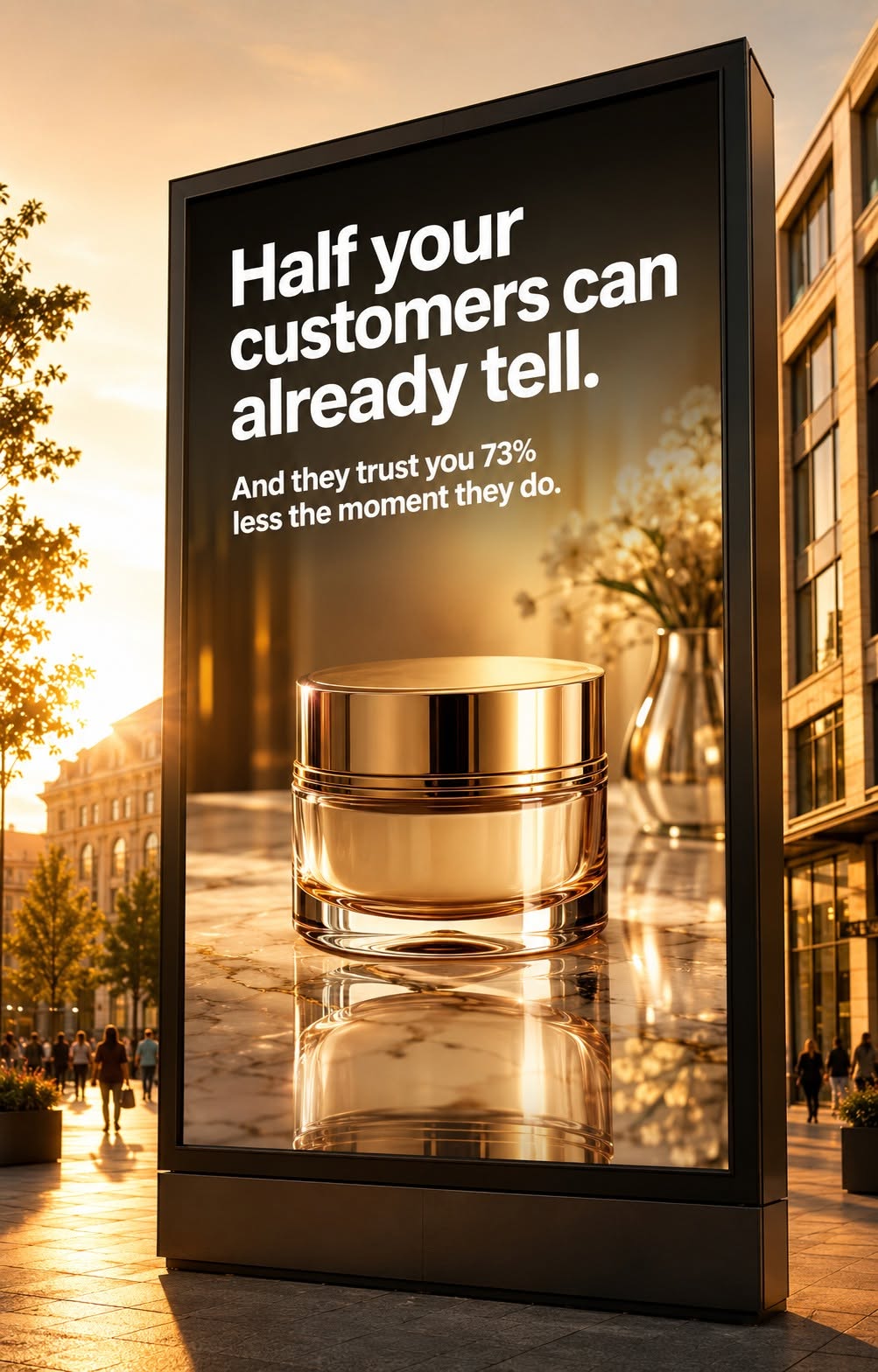
Trust in an ad drops from 48% to 13% the moment customers find out it was made entirely by AI.
That's a 73% collapse in trust from a single production decision (Smartly.io, 2025).
The real risk isn't the technology. It's what your own team believes about it.
82% of ad executives think consumers feel positive about AI in advertising. Only 45% of those consumers actually do (IAB, 2026). That 37-point blind spot is where strategies get built around a customer who doesn't exist.
When DM9 got caught modifying CNN Brasil footage to fake campaign results at Cannes Lions last year, twelve awards were pulled, the CCO resigned, and Cannes began mandating AI disclosure. The footage wasn't the scandal — the undisclosed AI was. And the brand, not the agency, owns that fallout.
So the answer isn't avoiding AI. Half your customers genuinely don't care — as long as they can't tell. The discipline is using AI aggressively in the process while keeping it invisible in the output: hybrid pipelines, brand-fidelity scoring, and governance that holds up across FTC, NY, California and the EU AI Act.
And almost nobody is checking. Only 19% of marketers track one AI-specific KPI — which means most brands can't prove their AI content meets their own standards until the failure is already public, not caught in QA.
If you ran that same survey inside your own org — your execs versus the customers you actually sell to — how wide would your 37-point gap be?
#AIGovernance #BrandContent #MarketingAI