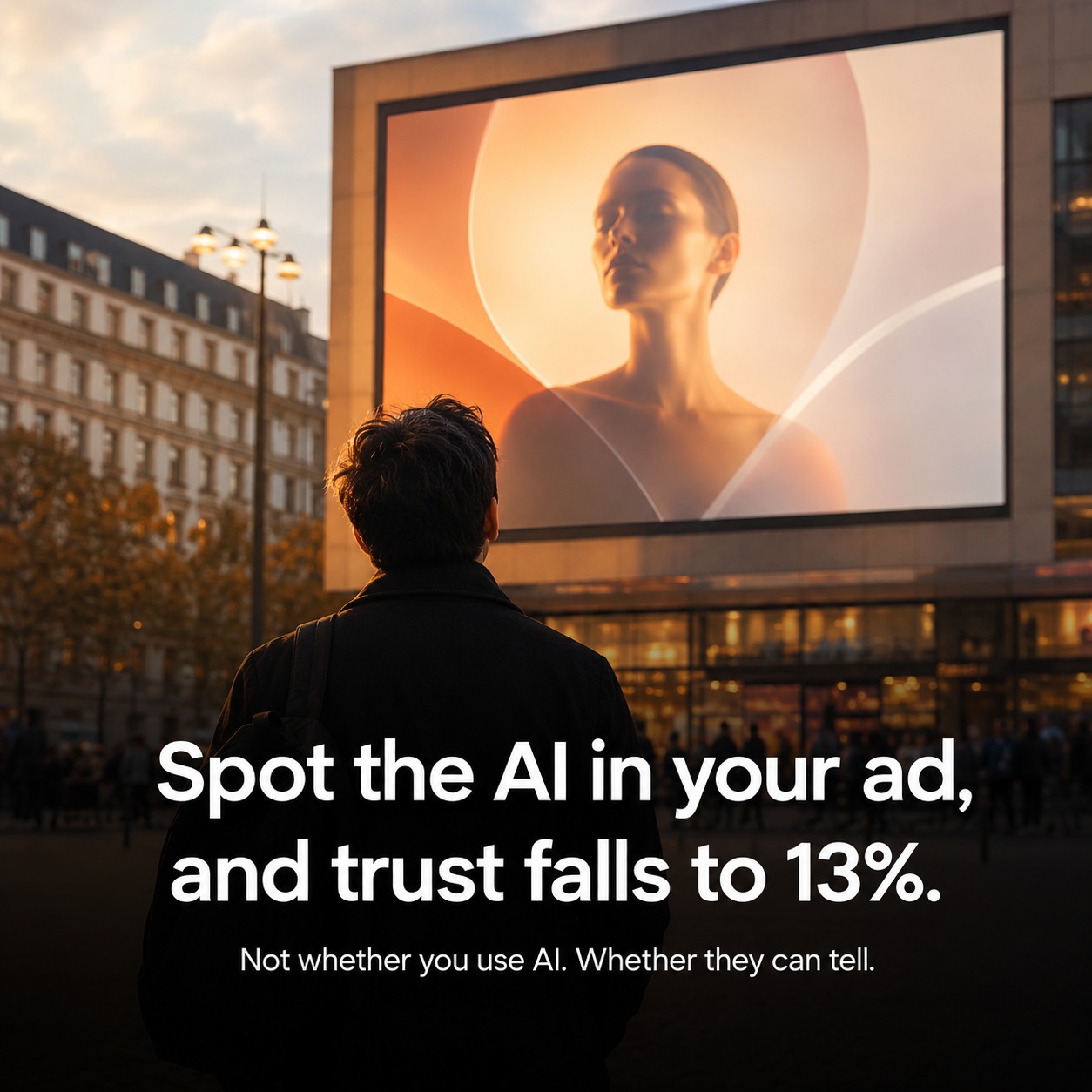
Consumer trust in an ad drops from 48% to 13% the moment it's clearly all-AI. That's the real AI brand content problem.
It isn't whether you use AI. It's whether consumers can tell.
Here's the gap quietly burning brand equity: 82% of ad executives think Gen Z and millennials feel positive about AI in advertising. Only 45% of those consumers actually do (IAB, 2026). That 37-point gap is where whole content strategies rest on an assumption the data already broke. Preference for AI content has fallen from 60% in 2023 to 26% in 2026 — and NielsenIQ's neuroscience found AI ads trigger weaker brain memory activation even when people rate them high-quality. You lose recall, not just trust.
The failure mode isn't hypothetical. In June 2025, agency DM9 won the Creative Data Grand Prix at Cannes Lions — then investigators found the case film used AI-generated footage, including modified CNN Brasil coverage, to fake results. The CCO resigned, twelve awards were revoked, and Cannes now mandates AI disclosure on every entry. The brand — not the agency — owns that fallout.
So the answer isn't "don't use AI." It's: use AI aggressively in the process, invisibly in the output. That's the architecture we build — a hybrid production pipeline (human where it matters, AI where it helps), brand fidelity scoring that audits assets against your real brand guidelines, and a governance layer that holds across FTC rules, New York and California law, and EU AI Act Article 50, where transparency breaches run up to €15M or 3% of global turnover.
Half your customers prefer brands that avoid GenAI content. The other half doesn't care, as long as they can't tell. Both want the same thing: work that feels human. The AI just shouldn't be the part they notice.
Save this for your next vendor or agency review — then check: does your agency contract say which AI they can use, and require disclosure? Most don't.
#AIGovernance #BrandStrategy #GenerativeAI #MarketingLeadership #AIinAdvertising