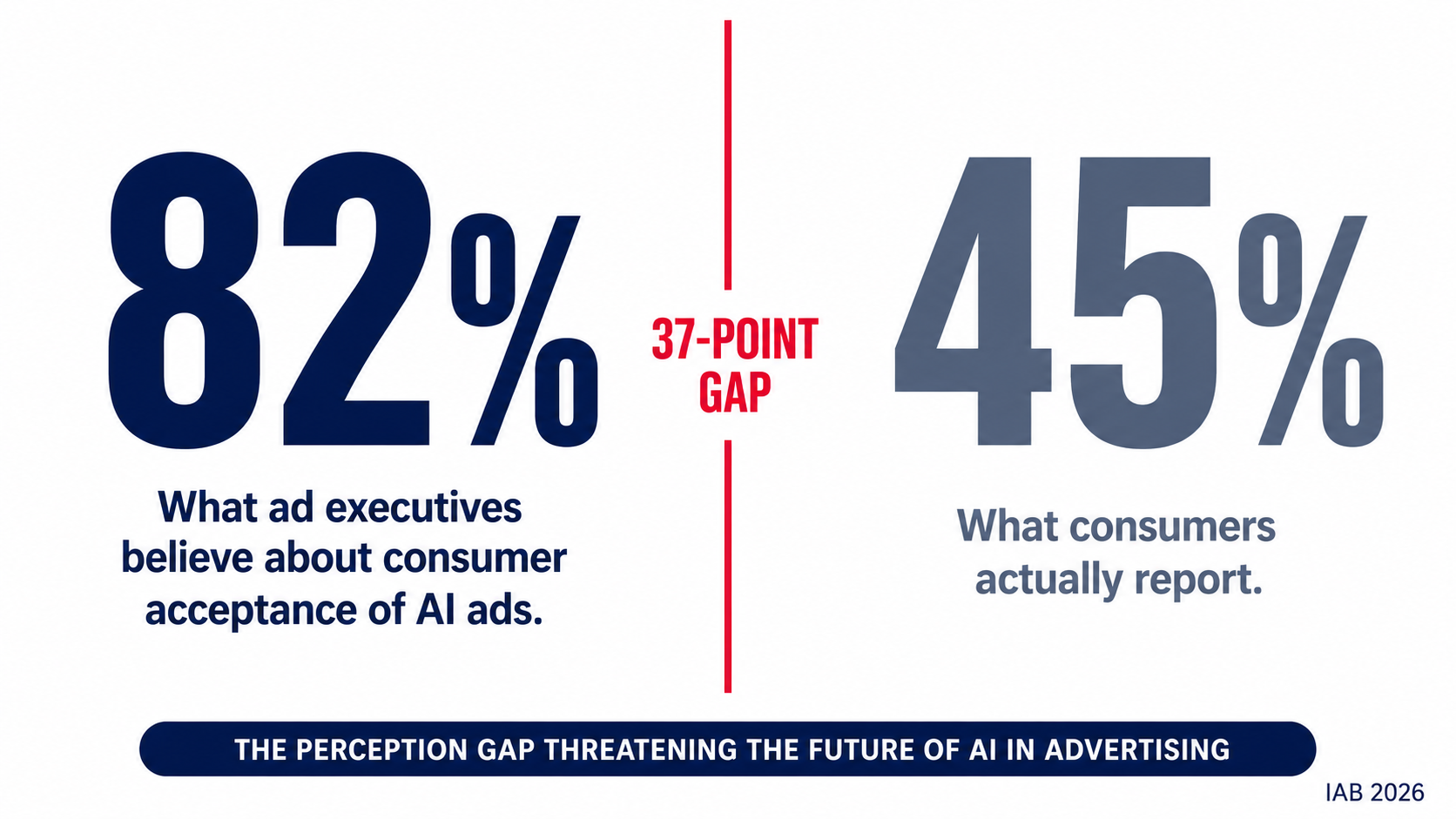
Eighty-two percent of advertising executives believe consumers feel positively about AI-generated ads. Forty-five percent actually do. That 37-point gap — from IAB's 2026 research — isn't a polling quirk. It's the operating assumption behind most enterprise AI content strategies right now, and it's wrong by 37 points.
The Coca-Cola holiday campaign wasn't a story about poor production quality. It was built from roughly 70,000 AI-generated clips at professional standards. What consumers flagged — in language including "soulless" and "dystopian" — wasn't technical failure. It was category recognition. McDonald's pulled a similar holiday spot under viewer pressure during the same period. The Gartner survey that followed, reporting in March 2026 that 50% of U.S. consumers now prefer brands that avoid GenAI in consumer-facing content, wasn't reporting a new sentiment. Consumer preference for AI content ran at 60% in 2023; by 2026, it had dropped to 26%. The brands that read the IAB data when it landed had time to build something different.
What the Brain-Scan Data Actually Shows
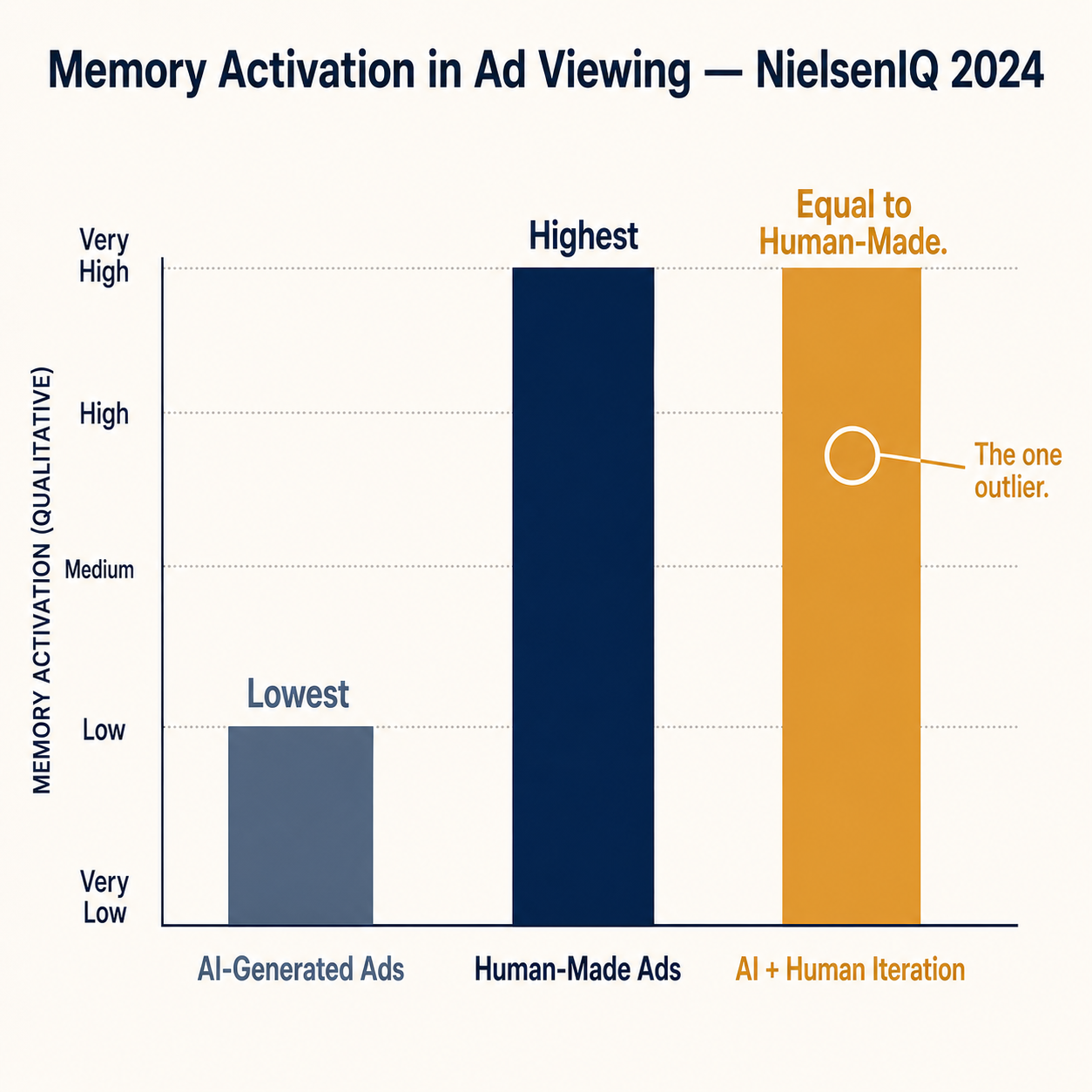
The consumer sentiment numbers are uncomfortable. The neurological data is structurally different.
NielsenIQ's 2024 copy-testing research ran AI-generated and human-made ads through memory-activation testing alongside traditional viewer surveys. AI ads scored as more annoying, more boring, and more confusing — but those subjective ratings weren't the central finding. Memory activation, the neurological correlate most directly linked to purchase-decision influence, was measurably weaker for AI ads even when those ads cleared technical quality benchmarks. One outlier appeared in NielsenIQ's data: an ad developed through extensive human-guided AI iteration that viewers didn't immediately classify as AI-generated. It performed within range of human-made equivalents.
That single data point defines the architecture problem. The variable wasn't production method. It was whether viewers categorized the content as AI before they processed it.
Smartly.io's 2025 research confirmed the same dynamic: consumer trust in advertising drops from 48% to 13% when the production source shifts from human-AI co-creation to entirely AI-generated output. Adobe's 2026 Digital Trends study adds a behavior dimension — one-third of consumers stop interacting with a brand entirely when they learn its content was AI-generated. These aren't opinion shifts. They're permanent behavior changes in a cohort now large enough to affect category economics.
Consumer preference for AI content dropped from 60% to 26% in three years. That is not a trough after a hype cycle. It is a structural shift in how audiences evaluate what they're being sold.
The Cannes Audit and What It Cost DM9
The clearest preview of governance failure at enterprise scale came from the DM9 incident at Cannes Lions in June 2025. The agency submitted AI-generated footage to simulate real campaign results — including modified CNN Brasil footage used without permission — and received the Creative Data Grand Prix. When the methodology became public, Cannes withdrew the award, revoked 12 others, and introduced mandatory AI disclosure requirements for all future entries. DM9's CCO resigned.
The precedent extends beyond the awards circuit. What the incident established: at sufficient visibility, AI content provenance will be retroactively audited against agency representations. The question for enterprise content programs isn't whether similar scrutiny will apply to commercial work. It's whether the agency contracts, the production metadata, and the disclosure documentation are ready for one.
Three Regulatory Deadlines Now Running Through Your Pipeline
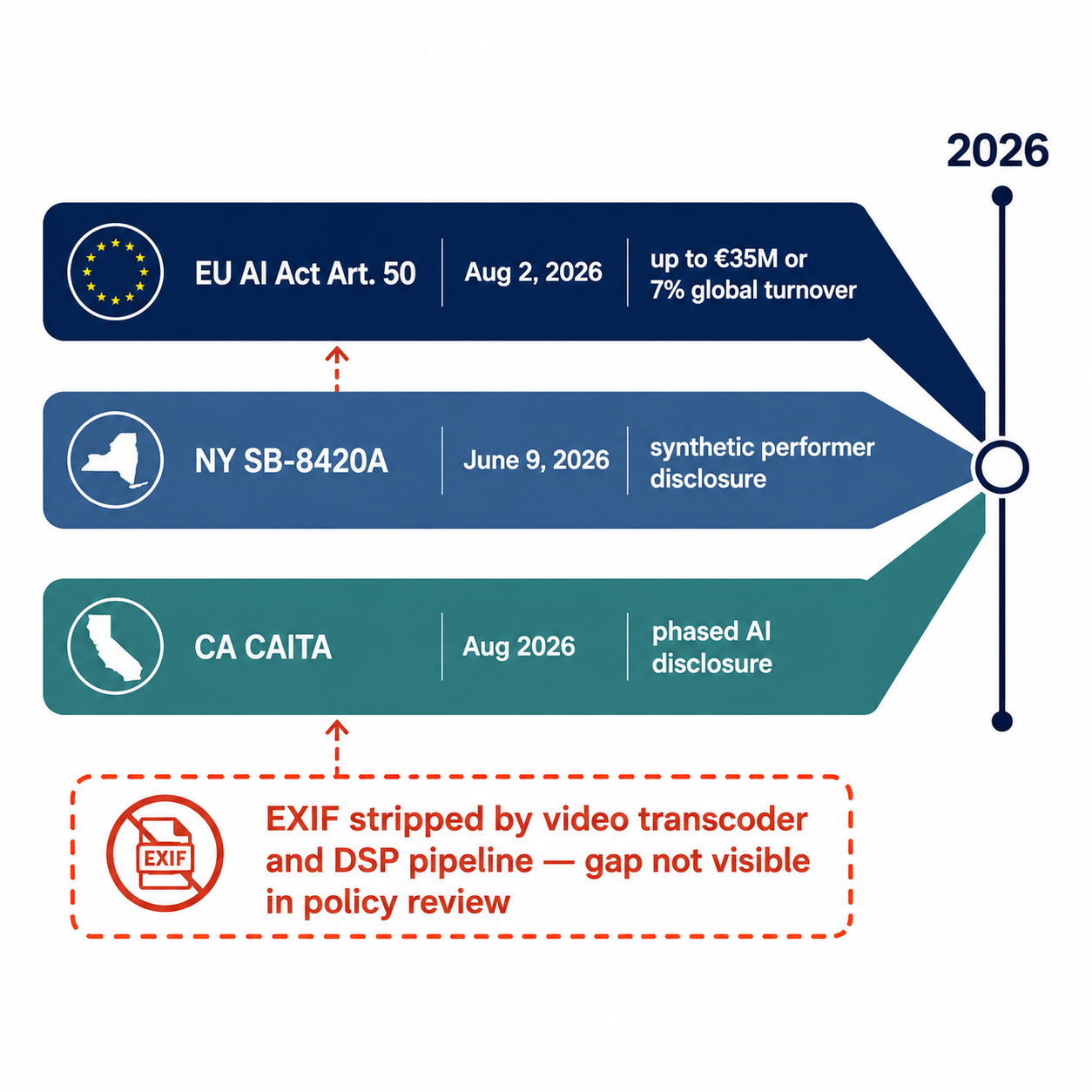
The Cannes review was a reputational audit. The regulatory audits in the second half of 2026 carry financial penalties measured against global revenue.
The EU AI Act's Article 50 transparency requirements became enforceable August 2, 2026. AI-generated content must be marked in machine-readable format, detectable as artificially generated. Penalties for transparency violations run up to €15 million or 3% of global annual turnover; for the most serious violations, up to €35 million or 7%. New York's SB-8420A, effective June 9, 2026, requires conspicuous disclosure of AI-generated synthetic performers in commerce ads. California's CAITA (AB 853) phases in AI disclosure requirements from August 2026.
One compliance gap most brand legal reviews miss: Article 50 requires machine-readable content marking — in practice, metadata embedded in the asset file. That metadata survives static image assets. It is routinely stripped by video transcoding software and by DSP ad-serving platforms before assets reach distribution. A brand with compliant source files may have non-compliant distributed content, with the gap created by the pipeline infrastructure between them. That gap doesn't appear in a policy document review. It surfaces in a pipeline audit.
The agency contract problem is structurally similar. A supplier marking deliverables "AI-assisted" to satisfy disclosure requirements has no regulatory definition of "assisted" to work from — a deliverable that is 5% AI-generated and one that is 95% AI-generated can both carry the same SOW label. The FTC's "clear and conspicuous" standard applies the moment synthetic performers appear in commercial content, regardless of how the statement of work characterizes the production method. Most agency contracts are written against the SOW category, not the regulatory standard.
What the Platform Investment Provides (and What It Doesn't)
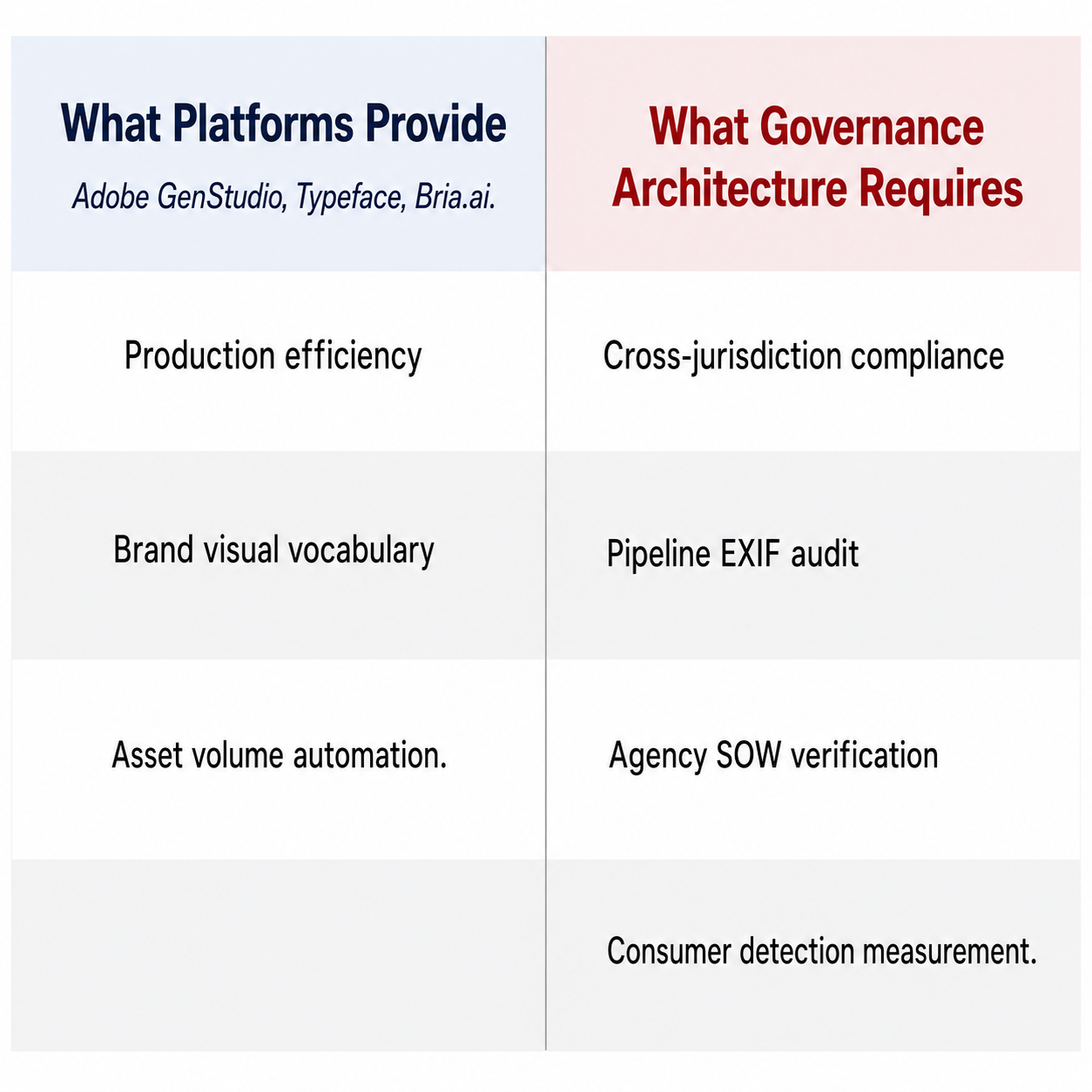
Adobe GenStudio, Typeface, and Bria.ai each represent genuine production capability. GenStudio's Content Production Agent and deep Creative Cloud integration make it the logical default for Adobe-stack organizations. Typeface — founded by former Adobe CTO, carrying over $165 million in funding — serves enterprise clients including Coca-Cola, PepsiCo, Disney, and Estée Lauder with a Brand Hub architecture that has earned its position. Bria.ai's self-service model fine-tuning, supporting up to 200 images in automated workflow or 5,000 with expert onboarding, won 2026 HPA awards for enterprise safety controls.
Each platform solves production efficiency within a branded visual vocabulary. None addresses governance architecture across jurisdictions. The fine-tuning platforms produce strong results on hero photography — standardized compositions, controlled lighting — and degrade on lifestyle and emotion content, which NielsenIQ's data flags as the most sensitive category for consumer AI-detection. Platform investment and governance architecture solve different problems, and they sit in different parts of the procurement conversation.
We documented the full architecture in AI Brand Content That Consumers Actually Trust: the hybrid pipeline design that routes AI aggressively through production volume while protecting perception-sensitive content classes with human review gates; the computer vision brand fidelity scoring layer that runs against actual brand guidelines rather than generic visual similarity metrics; and the agency audit methodology that maps what suppliers are actually using against what the SOW represents.
The Anti-AI Premium Is a Commercial Signal, Not a Campaign Theme
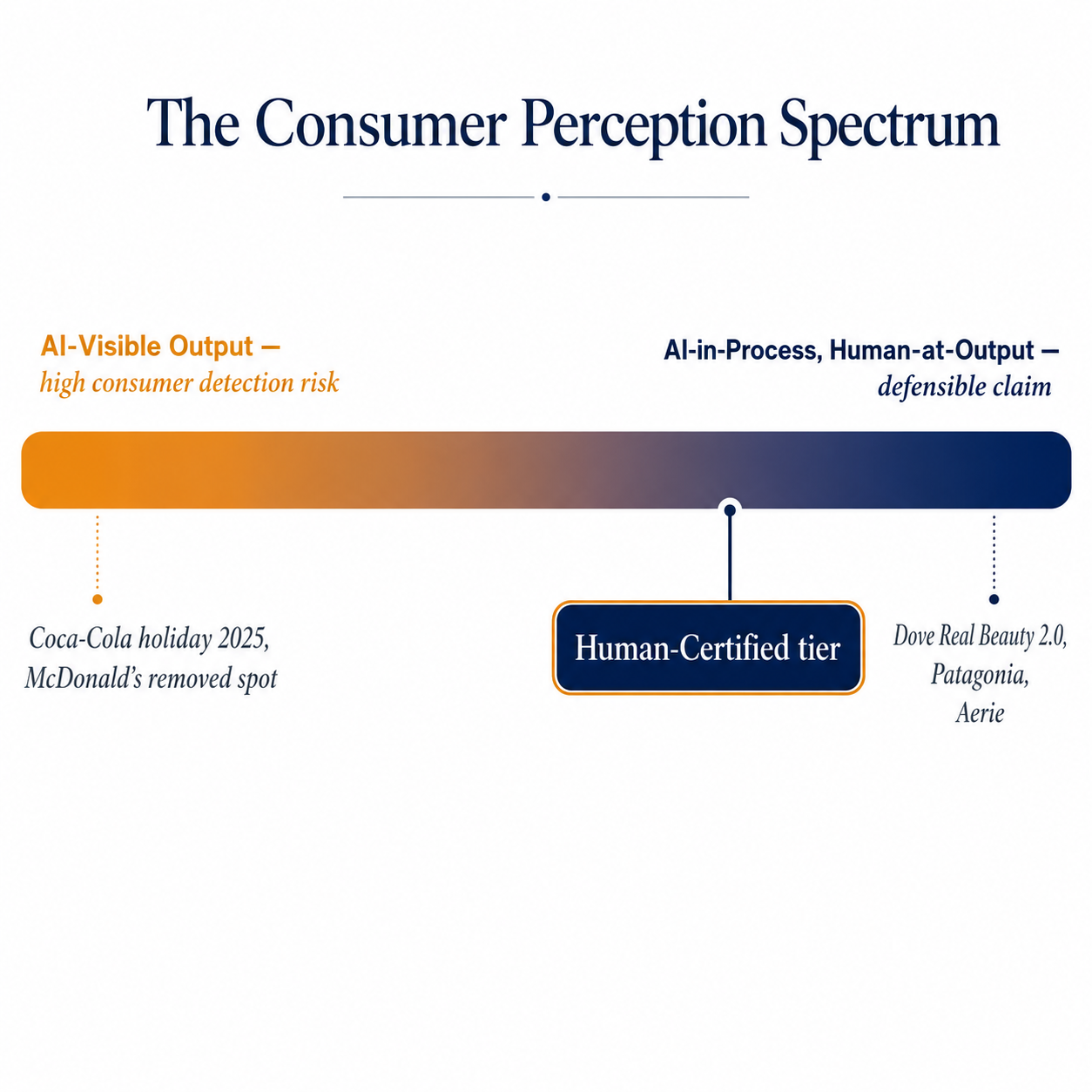
Dove's Real Beauty 2.0 explicitly pledges no AI-altered images. Patagonia doubled down on human-led storytelling with real employees and customers. Apple TV's "Pluribus" credits read: "This show was made by humans." Aerie 2025: "No retouching. No AI. 100% Aerie real." iHeartMedia found 90% of its listeners prefer media made by humans.
These brands are not abandoning AI in their content supply chains. They're making the consumer-facing claim about the output layer while building the audit capability that makes that claim defensible. Fashion brands are constructing human-only content tiers backed by blockchain verification. The "human-certified" market is estimated at a potential $10 billion by decade's end.
The pattern is consistent: the brands managing this well use AI aggressively where it doesn't intersect consumer perception — localization (AI now delivers professional-quality linguistic and cultural adaptation at roughly half the cost of traditional voiceover and review workflows), asset variation, structural copy — and protect the perception-sensitive creative layer with human judgment and the measurement infrastructure to verify it.
The Measurement Gap Is Where Most Programs Eventually Break
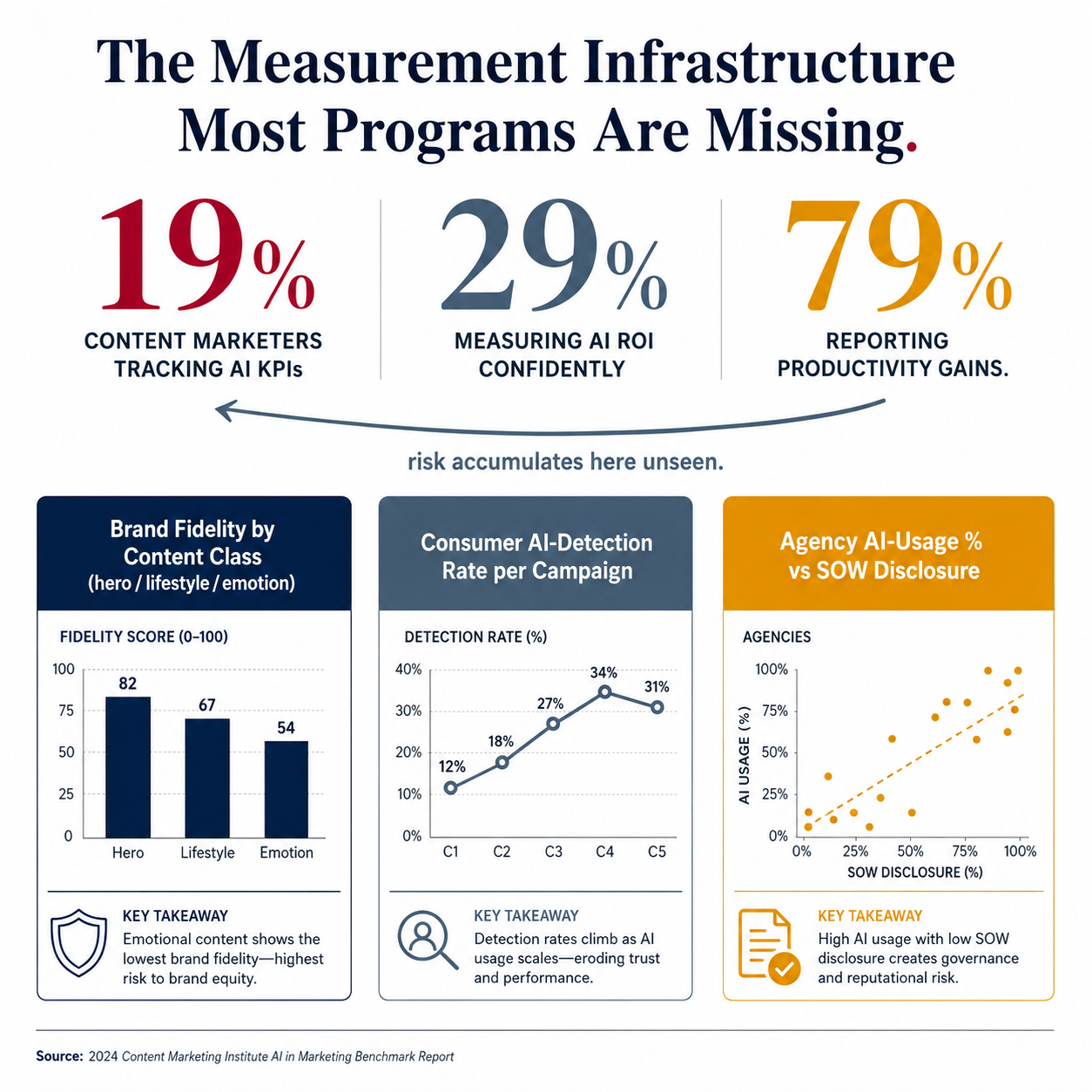
One number in the current data sits underappreciated: only 19% of content marketers track AI-specific KPIs. The majority of enterprise AI content programs are running without the feedback loop that would tell them whether the AI investment is affecting brand equity or only reducing cost-per-asset. Twenty-nine percent of executives report measuring AI ROI with confidence; 79% report productivity gains. The asymmetry is predictable: productivity is visible in every quarter's reporting. Brand-trust erosion is not — until it reaches the consumer behavior tipping point that Adobe and NielsenIQ are now measuring in aggregate.
Average enterprise content spend is $167.7 million annually, expected to reach $184 million in 2026 (IBM). AI production runs at roughly $100 per asset against $500 to $2,000 for traditional production. The efficiency ROI model is legible and gets documented. The brand-trust erosion model — what it costs when a measurable consumer cohort permanently stops engaging with content it has categorized as AI — rarely gets built into the same analysis.
The measurement infrastructure that changes this: brand fidelity score tracked by content class (hero, lifestyle, emotion), consumer AI-detection rate by campaign, and agency AI-usage percentage against SOW disclosure categories. Those three metrics are what convert a governance framework from a compliance checkbox into a management instrument. Without them, efficiency investment accumulates and governance exposure accumulates alongside it, invisibly, until something makes it visible.
The efficiency case for AI content production writes itself. The governance case requires someone to go build the measurement infrastructure first — before the campaign that makes it urgent.
If your organization is building or inheriting a hybrid AI content program spanning the U.S. and EU regulatory environments now in force, the full architecture and brand fidelity framework is at AI Brand Content That Consumers Actually Trust. The gap between brands that get this architecture right and those that don't is still closing — but the teams working it carefully are spread across industries that have not yet compared notes. We're genuinely interested in what you're finding.