What if the biggest problem with VAR isn’t bias or human error—but physics itself?
For years, elite football has trusted pixels to deliver “absolute justice.” Yet fans, players, and officials alike feel the same frustration: decisions decided by millimeters, drawn from blurry frames. Our latest whitepaper exposes why this isn’t an emotional backlash—it’s a measurable engineering failure.
📉 The hard truth:
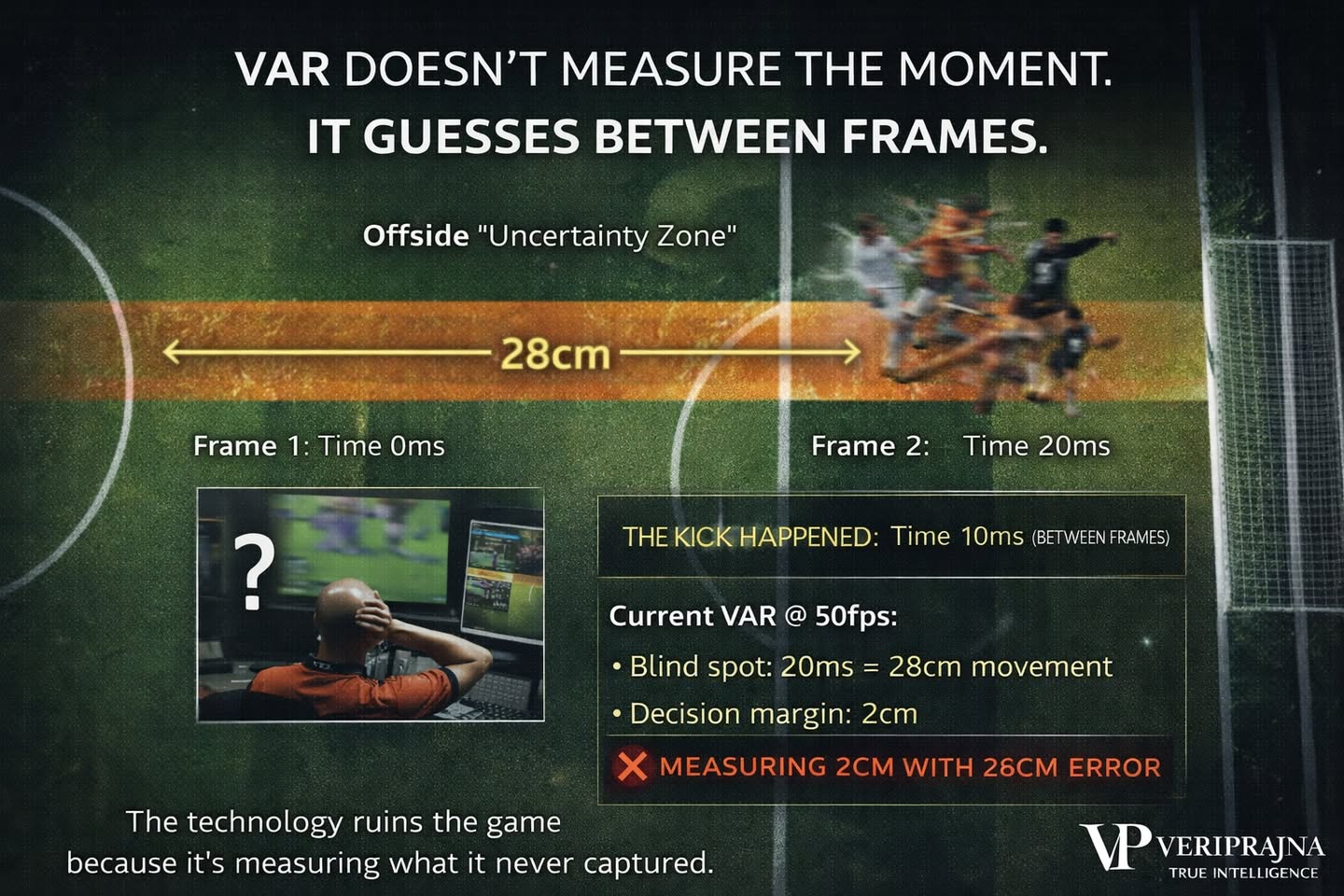
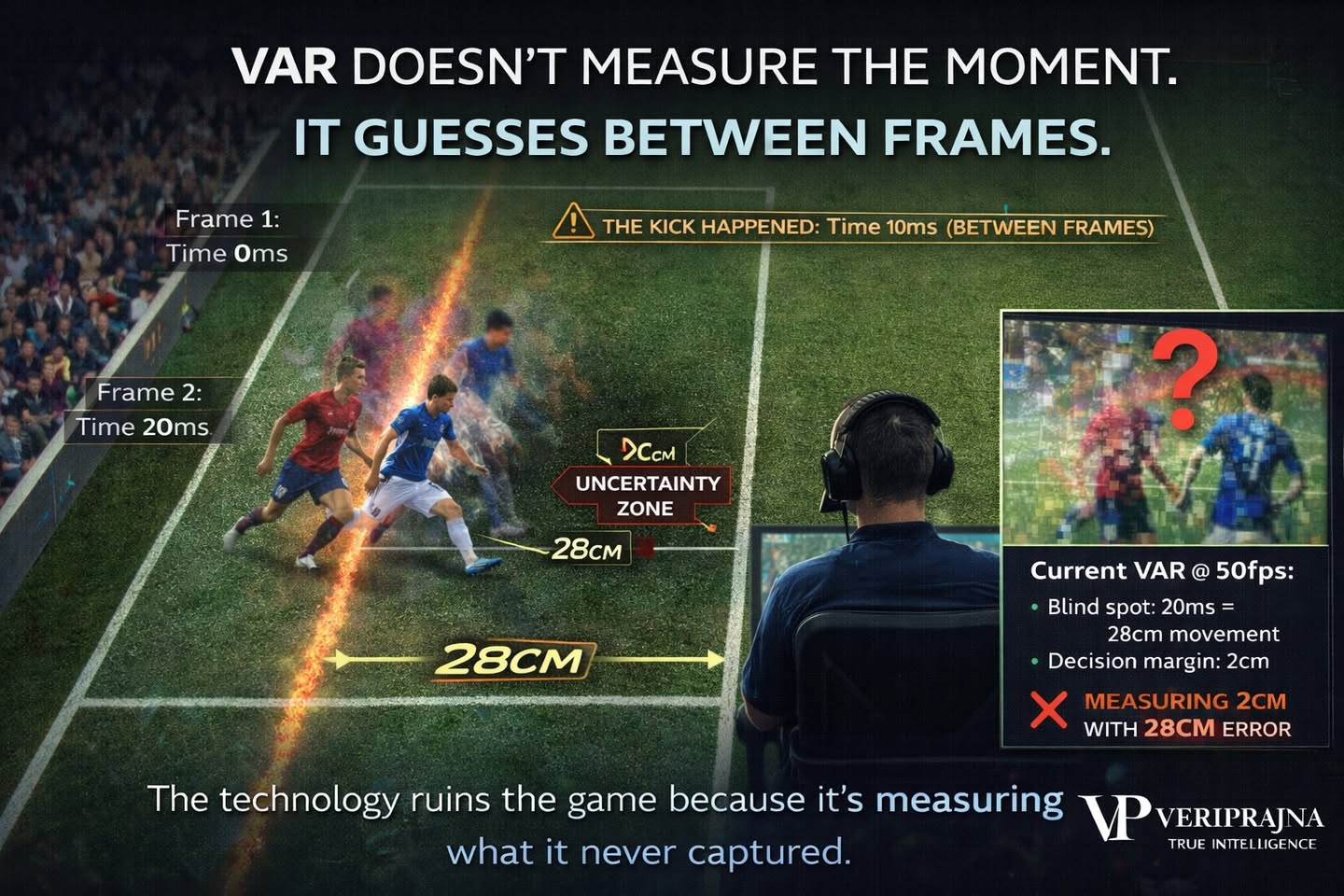
• Standard broadcast VAR operates at 50 fps, creating a 20 ms blind spot.
• At elite speeds, players move 20–30 cm between frames—yet decisions are made on 2–3 cm margins.
• Motion blur alone can introduce 10–20 cm of positional uncertainty.
That means football’s biggest calls are often decided inside a 30–40 cm “zone of uncertainty.”
📐 VeriPrajna’s research shows a different path.
By shifting from pixel-based judgment to Deep Sensor Fusion, we demonstrate how officiating can be rebuilt on physics, not guesswork:
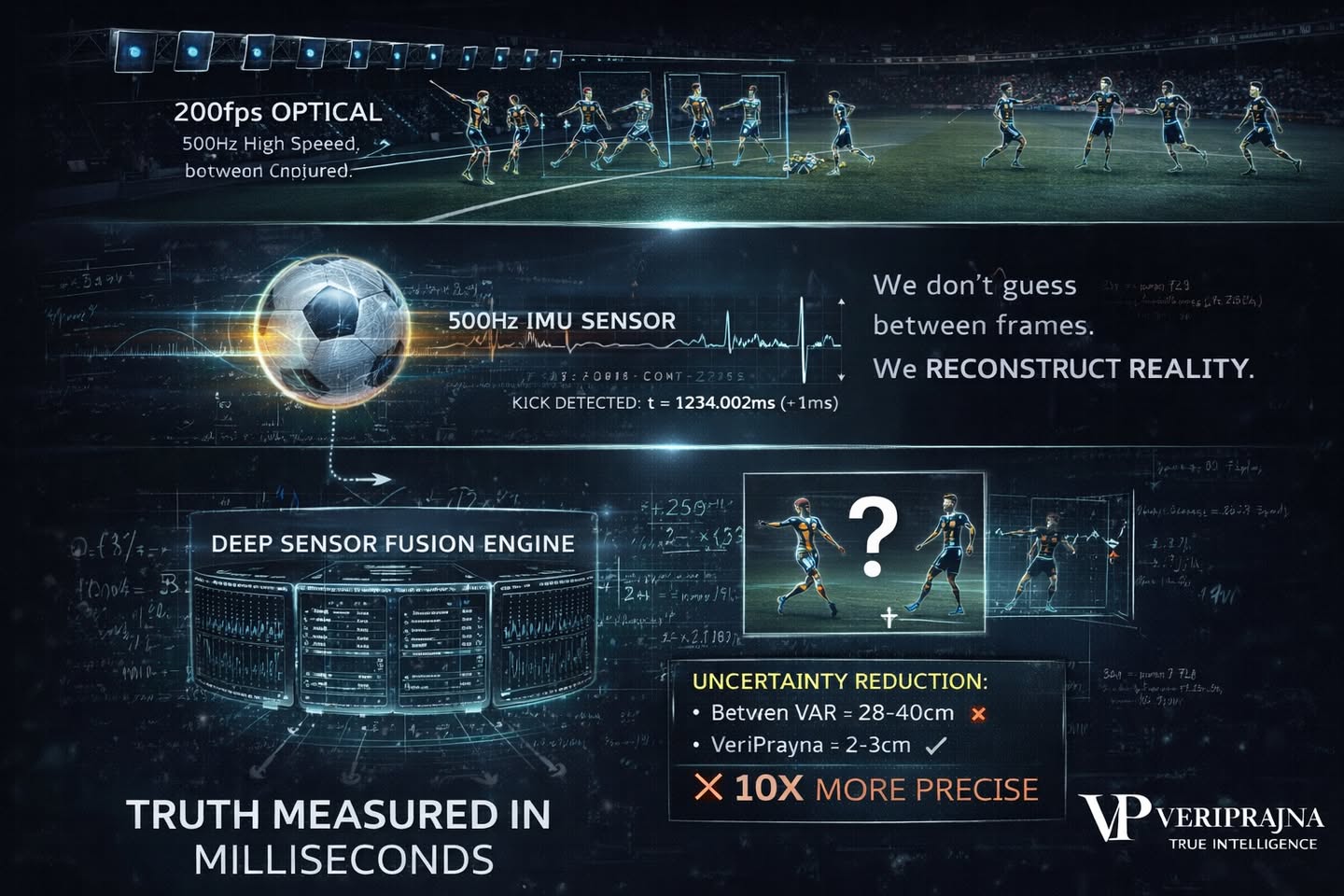
- 200 fps global-shutter optical tracking to reduce spatial ambiguity
- 500 Hz IMU-enabled match balls to identify the exact kick moment with ±1 ms precision
- Kalman filtering + spline interpolation to reconstruct play with sub-millimeter temporal accuracy
✅ The result?
A reduced uncertainty window of ~2–3 cm—an order-of-magnitude improvement over current VAR systems.
This whitepaper isn’t about drawing thicker lines on screens. It’s about re-engineering truth in sport—where decisions are based on measured reality, not interpolated pixels.
📄 Read the full whitepaper (link in comments) to explore the data, architecture, and math behind next-generation officiating.
📩 Want to discuss implementation, pilots, or partnerships?
Email us at [email protected]
or message us directly on WhatsApp: +91 92170 59957. Let’s talk about how Deep AI and sensor intelligence can restore trust—at scale.
#SportsTech #DeepAI #SensorFusion #FootballInnovation #VAR