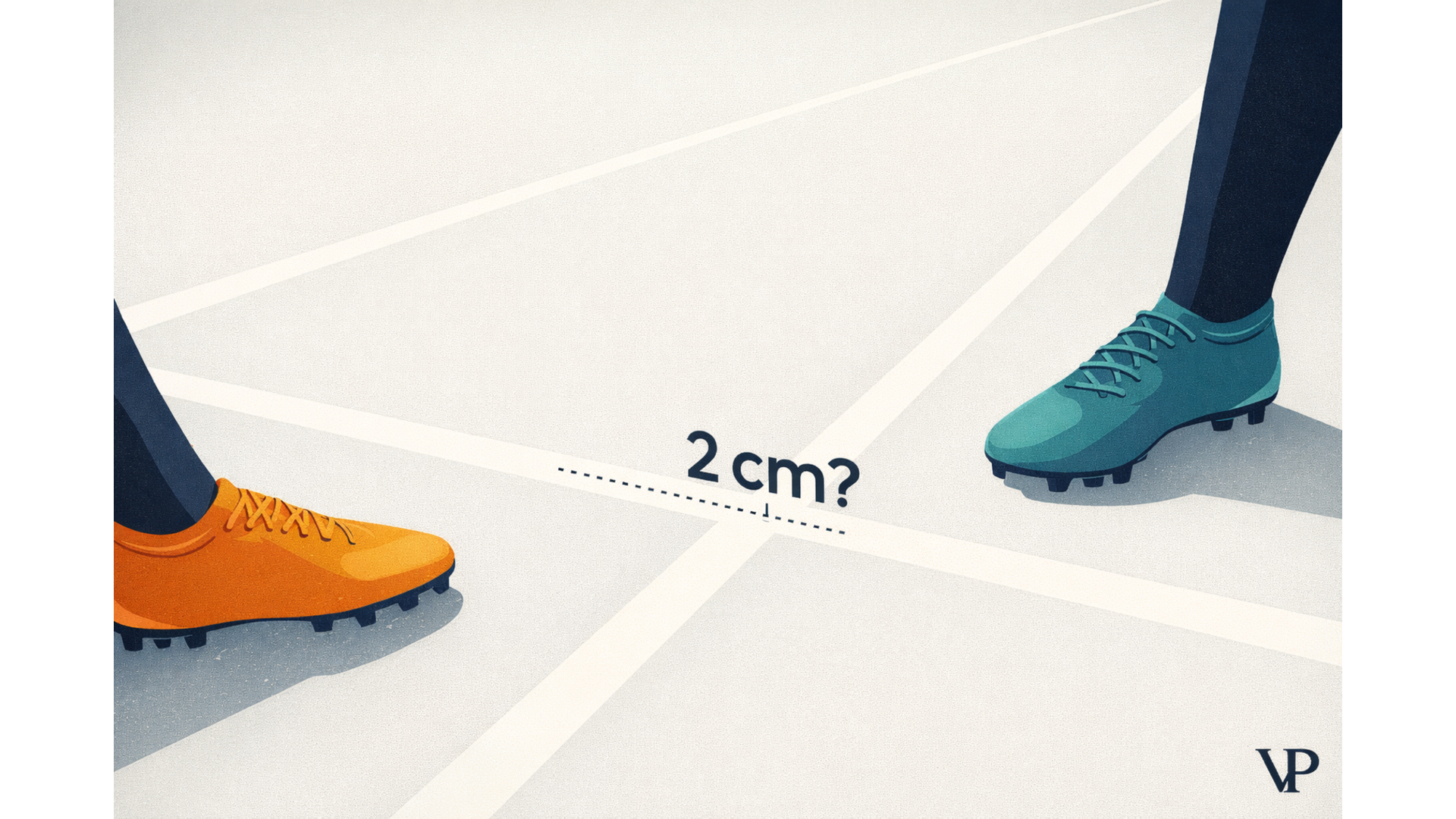
A striker's toe is ruled offside by two centimeters, and a stadium erupts. The replay shows a pixelated freeze-frame, a thin line drawn across a blurry image, and a goal wiped away. Fans call it a travesty. Pundits call it the death of football. But almost nobody asks the right question: was that image even capable of showing where the player actually was?
I've spent the better part of two years obsessing over this question. Not because I'm a disgruntled fan — though I am — but because I run a Deep AI company, and the VAR offside problem is one of the most elegant examples of a measurement system being asked to do something it was never designed to do. The cameras aren't lying. They're just not fast enough to tell the truth.
The common narrative is that VAR "ruins the game" because of bad operators or inconsistent rules. That's a distraction. The real issue is physics. And once you see it, you can't unsee it.
The 20-Millisecond Blind Spot
Standard broadcast cameras in European football operate at 50 frames per second. That means they capture a snapshot of the world every 20 milliseconds. In a living room, 20 milliseconds is nothing. On a football pitch, it's a chasm.
An elite attacker sprinting at 36 km/h covers 20 centimeters in that 20ms gap. If you factor in a defender stepping up in the opposite direction — playing the offside trap — the relative movement between them can reach 30 centimeters between frames. Yet the VAR operator is asked to pick one of those frames as the "moment of the pass" and draw a line accurate to a centimeter or two.
Think of it like trying to photograph a hummingbird's wings with a camera that takes one picture per second. You'd capture the bird, sure. But you'd never see the wings clearly. You'd see a blur, and you'd be guessing where the wingtips actually were. That's what VAR does with a sprinting footballer's toe.
The system claims centimeter precision from data that has a 30-centimeter blind spot. That's not measurement. That's a coin flip dressed up in technology.
Why "Better Software" Can't Fix Bad Data
The sports tech market is full of companies applying off-the-shelf AI models — object detectors, pose estimators — to standard broadcast footage and calling it innovation. I've looked at dozens of these solutions. They're impressive demos. They're also fundamentally limited.
If your input is a 50fps broadcast feed with motion blur and rolling shutter distortion, no neural network on earth can recover the information that was never captured. You can't sharpen a photo of something that moved 10 centimeters during the exposure. The data simply isn't there.
This realization hit my team hard about a year in. We'd been building increasingly sophisticated models, and the results kept plateauing. One evening, staring at a particularly maddening edge case, one of my engineers said something that reframed the entire project: "We're not solving an AI problem. We're solving a sensor problem." She was right. We'd been trying to extract truth from data that was physically incapable of containing it. We explored this realization — and its full implications — in our interactive analysis of the VAR precision problem.
Decoupling Time From Space
The core insight behind our approach is deceptively simple: stop using cameras to determine when the ball was kicked.
Cameras are good at showing where things are. They're terrible at telling you exactly when a split-second event happened. A professional footballer's boot makes contact with the ball for about 8 to 12 milliseconds. At 50fps, the camera might catch one frame before contact and the next frame after the ball has already left the foot. The actual moment of the kick? It happened between frames. It was never recorded.
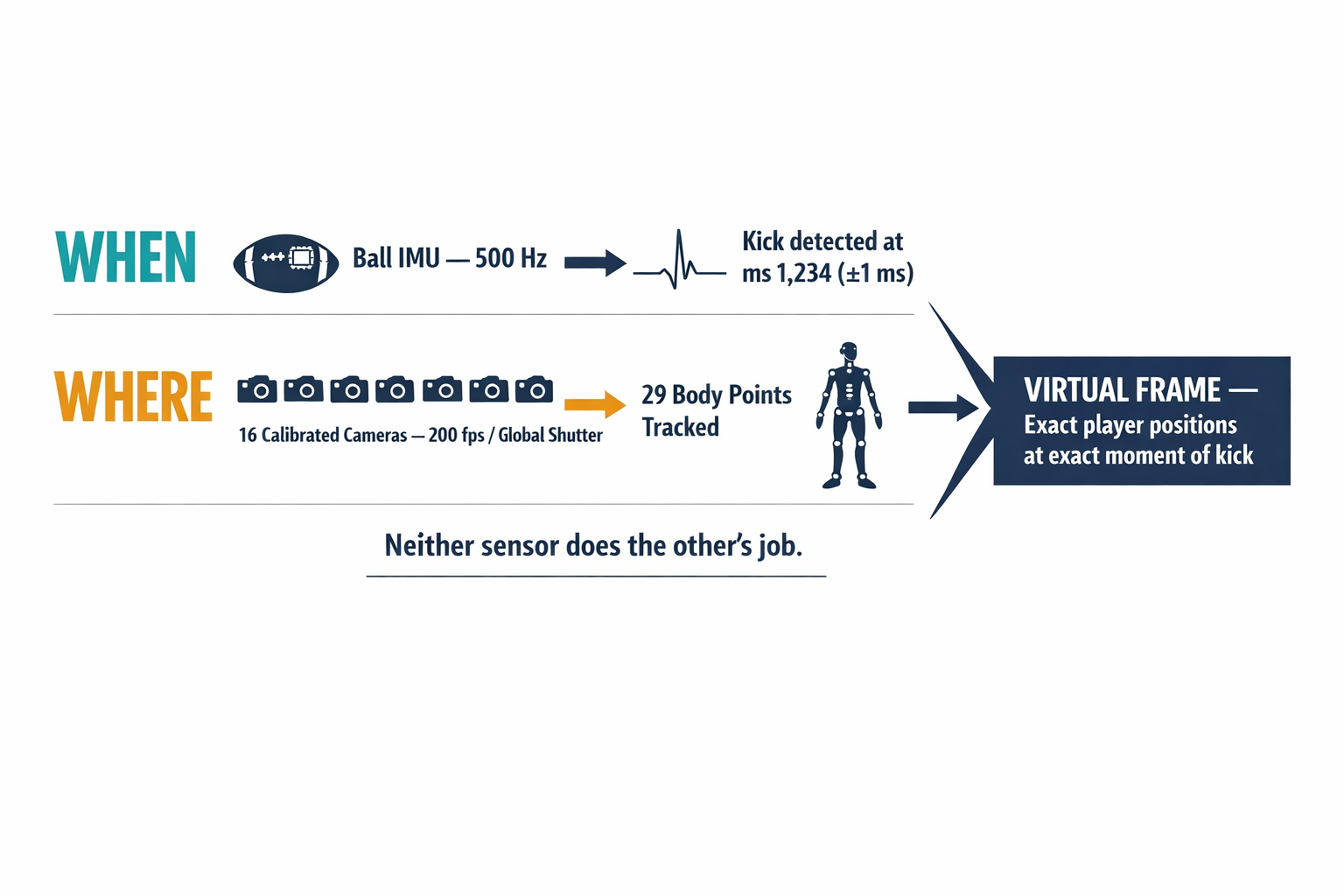
So we split the problem in two. We let a sensor inside the ball handle the "when," and we let an array of high-speed cameras handle the "where."
The ball carries an Inertial Measurement Unit — essentially a tiny accelerometer and gyroscope — sampling at 500 times per second. When a boot strikes the ball, the accelerometer registers a massive spike in force. The shape of that spike tells us whether it was a kick, a bounce, or a header. More importantly, it tells us the exact millisecond contact began — with a precision of plus or minus 1 millisecond.
Meanwhile, instead of broadcast cameras, we use 12 to 16 fixed, calibrated cameras running at 200 frames per second with global shutters. A global shutter means every pixel in the frame is exposed at the same instant — no distortion from fast-moving limbs. At 200fps, the gap between frames drops from 20 milliseconds to 5 milliseconds, and motion blur drops from ~10 centimeters to roughly 2 centimeters.
We let the ball tell us when to look. The cameras tell us where to look. Neither has to do the other's job.
Building the "Virtual Frame"
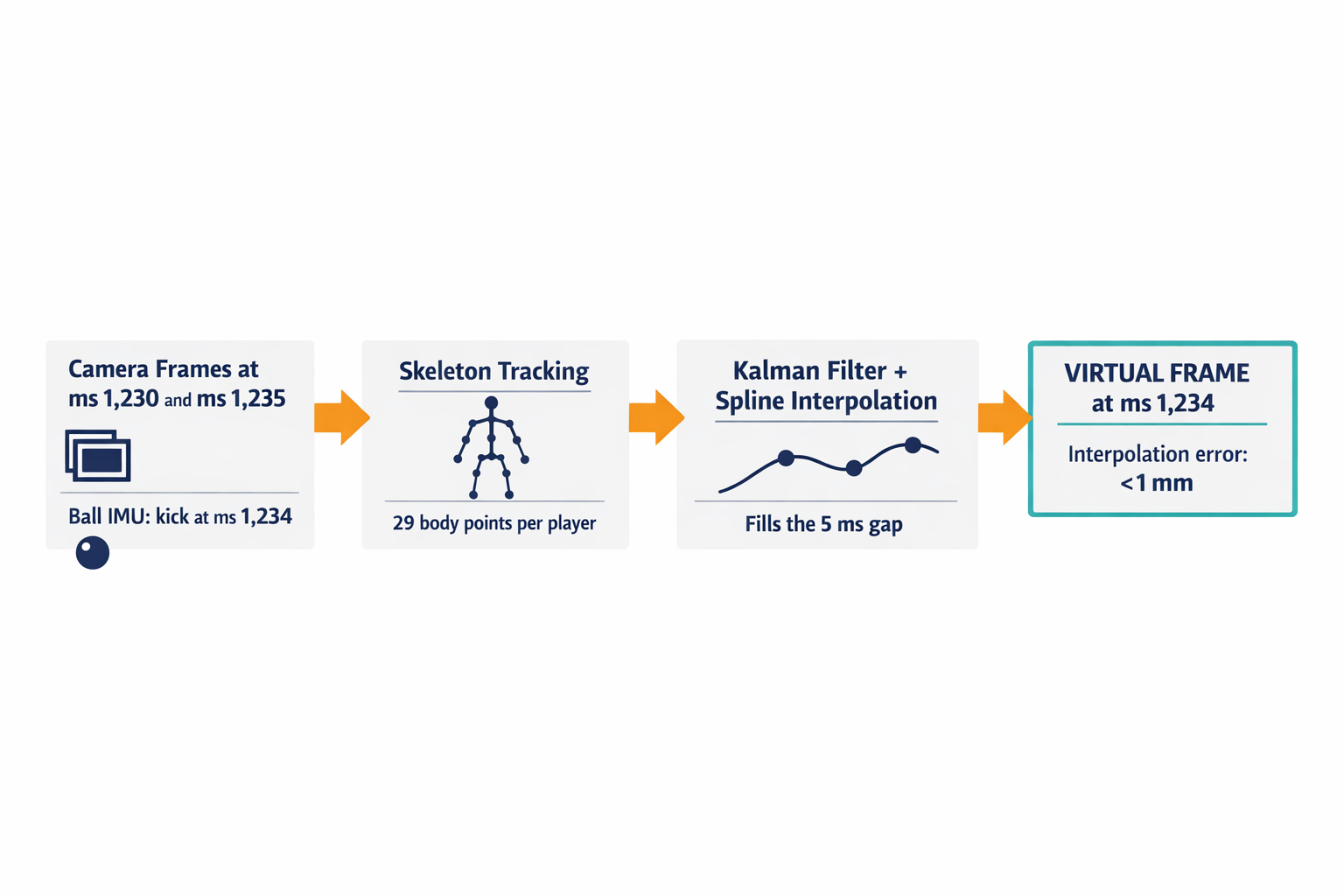
Now comes the part that kept me up at night. The ball sensor says the kick happened at, say, millisecond 1,234. The nearest camera frames are at millisecond 1,230 and millisecond 1,235. We need to know where every player's body was at exactly millisecond 1,234 — a moment no camera actually captured.
This is where the math earns its keep. We track every player's skeleton — not just a bounding box, but 29 specific body points including toe tips and shoulder edges — across the 200fps camera array. We then feed those trajectories through a Kalman filter, a mathematical tool originally developed for missile guidance that blends physics predictions with actual measurements. If a player's knee jitters by a few centimeters between frames due to detection noise, the filter knows that a human knee can't teleport, and it smooths the trajectory to match what's physically possible.
Once we have clean trajectories, we use cubic spline interpolation to calculate where each body point was at the exact millisecond of the kick. A spline fits a smooth curve through the known data points, respecting the fact that human limbs accelerate and decelerate in curves, not straight lines. The result is what we call a "virtual frame" — a mathematically reconstructed snapshot of reality at a moment between actual camera captures.
The interpolation error for smooth biological motion over a 5-millisecond gap is typically less than 1 millimeter. That's not a typo.
From 30 Centimeters to 3
Let me put the numbers side by side, because this is where the argument becomes irrefutable.
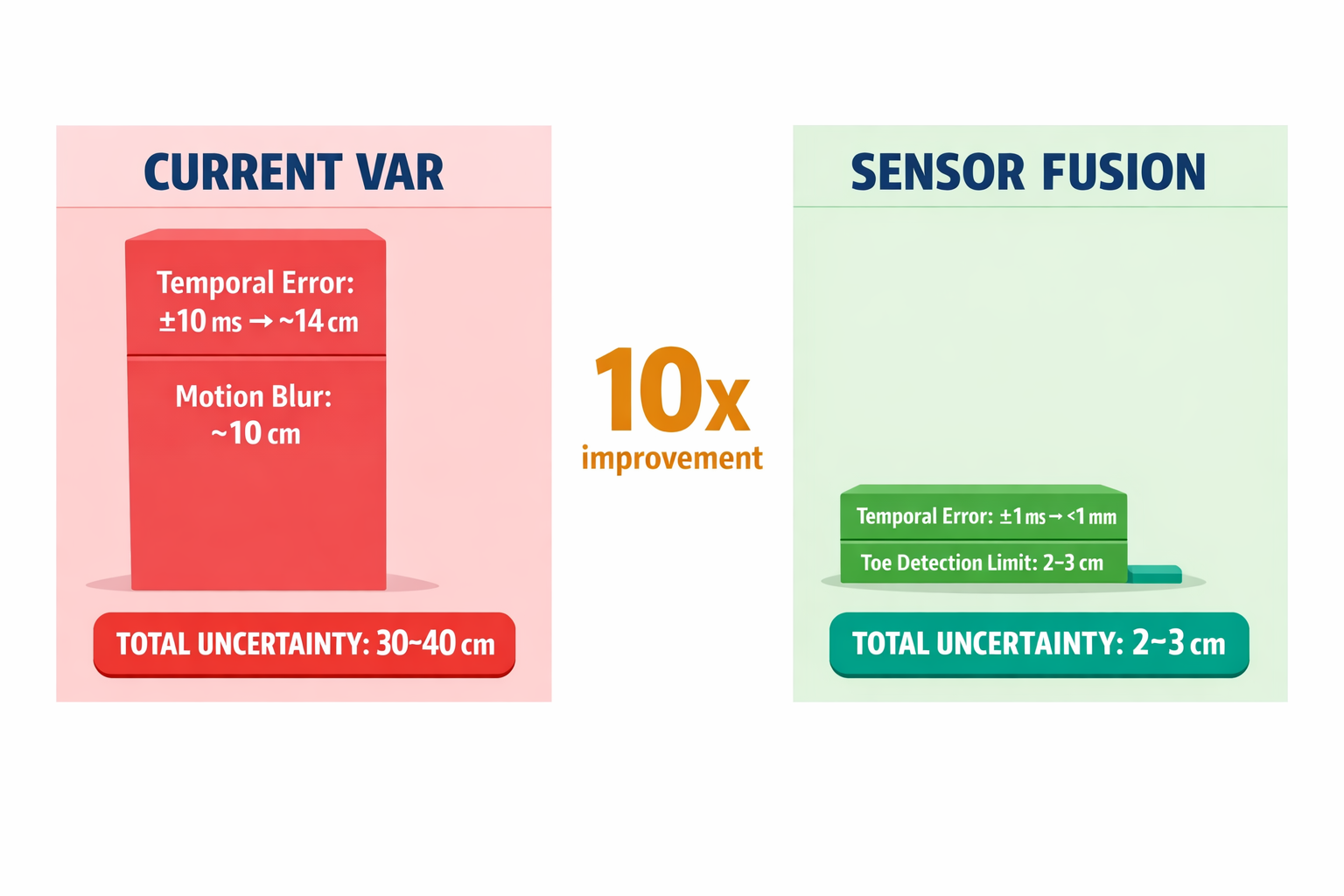
Current VAR at 50fps with manual frame selection: the temporal error is plus or minus 10 milliseconds. At typical relative speeds, that translates to a spatial uncertainty of about 14 centimeters. Add motion blur of roughly 10 centimeters. The total zone of uncertainty — the range within which the system genuinely cannot tell you whether a player was onside or off — is 30 to 40 centimeters.
With sensor fusion — 200fps cameras, 500Hz ball IMU, tightly coupled Kalman filtering, and spline interpolation — the temporal precision drops to plus or minus 1 millisecond. The remaining spatial error comes almost entirely from the neural network's ability to locate a toe tip or shoulder edge, which runs about 2 to 3 centimeters. The total zone of uncertainty: roughly 2 to 3 centimeters.
An order of magnitude. That's the difference between measuring with a ruler and measuring with a yardstick held at arm's length.
That 2-to-3-centimeter residual isn't a limitation of the math — it's a limitation of how precisely you can identify the exact tip of a toe in an image, even a sharp one. And it's honest. The system knows its own uncertainty and reports it, rather than pretending a blurry pixel is gospel.
For the full mathematical verification and the technical architecture behind these numbers, see our detailed research paper.
The Hardest Part Isn't the Algorithm
I want to be honest about something: the math is the easy part. The hard part is engineering a system that works in a stadium on a Saturday afternoon.
Processing 16 cameras at 200fps in 4K resolution generates roughly 40 gigabytes of data per second. You can't send that to the cloud — the latency alone would be a dealbreaker. So we built a distributed edge computing cluster that sits in the stadium server room: four compute nodes, each handling four cameras, connected via high-speed networking that creates a unified memory space. The system needs to produce a decision in under five seconds.
Then there's calibration. If a camera shifts by a fraction of a degree — from thermal expansion of the stadium roof, from wind load, from a pigeon landing on the mount — every measurement degrades. Our system runs continuous self-calibration using fixed pitch features like line markings and goalposts, updating its geometric model in real time.
And then there are the edge cases that no one thinks about until they happen. What if the pass isn't a clean kick but a dribble — continuous contact rather than a sharp impulse? The IMU detects sustained vibration instead of a spike, and the system switches to tracking the moment of release. What if the ball sensor's battery dies mid-match? The system degrades gracefully to optical-only mode, which at 200fps still has a 7-centimeter uncertainty — far better than current VAR's 30 centimeters.
These aren't afterthoughts. They're the difference between a research paper and a system that actually works.
What About the Cost? And Does FIFA Care?
Two questions I get in every conversation about this.
On cost: yes, retrofitting a stadium with 16 calibrated high-speed cameras, an edge computing cluster, and a PTP time synchronization backbone is a significant investment. It's not a software update. But consider what's at stake. A single wrongly disallowed goal in a Champions League knockout round can swing hundreds of millions in revenue, player transfers, and sponsorship deals. The Premier League alone generates over £3 billion annually in broadcast rights, and VAR controversies are actively eroding the product's credibility. The infrastructure cost is a rounding error against the integrity cost.
On FIFA: they've already moved in this direction. The Semi-Automated Offside Technology deployed at the 2022 World Cup uses limb-tracking cameras and a ball-embedded sensor — it's a step toward sensor fusion. But it still relies on lower frame rates and looser coupling between the ball and camera data. What we're proposing isn't a revolution in concept; it's a revolution in precision. The architecture exists in prototype. The question is whether the governing bodies will demand the engineering rigor to close the last 30 centimeters of uncertainty.
Beyond Offside: What a Digitized Pitch Makes Possible
Once you've built the infrastructure to track every player's skeleton at 200fps and the ball at 500Hz, offside is just the beginning.
Handball detection becomes mathematical rather than subjective — you can model a player's "natural silhouette" in 3D and detect whether an arm moved toward the ball faster than the torso's rotation would explain. Injury prevention gets a new tool: by calculating the exact forces on a player's joints during every sprint, cut, and deceleration, medical staff can monitor cumulative load and flag ACL-risk patterns before they become tears. Expected goals models move from crude 2D pitch coordinates to incorporating shot speed, body balance, and boot-to-ball contact point.
The pitch becomes a physics laboratory. And the same data that makes officiating fairer makes the sport smarter.
What This Actually Requires
I don't think the technology is the bottleneck anymore. The physics is understood. The sensors exist. The compute is available. The bottleneck is institutional willingness to admit that the current system — for all its expense and ceremony — is measuring the wrong thing.
VAR was sold as cameras that don't lie. The truth is subtler: cameras don't lie, but they also don't see fast enough to tell the whole truth. Acknowledging that isn't a failure of technology. It's the first step toward building technology that actually works.
We don't need to roll back VAR. We need to finish building it.
If you work in sports technology, broadcast engineering, or federation governance, I'd genuinely like to hear how you're thinking about the precision gap. The conversation matters more than any single solution — including ours.