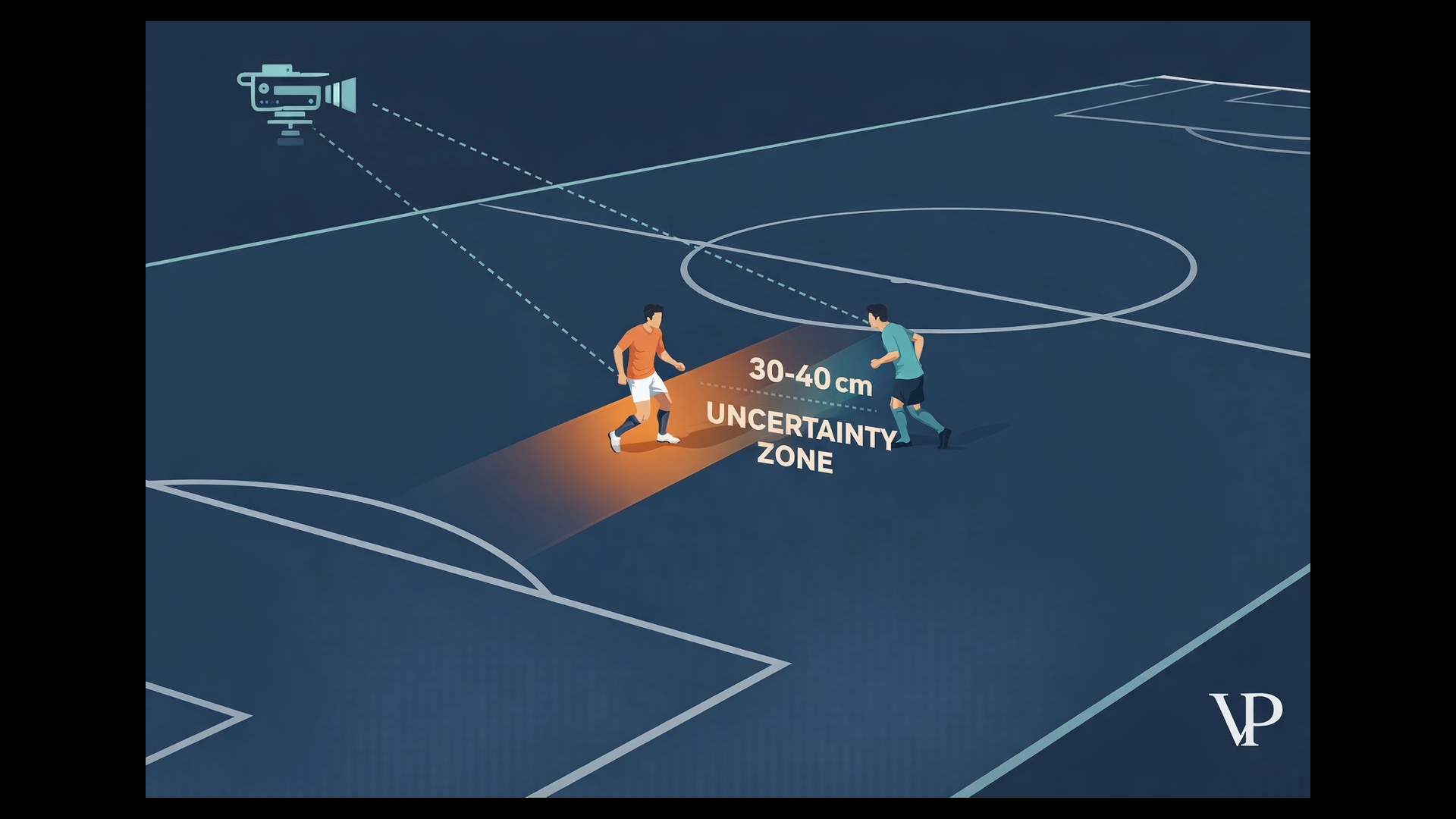
A striker's toe is ruled offside by two centimeters, and a goal is disallowed. The stadium erupts. Pundits debate. Fans rage. But almost nobody asks the question that actually matters: can the system even measure two centimeters?
Our engineering analysis says no. The current Video Assistant Referee system has a margin of error between 30 and 40 centimeters on a typical offside call — yet it routinely makes rulings based on margins ten times smaller than that. This isn't a refereeing problem. It's a measurement problem. And it has a solution.
We've spent months dissecting the physics, signal processing, and computer vision behind VAR's offside technology. What we found is that the frustration fans feel isn't irrational — it's technically justified. The cameras being used were designed to broadcast a football match, not to measure one. The system is trying to determine physical truth using tools that were never built for precision measurement. It's the equivalent of using a kitchen scale to weigh a single grain of sand and then arguing about the fourth decimal place.
The Pixel Fallacy: Why Cameras Lie About Offside
The core assumption behind current VAR is that a video frame represents a frozen, truthful snapshot of reality. It doesn't.
A broadcast camera in Europe captures 50 frames per second. That means it takes a picture of the world every 20 milliseconds. In a living room, 20 milliseconds is nothing. On a football pitch, it's a different story. An elite attacker sprinting at 36 km/h covers 20 centimeters in that gap. When you factor in a defender stepping up in the opposite direction, the combined movement between two frames can reach 30 centimeters.
Now consider what happens during an offside review. A VAR operator must pick the single frame that represents "the moment the ball was played." But a kick — the actual transfer of energy from boot to ball — takes roughly 8 to 12 milliseconds. At 50 frames per second, the camera might catch one frame before the foot touches the ball and the next frame after the ball has already left. The actual moment of contact almost always falls between frames.
The system asks for millimeter precision from a tool that has a 30-centimeter blind spot.
Then there's motion blur. During each frame's exposure window (roughly 10 milliseconds), a foot moving at high speed doesn't appear as a sharp point — it appears as a smear across multiple pixels. When the operator places a line on the "leading edge" of a player's body, they're picking an arbitrary point within a blur. The decision of whether a goal stands effectively becomes a lottery based on how the camera's shutter cycle happened to align with the striker's boot.
What Makes This a Measurement Problem, Not a Software Problem
The sports technology market is full of companies applying artificial intelligence to broadcast footage — running standard object detection models on the same 50-frames-per-second video that fans watch at home. These approaches inherit every limitation of that footage. No amount of clever software can recover information that the camera never captured.
Think of it this way: if someone hands you a blurry photograph and asks you to measure the exact length of an object in it, you can use the most sophisticated ruler in the world and still get the wrong answer. The problem isn't the ruler. It's the photograph.
This is why our approach starts at the sensor layer — the cameras and instruments themselves — rather than the software layer. We explored this problem in depth in our interactive analysis of VAR's precision crisis. The conclusion is stark: true officiating precision requires fundamentally different hardware, not just better algorithms.
Decoupling Time From Space: The Core Insight
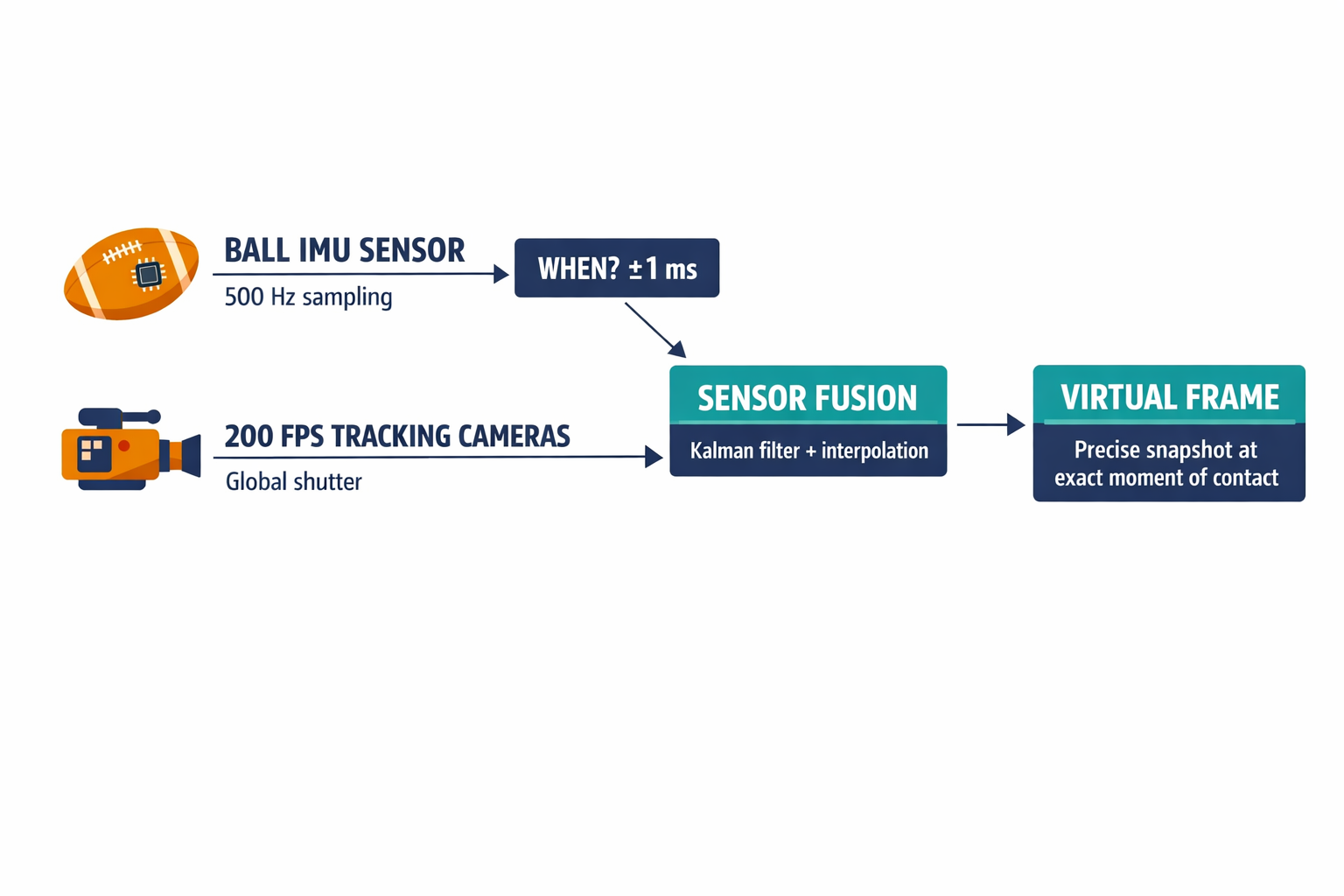
The single biggest insight in our research is this: the current system uses one tool — a camera — to answer two completely different questions. When was the ball played? And where were the players at that moment? These are separate physical measurements, and they demand separate sensors.
For the "when" question, we propose a high-frequency sensor embedded inside the match ball. An Inertial Measurement Unit (IMU) — essentially a tiny accelerometer and gyroscope — sampling at 500 times per second. When a foot strikes the ball, this sensor registers a massive spike in force. It can pinpoint the exact onset of contact to within plus or minus 1 millisecond. That's twenty times more precise than the best broadcast camera.
The sensor can even distinguish between a kick, a header, and a bounce by analyzing the shape of the impact signal. A kick produces a sharp, high-magnitude spike with a rise time under 2 milliseconds. A bounce is softer and longer. A header is somewhere in between.
For the "where" question, we propose dedicated tracking cameras running at 200 frames per second — four times the current broadcast rate — using global shutter sensors that expose every pixel simultaneously. This eliminates the motion blur and geometric distortion that plague current footage. Instead of a smear, you get a frozen, geometrically accurate image of every player on the pitch.
We let the ball tell us when to look. The cameras tell us where to look.
Building the Mathematical Bridge
With the ball sensor providing a precise timestamp and the cameras providing spatial data, there's still a gap to close. The kick might happen at, say, the 1,234-millisecond mark of the half. The nearest camera frames might be at 1,230 and 1,235 milliseconds. We need to know where every player's body was at exactly 1,234 — a moment no camera actually captured.
This is where sensor fusion comes in. Our system tracks a 29-point skeleton for every player on the pitch — not just their center of mass, but individual joints, including toe tips and shoulder edges. These skeletal positions are smoothed using a technique called a Kalman filter, which combines physics-based predictions ("a leg can't teleport one meter in five milliseconds") with actual camera observations to produce a clean, consistent trajectory for every limb.
Once we have that trajectory, we use mathematical interpolation to calculate where each joint was at the exact millisecond of the kick. It's similar to how you can predict where a car will be in half a second if you know its current speed and acceleration — except we're doing it for 22 athletes simultaneously, at the level of individual toes.
The result is what we call a "virtual frame" — a mathematically reconstructed snapshot of reality at the precise instant of contact. No guessing. No frame selection lottery.
From 30 Centimeters to 3: The Numbers
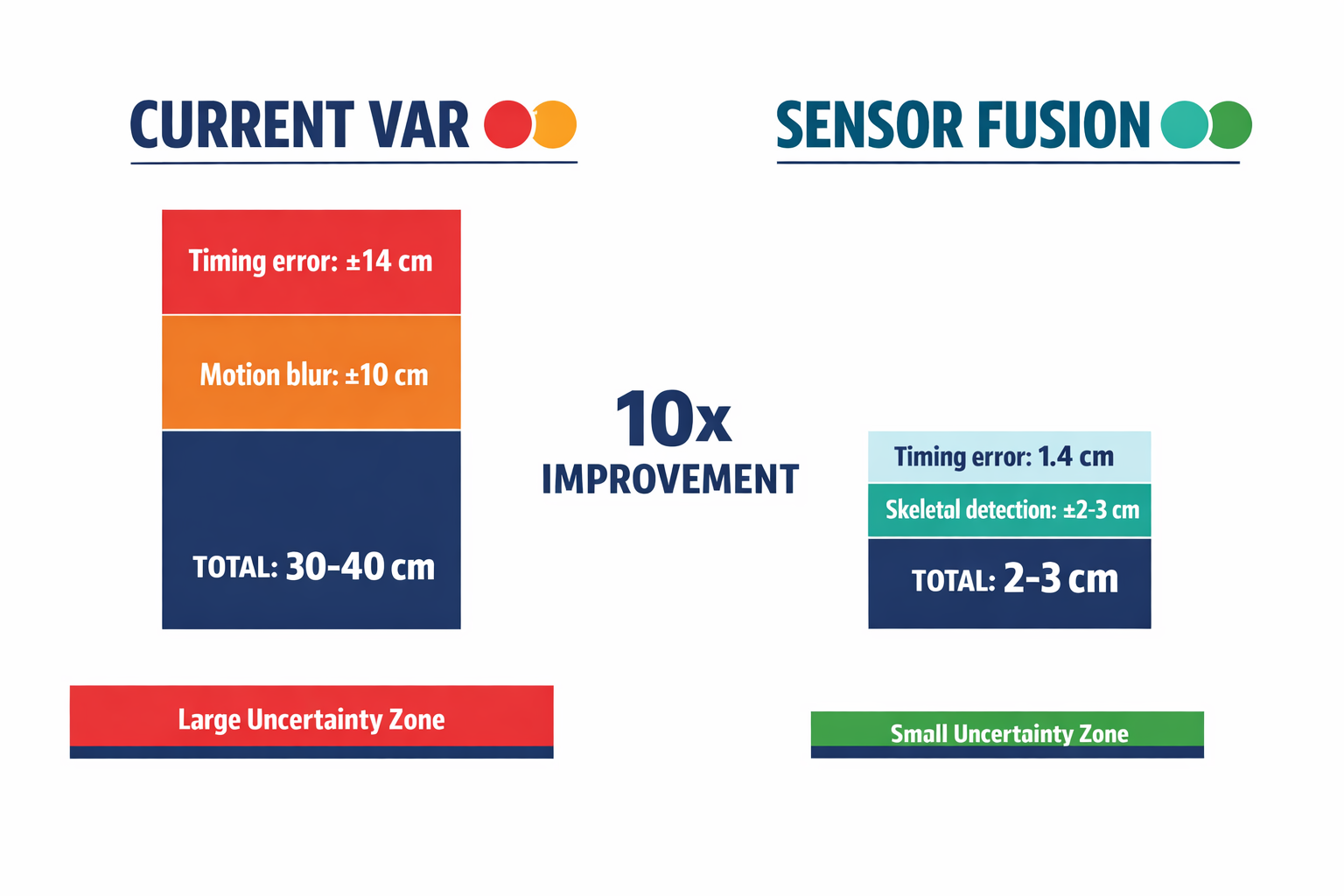
Here's what the math shows for a typical offside scenario where the attacker and defender are moving toward each other at a combined speed of about 14 meters per second:
Current VAR (50fps broadcast cameras): - Temporal error: ±10 milliseconds - Spatial uncertainty from timing alone: ±14 centimeters - Additional motion blur error: ±10 centimeters - Total zone of uncertainty: 30-40 centimeters
Sensor fusion system (200fps cameras + 500Hz ball sensor): - Temporal precision: ±1 millisecond - Spatial uncertainty from timing: 1.4 centimeters - Interpolation error for smooth biological motion: less than 1 millimeter - Remaining error (skeletal detection accuracy): ±2-3 centimeters - Total zone of uncertainty: 2-3 centimeters
An order-of-magnitude improvement — not from drawing thicker lines on blurry images, but from engineering a truer system of measurement.
That 2-3 centimeter figure is dominated by the accuracy of the skeletal detection model, not by timing errors. The temporal problem — which is the largest source of error in today's system — is essentially eliminated.
For the full technical methodology, including the mathematical foundations of our Kalman filtering and spline interpolation approach, see our detailed research paper.
What Happens When the System Breaks
Any serious engineering proposal has to answer the question: what happens when something goes wrong?
If the ball sensor fails mid-match — battery dies, signal interference — the system doesn't stop. It degrades gracefully to camera-only mode. With 200fps cameras, the uncertainty increases to about 7 centimeters. That's still four times better than current VAR. The match continues without interruption.
What about a crowded penalty box where defenders block the camera's view of an attacker's knee? Our architecture uses 12 to 16 fixed cameras positioned around the stadium. With that many overlapping angles, it's statistically improbable that any limb is hidden from all cameras simultaneously. When a joint is partially occluded, the system uses biomechanical constraints — a shin is always connected to a knee, which is always connected to a hip — to infer the hidden position and assigns a confidence score. If confidence drops below 95%, the system flags the incident for human review rather than making a call it can't support.
What About the Cost — and the Will?
Deploying this system isn't trivial. It requires dedicated camera arrays, edge computing hardware in every stadium, fiber-optic time synchronization, and a ball with an embedded sensor that still flies true. The processing load alone — 16 cameras at 200 frames per second in 4K resolution — generates roughly 40 gigabytes of data per second. This isn't a cloud solution. It's heavy infrastructure.
But the infrastructure question is really a priorities question. Football already spends billions on broadcast technology, stadium construction, and player transfers. The question isn't whether the sport can afford precision — it's whether it can afford to keep making decisions with a 30-centimeter margin of error while telling fans the call was accurate to the millimeter.
Beyond Offside: What a Digitized Pitch Makes Possible
Once a stadium has this level of measurement fidelity, offside is just the beginning.
The same skeletal and ball-tracking data can detect whether an arm moved toward the ball faster than the body's natural rotation — turning the subjective "handball or not?" debate into a geometric question. It can calculate the exact force on a player's knee during every sprint and deceleration, flagging injury risk before a ligament tears. It can model expected goals using the actual speed of the striker's leg swing and their body balance at the moment of the shot, not just their position on the pitch.
And for broadcasters, full 3D reconstruction means virtual camera angles from anywhere — including perspectives that no physical camera could ever capture.
The Real Question for Football
The common complaint that "VAR ruins the game" is usually dismissed as nostalgia or resistance to progress. Our analysis suggests something different: it's an accurate intuition about a system that promises certainty but delivers something closer to a coin flip on the tightest margins.
The fix isn't to abandon technology. It's to finish the job. We need to stop measuring pixels and start measuring physics.
We are currently in the uncanny valley of sports technology — enough tech to see the errors, not enough to fix them.
The tools exist. The mathematics work. The engineering is demanding but achievable. The remaining question is whether football's governing bodies are willing to move from broadcast-grade observation to measurement-grade precision — and whether fans, players, and clubs will demand it.
We'd welcome hearing from anyone working at the intersection of sports technology and precision measurement. This is a problem worth solving properly.