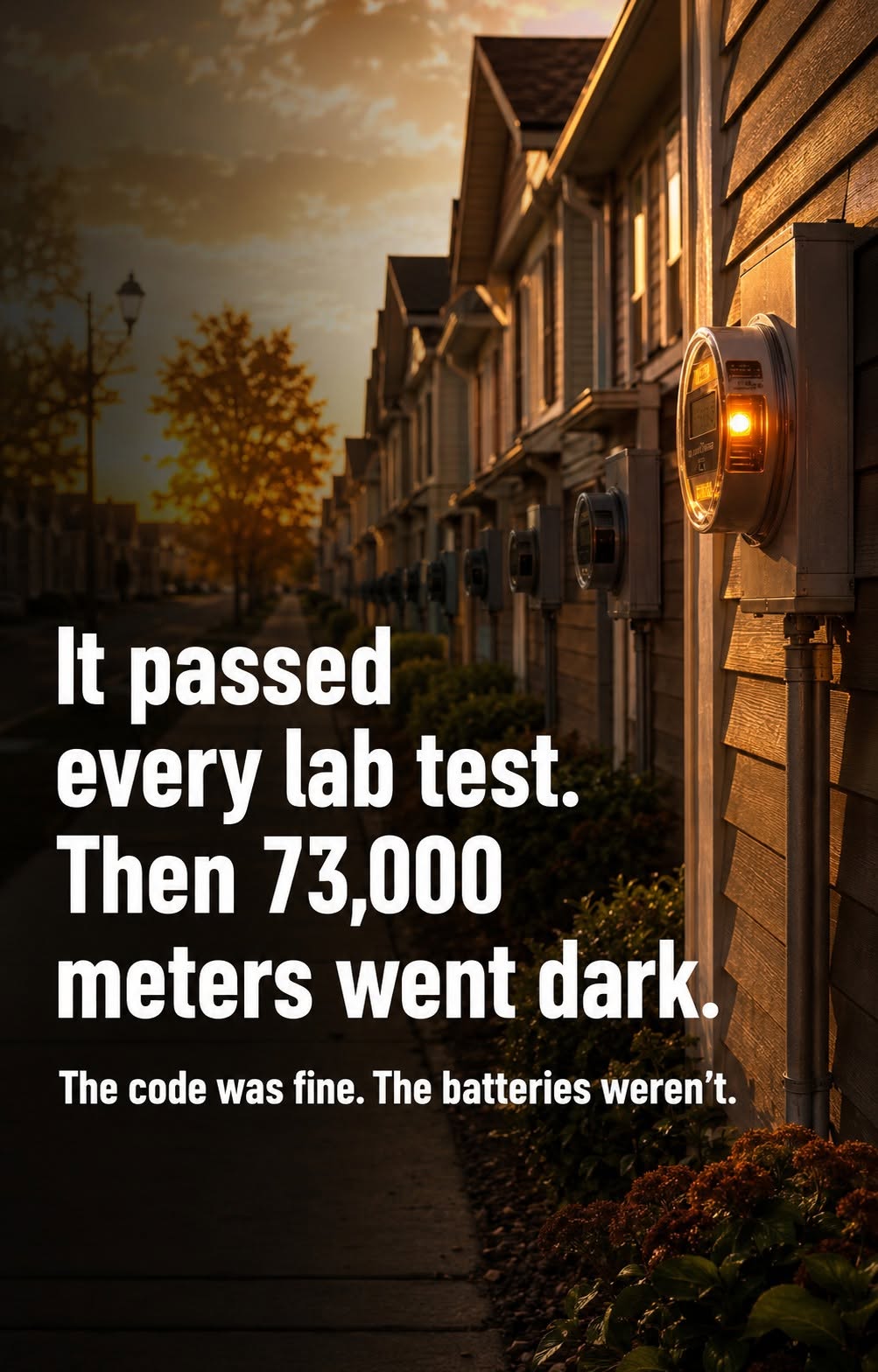
A firmware update that passed every lab test bricked 73,000 smart meters in the field.
In November 2024, Aclara pushed an update to 88,000 meters in Plano, TX. In the lab it ran clean. In the field, 73,000 went dark and cost the city $765,000 in emergency manual reads.
The root cause wasn't the code. It was the batteries.
The firmware was tested on meters with fresh batteries and strong signal. But 83% of the deployed fleet was running on batteries at 60-75% capacity. The new power routines drew more current during the flash write, enough to trip brownout protection on degraded cells. The radios reset, lost network registration, and never came back.
Your MDMS shows the meter reporting, so it looks healthy. It cannot see that 29% of endpoints have failed silently, or that NAND flash is wearing out under 15-minute logging until the readings drift 2-8%.
Predictive maintenance is not about reading consumption better. It is about scoring endpoint health — battery, signal, flash wear — before a routine firmware push knocks a degraded fleet dark. Toronto Hydro spent $5.6M on 470,000 failing transmitters.
You cannot patch a meter that is too degraded to accept the patch. At that point it is not a firmware fix, it is a truck roll and a $650-$1,400 replacement per endpoint.
For utilities running mixed fleets: are you validating firmware against your real battery and signal distribution on a staging fleet first, or pushing to production?
#SmartGrid #AMI #PredictiveMaintenance