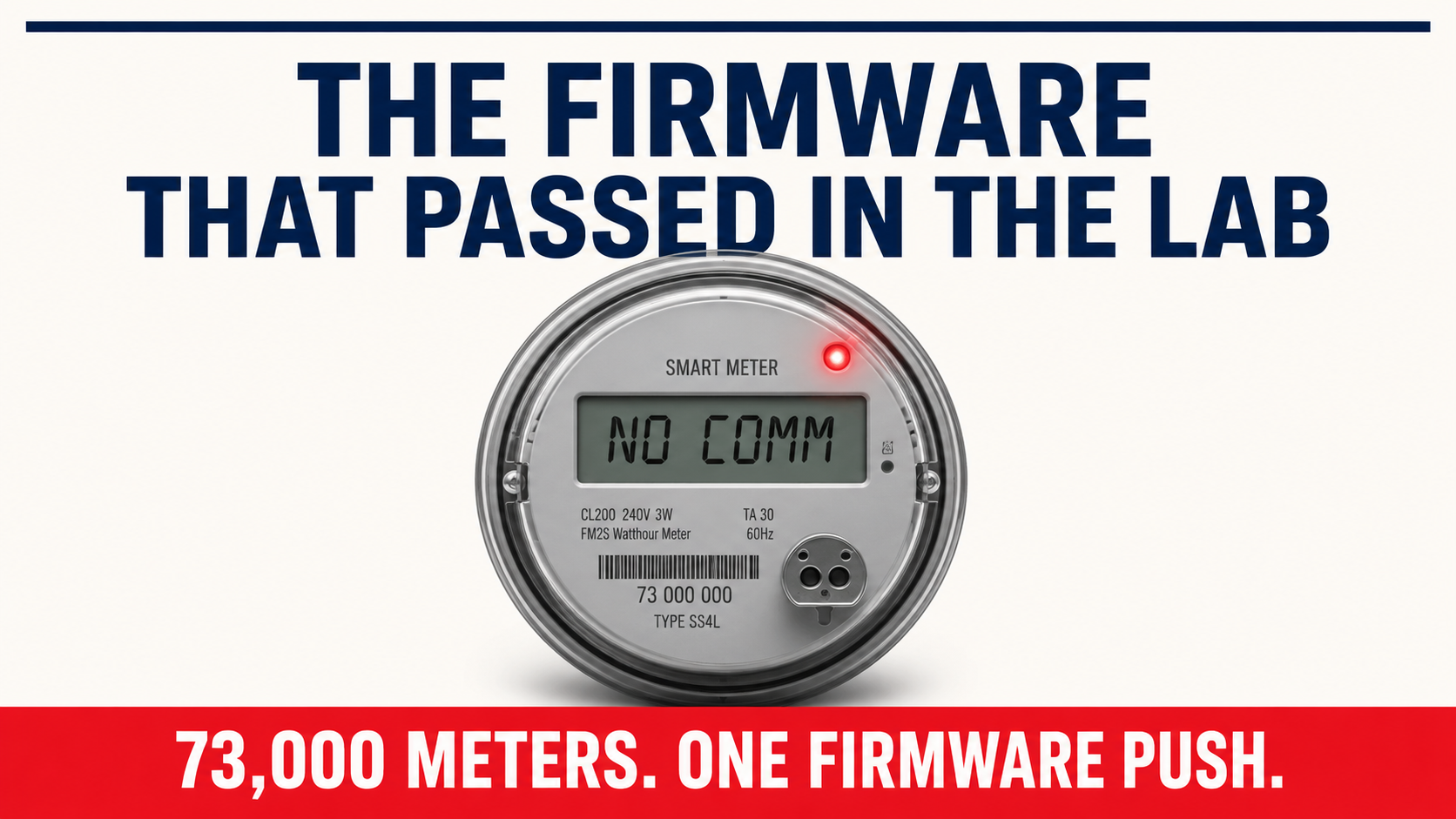
The most expensive smart meter failure isn't a cyberattack — it's a firmware push that worked in the lab and failed in the field. Most AMI head-end systems cannot tell the difference until the meters are already dark.
In November 2024, Aclara pushed a firmware update to 88,000 water meters in Plano, Texas. The goal was to fix battery drain issues reported since 2023. In the lab, the firmware passed. In the field, 73,000 meters went dark. The root cause was a testing gap, not a code defect: the firmware was validated against meters with new batteries, but 83% of Plano's deployed fleet had batteries at 60–75% capacity after four to five years in service. The updated power management routines drew slightly more current during the flash write, triggering brownout protection on degraded cells. The meters reset, lost their network registration, and never recovered.
Plano hired 20 temporary meter readers. The emergency cost: $765,000 over two years. Similar Aclara failures have been documented in Minneapolis, Toronto, and New York City.
We built the predictive maintenance and firmware validation system for AMI fleets at Veriprajna's smart meter AI page.
The $15.4M Pattern Across Three Cities

The Plano incident wasn't isolated. Toronto Hydro discovered 470,000 transmitters degrading through a different mechanism: NAND flash memory wear. Smart meters logging data at 15-minute intervals for demand response programs burn through write cycles faster than manufacturers' 20-year projections assumed. Consumption readings drifted by 2–8%, generating billing disputes. By the time a meter stopped communicating, the flash memory was too worn to accept a firmware patch — requiring physical replacement at $650–$1,400 per endpoint. Toronto's initial remediation cost was $5.6M.
Memphis, Tennessee is now running a $9M repair fund for a systemic failure affecting 8% of its deployed fleet.
Combined remediation costs across Plano, Toronto, and Memphis exceed $15.4M. Each failure started with a signature the AMI head-end was not watching.
What connects these incidents is the gap between what the head-end tracks and what actually precedes a mass failure. The head-end tells you which meters stopped talking. It does not tell you which meters are approaching the battery-age threshold, the flash write-cycle cliff, or the RF signal-margin floor that will cause the next firmware push to behave differently than it did in the lab.
What the MDM System Was Built to Miss
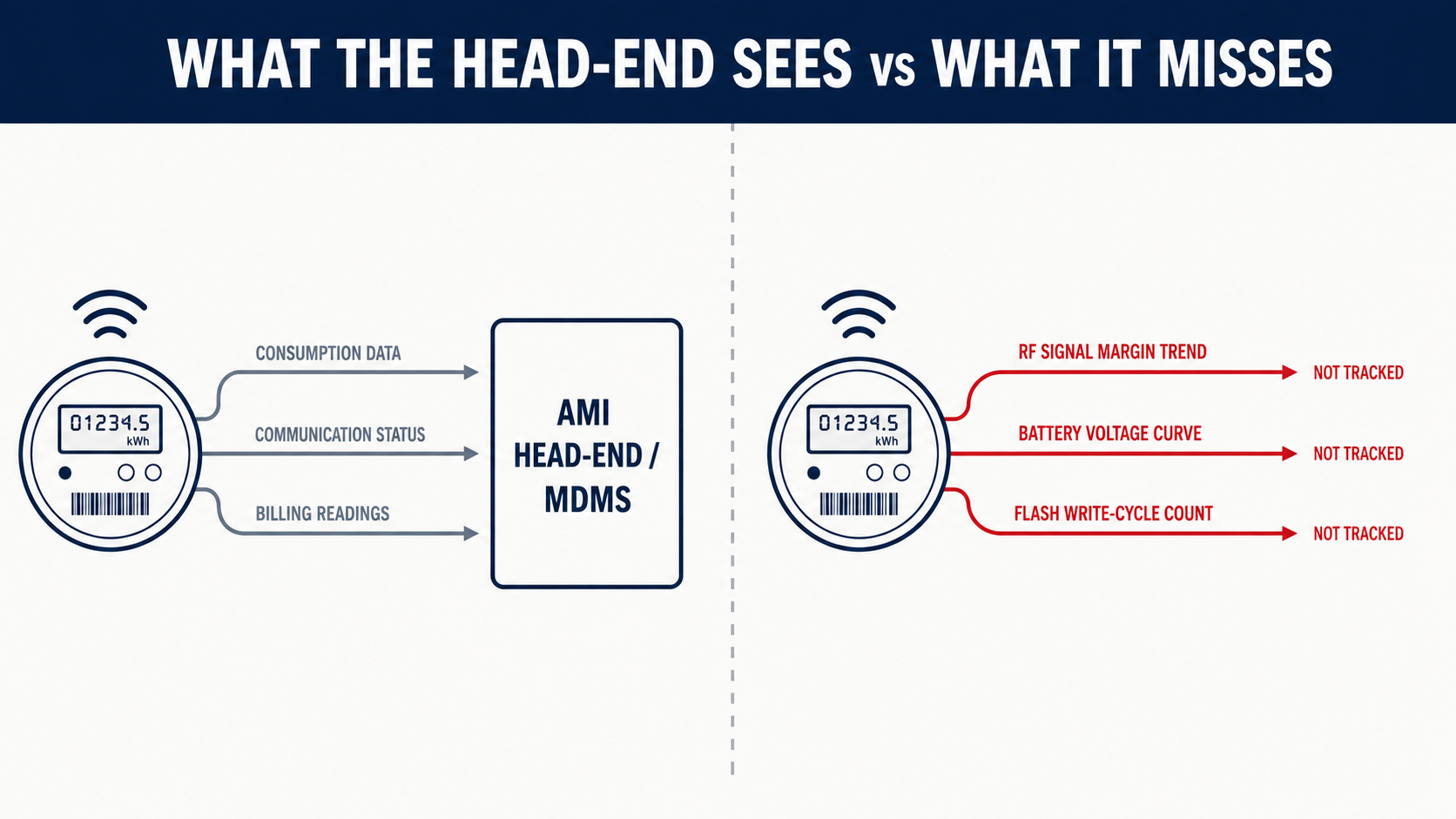
MDM platforms from Oracle, SAP, Itron, and the major AMI vendors were designed to process consumption data, manage billing, and flag meters that stop reporting. The coverage of these platforms is well-documented — and so is what falls outside of it.
The signatures that precede a mass failure are not in consumption data. They live in operational telemetry that MDM platforms do not standardize: RF signal margin trends over time, read interval variance, transmission retry rates, flash memory write-cycle counts, battery voltage degradation curves. A meter can log 15-minute consumption data accurately for months while its RF signal margin quietly degrades and its flash memory approaches a write-cycle cliff. The MDMS sees it as healthy because it is reporting. The pre-failure trajectory is invisible.
Vendor analytics compound this. Itron's Distributed Intelligence platform — covering more than 100 million endpoints and now running NVIDIA edge-AI inference through a partnership announced at DistribuTECH 2026 — was built for load disaggregation and grid-edge intelligence, not for endpoint health scoring against battery-age cohorts. Landis+Gyr's Revelo and Sensus/Xylem's Evolve (launched February 2026, repositioning meters as active grid sensors) pursue similar directions. Vendor-native analytics optimize for the data products the vendor can monetize. A utility running a mixed fleet across multiple AMI vendors has no platform watching the pre-failure indicators that cross vendor boundaries.
Firmware Validation That Reflects the Deployed Fleet
Every AMI vendor tests firmware under controlled conditions: new batteries, strong RF signal, consistent ambient temperature. No vendor tests against the actual distribution of battery ages, RF environments, and flash memory wear states in a fleet that has been operating for several years.
The gap is systematic, not negligent. A vendor cannot simulate every utility's specific fleet profile in a lab. But the utility absorbs the cost when the lab result does not transfer — $765,000 in Plano's case, and that number assumes the meters could eventually be read manually. For a larger utility, the math is worse.
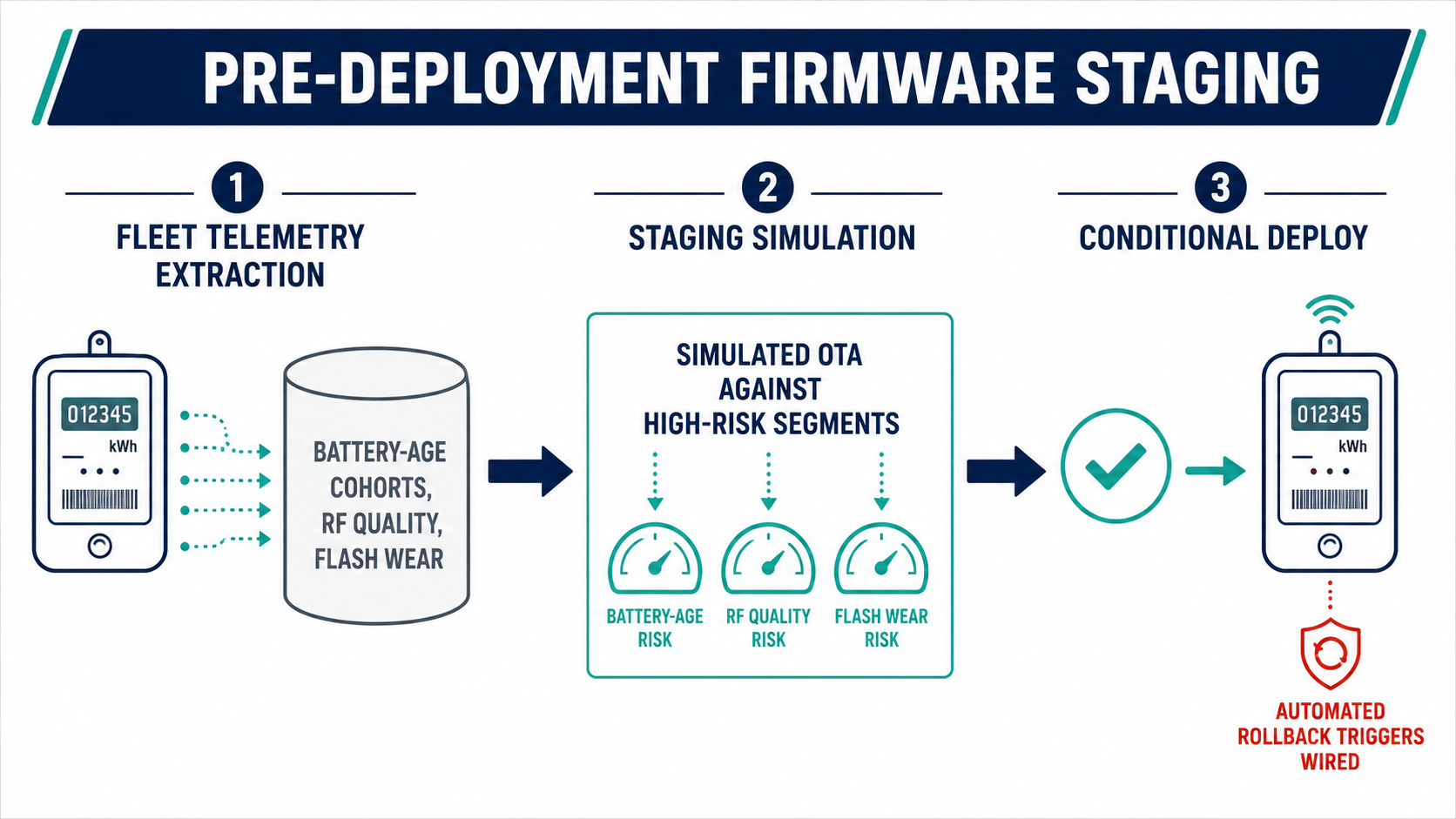
The correct intervention is a pre-deployment staging environment that replicates the fleet's actual risk profile before a firmware push is authorized: fleet telemetry extracted and segmented by battery-age cohort, RF signal quality, and flash memory wear state; simulated OTA deployment run against the highest-risk segments before touching production; and automated rollback triggers wired to real-time brownout and communication failure signals during the first deployment wave.
None of this requires replacing the AMI head-end or the MDMS. It operates as an AI layer between the head-end's telemetry output and the firmware authorization workflow — reading the signals the existing systems already capture but do not act on.
NERC CIP-003-9 Changed the Accountability Structure
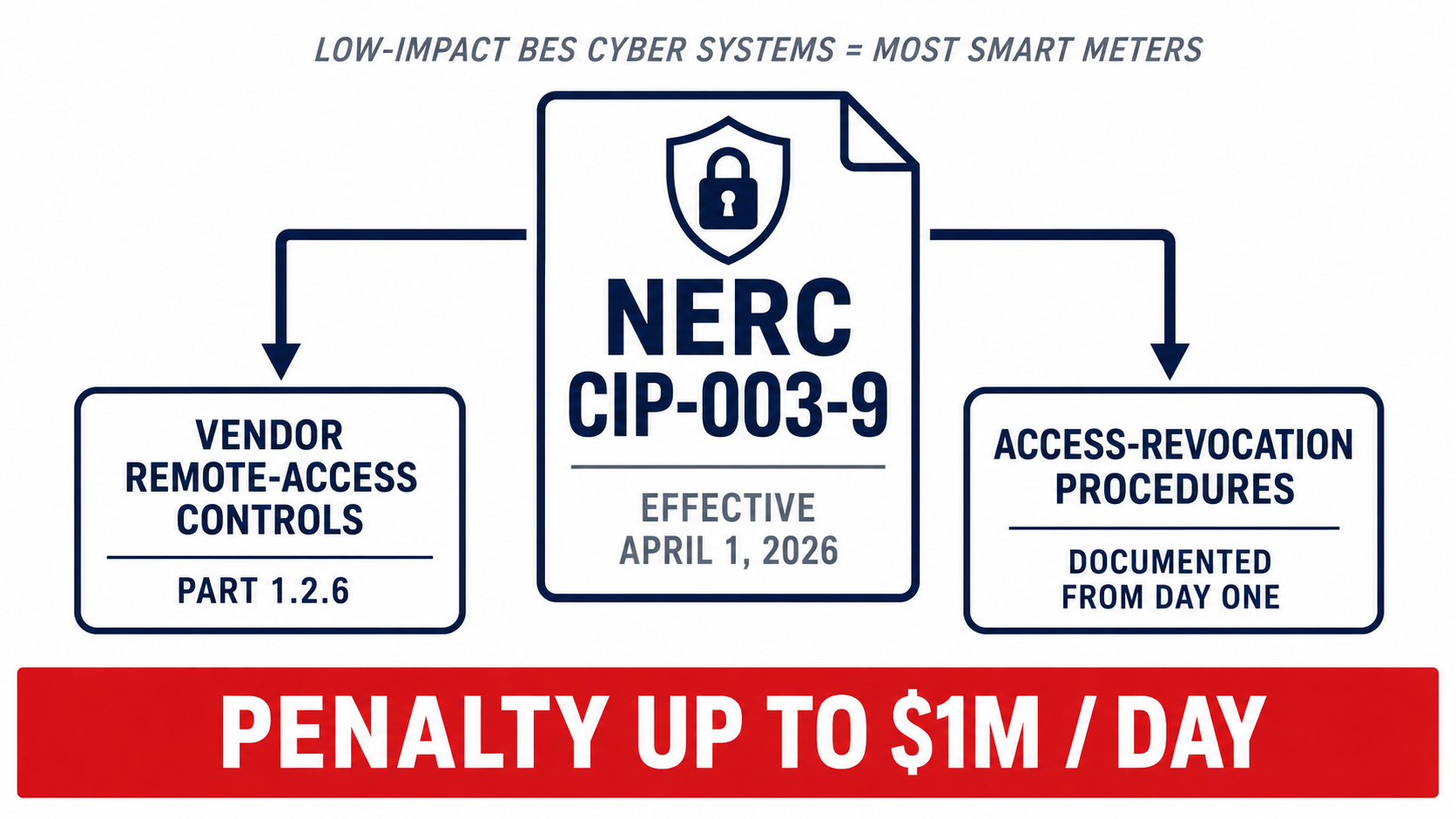
NERC CIP-003-9 took effect April 1, 2026, introducing vendor remote-access security controls for low-impact BES Cyber Systems — a classification covering most smart meters. Part 1.2.6 requires documented access-revocation procedures for every vendor with electronic remote access, implemented from day one.
For utilities planning OTA firmware pushes, the compliance posture shifted. A firmware deployment that disables a significant share of the fleet is now simultaneously an operational failure and a potential NERC CIP compliance event: were the vendor's remote-access controls documented? Can the utility produce the access-revocation procedures in a post-incident audit? NERC penalties run up to $1M per day.
Utilities that have firmware validation processes in place — alongside documented vendor access controls — are better positioned in both dimensions. Fewer field failures, and a cleaner audit trail if something does go wrong.
The 29% Silent Failure Problem
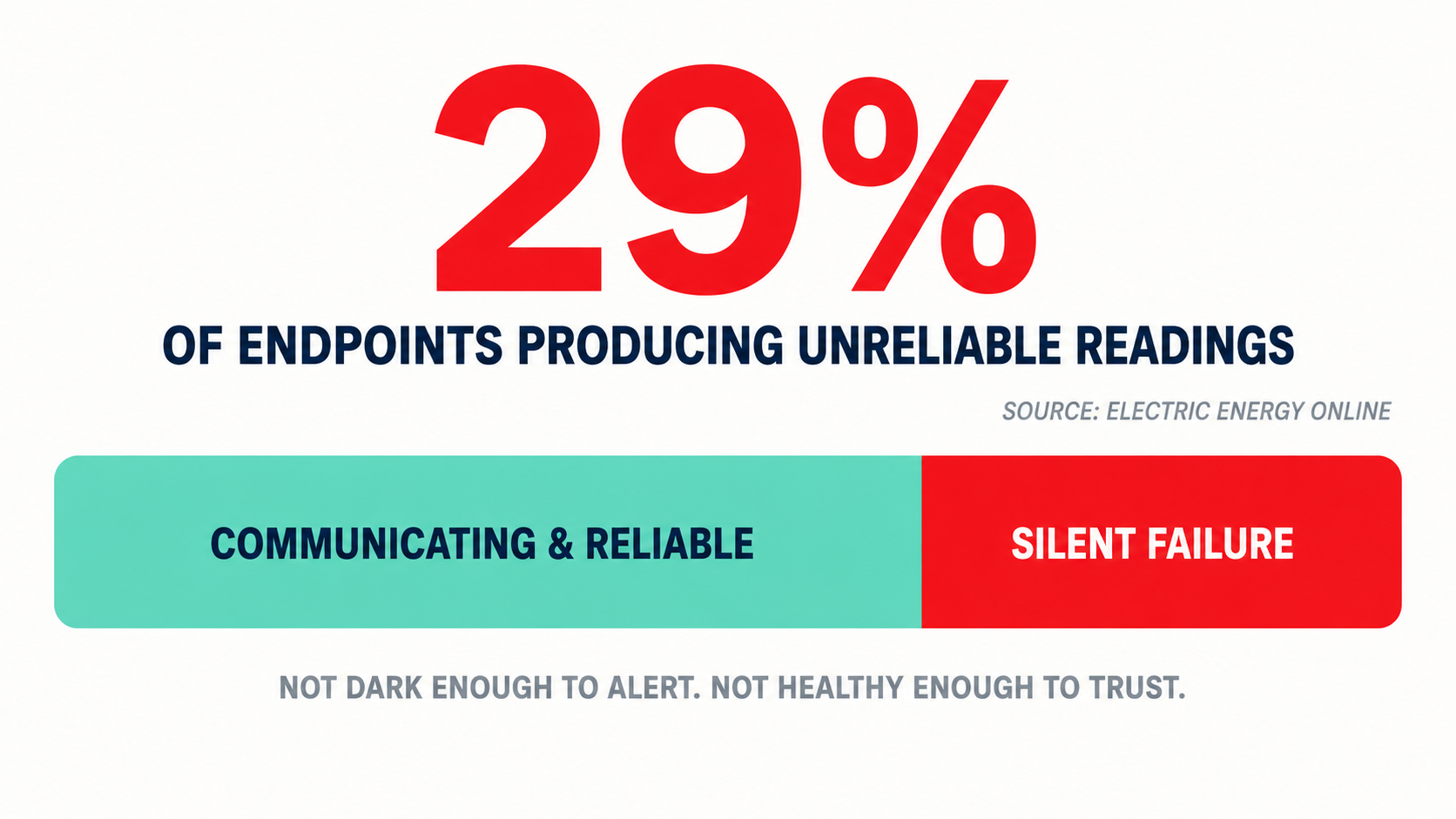
The harder problem doesn't generate an alert. Electric Energy Online has documented a 29% silent endpoint failure rate at some utilities: endpoints not dark enough to trigger communication alerts, but not healthy enough to produce reliable readings. Radio modules degraded. Flash memory corrupted. Batteries dropped below the brownout threshold for cold-weather transmission events.
The head-end saw them as communicating. The billing system processed their data. A substantial share of the fleet was producing readings that had drifted in the 2–8% variance range Toronto documented — and no operational flag ever fired.
Predictive analytics trained on pre-failure telemetry signatures — rather than on binary communicating/silent status — is the only mechanism for catching these endpoints before billing disputes and compliance audits surface them. The AMI head-end's MDM dashboard, segmented by battery-age cohort and RF signal quality trends, shows a very different picture of fleet health than the standard communication-status view.
Three Questions Before the Next Firmware Push
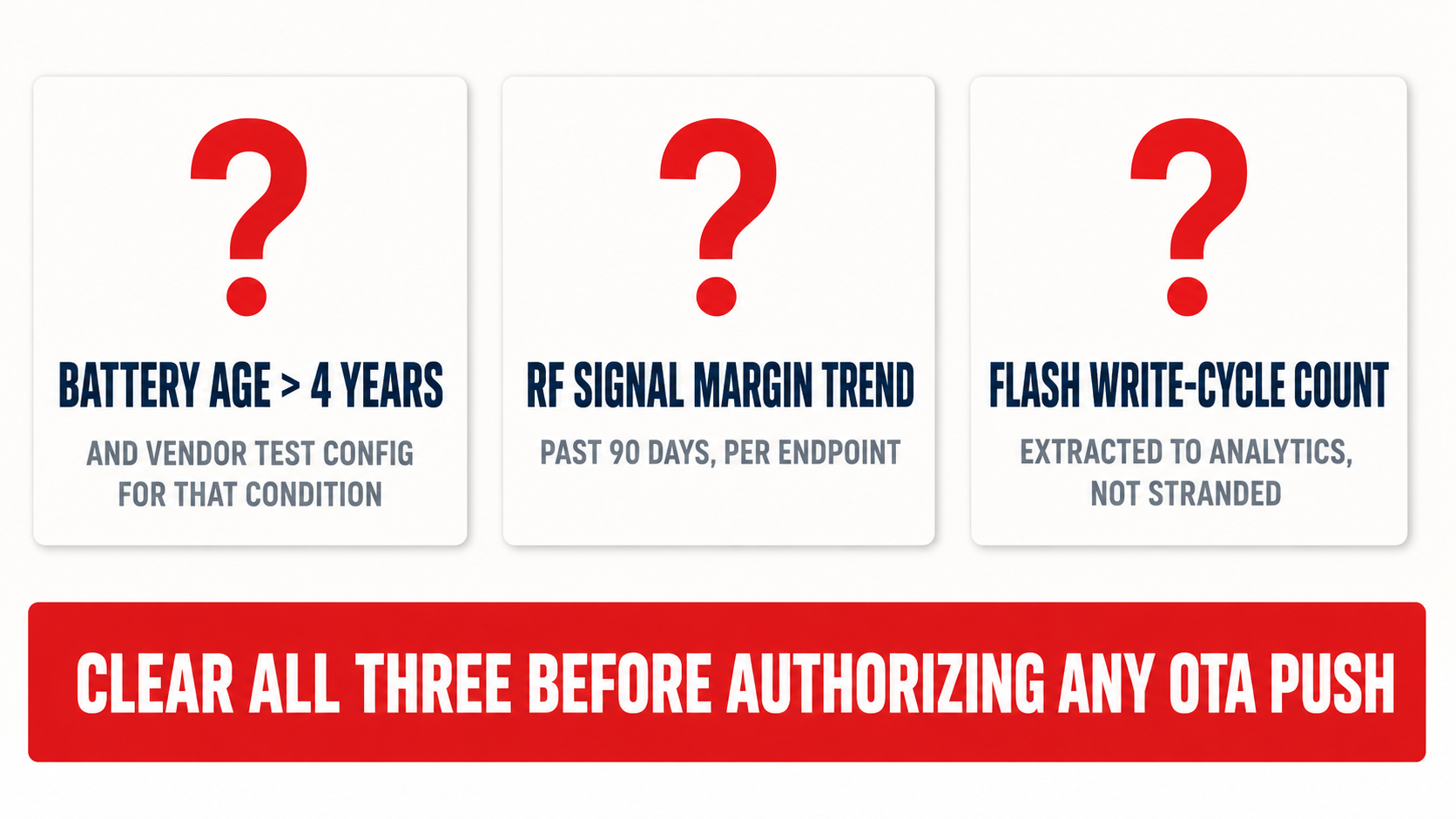
Before authorizing any OTA firmware update on a fleet with significant accumulated battery age, there are three questions worth having answered: What percentage of the deployed fleet has batteries older than four years, and what is the firmware vendor's documented test configuration for that battery condition? Is RF signal margin trending available by endpoint for the past 90 days? Is flash memory write-cycle count accessible from the head-end, or is it telemetry that has never been extracted into the analytics stack?
If the answers are uncertain, the Plano failure pattern is present in the fleet — not inevitably, but without the visibility to assess.
The full architecture for endpoint health scoring, firmware pre-deployment validation, and NERC CIP-003-9 compliance instrumentation is documented at Veriprajna's smart meter AI page. The vendors designing the next AMI generation — Itron, Landis+Gyr, Sensus — are building the intelligence layer for grid analytics and demand response. The meter health problem that caused the last three major incidents sits in the gap that intelligence layer was not designed to close. We are curious how many utilities have already run their own version of this diagnostic and what they found.