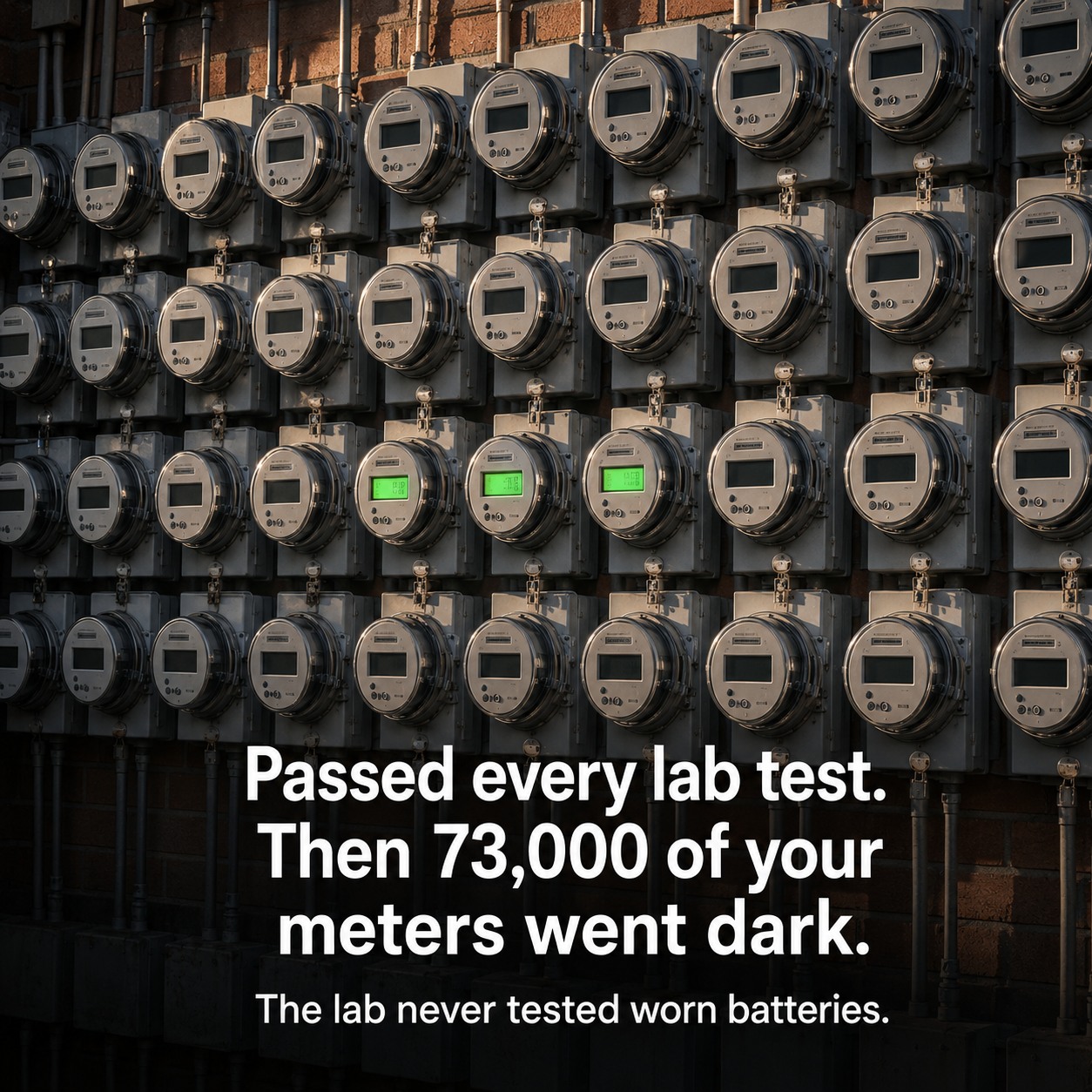
73,000 smart meters went dark from a single firmware update. The lab tested it. The field still broke.
Here's the part that should worry every utility running AMI at scale.
In Plano, TX, Aclara pushed a firmware update to 88,000 meters in November 2024. In the lab it worked perfectly. In the field, 73,000 went offline and never came back.
The root cause wasn't bad code. It was an untested assumption. The firmware was validated against meters with new batteries and strong RF signal. But 83% of the deployed fleet was running on 4-5 year old batteries at 60-75% capacity. The updated power routines drew slightly more current during the flash write — just enough to trip brownout protection on degraded cells. Transmission modules reset, lost network registration, and never came back.
The city hired 20 temporary meter readers. Cost: $765,000. Similar Aclara failures are documented in Minneapolis, Toronto, and New York City.
This is the gap nobody's watching: your MDMS tells you which meters stopped talking. It doesn't tell you which ones are about to. Our research found utilities where 29% of endpoints had failed silently — no alert, no flag, just gone. By the time a degraded endpoint stops talking, its NAND flash is often too worn to even accept a firmware fix — it has to be physically swapped at $650-$1,400 each. And NERC CIP-003-9 (effective April 2026) now tightens firmware OTA controls, with penalties up to $1M/day.
Predictive endpoint health scoring and pre-deployment firmware validation aren't features your AMI vendor ships. They're the missing layer between the head-end and the meter — and the reason Plano, Memphis, and Toronto are still paying for it (a combined $15.4M and counting) instead of getting ahead of it.
Save this before your next firmware push. What's your rollback plan if 80% of the fleet doesn't come back online?
#SmartMeters #AMIAnalytics #PredictiveMaintenance #UtilityAI #GridResilience