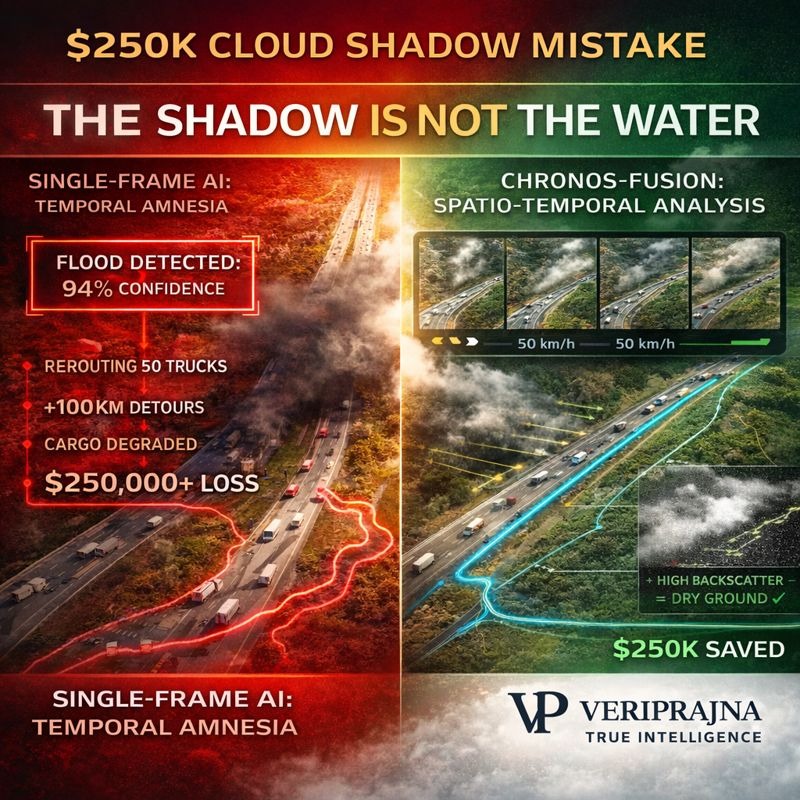
A flooded road that never existed cost an enterprise hundreds of thousands.
What if your AI can’t tell a shadow from a catastrophe?
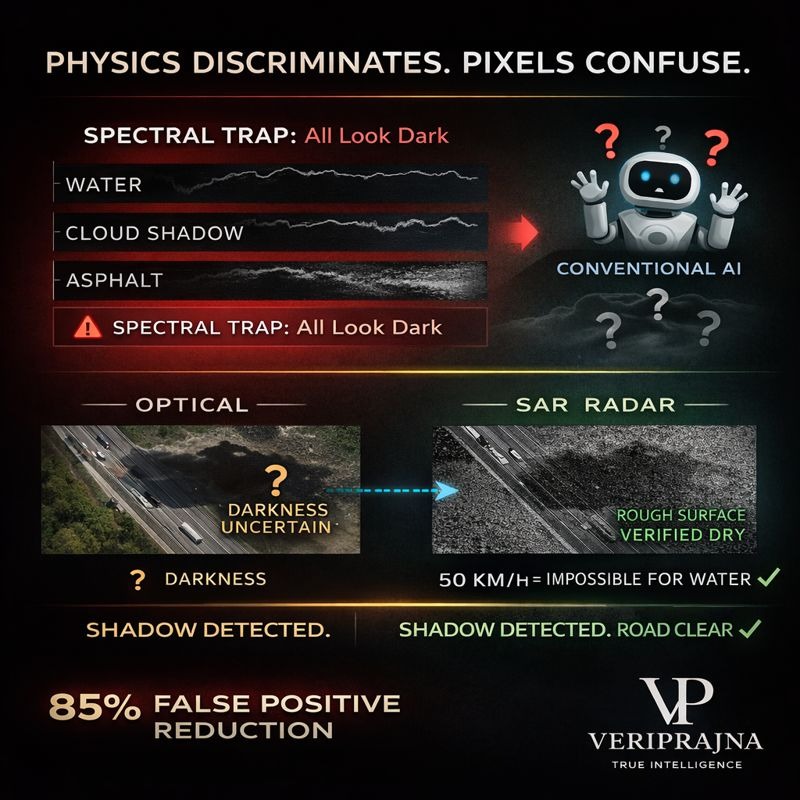
Most “AI-powered” flood intelligence systems still rely on single-frame inference—static snapshots that mistake cloud shadows for floodwaters. The result? Phantom alerts, rerouted supply chains, delayed deliveries, wasted fuel, broken SLAs, and eroded trust.
Our latest whitepaper exposes why this happens—and how to fix it.
Inside, we show how wrapper-based AI fails in the real world, and why Deep, Spatio-Temporal AI is now mission-critical for enterprises operating at scale. Drawing from real operational scenarios and rigorous benchmarks, the paper demonstrates how treating time as data and physics as a constraint changes everything.
📊 What the data proves:
• False flood alerts caused by cloud shadows can trigger cascading supply-chain losses and emergency resource misallocation
• Static optical models plateau at ~0.65 mIoU, while VeriPrajna’s spatio-temporal fusion exceeds 0.91 mIoU
• 85% reduction in shadow-driven false positives using Optical + SAR fusion
• 96% temporal consistency, eliminating “flickering” alerts that cause alert fatigue
• End-to-end inference on enterprise-scale regions in <45 seconds
This isn’t about detecting pixels.
It’s about understanding reality.
If your operations depend on flood intelligence—for logistics, insurance, disaster response, infrastructure resilience, or climate risk—this whitepaper lays out the architectural shift from detection to understanding.
👉 Read the full whitepaper (link in comments)
👉 Want to discuss how this applies to your enterprise systems?
📧 Email us at [email protected]
💬 Or WhatsApp +91 9217059957 to speak directly with our team
Because when AI decisions move trucks, trigger payouts, or deploy emergency crews—“good enough” is no longer good enough.
#DeepAI #EnterpriseAI #FloodIntelligence #ClimateTech #GeospatialAI