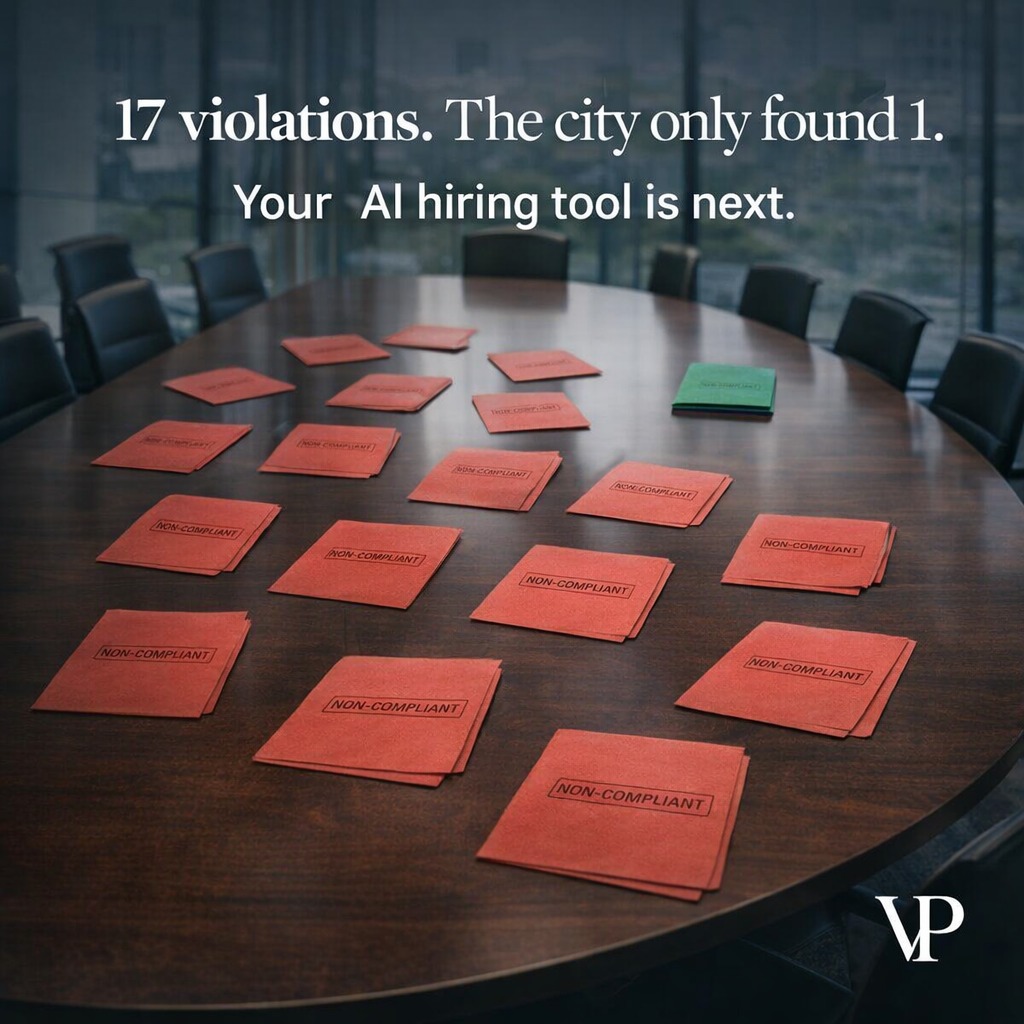
NYC auditors found 17 violations. The city's own review? Just 1.
That gap isn't a rounding error. It's a warning sign for every company using AI in hiring, lending, or risk assessment.
Here's what happened: the December 2025 audit of NYC's AI hiring law revealed that regulators missed the vast majority of non-compliance. 75% of consumer complaints never even reached the right agency. And out of 391 employers studied, roughly 95% hadn't met their legal obligations.
The takeaway isn't that regulation failed. It's that enforcement just got serious.
Colorado, Illinois, and the EU are all rolling out new AI accountability laws in 2026 — each with different standards for bias testing, data quality, and explainability. They conflict with each other. And none of them accept "the model said so" as an answer.
This is exactly why our team builds deterministic AI systems instead of thin API layers over general-purpose models.
The difference matters:
Probabilistic wrappers guess and generate plausible answers.
Deterministic systems measure and trace every decision to its source.
When a regulator asks why your tool flagged one candidate over another, you need a verifiable chain of logic — not a post-hoc narrative from a black box.
Our latest whitepaper breaks down the full regulatory landscape for 2026, the architectural failures that got us here, and what audit-ready AI actually looks like in practice.
Save this if you're navigating AI compliance across multiple jurisdictions 🔖
What's the biggest compliance gap you've seen in how companies deploy AI today?
#AICompliance #AlgorithmicAccountability #EnterpriseAI #ResponsibleAI #AIRegulation