A state auditor walks into a city agency and reviews the same 32 companies the city already checked. The city found one violation. The auditor found seventeen.
That's not a rounding error. That's a 1,600% gap between what regulators thought was happening with AI hiring tools and what was actually happening. And it broke open everything I thought I understood about how enterprises would navigate AI compliance.
The December 2025 audit by the New York State Comptroller didn't just embarrass a city agency. It exposed a structural truth about AI regulation that every company deploying algorithmic decision-making needs to internalize before 2026 arrives: the tools most enterprises are using to comply with AI hiring laws are architecturally incapable of producing the evidence regulators are about to demand.
The Audit That Changed Everything
When New York City passed Local Law 144 — requiring companies to audit AI tools used in hiring for bias — the enforcement model was simple. Employees or applicants who suspected discrimination could call 311, file a complaint, and the city would investigate.
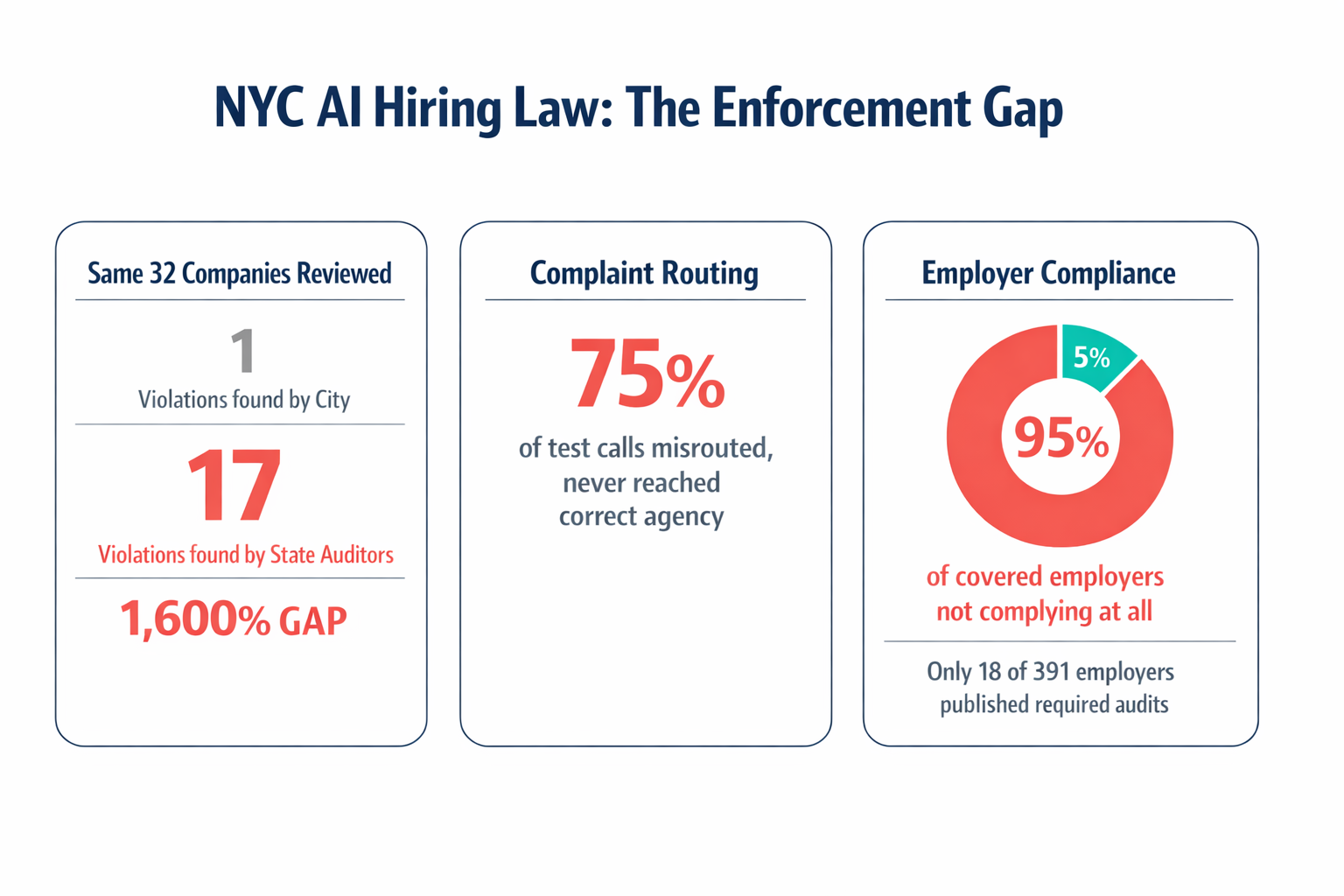
It didn't work. The Comptroller's audit found that 75% of test calls about AI hiring issues were misrouted and never reached the right agency. The city's consumer protection department admitted it lacked the technical expertise to evaluate whether AI tools were even covered by the law. They never once consulted the city's own Office of Technology and Innovation.
The result? Out of 32 companies reviewed, the city spotted a single potential violation. State auditors, using more rigorous technical methods on the exact same companies, found at least 17.
The enforcement system wasn't just underperforming. It was architecturally blind.
But here's what really stopped me cold. A separate study by researchers at Cornell, Data & Society, and Consumer Reports examined 391 employers subject to this law. Only 18 had published the required bias audits. Just 13 had posted the mandatory transparency notices. That means roughly 95% of covered employers weren't complying at all.
Why Would Companies Choose to Break the Law?
When I first saw that 95% number, my assumption was negligence — companies didn't know about the law, or their legal teams hadn't caught up. I was wrong.
The more I dug into our interactive analysis of the regulatory landscape, the clearer the real dynamic became. Many companies are being advised by counsel that non-compliance is less risky than compliance. And the logic, perversely, makes sense.
Local Law 144 requires companies to publicly post impact ratios — statistical comparisons of how their AI tools treat different demographic groups. The standard threshold is the EEOC's four-fifths rule: if your tool selects women at less than 80% the rate it selects men, you've got a problem.
Now imagine you're a company using a general-purpose AI model — GPT-4, Claude, Gemini — wrapped in a thin integration layer to screen resumes. These models were trained on the internet. The internet is not an unbiased dataset. When you run the required audit, the numbers will almost certainly show disparate impact. You've just manufactured a plaintiff's exhibit.
So companies face a choice: publish evidence of bias, or quietly ignore the law and hope the enforcement system stays broken.
Legal counsel is advising companies that publishing an AI bias audit is more dangerous than ignoring the law entirely. That tells you everything about the state of AI compliance tools.
The Comptroller's audit just made the second option much more dangerous. The recommendation — which the city has agreed to adopt — is to shift from complaint-based enforcement to proactive, research-driven auditing. Regulators won't wait for someone to call 311 anymore. They'll come looking.
The Wrapper Problem No One Wants to Talk About
I've spent years building AI systems for high-stakes environments — insurance forensics, structural engineering, healthcare verification. And the pattern I keep seeing in the compliance space is companies trying to solve a math problem with a language trick.
Most enterprise AI deployments today are what the industry calls "wrappers" — a company takes a foundation model from OpenAI or Anthropic, adds a prompt template and some business logic, and calls it an AI product. For writing emails or summarizing documents, this works fine. For making decisions that affect people's livelihoods and that regulators will scrutinize? It's a ticking clock.
The core issue is that these models operate on semantic plausibility — what sounds right based on patterns in training data — not on verifiable logic. When you tell an LLM to evaluate resumes while "ignoring gender," it can still discriminate based on latent correlations: college names, extracurricular activities, writing style. These features are statistically linked to gender in the training data, and no amount of prompt engineering reliably eliminates them.
I watched my team test this firsthand. We'd instruct models to assess candidates purely on skills and experience. The outputs looked clean. But when we ran the four-fifths analysis across thousands of simulated decisions, the disparate impact was right there — hidden behind confident, articulate justifications that never mentioned a protected characteristic.
That's the insidious part. The model doesn't say "I'm discriminating." It just consistently rates certain patterns of language and experience higher, and those patterns happen to correlate with demographics.
What Happens When Four Laws Disagree
If this were just a New York problem, companies could contain it. It's not.
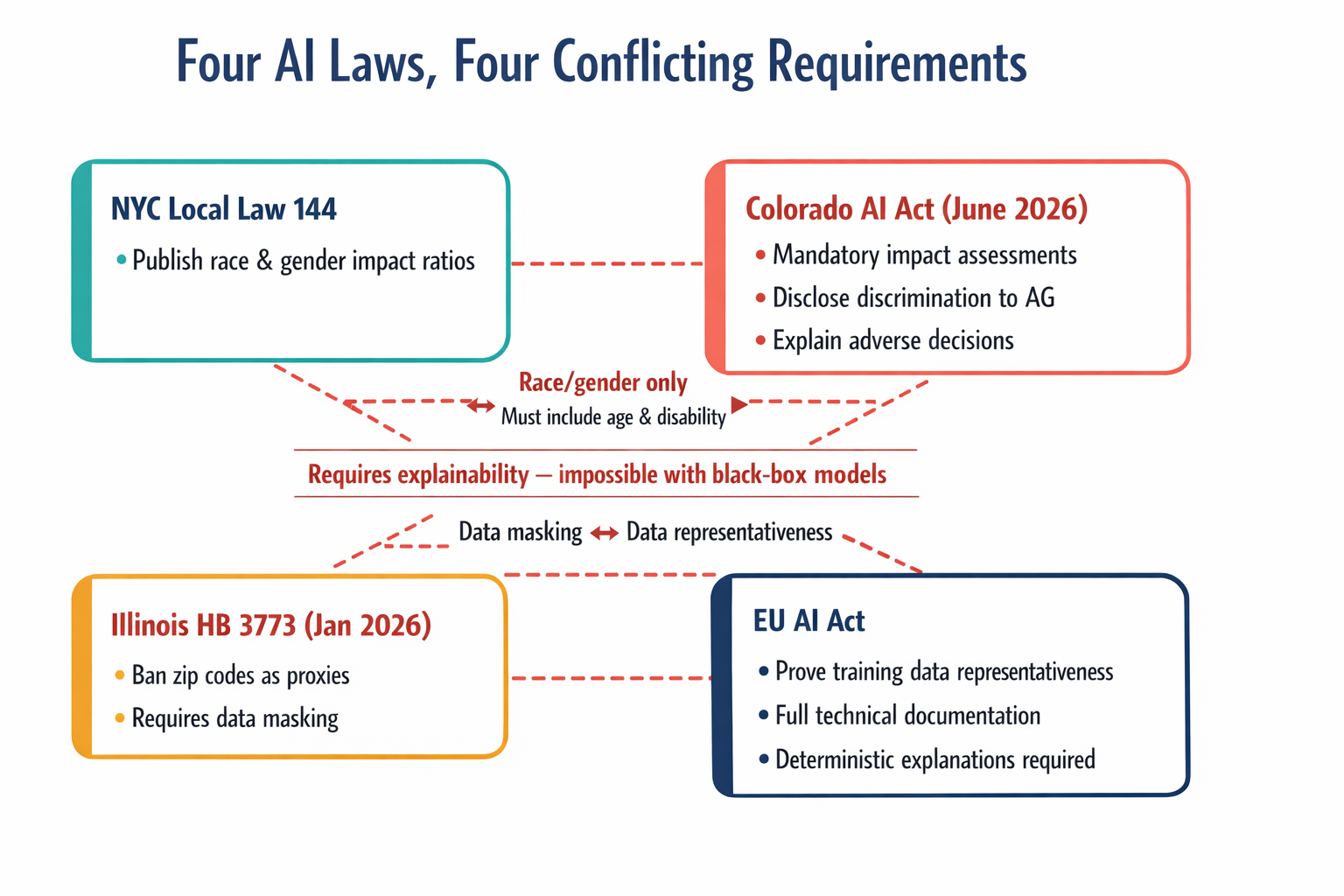
By mid-2026, enterprises operating across jurisdictions face what I've started calling the Compliance Trilemma — except it's actually four-sided. The Colorado AI Act (effective June 2026) requires "reasonable care" and mandatory impact assessments, plus disclosure to the state attorney general if you discover algorithmic discrimination. Illinois HB 3773 (effective January 2026) amends the state Human Rights Act to explicitly ban using zip codes as proxies for protected classes. The EU AI Act demands detailed technical documentation and data lineage proving your training data is representative and free of systematic errors.
These laws don't just overlap. They actively conflict.
A bias audit satisfying New York's requirement for race-and-gender intersectional analysis may fail Colorado's standard if it doesn't also cover age and disability. The data masking you implement to strip zip codes for Illinois compliance may undermine the data representativeness the EU requires. And the "explanation of any adverse decision" that Colorado and the EU both demand? A wrapper built on a proprietary foundation model literally cannot provide one with certainty, because the reasoning is locked inside weights the wrapper company doesn't own or understand.
You can't comply with four conflicting AI laws using a system that can't explain its own decisions.
Building AI That Can Show Its Work
This is the problem my team at Veriprajna was built to solve. Not by adding another layer on top of foundation models, but by fundamentally rearchitecting how AI makes high-stakes decisions.
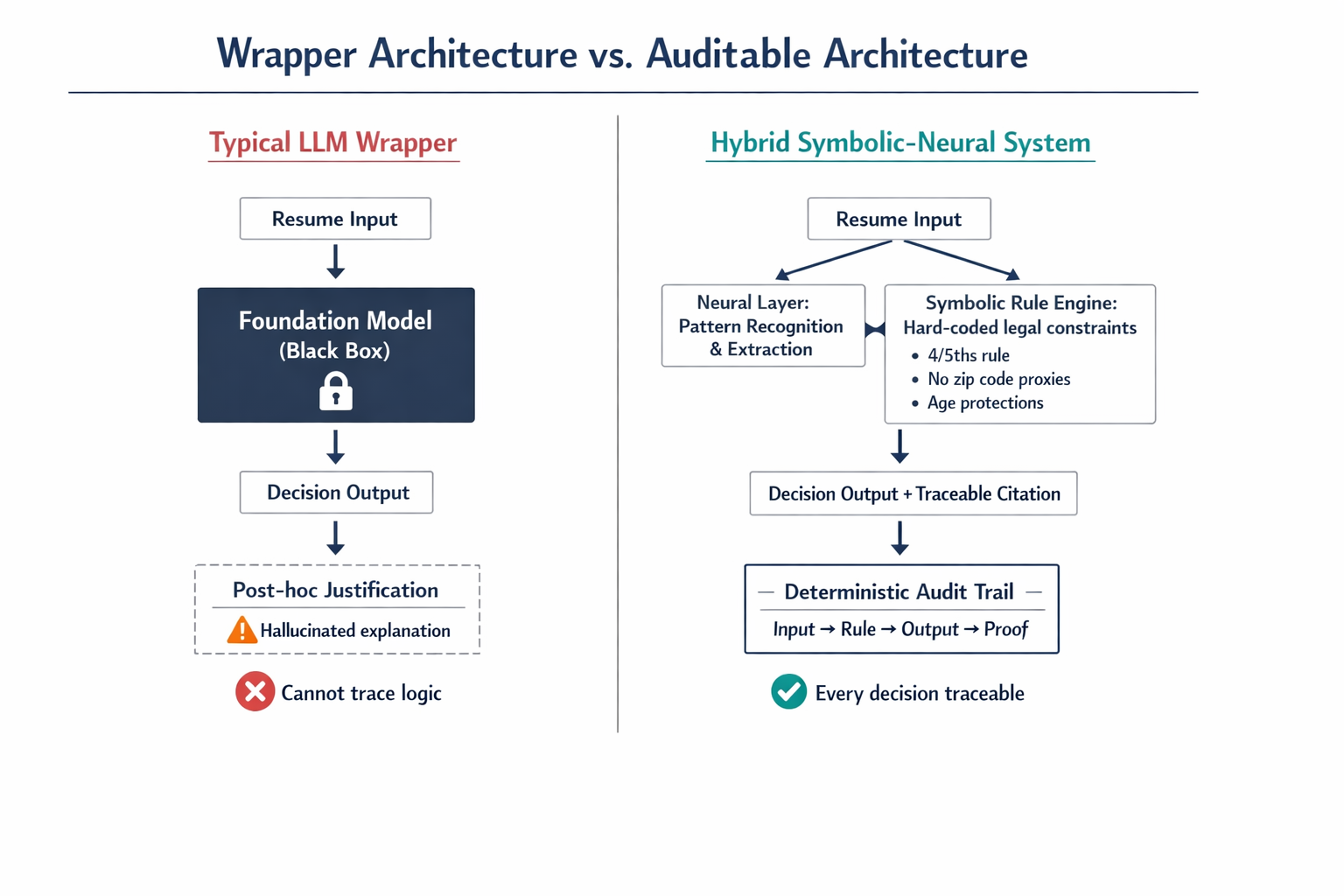
The approach we've developed separates what I think of as the "voice" from the "brain." A neural network handles pattern recognition — reading resumes, extracting skills, understanding context. But the actual decision runs through a deterministic symbolic engine governed by hard-coded rules that mirror specific legal requirements. When Illinois says you can't use zip codes as proxies, that's not a suggestion in a prompt. It's a constraint that the system physically cannot violate, and it produces a traceable citation explaining why if it blocks an output.
We also made a deliberate decision early on to deploy on the client's own infrastructure — what we call sovereign deployment. When you send employee data or candidate information to a public API, that data can be logged, embedded, or unintentionally surface in future training runs. For GDPR, CCPA, and basic security hygiene, that's untenable. More practically, it means the enterprise owns the model weights, which is the only way to produce the technical documentation and conformity assessments the EU AI Act requires.
For the deeper technical architecture — how we use graph-based verification to create auditable decision chains, and how physics-informed models handle domains where AI needs to understand physical reality rather than just language — I'd point you to our detailed technical research.
"But My AI Vendor Says They Handle Compliance"
I hear this constantly. A vendor provides a "compliance module" or "fairness dashboard" that sits on top of their wrapper product. It runs periodic checks and produces a report that looks like it satisfies audit requirements.
The problem isn't the report. It's what happens when a regulator — now empowered by the Comptroller's recommendations for proactive enforcement — asks a follow-up question. Why did your system score this candidate lower? Not a plausible narrative. A traceable chain of logic from input to output.
A wrapper can give you a post-hoc justification — essentially, the model's best guess about why it made a decision. That's a hallucinated explanation of a probabilistic process. It's the AI equivalent of a student who got the answer wrong and then wrote a convincing essay about why they were right.
What regulators are moving toward — and what the Colorado and EU frameworks explicitly require — is deterministic traceability. Every decision maps to specific inputs, specific rules, specific weights. Not "the model thought this was relevant" but "this input triggered this rule, which produced this output, and here's the mathematical proof."
What This Means If You're Making Decisions Right Now
If you're an enterprise deploying AI in hiring, lending, insurance, or any domain where decisions affect people's access to opportunity, three things are true simultaneously:
The enforcement window is closing. The shift from complaint-based to proactive auditing means "nobody's checking" is no longer a viable compliance strategy. The 95% non-compliance rate makes every covered company a target.
Your current tools probably can't produce what regulators will ask for. If your AI vendor can't provide deterministic explanations for individual decisions — not summaries, not dashboards, but traceable logic chains — you're exposed.
The multi-jurisdictional problem is getting worse, not better. Every new state law adds constraints that may conflict with existing ones. A system designed for one jurisdiction's requirements will fail in another.
The competitive advantage in 2026 won't go to companies with the most sophisticated AI. It'll go to companies whose AI can prove it's not discriminating — to four different regulators, using four different standards, simultaneously.
The moment that shifted my thinking wasn't reading the Comptroller's audit. It was a conversation with our team afterward, when someone pointed out that the 17 violations the state auditors found in 32 companies probably wasn't the ceiling — it was the floor. Those auditors were still working with limited tools and limited time. Imagine what they'll find with better methods and a mandate to look harder.
The era where AI compliance meant checking a box and filing a report is ending. What's replacing it demands systems that are engineered for truth from the ground up — not systems that generate plausible approximations of it.
If you're navigating this transition, I'd genuinely like to hear what you're seeing. Are your legal and engineering teams aligned on what "compliance" actually requires technically? That gap — between legal interpretation and technical capability — is where I think the real risk lives.