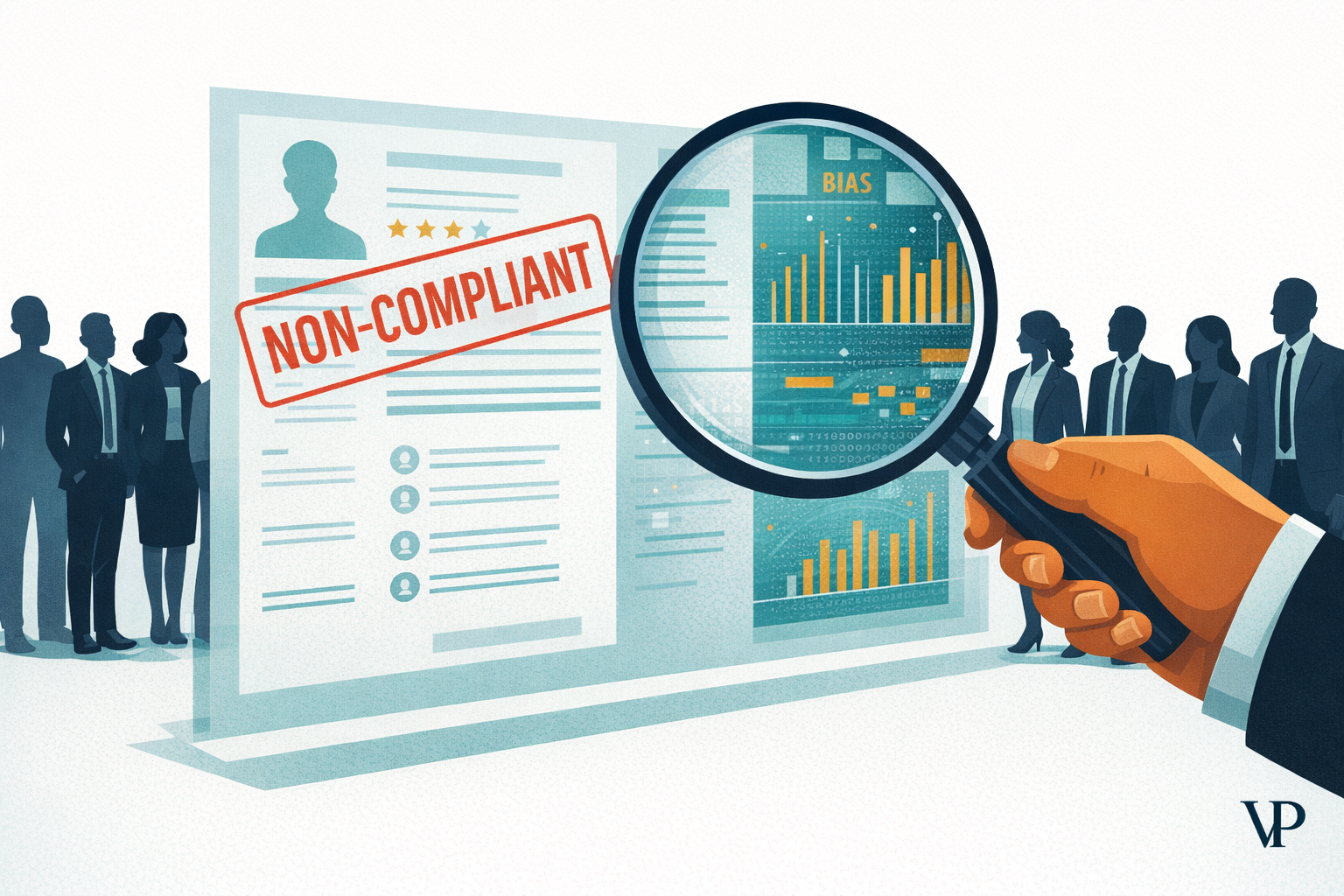
New York City thought it had AI hiring under control. Then state auditors checked the work — and found the city had missed 94% of the violations.
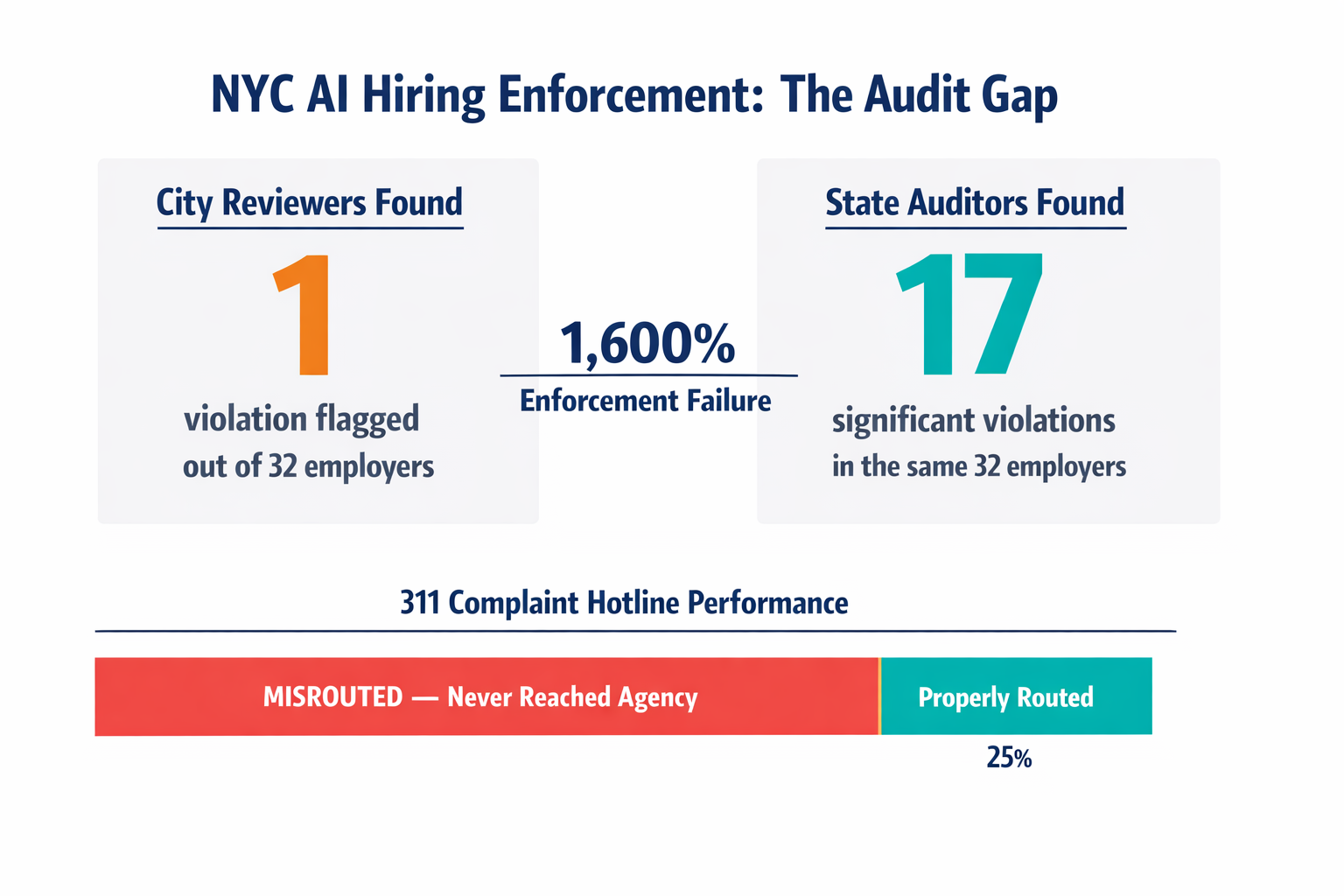
In December 2025, the New York State Comptroller audited how the city enforced Local Law 144, the landmark regulation governing AI tools used in hiring decisions. The city's own reviewers had flagged just one case of potential non-compliance across 32 employers. State auditors, using more rigorous methods, found at least 17 significant violations in the same group. That's a 1,600% enforcement failure rate. And it exposed something far bigger than one city's oversight problem: the AI systems most enterprises rely on for high-stakes decisions — thin software layers wrapped around general-purpose models like GPT-4 or Claude — are structurally incapable of meeting the compliance demands heading toward every major company in 2026.
We've spent the past year studying this collision between AI architecture and regulatory reality. The picture is worse than most executives realize — and the fix requires rethinking what enterprise AI actually is.
The Audit That Changed Everything
The Comptroller's audit didn't just find missed violations. It uncovered a system that was broken at every level.
Auditors discovered that 75% of test calls to the city's 311 hotline about AI hiring concerns were misrouted and never reached the enforcement agency. The city's Department of Consumer and Worker Protection (DCWP) admitted its staff lacked the technical expertise to evaluate whether an AI tool was actually influencing hiring decisions. They never once consulted the city's own Office of Technology and Innovation.
A regulation that relies on consumer complaints to trigger enforcement is only as good as the phone system that takes those complaints. New York's was failing three out of four times.
The practical result: companies could claim their AI tools were just "assisting" human decisions — not driving them — and no one had the expertise to push back. That era of self-classification is ending. The Comptroller's office has recommended a shift to proactive, research-driven enforcement, and the DCWP has agreed to adopt it.
For enterprises, this means regulators won't wait for someone to complain. They'll come looking.
Why 95% of Companies Aren't Complying
The enforcement gap in New York City isn't an isolated bureaucratic failure. It reflects a much deeper problem across the private sector.
A study by researchers at Cornell University, Data & Society, and Consumer Reports examined 391 employers subject to the city's AI hiring law. The findings were stark: only 18 had published the legally required bias audits, and just 13 had posted transparency notices. That's roughly 95% non-compliance.
This isn't simple negligence. It's a rational — if risky — calculation. The law requires companies to publicly post impact ratios that compare how their AI tools select candidates across different demographic groups. If those ratios fall below the EEOC's four-fifths threshold (meaning one group is selected at less than 80% the rate of another), the company has essentially published evidence of discrimination.
And here's the structural problem: most AI hiring tools built on general-purpose language models will produce exactly that evidence. These models were trained on historical data that reflects decades of hiring bias. When you run a bias audit on their outputs, the bias shows up in the numbers. We explored this dynamic in depth in our interactive analysis of regulatory truth and algorithmic accountability.
Legal counsel is advising some companies that non-compliance with the law is less risky than publishing the statistical evidence of bias their own AI generates.
That calculation only works in a world of passive enforcement. In a world of proactive auditing, it becomes a ticking clock.
Why Wrapper AI Can't Fix This
The term "wrapper" describes the dominant architecture in enterprise AI today: a company takes a powerful general-purpose model from OpenAI, Anthropic, or Google, adds a thin layer of custom instructions on top, and deploys it for hiring, claims processing, or risk assessment.
This works well for drafting emails. It fails catastrophically for regulated decisions, and the reason is fundamental to how these models work.
A large language model predicts the next most likely word in a sequence. It operates on what sounds plausible, not what is legally or factually correct. When you tell it to evaluate a resume "without considering gender," it doesn't actually remove gender from its analysis. It still picks up on signals that correlate with gender in its training data — the name of a college, participation in certain activities, even writing style. The bias doesn't disappear. It goes underground.
Attempts to fix this through better prompts or safety instructions are inherently fragile. Our research on AI in architecture and engineering found that language models exhibit what we call "exotic bias" — they favor outcomes that appear frequently in their training data, even when those outcomes are contextually wrong. In hiring, this means the model gravitates toward candidates whose resumes resemble the tech-heavy content it was trained on, regardless of what the actual job requires.
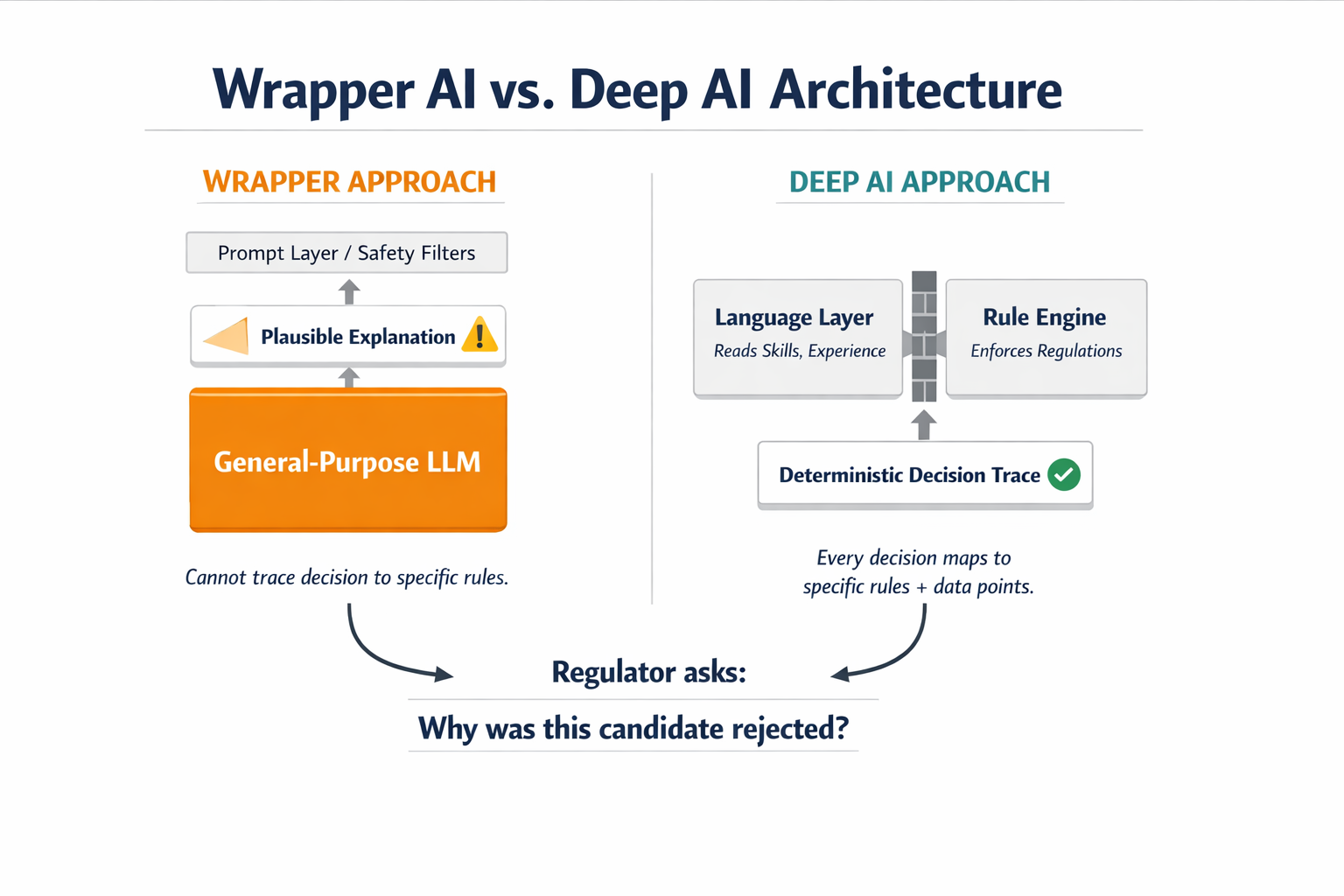
The deeper problem is auditability. When a regulator asks why a candidate was rejected, a wrapper system can only offer a plausible-sounding explanation after the fact. It cannot trace the decision back to specific rules, weights, or data points. It's the difference between a system that can explain itself and one that can only narrate a story about itself.
The Compliance Trilemma Hitting in 2026
If this were only a New York City problem, enterprises could treat it as a regional nuisance. It's not.
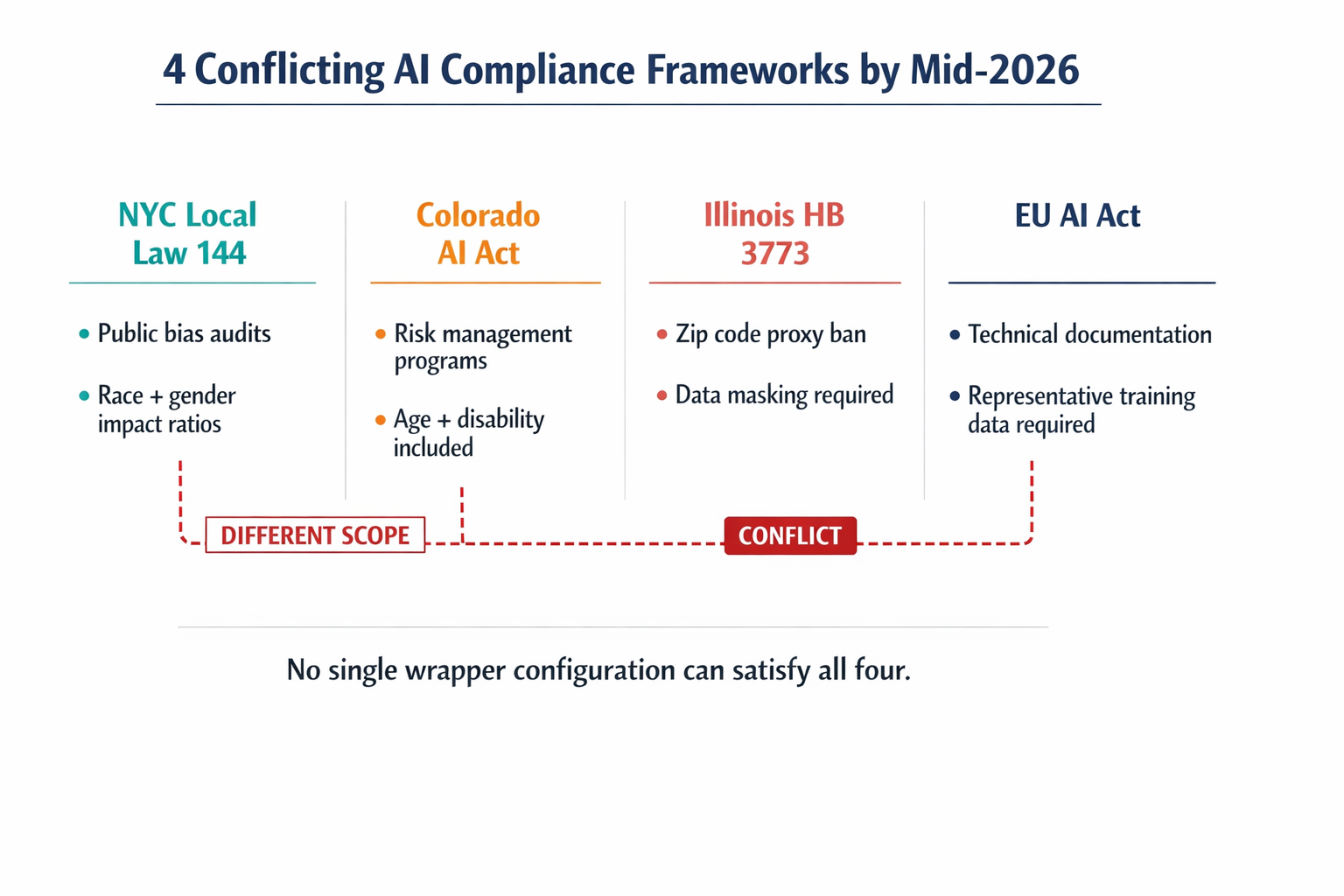
By mid-2026, companies operating across multiple jurisdictions will face at least four conflicting AI compliance frameworks simultaneously:
NYC Local Law 144 requires public posting of bias impact ratios broken down by race and gender intersections
Colorado's AI Act (SB 24-205), effective June 2026, mandates risk management programs and requires companies to disclose "algorithmic discrimination" to the state Attorney General
Illinois HB 3773, effective January 2026, bans the use of zip codes as proxies for protected classes — a common shortcut in AI screening
The EU AI Act requires detailed technical documentation, proof of training data quality, and formal conformity assessments for high-risk systems
These laws don't just overlap. They actively conflict. A bias audit satisfying New York's race-and-gender requirements may fail Colorado's standard if it doesn't also address age and disability. The data masking techniques needed to comply with Illinois's zip code ban may undermine the EU's requirement that training data be "representative."
No single wrapper configuration can satisfy four jurisdictions with divergent definitions of fairness, different required metrics, and conflicting data handling rules.
A general-purpose model with a prompt layer on top has no mechanism for navigating these conflicts. It doesn't know which jurisdiction's rules apply. It can't switch between metric frameworks. It certainly can't prove to four different regulators that it handled each of their requirements correctly.
What "Deep AI" Actually Means for Compliance
Solving this requires a different kind of AI architecture — one we describe as "Deep AI" in contrast to the wrapper approach. The distinction isn't marketing. It's structural.
The core idea is separating the language capability from the decision logic. Think of it as giving the system two brains: one that understands human language and patterns, and another that enforces hard rules with zero flexibility.
When our system processes a job application, the language layer identifies skills, experience, and qualifications. But the decision layer — built on symbolic logic and explicit business rules — enforces every applicable regulation. If Illinois law prohibits using zip codes as a proxy for race, the rule engine blocks that data from influencing the outcome. Not through a polite instruction to the model, but through an architectural wall that cannot be talked around.
This matters for auditability in a way that wrapper systems simply cannot match. Every decision traces back to specific rules, specific data points, and specific logical steps. When a regulator asks why a candidate was scored a certain way, the system doesn't generate an explanation. It produces the actual chain of reasoning, with citations to the applicable law.
We also advocate for what we call sovereign infrastructure — running these systems on the enterprise's own servers rather than sending sensitive data to third-party APIs. When you route employee records or candidate information through a public API, that data can be logged, embedded in future training runs, or exposed in ways that violate GDPR, CCPA, and internal security policies. Owning the infrastructure means owning the audit trail. For the full technical methodology behind this architecture, see our detailed research on deterministic AI for regulatory compliance.
But Can Deterministic Systems Handle Real-World Complexity?
A fair objection. Hard-coded rules sound brittle. What happens when the law changes, or when a new jurisdiction adds requirements?
This is precisely why the architecture separates the rule engine from the language engine. Updating a rule — say, adding disability as a protected category to satisfy Colorado's broader standard — means updating a single node in the system's logic graph. It doesn't require retraining the model, re-engineering prompts, or hoping the language model "remembers" the new instruction.
Another reasonable concern: doesn't this approach sacrifice the flexibility that makes AI useful in the first place? It does sacrifice one specific kind of flexibility — the freedom to generate plausible-sounding outputs that might be wrong. For drafting marketing copy, that tradeoff doesn't make sense. For deciding who gets a job, a loan, or an insurance payout, it's the only tradeoff that does.
What Should Enterprises Do Now?
The December 2025 audit marks the end of a grace period. Proactive enforcement is coming, multi-jurisdictional conflicts are already here, and the 95% non-compliance rate means regulators have an enormous target-rich environment. Four steps matter most:
Build an AI inventory. Most enterprises don't have a complete picture of where AI influences decisions. Every tool — from resume screeners to claims processors — needs to be cataloged, classified by risk level, and mapped to applicable regulations.
Stress-test your bias audits. If your current system produces impact ratios that would fail the four-fifths rule, you need to know now, not when a regulator publishes the results. Run the analysis internally before someone runs it for you.
Evaluate your architecture honestly. If your AI vendor's compliance strategy depends on prompt engineering or safety filters layered on top of a general-purpose model, ask them one question: can you produce a deterministic trace of every decision? If the answer involves the word "approximately," you have a wrapper, not a solution.
Plan for jurisdictional conflict. A system that satisfies one law but violates another isn't compliant — it's a liability in a different zip code. Your architecture needs to handle multiple regulatory frameworks simultaneously, not sequentially.
The competitive advantage in 2026 won't go to companies with the most sophisticated AI. It will go to companies whose AI can prove it followed the rules.
The era of deploying AI and hoping no one checks is over. The question isn't whether your systems will be audited. It's whether they'll survive the audit when it comes.
We'd welcome hearing how your organization is navigating these challenges — especially if you're operating across multiple jurisdictions with conflicting requirements. The solutions will come from shared experience, not from any single vendor.