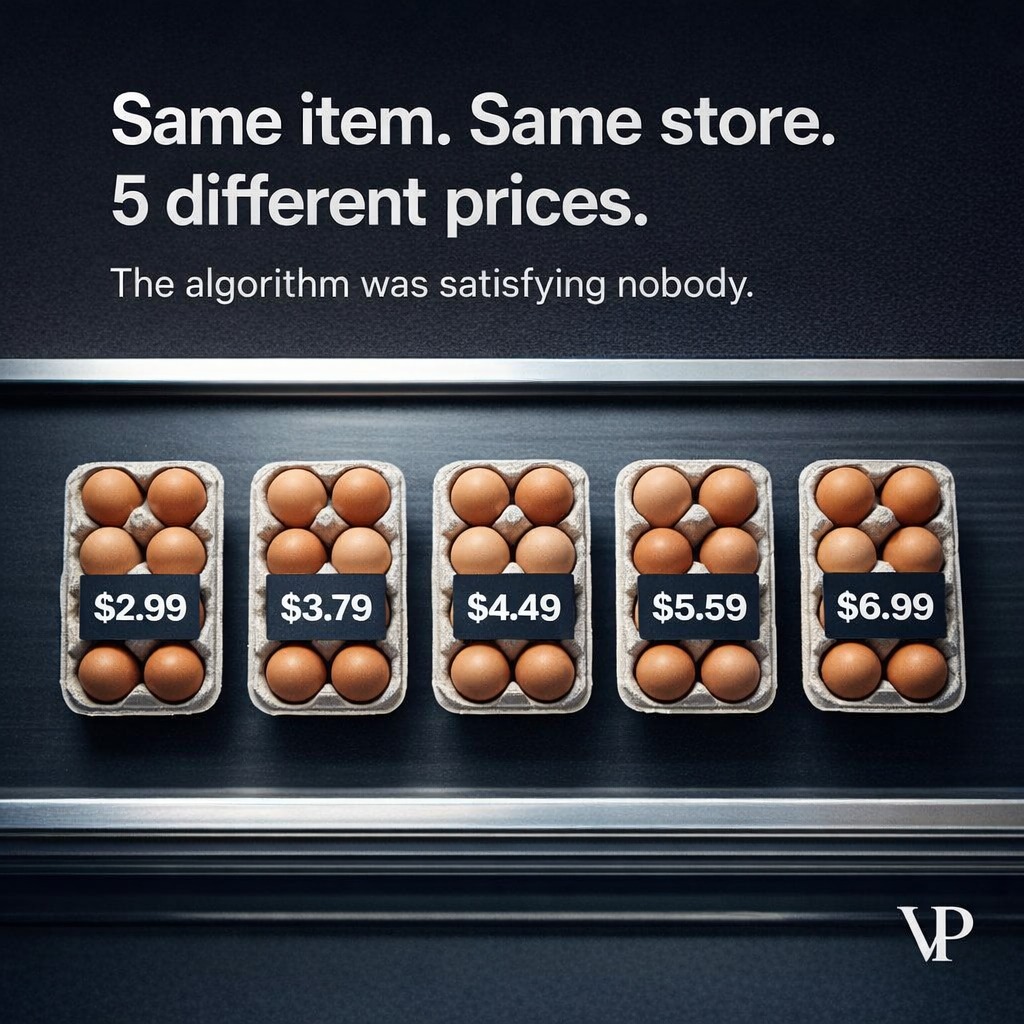
Same item. Same store. Different price — depending on who's buying.
That's not a glitch. That's what happens when AI pricing runs without guardrails.
The Instacart pricing collapse ended in a $60M FTC settlement. Their algorithm was charging different users different prices for identical groceries — up to 23% more on the same product.
The root cause wasn't greed. It was architecture.
Most enterprise AI today runs on probabilistic models. They predict patterns. They optimize metrics. But they don't reason about rules, fairness, or law.
That's the difference between pattern matching and actual intelligence.
Our latest whitepaper breaks down:
→ How multi-armed bandit algorithms crossed from dynamic pricing into illegal discrimination
→ Why New York now requires real-time disclosure when algorithms use your personal data to set prices
→ The shift from "black box" optimization to deterministic, auditable AI systems
→ How neuro-symbolic architecture builds compliance into the decision layer — not as an afterthought
The era of "deploy fast, explain later" is over. New federal and state regulations now mandate impact assessments, audit trails, and mathematical proof of fairness.
Companies still running thin software layers on top of non-deterministic models aren't just taking technical risks. They're taking legal ones.
We built our approach around a simple principle: every algorithmic decision should be explainable, verifiable, and compliant before it reaches a single customer.
Save this if you're thinking about AI governance for 2026 📌
What's the bigger risk for enterprises right now — moving too fast with AI, or not moving at all?
#AlgorithmicPricing #AIGovernance #DeterministicAI #NeuroSymbolicAI #EnterpriseTech