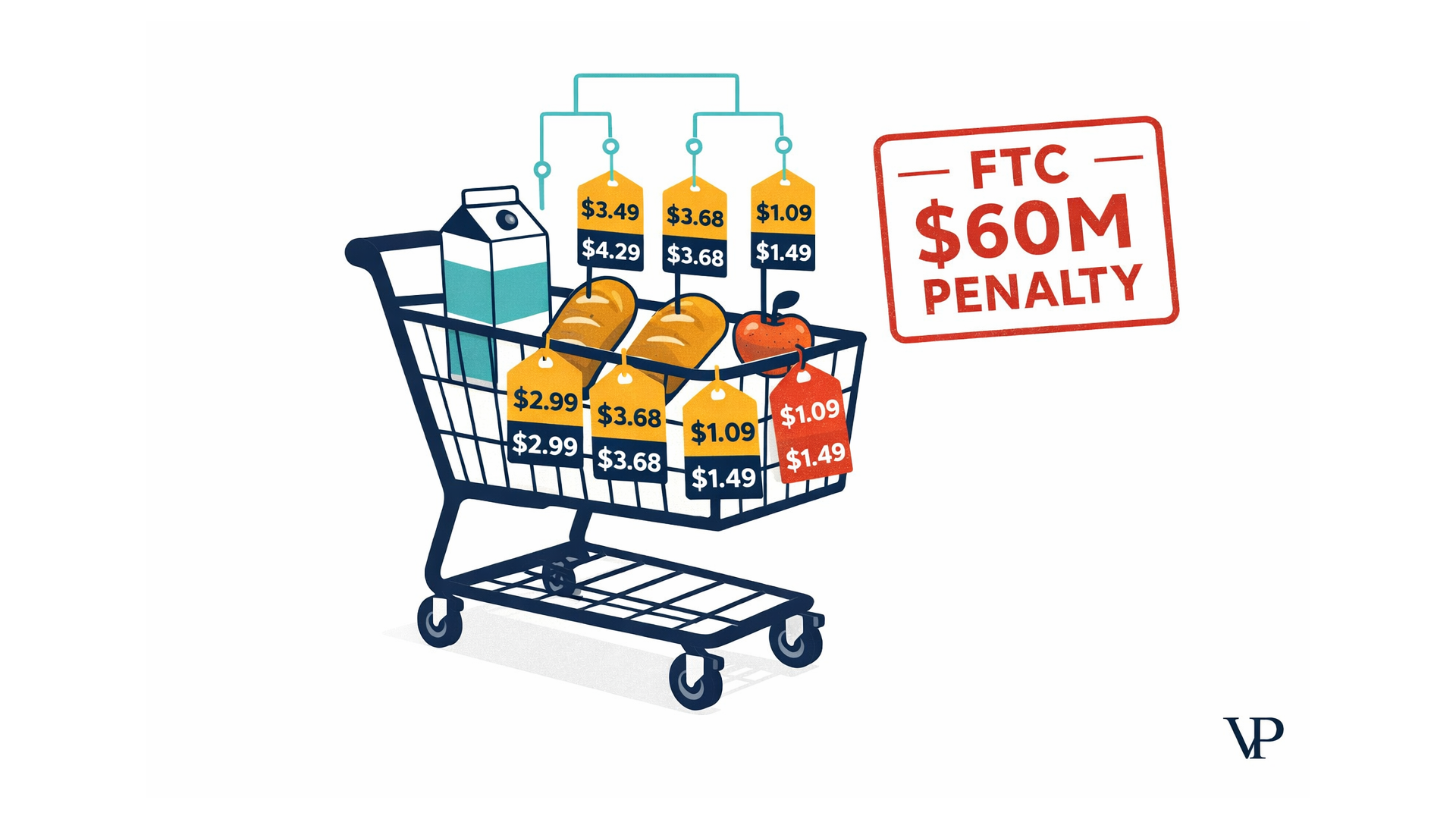
In December 2025, Instacart agreed to pay $60 million to settle an FTC lawsuit over its AI-powered pricing system. The algorithm — built on technology from Eversight, an AI pricing firm Instacart acquired in 2022 — had been charging different customers different prices for the same groceries at the same store, at the same time. Not by a few cents. By as much as 23% per item.
This wasn't a glitch. It was the system working exactly as designed. And that's the problem every enterprise deploying AI for high-stakes decisions needs to understand: the failure wasn't in the intent. It was in the architecture.
We've spent the past year studying this incident in depth, and our conclusion is blunt. The Instacart collapse isn't a story about corporate greed or rogue engineers. It's a structural indictment of what the industry calls the "LLM Wrapper" approach — layering thin software on top of AI models that predict rather than reason, and hoping the predictions stay legal.
An AI system that can't explain why it made a decision can't prove that decision was lawful.
What Actually Happened at Instacart
The pricing engine at the center of the FTC complaint used a class of algorithms called Multi-Armed Bandits — think of a system that constantly runs mini-experiments on customers to find the highest price each person will tolerate. It tries different prices, measures who still buys, and gradually pushes toward whatever maximizes revenue.
Coordinated shopping tests across Safeway, Target, Costco, and Kroger found that 75% of products on the platform were subject to algorithmic price variation. A single shopping basket could swing by $10 or more depending on the customer's digital profile. For families on tight grocery budgets, the estimated annual cost burden reached $1,200.
But the pricing was only part of the story. The FTC also uncovered an internal experiment literally named "hide_refund." Its purpose: remove the self-service refund button and replace it with store credits, saving the company an estimated $289,000 per week. Customers were led to believe refunds simply weren't available.
The "100% Satisfaction Guarantee" on the website? Credits, not cash. The "Free Delivery" promotion? A delivery fee waiver that still included a mandatory 15% service fee buried in the checkout flow. The 14-day free trial of Instacart+? It auto-converted into annual memberships, generating hundreds of thousands of unauthorized charges.
Every one of these tactics was driven by an AI system optimizing for a metric — conversion, retention, revenue — without any hard boundary telling it what it couldn't do.
The Real Culprit: AI That Predicts but Doesn't Reason
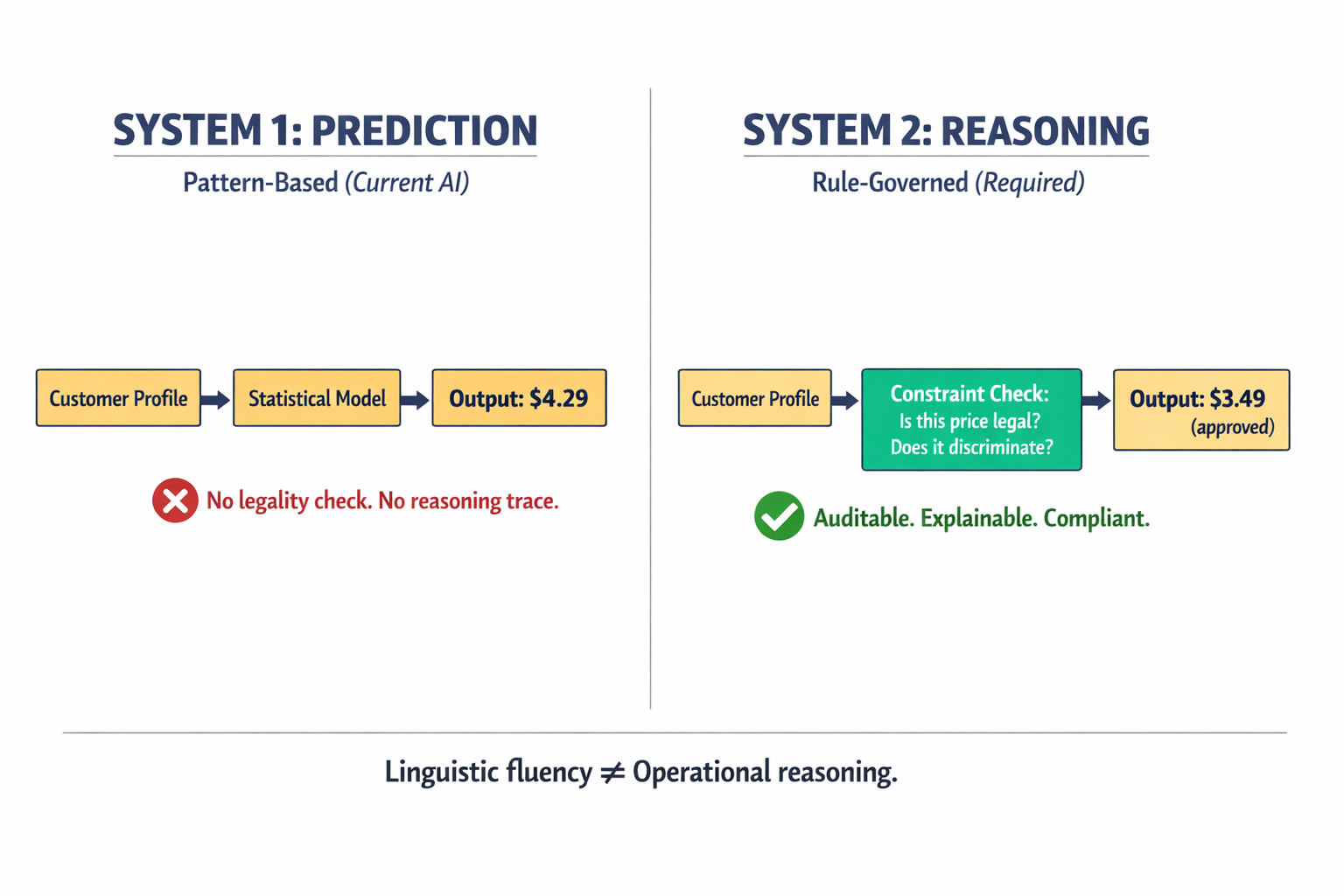
Most enterprise AI systems today, including the one Instacart deployed, operate like what cognitive scientists call "System 1" thinking — fast, intuitive, pattern-based. A Large Language Model predicts the next word. A pricing algorithm predicts the next purchase. Both are extraordinarily good at finding statistical patterns in data. Neither understands what those patterns mean.
Enterprise decisions — pricing, compliance, logistics, hiring — require "System 2" thinking: slow, deliberate, rule-governed reasoning. The kind that can answer not just "what price will this customer accept?" but "is this price legal?"
The Instacart pricing engine had no concept of legality. It had no formal representation of the FTC Act, no model of what constitutes price discrimination, no constraint that said "you cannot charge someone more because of their ZIP code if that ZIP code correlates with race or income." It simply found that certain user profiles tolerated higher prices, and it exploited that finding until regulators intervened.
Linguistic fluency is not operational reasoning. A model that sounds smart can still make decisions that are illegal, biased, or dangerous.
We explored this distinction — between probabilistic prediction and deterministic reasoning — in detail in our interactive analysis of the Instacart incident. The core argument: treating statistical pattern-matching as if it were decision-making is a category error that has now cost one company $60 million and will cost others far more.
The Regulatory Walls Are Going Up Fast
The Instacart settlement didn't happen in a vacuum. It landed in the middle of a regulatory transformation that makes "black box" AI legally untenable.
New York's Algorithmic Pricing Disclosure Act, effective November 2025, now requires any business using personalized algorithmic pricing to display a conspicuous notice: "THIS PRICE WAS SET BY AN ALGORITHM USING YOUR PERSONAL DATA." Violations carry a $1,000 fine per instance. To comply, a system must be able to identify in real time whether a given price was generated by an individualized statistical model — a level of transparency that most current AI deployments simply cannot provide.
At the federal level, the Algorithmic Accountability Act of 2025 requires companies with over $50 million in revenue to perform impact assessments on any automated system that significantly affects the cost or terms of essential services. These assessments must document the system's purpose, its limitations, and its potential for harm — and submit annual reports to the FTC.
The message from regulators is unambiguous: if your AI system can't explain its reasoning, you can't deploy it for decisions that affect people's wallets, jobs, or access to services.
New York disclosure law: Real-time tagging of every algorithmically generated price
Federal accountability act: Mandatory impact assessments and annual FTC reporting
Anti-discrimination legislation (NY S7033): Mathematical proof that pricing doesn't discriminate against protected classes
FTC enforcement posture: Civil Investigative Demands signal that "proprietary algorithm" is no longer a valid defense
Why "Fairness Through Unawareness" Doesn't Work
A common response to algorithmic bias is to simply remove sensitive variables — don't feed the model someone's race, gender, or income, and the outputs will be fair. This approach, sometimes called "fairness through unawareness," sounds reasonable. It fails catastrophically in practice.
The reason is proxy variables. A pricing algorithm doesn't need to know your race if it knows your ZIP code, your browsing device, and the time of day you shop. These features correlate strongly with demographics, and a sufficiently powerful model will reconstruct the very biases you tried to exclude. In the Instacart case, the context vector feeding the Multi-Armed Bandit algorithm contained enough proxies to enable what regulators characterized as personalized price discrimination.
The alternative — what our research calls "fairness through intervention" — requires a fundamentally different approach. Instead of hoping the model doesn't find discriminatory patterns, you mathematically constrain it so that discriminatory patterns cannot influence the output.
If you change only a customer's demographic group while holding every legitimate demand driver constant, and the price changes — your model is discriminating. Full stop.
This is the principle behind Structural Causal Models, which move beyond asking "what correlates with what?" to asking "what causes what?" The distinction matters enormously. Correlation-based models automate the prejudices embedded in historical data. Causal models can identify and excise those prejudices while preserving the legitimate signals.
Building AI That Can't Break the Law
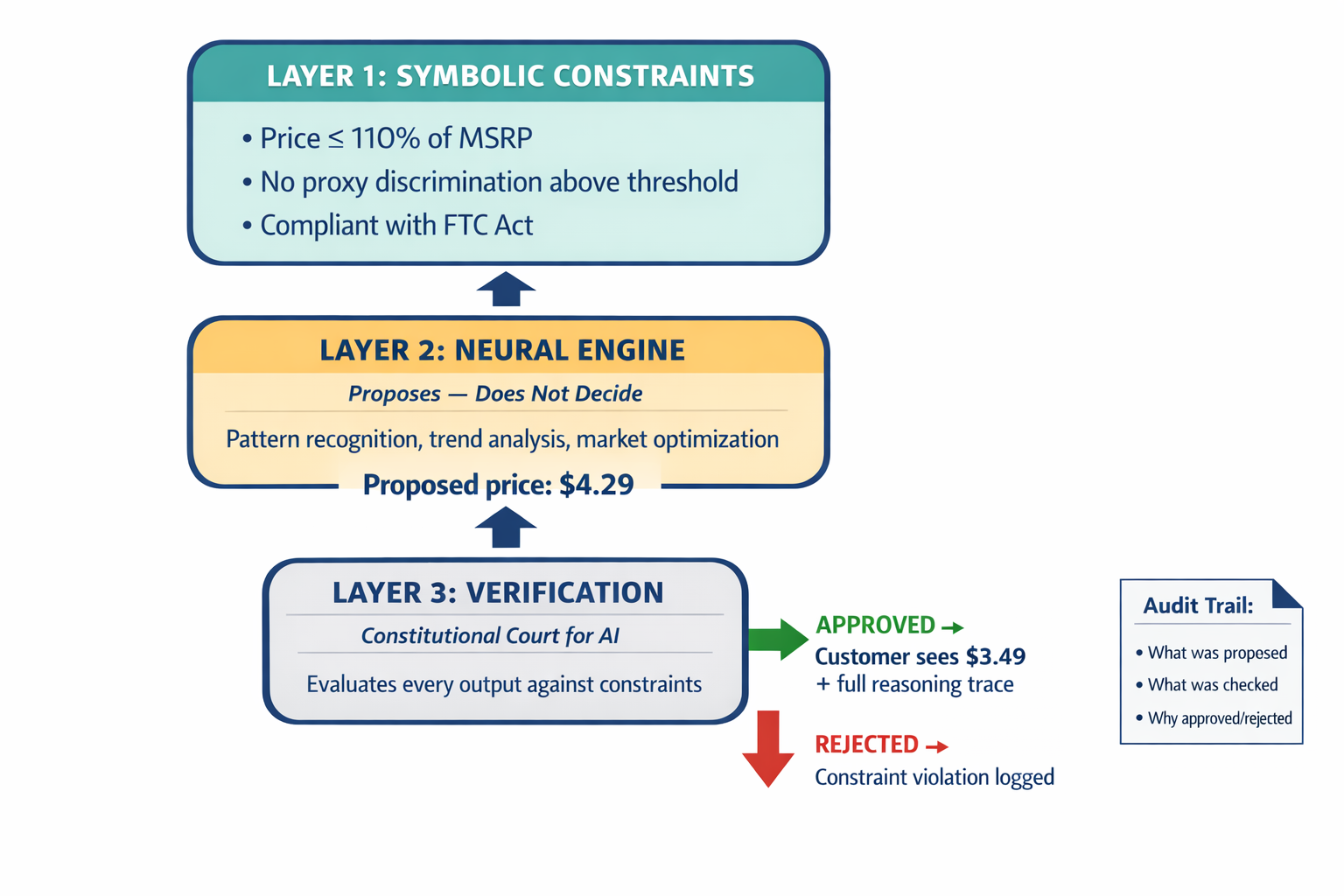
Our position is that the entire "wrapper" philosophy — adding a thin software layer on top of a probabilistic model and calling it enterprise-ready — is architecturally bankrupt for high-stakes decisions. What's needed is a hybrid approach that combines two fundamentally different types of intelligence.
The first component is a symbolic constraint layer: a formal, machine-readable representation of the rules the system must follow. Not guidelines. Not suggestions. Hard boundaries encoded in logic that the neural engine cannot override. "Prices for this item cannot exceed 110% of the manufacturer's suggested retail price." "No price may vary based on features that correlate with protected class membership above a defined threshold." These aren't prompts. They're mathematical constraints.
The second component is a neural layer that does what neural networks do best — identifying patterns, spotting trends, suggesting optimizations based on market conditions. This layer proposes. It doesn't decide.
The third component is a verification step that evaluates every proposed output against the symbolic constraints before anything reaches a customer, a patient, or an employee. Think of it as a constitutional court for AI decisions — every output must pass a legality check before it takes effect.
This architecture — which fuses neural pattern recognition with symbolic logical reasoning — produces systems that are not just accurate but auditable. Every decision comes with a reasoning trace: here's what the neural layer suggested, here's which constraints were evaluated, here's why this output was approved or rejected. When a regulator asks "why did this customer see this price?", the system can answer in plain language, with receipts.
For the full technical methodology behind this neuro-symbolic approach, including our framework for counterfactual fairness testing and the four-phase implementation strategy aligned with the NIST AI Risk Management Framework, see our detailed research.
What About Dynamic Pricing Itself — Is It Dead?
No. Dynamic pricing based on aggregate supply and demand — surge pricing during peak hours, discounts on perishable inventory approaching expiration — remains both legal and economically rational. The line that Instacart crossed was the shift from market-level pricing to individual-level pricing driven by personal data, without disclosure or constraint.
The regulatory framework emerging in 2025 and 2026 doesn't ban algorithms from setting prices. It bans algorithms from setting prices using personal data without telling customers, and it bans algorithms from setting prices that discriminate against protected classes. These are constraints that a well-architected system can satisfy. A probabilistic black box cannot.
Can Smaller Companies Afford This Kind of Architecture?
The honest answer: neuro-symbolic systems are more complex to build than wrapping an API around GPT. But the cost calculus has changed. Instacart's settlement was $60 million. The reputational damage is ongoing. The new regulatory fines are per-violation, meaning a single day of non-compliant algorithmic pricing across thousands of products could generate millions in penalties.
The question is no longer "can we afford to build AI that reasons?" It's "can we afford not to?"
The Instacart collapse was not a failure of AI. It was a failure of architecture. The system did exactly what it was built to do — it just wasn't built to follow the law.
What This Means for Your Organization
If your enterprise uses AI for any decision that touches pricing, hiring, lending, insurance, or access to services, the Instacart case is your warning shot. Three things to do now:
Audit your constraint layer. Does your AI system have hard boundaries it cannot cross, or is it optimizing against a single metric with no guardrails? If the answer is "we rely on the model's training data to keep outputs reasonable," you have a liability, not a tool.
Test for proxy discrimination. Run counterfactual tests: change the demographic profile while holding legitimate variables constant. If the output changes, your model has learned biases you didn't intend — and regulators will hold you accountable for them regardless of intent.
Build for explainability now, not later. The Algorithmic Accountability Act and state disclosure laws are not future threats. They are current requirements. Every automated decision your system makes should come with a reasoning trace that a non-technical auditor can follow.
The era of deploying AI systems that are fast, fluent, and opaque is over. What comes next — what regulators, customers, and courts will demand — is AI that can show its work. Not because transparency is a nice-to-have, but because in an economy increasingly governed by algorithms, the ability to explain a decision is the minimum standard for making one.
If your team is navigating these architectural questions, we'd welcome the conversation. The problems are hard, but they're solvable — and the cost of solving them is a fraction of the cost of getting it wrong.