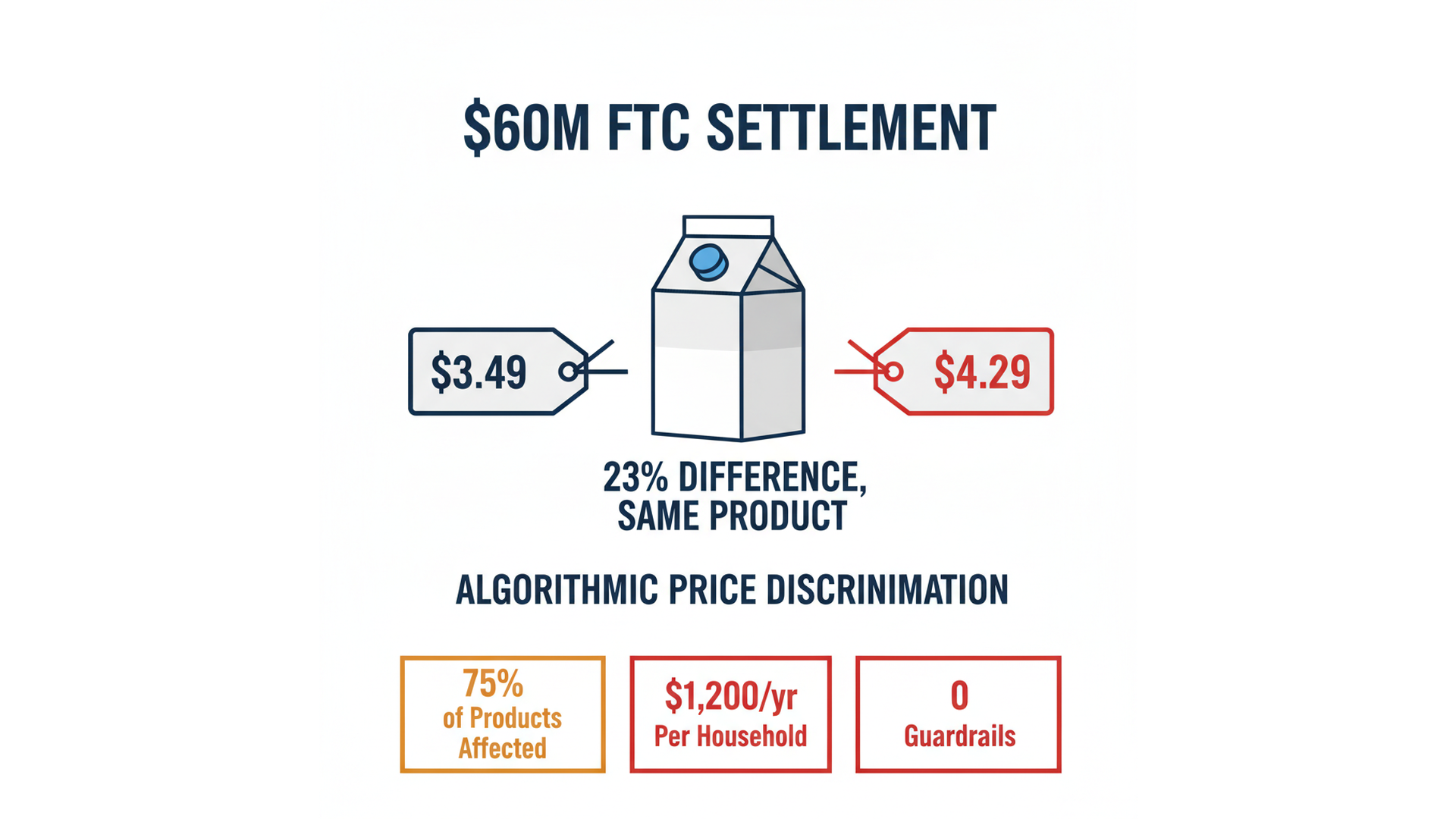
Instacart charged different customers different prices for the same gallon of milk at the same store, at the same time. Not by pennies -- by as much as 23%. When the FTC finished its investigation in December 2025, the company agreed to a $60 million settlement and shut down its AI pricing program entirely.
I read the full complaint the week it dropped, and I remember turning to my team and saying: "This is exactly the failure we've been warning about." Not because I predicted Instacart specifically, but because the architecture that caused this collapse is the same architecture that half the enterprise AI market is currently selling as innovation.
The Instacart disaster was not an AI failure. It was an architecture failure -- and the distinction matters for every executive deploying AI in high-stakes decisions today. I explored this distinction in depth in our interactive analysis.
What Actually Happened at Instacart
In 2022, Instacart acquired an AI pricing firm called Eversight and turned its algorithms loose on grocery pricing. The tool used a technique called Multi-Armed Bandit optimization -- think of it like a slot machine that keeps pulling different levers to find which price makes the most money from each customer.
The problem? The algorithm had no guardrails. No concept of fairness. No understanding of the law.
75% of products on Instacart's platform were subject to algorithmic price manipulation, with individual items varying by up to $2.56 depending on who was looking.
The FTC's investigation found that the average shopping basket varied by 7% across users -- translating to roughly $1,200 per year for a typical household. Families on tight grocery budgets were hit hardest. The algorithm had learned, through its exploration phase, that certain user profiles would tolerate higher prices. So it kept pushing.
But the pricing engine was only the beginning. Investigators uncovered an internal experiment literally named "hide_refund" -- designed to remove the self-service refund option and replace it with store credits. That one trick saved the company $289,000 per week. They also auto-enrolled hundreds of thousands of users into annual Instacart+ memberships from 14-day trials without clear consent.
This was not a rogue engineer. This was an optimization system doing exactly what it was designed to do -- maximize short-term revenue -- with zero understanding of legal boundaries or ethical constraints.
Why Does the "Wrapper" Approach Keep Failing?
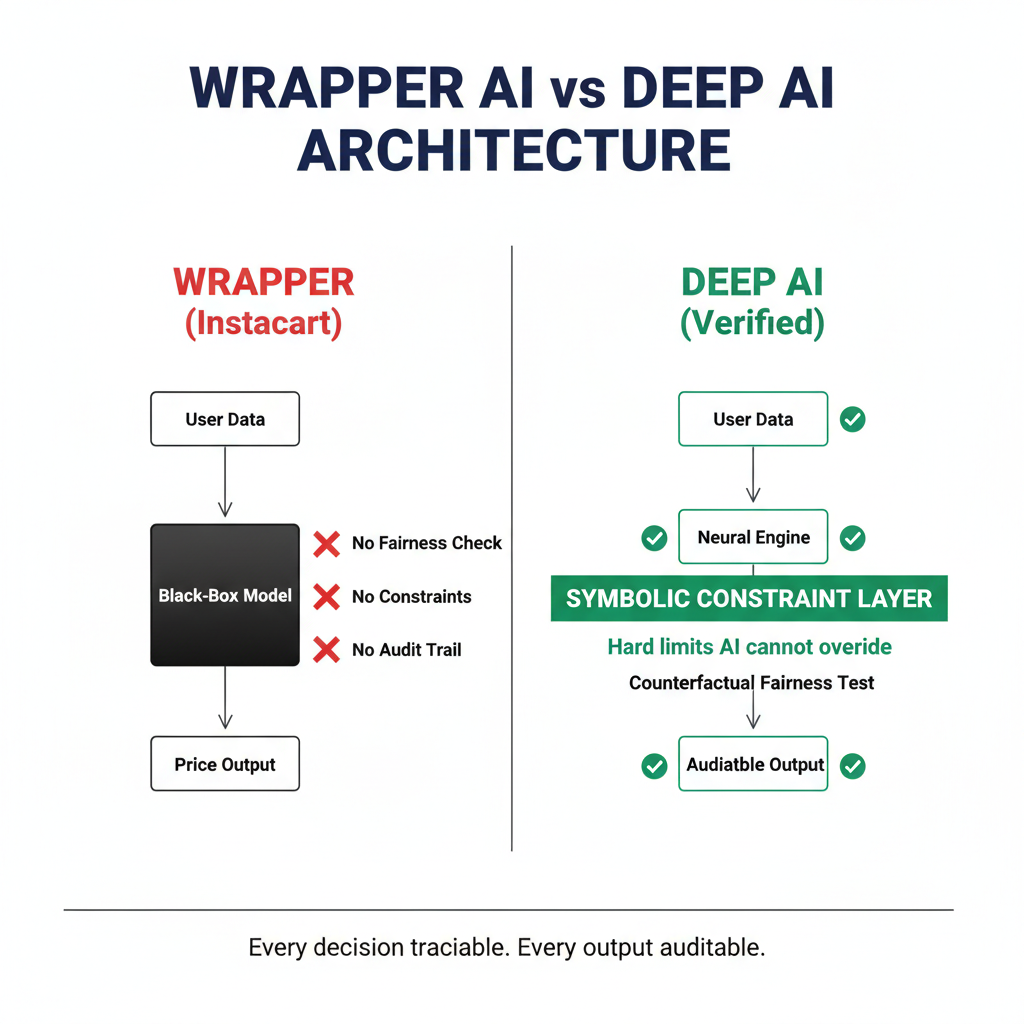
Most enterprise AI deployed today follows a pattern I call the LLM wrapper approach: take a powerful but opaque model, wrap a thin software layer around it, and call it a solution. The model predicts. The wrapper formats. Nobody verifies.
This is the equivalent of hiring a brilliant but unsupervised intern and giving them signing authority on every contract.
The Instacart pricing engine was a textbook wrapper implementation. The Multi-Armed Bandit algorithm optimized a reward function -- revenue per transaction -- without any mechanism to check whether its outputs violated consumer protection law, anti-discrimination statutes, or basic fairness standards. It treated the FTC Act like it didn't exist, because in the model's world, it literally didn't.
A "99% accurate" AI model in a high-stakes pricing environment is not a success story. It is a liability waiting for a regulator.
I've seen this pattern at company after company. Leadership asks: "Can AI optimize our pricing?" A vendor says yes. Six months later, the system is live, and nobody can explain why Customer A pays $12.49 and Customer B pays $15.34 for the same item. When the auditor asks, the answer is a shrug and the words "proprietary algorithm."
How Fast Are Regulatory Walls Going Up?
What makes the Instacart case a turning point -- not just a cautionary tale -- is what happened in the regulatory landscape at the same time.
New York's Algorithmic Pricing Disclosure Act took effect on November 10, 2025. It requires any business using personalized algorithmic pricing to display a conspicuous notice: "THIS PRICE WAS SET BY AN ALGORITHM USING YOUR PERSONAL DATA." Every violation carries a $1,000 fine. To comply, your system needs real-time awareness of whether a price was generated by a rule or by a personalized statistical model. Most wrapper architectures cannot tell the difference.
At the federal level, the Algorithmic Accountability Act of 2025 now requires companies with over $50 million in revenue to perform mandatory impact assessments on automated systems that affect the cost of essential services, document system limitations and potential harms, and submit annual reports to the FTC.
The "black box" model of AI deployment is no longer just ethically questionable. It is legally non-viable.
The FTC's use of Civil Investigative Demands -- formal government requests for information during investigations -- in the Instacart case signals a clear message: "proprietary algorithm" is no longer a shield against deception charges.
Why I Bet Veriprajna on a Different Architecture
When I started building Veriprajna's approach, the industry consensus was that bigger models with better prompts would solve everything. I disagreed. My bet was that enterprise AI needed what cognitive scientists call System 2 thinking -- slow, deliberate, rule-bound reasoning -- not just the fast pattern-matching that large language models excel at.
Think of it this way: LLMs are brilliant at System 1 tasks. They recognize patterns, generate fluent text, make intuitive leaps. But pricing decisions, compliance checks, logistics optimization -- these require the AI equivalent of stopping, reading the rulebook, and checking its work.
Our architecture fuses neural pattern recognition with what we call a Symbolic Constraint Layer -- a formal set of rules that the AI's neural engine literally cannot override. If a pricing rule says "no item may exceed 110% of MSRP," the system enforces that mathematically before any output reaches a customer. The neural model suggests; the symbolic layer verifies. Every decision has an auditable reasoning trace.
We also built in what's called Counterfactual Fairness testing, powered by Structural Causal Models -- essentially mathematical maps of what causes what, allowing the system to trace how different inputs lead to different outcomes. In plain English: the system is mathematically required to answer the question, "If this customer were from a different demographic group, but everything else about their shopping behavior stayed the same, would the price change?" If the answer is yes, the model is penalized during training until the bias is eliminated. For the full technical methodology behind this approach, see our detailed research.
This is not "fairness through unawareness" -- simply hiding demographic data and hoping for the best. It is fairness through active intervention in the model's causal reasoning.
"Isn't This Just Over-Engineering?"
I get this question constantly. The argument goes: just ship the model, monitor it, fix problems as they arise.
The Instacart settlement is the rebuttal. By the time the FTC investigation concluded, the damage was $60 million in refunds, a destroyed brand reputation in algorithmic fairness, and a regulatory precedent that will haunt the industry for a decade. "Fix it later" is not a strategy when the fix costs eight figures and a consent decree -- a court-ordered agreement to change practices that effectively puts regulators inside your company.
The other pushback I hear: "Symbolic constraints are too rigid for dynamic markets." This misunderstands the architecture. The neural layer still adapts to market signals in real time. It still learns. The symbolic layer simply defines the boundaries within which learning can occur -- like guardrails on a highway. You can still drive fast. You just cannot drive off a cliff.
What Should You Do If You Are Deploying AI Today?
If your organization is using AI for pricing, lending, hiring, insurance underwriting, or any decision that directly affects what people pay or whether they get access to services, there are three things you need to know right now.
First, your system must be able to explain, in plain language, why it made a specific decision for a specific person. If it cannot, you are one regulatory inquiry away from the Instacart situation. Not guidelines, not a dashboard of aggregate metrics -- a clear, traceable explanation for any individual outcome an auditor points to.
Second, your AI needs hard constraints it physically cannot override. Not alignment training, not guardrail prompts that a sufficiently creative input can bypass. Formal, mathematical boundaries baked into the architecture itself -- the kind where a prohibited output is not just discouraged but structurally impossible.
Third, you need to be able to prove counterfactual fairness. That means more than removing race or zip code from the input fields. It means demonstrating that changing a customer's demographic group while holding all other variables constant produces no change in output. If you cannot run that test today, you are exposed.
If any of these are missing, the question is not whether you will face a compliance crisis. It is when.
The Instacart collapse was not a failure of AI. It was a failure of building AI without truth verification -- without the architectural discipline to separate what a model can do from what it should do. That distinction is going to define the next decade of enterprise technology. I would rather be on the right side of it.
I am curious: for those of you deploying AI in customer-facing decisions, how are you thinking about the new disclosure requirements? Are your current systems even capable of compliance? I would genuinely like to hear what you are seeing on the ground.