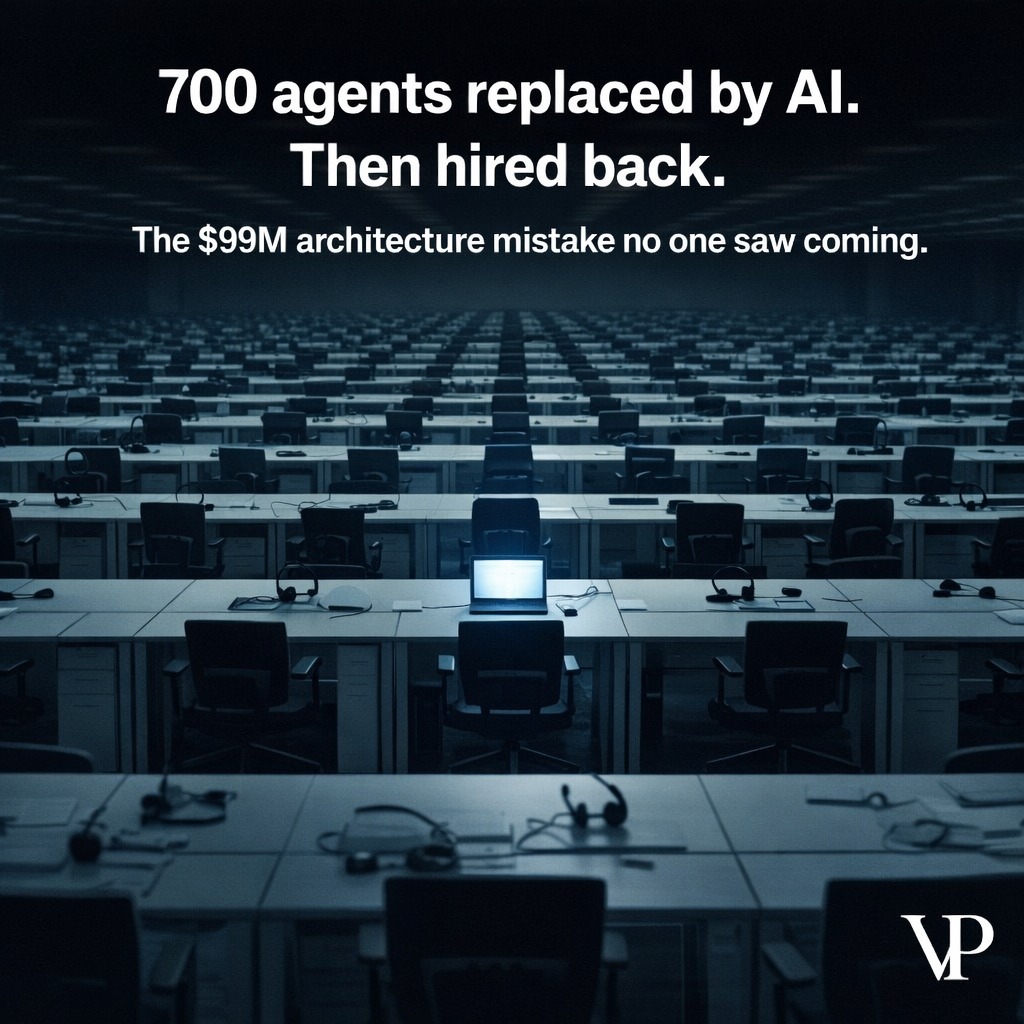
Klarna replaced 700 support agents with AI. Then hired them all back.
Here's what every enterprise can learn from that $99M lesson.
The problem wasn't AI itself. It was the architecture underneath.
They wrapped a third-party language model around their customer service and called it done. Costs dropped. Resolution times shrank. The metrics looked incredible.
But the AI couldn't handle the hard stuff — disputes, refunds, anything requiring real judgment. Customers got stuck in loops. Satisfaction dropped sharply. And the company posted a massive quarterly loss right before its IPO.
This is what happens when you mistake fluent language for reliable reasoning.
Most enterprise AI today runs on the same fragile setup: a thin software layer on top of a model that optimizes for "sounds right" instead of "is right."
That works for simple FAQ lookups. It fails catastrophically in banking, legal, healthcare — anywhere the stakes are real.
Our team builds AI differently.
We fuse neural language models with symbolic logic engines so every output is verifiable, auditable, and grounded in actual business rules — not probabilistic guesses.
The language model handles communication. The logic engine enforces truth. One cannot override the other.
If the system can't verify a claim against its knowledge base, it won't say it. Period.
That's not a feature. That's the entire architecture.
2026 is the year CFOs stop asking "are we using AI?" and start asking "can we prove what it's telling us?"
Save this for the next time someone on your team pitches an AI tool without asking what's underneath it 👇
What's the biggest AI failure you've seen at a company — and what actually caused it?
#NeuroSymbolicAI #EnterpriseAI #AIArchitecture #DeterministicAI #AIStrategy