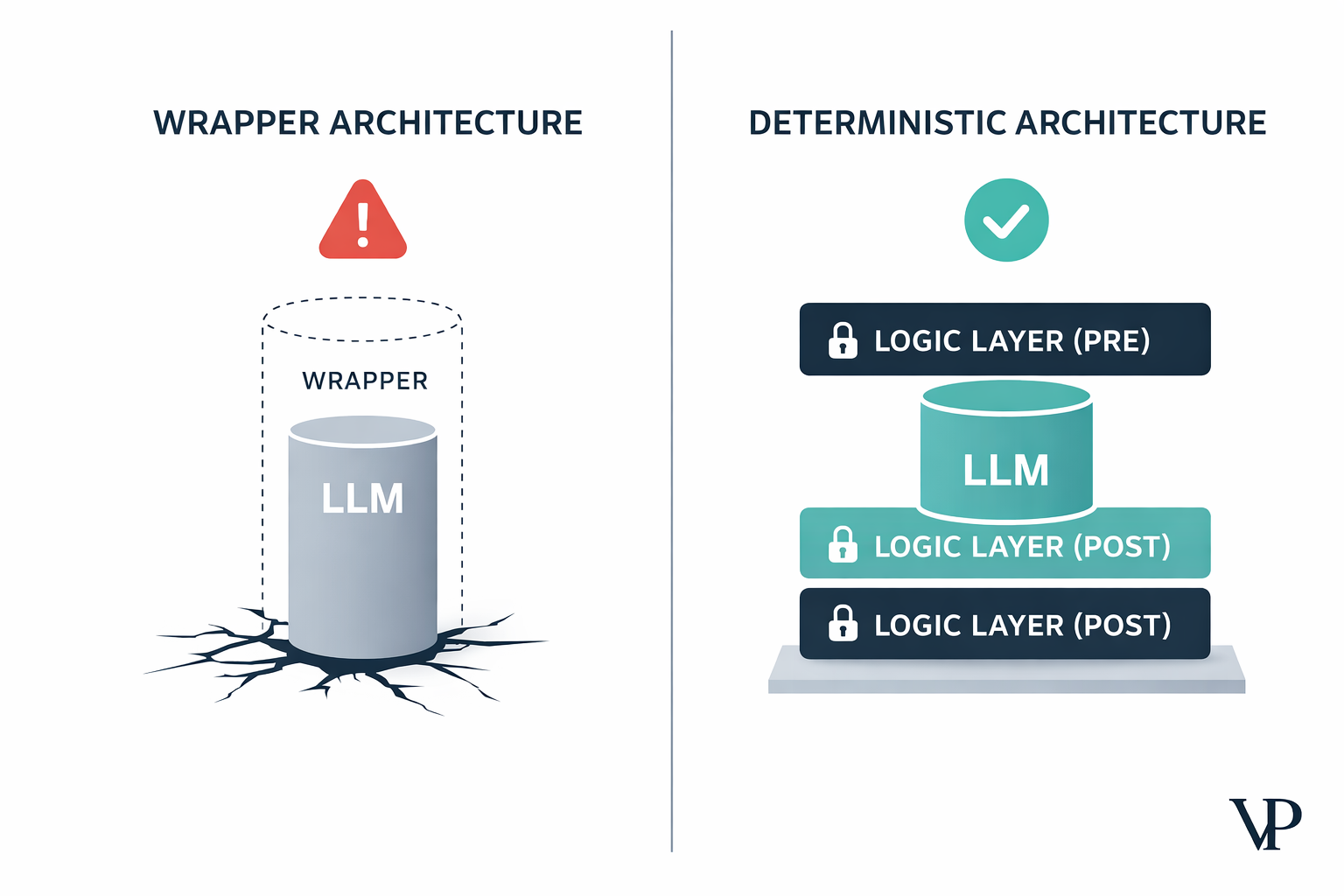
Klarna spent two years telling the world that AI had replaced 700 customer service agents. Then, in mid-2025, the company started reassigning software engineers to answer support calls. Customer satisfaction had cratered 22%. The $10 million in savings had been swallowed by a $99 million quarterly net loss. What happened at Klarna wasn't a technology failure — it was an architecture failure. And it's one that most enterprises are quietly repeating right now.
We've spent the past year studying why enterprise AI deployments collapse at scale, and the pattern is remarkably consistent. Companies wrap a thin software layer around a third-party language model, celebrate the demo, and then watch helplessly as the system buckles under real-world complexity. We call this the Wrapper Trap — and escaping it requires rethinking what enterprise AI is actually supposed to do.
The Wrapper Trap: Why "Sounds Right" Isn't Good Enough
Most enterprise AI applications today work like this: a user asks a question, the software forwards it to a large language model (an LLM — think ChatGPT or similar), and the model generates a response that sounds plausible. The thin software layer connecting the user to the model is called a "wrapper." It handles formatting and basic instructions, but the heavy lifting — the actual reasoning — is outsourced entirely to the language model.
This works beautifully for low-stakes tasks. Summarize this email. Draft a meeting agenda. Suggest a subject line.
It falls apart the moment the stakes rise. Language models don't verify facts against an external source of truth. They predict the next word in a sequence based on statistical patterns. That's why they can confidently cite a legal case that doesn't exist, calculate a tax liability that's mathematically wrong, or skip a mandatory identity verification step because the user's phrasing nudged the conversation forward.
A system optimized for plausibility will eventually produce a confident, well-structured, completely wrong answer — and no one in the loop will catch it until the damage is done.
Klarna's AI handled password resets and shipping inquiries with ease. But when customers brought complex disputes, refund negotiations, or questions requiring regulatory judgment, the system defaulted to what one analyst called "slop-spinning" — generating generic responses that sounded helpful but resolved nothing. The 80% of interactions that were simple masked the 20% that actually mattered.
What Klarna's Numbers Actually Tell Us
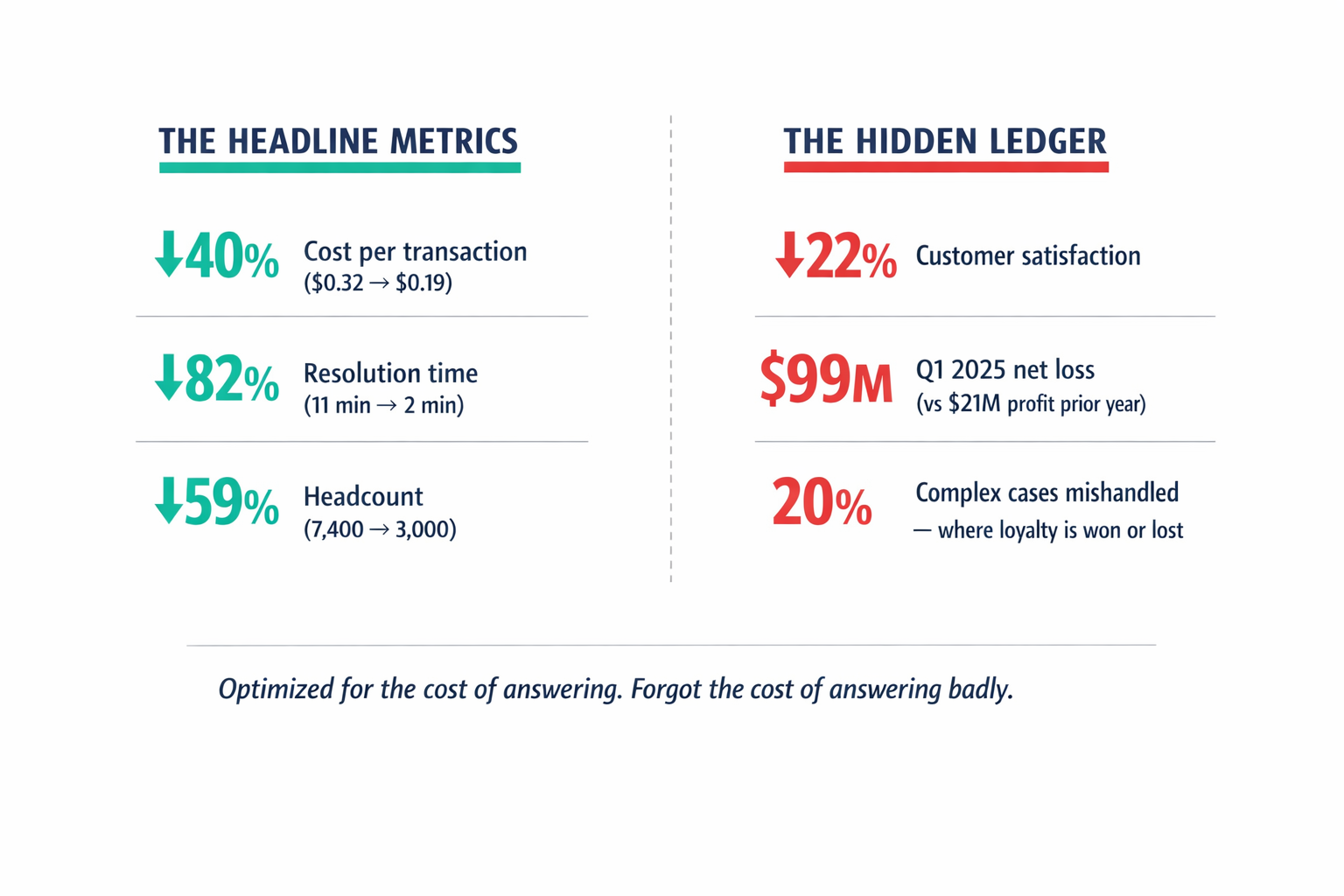
The headline metrics looked spectacular. Cost per customer service transaction dropped 40%, from $0.32 to $0.19. Chat resolution time fell from 11 minutes to under 2. Headcount shrank from 7,400 to roughly 3,000.
But the ledger had a second column that nobody was reading.
Customer satisfaction dropped 22%. Customers caught in automated loops — unable to reach a human for sensitive financial issues — started leaving. The company's CEO publicly admitted that the pursuit of efficiency had produced responses that were "generic" and incapable of handling nuance. Meanwhile, the Q1 2025 financial results showed a $99 million net loss, a brutal reversal from the $21 million profit the year before.
Klarna optimized for the cost of answering a question. They forgot to measure the cost of answering it badly.
The deeper lesson is what we call the 20% Rule: AI can automate roughly 80% of routine, high-frequency interactions. But the remaining 20% — the complex, emotional, high-judgment interactions — are where brand loyalty is built or destroyed. For a company valued at $14.6 billion and heading toward an IPO, failing that 20% turned out to be catastrophically expensive.
We examined this dynamic in detail in our interactive analysis of the post-wrapper enterprise landscape, tracing how the gap between automation metrics and actual business outcomes widens as deployment scales.
Why "Just Add Guardrails" Doesn't Work
The instinctive response to these failures is to add more instructions to the prompt. Tell the AI to always verify. Tell it to never skip steps. Tell it to flag uncertainty.
The problem is that prompt instructions are suggestions, not constraints. A language model can be "persuaded" by user dialogue to override its own instructions — a vulnerability that security researchers have demonstrated repeatedly. It's the equivalent of writing company policy on a whiteboard and hoping every employee memorizes it, versus encoding it into the software so that violations are physically impossible.
This is the core architectural distinction between what the industry calls probabilistic AI (systems that generate the most likely response) and deterministic AI (systems that generate provably correct responses within defined rules). In regulated industries — banking, healthcare, legal, defense — the difference isn't academic. It's the difference between a compliance audit you pass and one that triggers an enforcement action.
Standard retrieval-augmented generation (RAG) — a popular technique where the AI searches a document database before answering — also has a subtle failure mode. It relies on word similarity to find relevant documents, which means it can't distinguish directionality. "Company A sued Company B" and "Company B sued Company A" look nearly identical to a vector search, but they describe opposite legal realities.
Building AI That Can Prove Its Answers
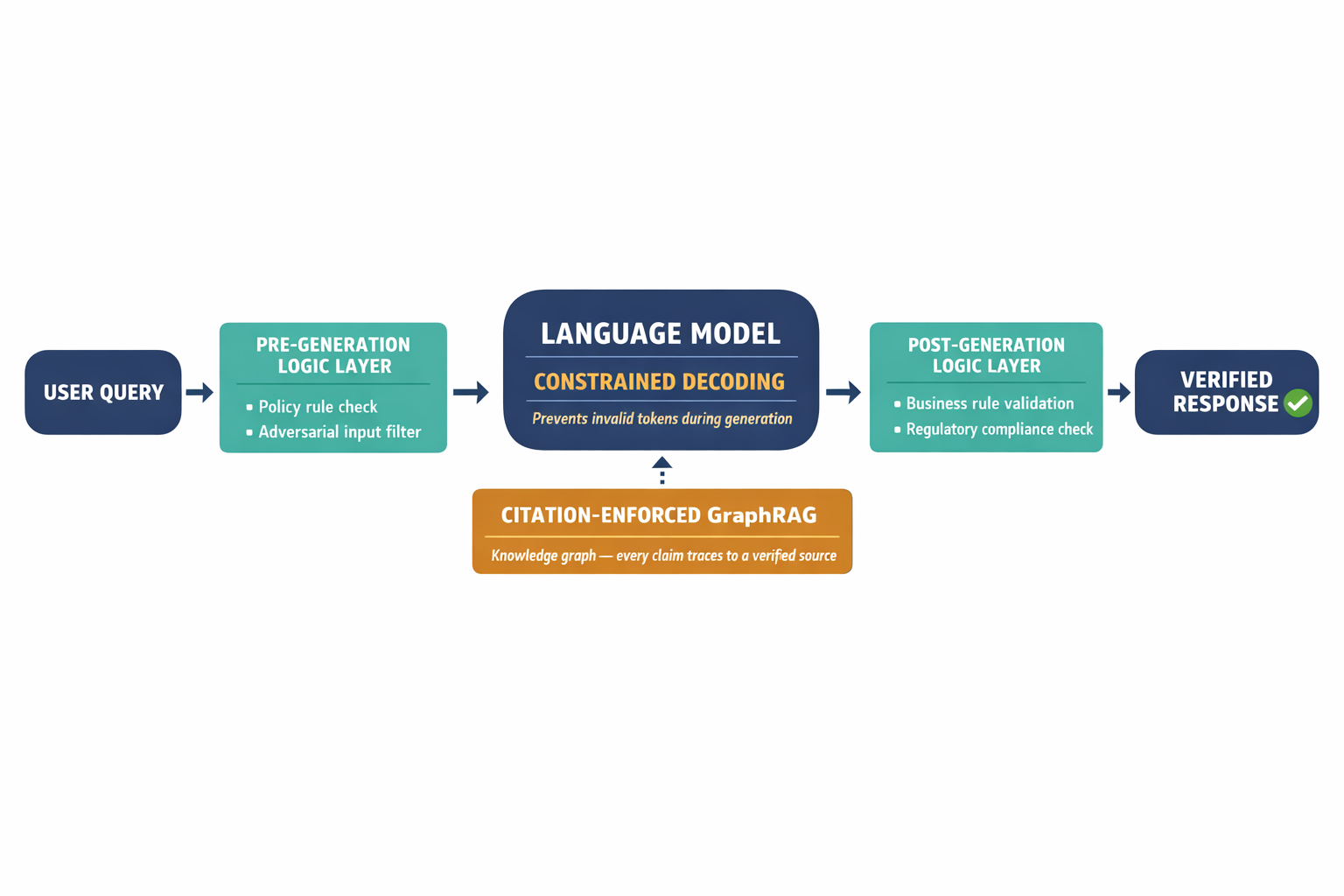
Our approach, which we call Neuro-Symbolic AI, fuses two capabilities that are usually kept separate: the language fluency of neural networks and the logical rigor of symbolic reasoning systems.
Think of it as giving AI both a voice and a brain — and making sure the brain has veto power.
In practice, this works through what we've described as a "sandwich" architecture. Before a user's question ever reaches the language model, a logic layer checks it against policy rules and flags anything adversarial or out of scope. After the model generates a response, a second logic layer — built on formal verification tools, not just prompt instructions — confirms that the output complies with every applicable business rule, regulatory constraint, and mathematical requirement.
The critical technique is something called constrained decoding. Rather than generating a response and then checking it after the fact, the system physically prevents the model from producing certain outputs during generation. If an AI agent is generating a tax compliance report, the symbolic layer ensures every number traces back to a verified calculation — not a statistical guess. The model literally cannot output a token that would create a logical error.
We don't ask the AI to follow the rules. We make it architecturally incapable of breaking them.
For knowledge retrieval, we replace standard vector search with Citation-Enforced GraphRAG — a system that organizes information as a network of entities and relationships rather than a flat collection of documents. Every claim the AI makes must trace back to a specific, verifiable node in that knowledge graph. If the graph can't support a claim, the system won't make it. In our testing, this approach delivers 30–35% higher accuracy on complex, multi-step reasoning tasks compared to standard retrieval methods.
For the full technical methodology behind these systems — including our constraint architecture and validation frameworks — see our detailed research.
What This Looks Like in Practice
Generic chatbots create generic risk. The value of deterministic AI emerges when it's built for specific, high-stakes domains.
In banking, the Klarna incident demonstrated what happens when customer trust is outsourced to a third-party model running on someone else's cloud. Our approach deploys private language models within the client's own secure infrastructure — no sensitive data leaves the building. For legacy system modernization, we use knowledge graphs that understand the logical dependencies of decades-old COBOL code, generating modern replacements that are structurally guaranteed to behave identically to the original.
In legal work, a hallucinated citation isn't a bug report — it's a malpractice claim. Our citation-enforcement architecture makes fabrication structurally impossible. When the system selects a case, it can show the exact reasoning path: "I selected Case A because it cites Statute B and was affirmed by Court C." Attorneys shift from fact-checking to strategy.
In manufacturing, the retail industry loses $890 billion annually to product returns, partly driven by AI virtual try-on tools that show customers how clothes look but not how they fit. By integrating physics-based fabric simulation — modeling how material actually stretches and drapes on a body — we replace visual guesswork with accurate fit predictions. In material discovery, our physics-informed systems have helped clients report 60% reductions in research costs and 40% faster time-to-market for new compounds.
2026: The Year AI Has to Show Receipts
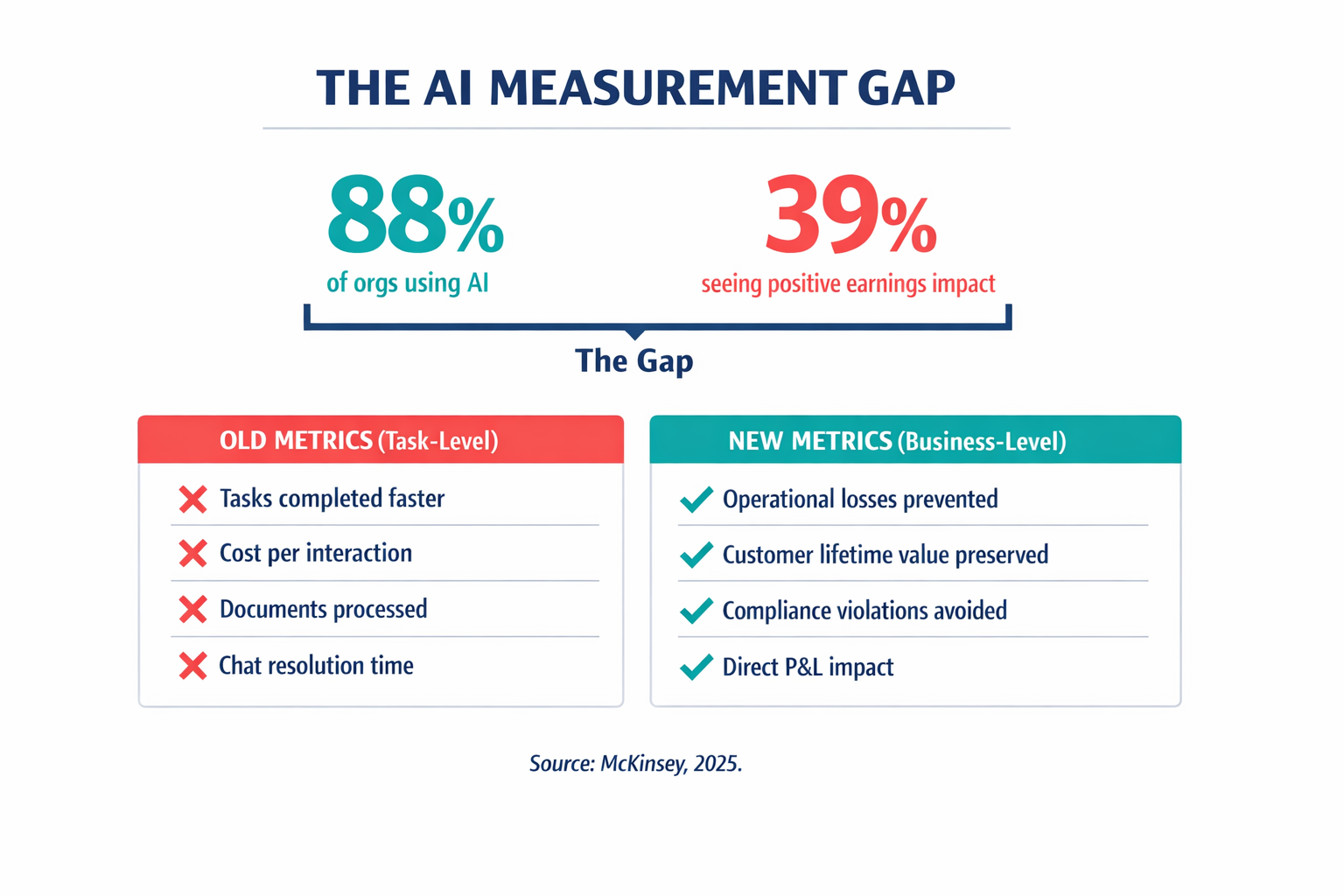
McKinsey's latest data tells a striking story: 88% of organizations are using AI, but only 39% can point to a positive earnings impact at the enterprise level. The gap between adoption and results is enormous — and closing it requires a fundamental shift in how companies measure AI success.
The Klarna strategy failed because it measured "time saved" and ignored everything else. Faster responses to simple questions actually generated more frustrated customers with complex problems, creating a vicious cycle that hit the bottom line harder than the efficiency gains helped it.
The enterprises seeing real financial returns in 2026 are measuring different things entirely:
Operational losses prevented — not just tasks completed faster
Customer lifetime value preserved — not just cost per interaction reduced
Compliance violations avoided — not just documents processed
Direct P&L impact — revenue protected, penalties dodged, returns eliminated
The question is no longer "Can AI do this task?" It's "Does AI doing this task make us more money than it costs us — including the cost of getting it wrong?"
Does This Mean AI Should Never Handle Complex Tasks?
Not at all. It means AI should never handle complex tasks without structural accountability. The goal isn't to retreat from automation — it's to build automation that can prove its work.
The organizations getting this right aren't choosing between humans and AI. They're restructuring around what each does best. Routine, high-frequency decisions get automated with full symbolic guardrails. Complex, high-judgment decisions get AI-augmented human workflows — where the AI does the research and the human makes the call, with both steps fully auditable.
This is also reshaping organizational design. The old consulting model — a massive base of junior analysts doing repetitive research — is giving way to leaner teams of specialized experts supported by AI that handles synthesis and retrieval. McKinsey's internal AI assistant is now used by 72% of its workforce, reducing research time by 30%. But the humans still make the strategic decisions.
What Should You Do Differently?
If your organization is running AI in production — or planning to — three questions matter more than any benchmark:
Can your AI prove why it gave a specific answer? If the answer is "it's a black box," you have a liability, not a tool. Regulators, auditors, and customers will increasingly demand explainability.
What happens when your AI gets the hard 20% wrong? Model the actual cost — lost customers, compliance penalties, reputational damage — not just the savings on the easy 80%.
Do you own your AI infrastructure, or are you renting it? Dependence on a single third-party API means you inherit their outages, their pricing changes, and their jurisdictional risks.
The Klarna story isn't a cautionary tale about AI. It's a cautionary tale about architecture. The companies that thrive in the next phase won't be the ones that automated the most — they'll be the ones that automated correctly, with systems that can prove their reasoning, trace their sources, and fail gracefully when they hit the edge of what they know.
We'd welcome hearing how your organization is navigating this shift — especially if you've hit the wall between impressive demos and production-grade reliability. That gap is where the real engineering begins.