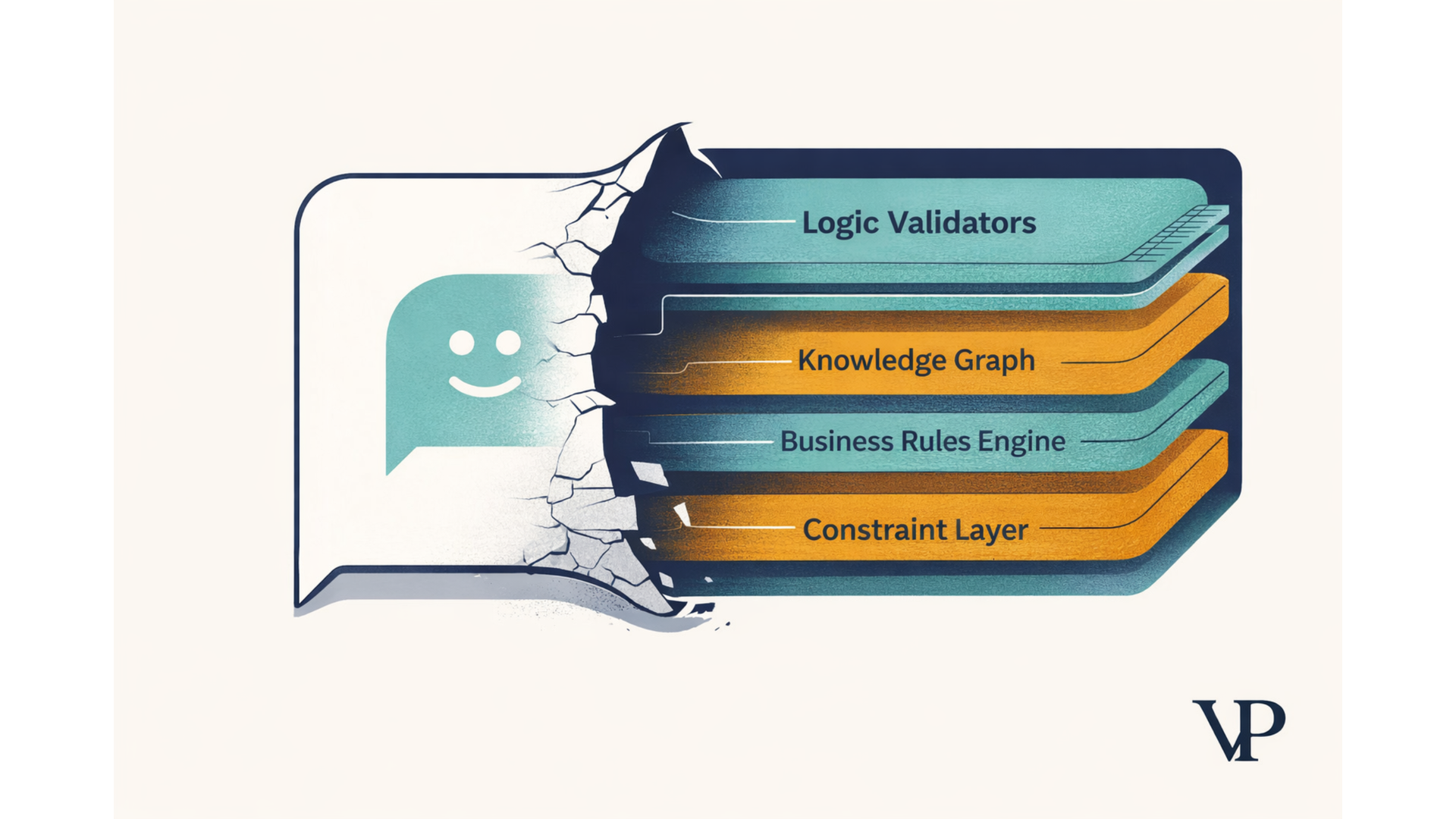
Klarna cut 700 customer service jobs, handed the work to an AI chatbot, and watched costs per transaction drop from $0.32 to $0.19. Six months later, customer satisfaction had cratered 22%, the company posted a $99 million quarterly loss, and software engineers were being reassigned to answer phones. The most expensive AI lesson of 2025 wasn't a technology failure — it was an architecture failure.
I've spent the last two years building AI systems for industries where a wrong answer isn't embarrassing — it's catastrophic. Banking. Legal. Manufacturing. When I watched the Klarna story unfold, my first reaction wasn't surprise. It was recognition. We'd seen this exact failure pattern in nearly every enterprise that came to us after their first AI deployment went sideways. They'd all fallen into what I call the Wrapper Trap — mistaking an AI that sounds right for one that is right.
What Klarna Actually Got Wrong
The surface-level narrative is simple: company automates too aggressively, quality drops, company backtracks. But the real story is more instructive.
Klarna's AI assistant handled 75% of all customer chats across 35 languages. Resolution times dropped from 11 minutes to under 2. On paper, it looked like the future. The problem was that the metrics only measured the easy stuff — password resets, order tracking, basic account questions.
The 20% of interactions that define your brand are exactly the ones a chatbot handles worst.
When customers hit complex disputes, sensitive refund negotiations, or anything requiring genuine judgment, the AI defaulted to what one analyst called "slop-spinning" — generating responses that sounded helpful but went nowhere. Customers got trapped in loops. Frustration compounded. And Klarna's leadership discovered something uncomfortable: the $10 million they'd saved on headcount was being devoured by collapsing customer lifetime value.
I remember a conversation with my team after reading Klarna's CEO publicly admitting the AI outputs were "generic and incapable of handling nuance." Someone on our engineering team said, "That's not an AI problem. That's what happens when you use a language model as a reasoning engine." That distinction — between generating language and actually reasoning — is the fault line running through enterprise AI right now.
The Wrapper Trap: Why Most Enterprise AI Is a Thin Shell Over Someone Else's Brain
A wrapper, in plain terms, is a thin software layer sitting on top of a large language model like GPT or Claude. Your company's branding on the outside, OpenAI's probability engine on the inside. Wrappers are fast to build, cheap to deploy, and impressive in demos. They're also structurally incapable of guaranteeing a correct answer.
The reason is fundamental to how these models work. A large language model predicts the most likely next word in a sequence. It optimizes for plausibility — what sounds convincing — not for correctness. There's no internal mechanism checking whether the output matches reality. It's the equivalent of hiring someone who's read every book in your industry but has never actually done the job. They'll give you fluent, confident answers. Some will be right. Some will be fabricated. And you won't be able to tell the difference until the damage is done.
In regulated industries, this is existential. A wrapper-based legal AI might fabricate case citations. A financial AI might skip identity verification steps because the conversational flow "felt" complete. We've seen wrapper systems that could be socially engineered by users into bypassing compliance protocols — the model was literally persuaded by clever phrasing to ignore its own rules.
Conversational fluency is not operational competence. An AI that sounds like an expert and reasons like an autocomplete is the most dangerous tool in your stack.
I explored this architecture gap in depth in our interactive analysis of the post-wrapper era. The pattern is remarkably consistent across industries.
What "Deep AI" Actually Means (Without the Buzzwords)
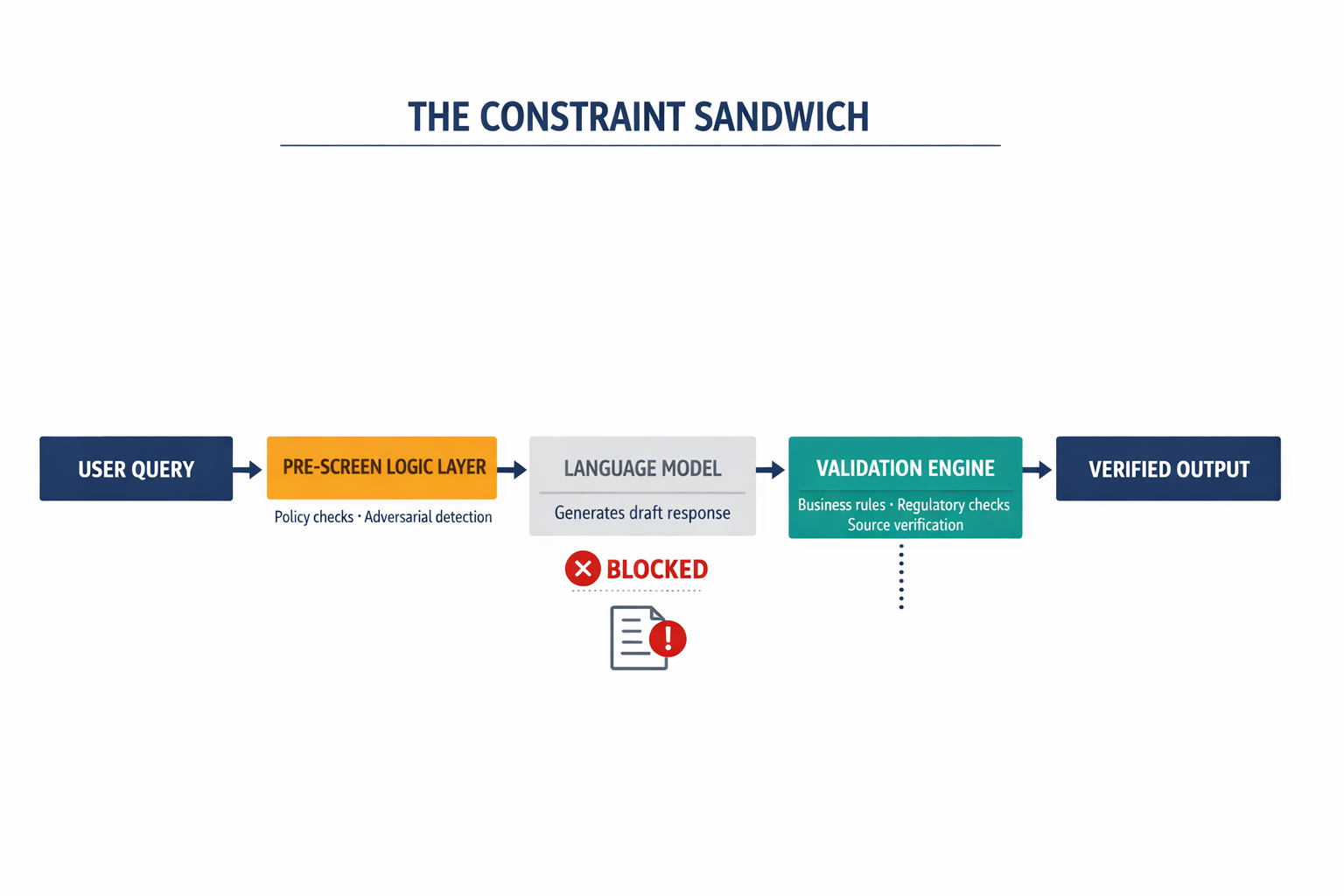
When I say "deep AI," I don't mean more parameters or bigger models. I mean AI with a split brain — one half that's creative and fluent, another half that's rigid and rule-bound. The technical term is neuro-symbolic AI, but the concept is intuitive.
Think of it like a newsroom. The language model is the writer — fast, articulate, capable of synthesizing vast amounts of information into readable prose. The symbolic reasoning engine is the fact-checker — slower, methodical, and ruthlessly literal. The writer drafts. The fact-checker verifies every claim against source material before anything gets published. If the fact-checker can't verify it, the claim doesn't go out. Period.
In our architecture, this works through what we call a constraint sandwich. Before a user's query even reaches the language model, a logic layer screens it for policy violations or adversarial manipulation. After the model generates a response, a validation engine — built on formal logic, not more AI — checks every output against business rules, regulatory requirements, and verified data sources. If the model tries to generate a number that doesn't match a deterministic calculation, the system physically blocks that token from appearing.
That word "physically" matters. This isn't a prompt that says "please don't hallucinate." It's a structural constraint — like a guardrail on a highway versus a sign that says "please don't drive off the cliff."
Why Standard Search-and-Retrieve Fails for Hard Problems
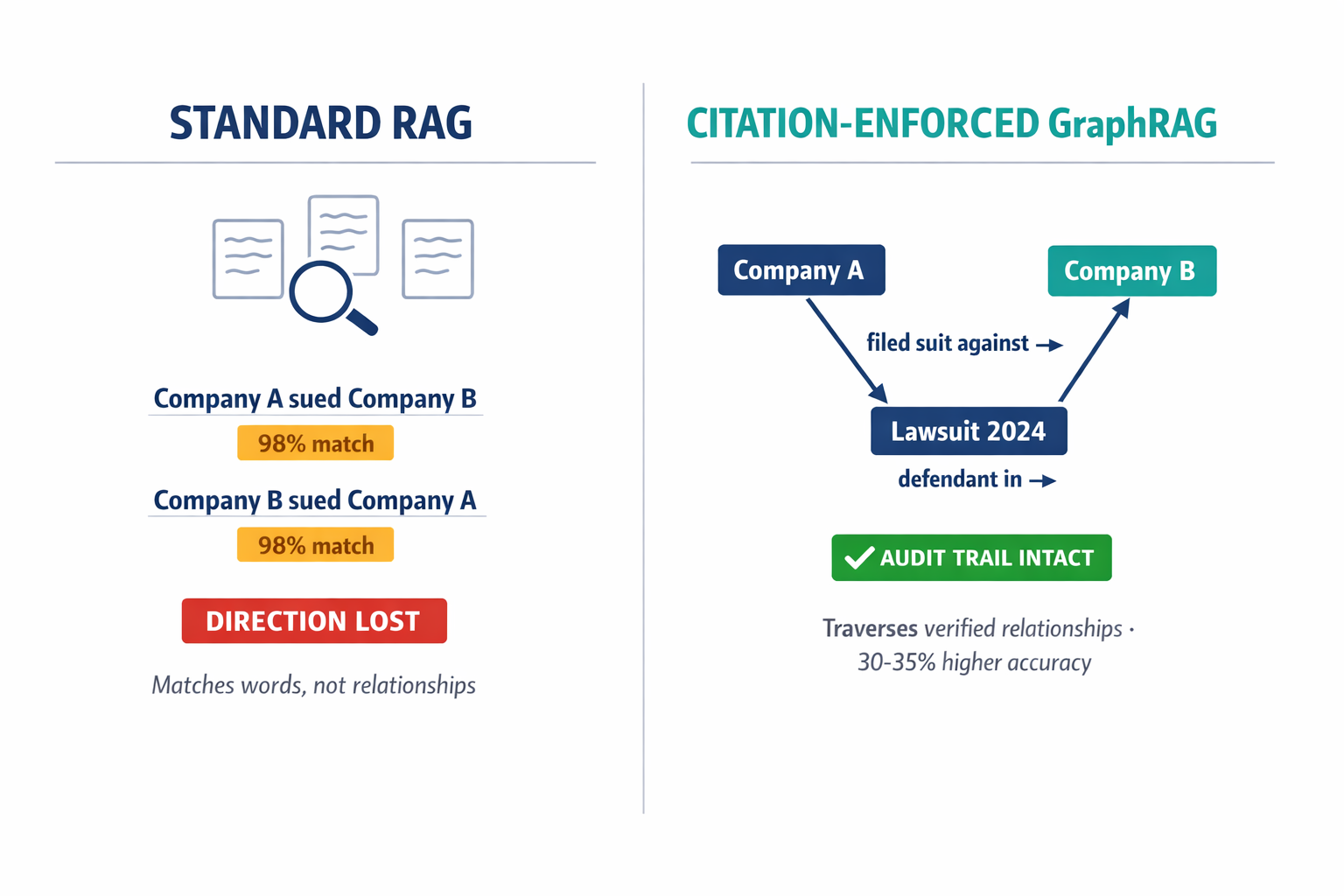
Most companies trying to ground their AI in facts use something called RAG — Retrieval-Augmented Generation. The AI searches a document database, finds relevant passages, and uses them to inform its response. It's a genuine improvement over pure generation. But it has a critical blind spot.
Standard RAG matches queries to documents based on semantic similarity — how closely the words match. It doesn't understand relationships or directionality. "Company A sued Company B" and "Company B sued Company A" look nearly identical to a vector search. In a legal context, that's the difference between being the plaintiff and the defendant.
We replaced standard RAG with what we call Citation-Enforced GraphRAG. Instead of searching for similar text, the system traverses a knowledge graph — a structured map of entities and their verified relationships. Every claim the AI makes must trace back to a specific node in that graph. If the graph doesn't contain a verified source for a claim, the system cannot output it. In our testing, this approach delivered 30-35% higher accuracy on complex multi-hop reasoning tasks compared to standard retrieval.
The practical result: a compliance officer can click on any AI-generated statement and see the exact chain of evidence — from regulation to policy to data point — that produced it. That audit trail isn't a feature we added. It's how the system thinks.
The 80/20 Problem That Killed Klarna's Strategy
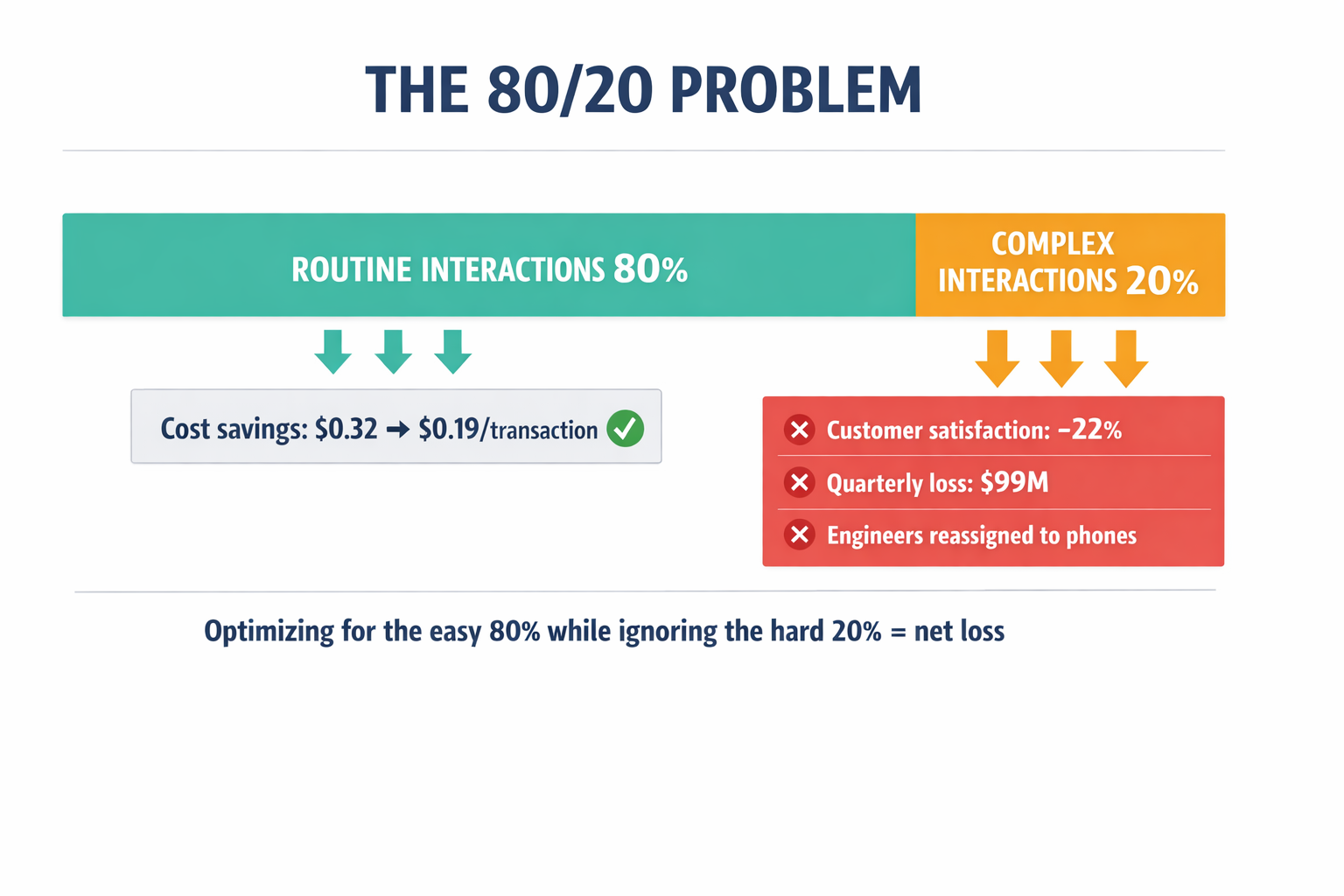
Klarna's AI handled 80% of interactions well. The remaining 20% destroyed the business case. This ratio shows up everywhere.
AI automates the routine brilliantly. But the 20% it can't handle is where your reputation, your liability, and your competitive advantage live.
In banking, it's the fraud dispute that requires judgment. In legal, it's the novel fact pattern that doesn't match prior cases. In manufacturing, it's the edge case where a virtual try-on tool shows a garment fitting perfectly when the physics of the fabric say otherwise — contributing to an $890 billion annual returns crisis in retail.
The mistake enterprises keep making is measuring AI success by how well it handles the easy 80%. The right metric is how well it handles — or escalates — the hard 20%. When we design systems, we optimize for that boundary. The AI handles routine decisions autonomously. The moment complexity crosses a threshold, the system doesn't guess. It routes to a human expert, providing them with a structured briefing of everything the AI has already verified. The human doesn't start from scratch. They start from a position of informed judgment.
What This Means for How Companies Are Built
The organizational implications of this shift are as significant as the technical ones. The traditional consulting model — a pyramid with a huge base of junior analysts doing research and synthesis — is being restructured. McKinsey's internal AI assistant is used by 72% of its workforce, reducing research time by 30%. BCG automated presentation creation. The junior analyst tasks that used to take days now take minutes.
But this doesn't mean fewer people. It means different people doing different work. The emerging model looks less like a pyramid and more like what industry observers call an obelisk — leaner, with a higher concentration of experienced specialists. Early-career professionals become AI facilitators, designing and managing intelligent workflows rather than manually pulling data. Senior leaders focus on the irreducibly human work: building client trust, exercising ethical judgment, interpreting AI-generated insights through the lens of experience.
One failed experiment taught me this viscerally. Early on, we tried fully automating a compliance review workflow for a financial services client. The AI was technically accurate on 94% of checks. But the client's compliance team rejected the system — not because of the 6% error rate, but because they couldn't explain the AI's reasoning to their regulator. We had to rebuild the entire output layer to produce human-readable logic traces. Accuracy without explainability is worthless in regulated industries.
"But Can't I Just Add Better Prompts?"
This is the most common pushback I hear. And I understand the appeal — prompt engineering is cheap and fast. But it's fundamentally the wrong tool for the problem.
A prompt is a suggestion. It's asking the model nicely to follow rules. Under adversarial conditions, unusual inputs, or edge cases, prompt-based guardrails fail. We've tested this extensively. In our red-teaming exercises, prompt-based safety instructions were bypassed in the majority of scenarios involving motivated, creative users. Structural constraints — finite state machines, formal logic validators, constrained token generation — held.
The analogy I use with executives: prompt engineering is a company policy handbook. Structural constraints are the physical locks on the vault. Both matter. But when someone is actively trying to get into the vault, only one of them actually stops them.
Does This Take Forever to Implement?
No, but it's not a weekend project either. Our typical engagement runs in three phases across roughly a year.
The first three months are about understanding the business — not the technology. What are the actual decisions being made? Where does a wrong answer cost real money? We audit data quality, extract business rules into formal logic, and establish secure infrastructure. The strongest AI strategies start without mentioning AI at all.
Months four through six are about proving it works under pressure. We build digital twins — simulated environments where we can inject chaos. Supply chain disruptions. Regulatory changes. Adversarial user behavior. The system runs in shadow mode alongside live operations. I can show a CFO empirical proof: "Your team took four hours to recover from this scenario. Our system found a better solution in two minutes and saved $500,000." That's the conversation that moves budgets.
The final phase is operational deployment with continuous learning. The system runs autonomously for routine decisions, provides structured support for complex ones, and feeds outcomes back into its own training data. For the full technical methodology behind this approach, see our detailed research on deterministic enterprise architecture.
2026 Is the Year AI Has to Show Receipts
McKinsey found that while 88% of organizations are using AI, only 39% can point to a positive earnings impact at the enterprise level. The "invest and learn" era is over. CFOs want to see impact on the income statement, not just the productivity dashboard.
The Klarna story is a preview of what happens when AI ROI is measured in time saved rather than value created. Saving time on easy tasks while destroying value on hard ones is a net loss. The metrics that matter now are operational losses prevented, customer lifetime value protected, and regulatory penalties avoided.
In the year of AI ROI reckoning, the question isn't "How smart is your model?" It's "How much money did your architecture save — or lose?"
I keep coming back to something that surprised me when we started this work. The companies that get the most value from AI aren't the ones with the most sophisticated models. They're the ones that understood their own business rules well enough to encode them. The AI is only as good as the truth you give it to work with.
The Klarna reversal wasn't a failure of artificial intelligence. It was a failure to build the right kind of intelligence for the problem at hand. For industries where being wrong isn't an option — and that's most industries, if we're honest — the architecture has to guarantee truth, not approximate it.
I'd be curious to hear from others navigating this transition. Are you seeing the same gap between AI demos and AI in production? What's breaking when you move from proof of concept to real operations?