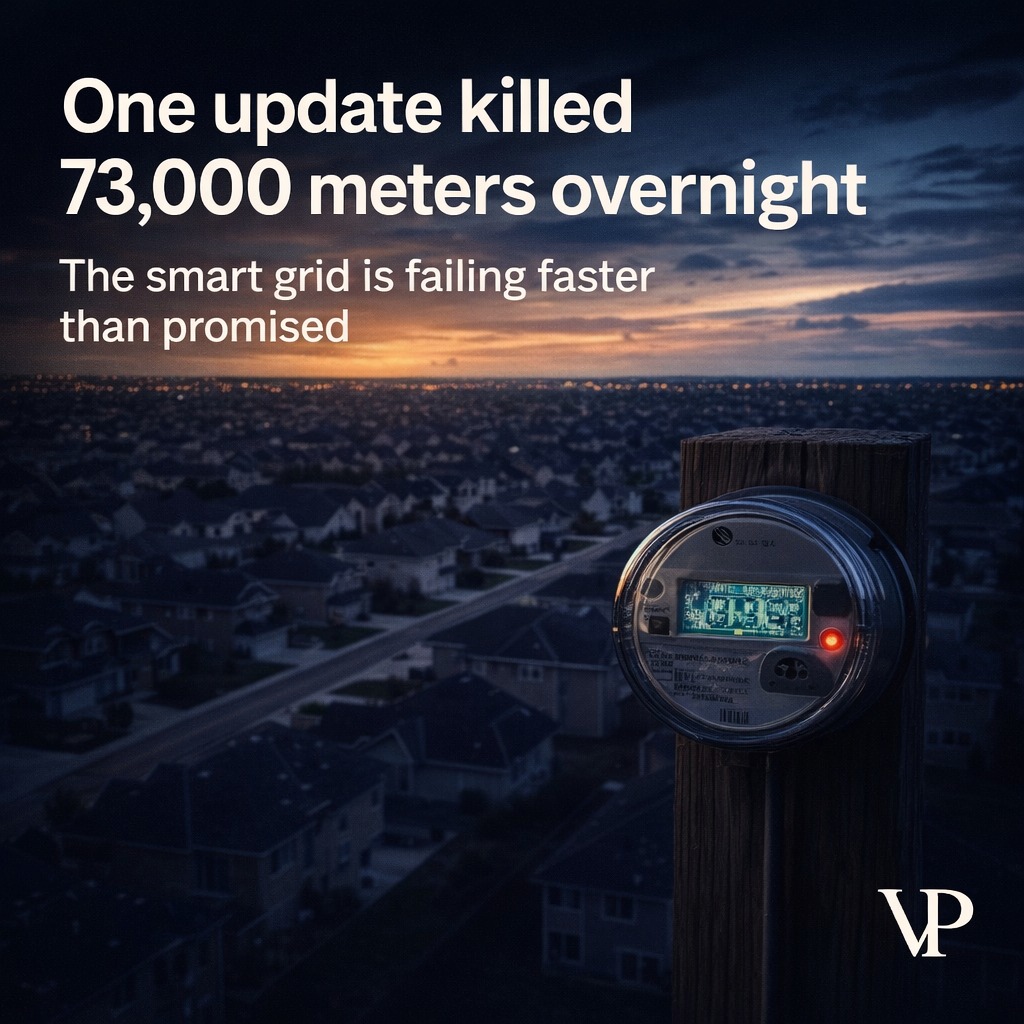
One firmware update knocked 73,000 smart meters offline overnight.
That's not a hypothetical. It happened in Plano, Texas — and the city had to hire 20 extra staff just to read meters by hand.
Here's what most people miss about "smart" infrastructure:
The devices were sold with 20-year lifespans.
Many are failing in under five.
Memory chips wear out from constant data logging. Software patches designed to fix hardware problems end up creating worse ones. And a single remote command error could theoretically shut off service to entire neighborhoods.
Plano spent $765K on manual workarounds.
Toronto faced $5.6M in transmitter replacements.
Memphis set aside $9M for widespread repair.
The UK regulator Ofgem now requires automatic payouts to customers when meters fail — because the problem got that bad.
So why are most "AI solutions" in this space just chatbot interfaces plugged into public APIs?
That approach sends sensitive grid data off-premise. It lacks the deep technical context to actually verify firmware safety. And it creates total dependency on a third party for mission-critical operations.
Our team built something different.
We deploy private AI models on infrastructure the utility actually owns. No data leaves the building. Our systems learn the specific patterns of each meter network — catching degradation signals before they become headlines.
The results across the industry speak clearly: organizations using this approach see dramatically fewer equipment failures, significantly longer asset lifespans, and maintenance costs that drop substantially.
We broke down the full technical architecture, real-world case studies, and ROI framework in our latest whitepaper.
Save this if you work in utilities, energy tech, or critical infrastructure 🔖
What's the oldest piece of "smart" technology you still rely on daily?
#SmartGridResilience #PredictiveMaintenanceAI #UtilityInfrastructure #DeepAI #AMIreliability