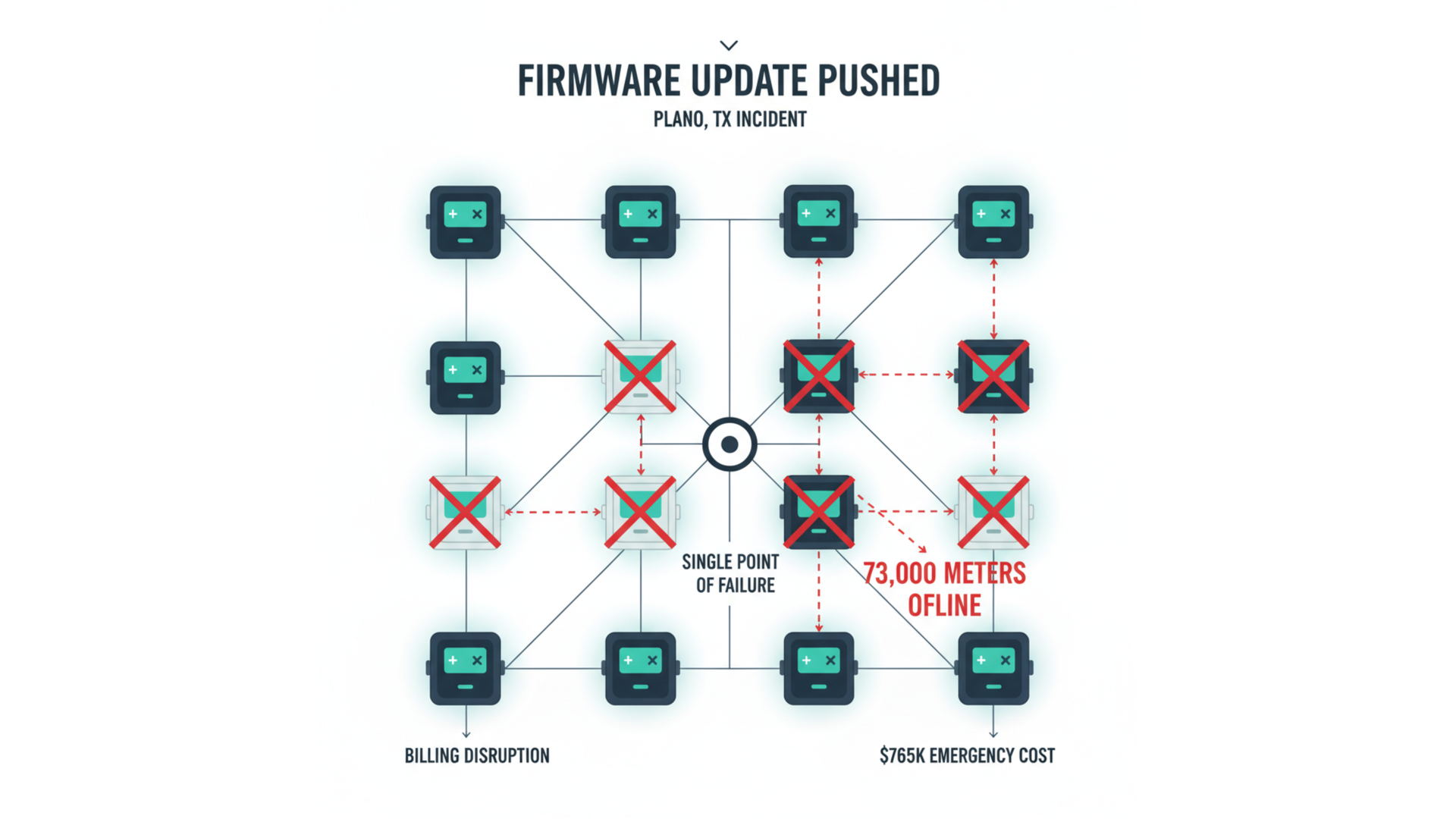
A firmware update pushed on a Tuesday evening in Plano, Texas knocked 73,000 water meters offline. One update. Seventy-three thousand meters. The city had to hire 20 temporary meter readers at a cost of $765,000 just to keep billing running.
When I first read about the Plano incident, I thought it was an outlier. Then I started pulling the thread. Toronto: 470,000 transmitters failing early, $5.6 million in initial remediation. Memphis: an 8% systemic failure rate across their entire Advanced Metering Infrastructure (AMI) network, with a $9 million repair fund. In the UK, the regulator Ofgem has started mandating automatic compensation payments of 40 pounds per customer when smart meter service standards slip. This isn't a glitch. It's a pattern — and it reveals a fundamental fragility in the infrastructure we've been told is "smart."
My team and I spent weeks dissecting the technical root causes across these incidents. What we found convinced me that the utility sector is sitting on a ticking clock, and the generic AI tools flooding the market right now won't defuse it. I wrote an interactive deep-dive on AMI resilience that lays out the full picture. This article is the short version — the argument I'd make if I had 10 minutes with a utility CEO.
How Does a Single Firmware Update Kill 73,000 Meters?
The Plano story is worth understanding in detail because it illustrates a failure pattern that's repeating across the industry.
The city signed a $10.2 million contract for 87,000 smart water meters, expecting 20 years of service. Within four years, batteries started dying prematurely. The vendor pushed a remote firmware update to optimize power consumption. That update malfunctioned — and the entire network went silent.
A software patch designed to extend hardware life became the single point of failure that killed the network.
I keep coming back to this because it's not a freak accident. It's a design-level vulnerability. Smart meters are no longer simple measurement devices. They're networked computers running firmware on embedded processors with flash memory, edge AI chips, and remote kill switches. Every one of those components introduces failure modes that didn't exist when meters were mechanical. A firmware update that works perfectly in the lab can fail catastrophically when deployed to a device with a slightly degraded battery or weak signal strength in a rural area.
The similar failures in Minneapolis, Toronto, and New York City involving the same vendor technology tell me this isn't a vendor problem. It's a systemic one.
Why Do "Silent" Failures Worry Me More Than Dramatic Outages?
The dramatic failures — 73,000 meters going dark — make headlines. But the slow-burn failures worry me more.
Smart meters use NAND flash — the memory chips inside storage devices — to store firmware and usage logs. Every write operation generates waste data that needs garbage collection, which physically wears down memory cells. If the embedded file systems aren't optimized for this, data corruption starts within a few years. The dangerous part: the meter keeps operating. It just starts transmitting wrong numbers.
Silent inaccuracy means customers get incorrect bills, disputes pile up, and public trust erodes — all while the utility's dashboard shows green across the board. Software complexity in smart meters has doubled in recent years, outpacing traditional testing methods. The gap between what these devices can do and what we can verify they're doing correctly is widening.
Why Can't Off-the-Shelf AI Fix Critical Infrastructure?
After the Plano incident, I watched the market response. Vendors started pitching AI-powered monitoring, predictive maintenance dashboards, "smart" analytics layers. Most of them are what I'd call LLM wrappers — thin interfaces on top of public APIs like GPT-4 or Claude. They look impressive in demos. They're dangerous for critical infrastructure.
The data sovereignty problem alone should be disqualifying. When you use a public AI API, your grid architecture data, customer consumption patterns, and proprietary firmware code leave your network and land on someone else's servers. For a utility handling GDPR-regulated data and critical infrastructure telemetry, that's not a tradeoff — it's a liability. Beyond that, generic models simply can't perform binary analysis on firmware compiled for a specific hardware revision deployed in a specific geography. They don't know your legacy codebase. They don't remember the nuance of your last three maintenance cycles. A context window is not institutional knowledge.
And there's the dependency trap: if your "AI solution" is a prompt wrapper around a foundation model, you have no defensible capability. The API provider can change pricing, modify the model, or experience downtime — and your critical infrastructure monitoring goes with it.
Renting intelligence from a public API isn't an AI strategy. It's an architecture built on someone else's decisions.
What Does Sovereign Deep AI Look Like in Practice?
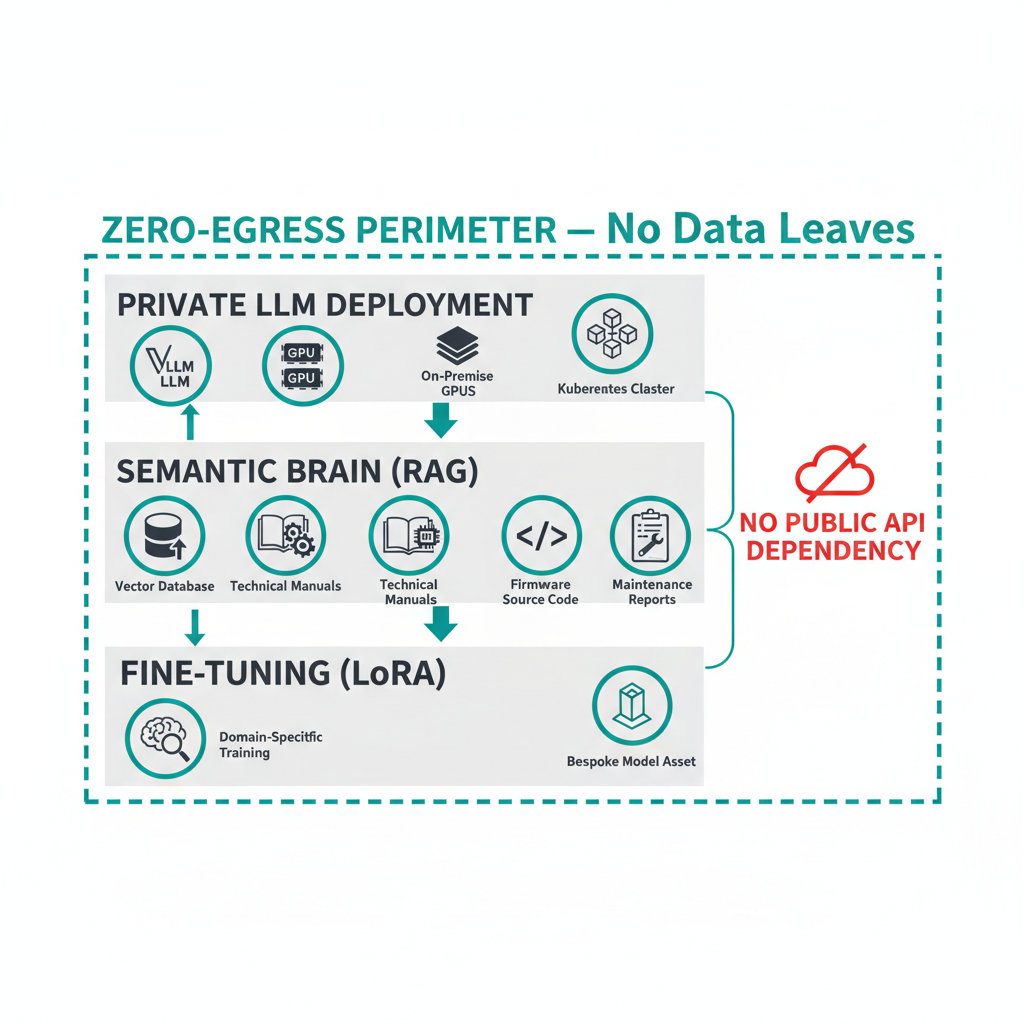
At Veriprajna, we've been building what I call "Deep AI" — sovereign, private intelligence architecture that lives entirely on hardware the utility controls. No data leaves the perimeter. No API dependencies. No "security theater" where the interface feels private but the backend is public.
The foundation is private Large Language Models deployed directly onto the client's infrastructure — their own Virtual Private Cloud or on-premise GPUs, running inference through tools like vLLM (software for running language models faster) and Text Generation Inference on the client's Kubernetes clusters (software that manages and orchestrates cloud applications). The network runs strict zero-egress rules, so data physically cannot phone home to the public internet. On top of that deployment layer, we build what I think of as a "semantic brain" using advanced Retrieval-Augmented Generation — technical manuals, historical maintenance reports, firmware source code, all indexed in local vector databases with role-based access controls. If an employee doesn't have permission to view a document in SharePoint, the AI won't surface that information either.
The final piece is fine-tuning models on the utility's own data using techniques like LoRA (a technique for efficiently customizing AI models without retraining them from scratch). A generic model like Llama 3 is good at English. It's not good at your company's specific nomenclature, your legacy systems, your operational history. Fine-tuning creates a bespoke model asset that belongs to the client and increases domain-specific accuracy by up to 15%. For the full technical methodology, see our detailed research.
How Would Deep AI Have Caught the Plano Failure?
The most immediate application of this architecture is shifting from reactive to predictive maintenance. Our Deep AI models analyze high-frequency sensor data to establish what normal looks like for each device, then flag deviations in real time.
This isn't just spotting obvious spikes. The system detects three types of anomalies: single-point outliers like a sudden voltage spike, contextual anomalies where a reading is normal in isolation but suspicious given the time or conditions, and collective patterns where a fleet of meters all show slightly increased communication latency — the kind of subtle signal that precedes a systemic failure.
AI predictive maintenance has been shown to reduce infrastructure failures by 73% and extend asset lifespans by up to 40%.
The feedback loop matters as much as the detection. When the system flags a fault, it provides explainable outputs — not just "anomaly detected" but a local explanation that a human engineer can verify. That verification feeds back into the model. False positives decrease over time. Trust increases.
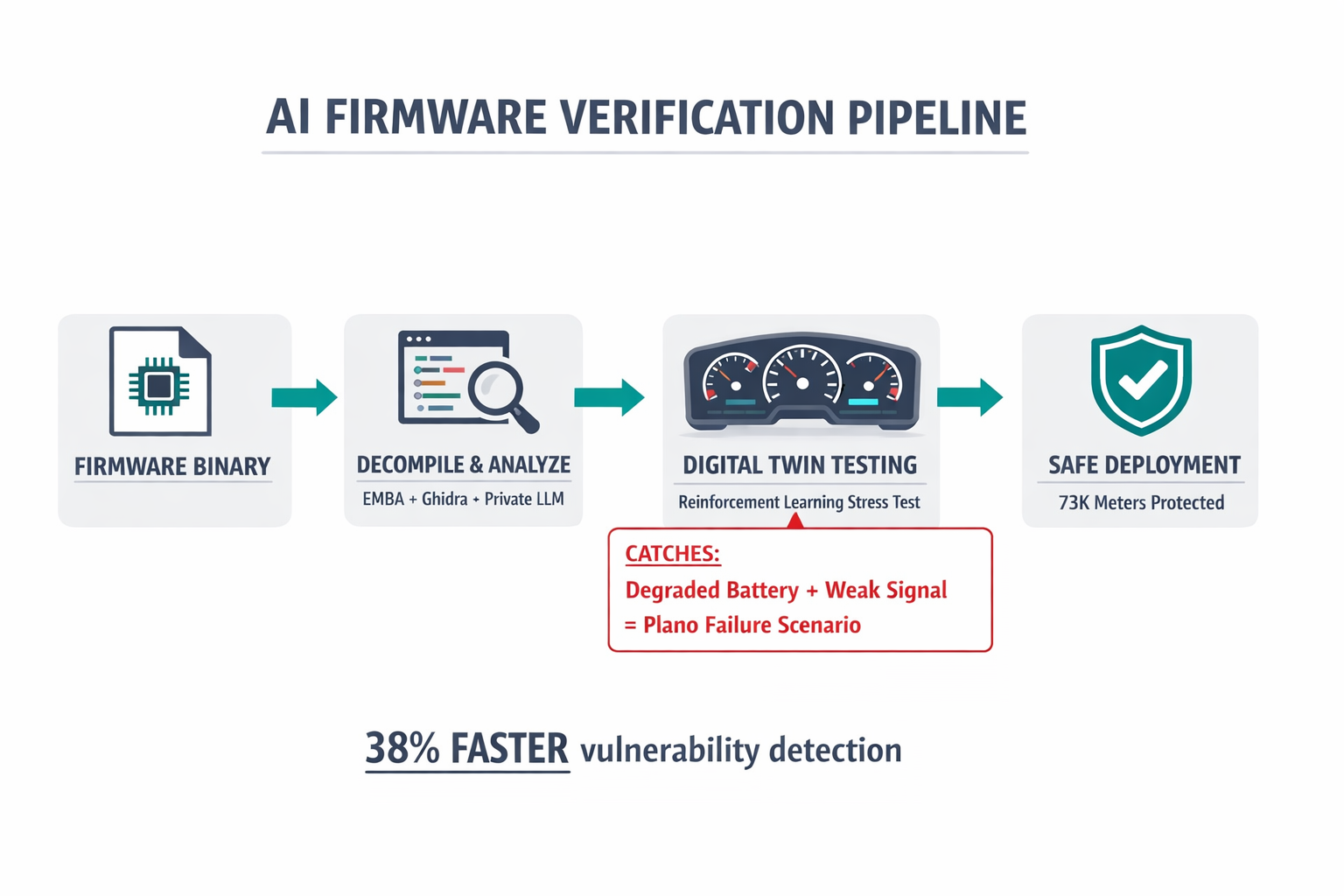
The Plano disaster happened because nobody verified a firmware update before pushing it to 73,000 devices. Our firmware analysis pipeline is designed to make that scenario impossible. We use tools like EMBA and Ghidra to extract and decompile firmware binaries, then run our private LLM against the decompiled code to identify logic flaws, insecure coding practices, and potential vulnerabilities — even for "black box" systems where source code isn't available. Before anything touches a real device, the firmware gets deployed into a digital twin: a virtual replica of the meter fleet running in a simulated environment. AI agents use reinforcement learning to stress-test the firmware, and this approach finds vulnerabilities 38% faster than random testing.
One conversation with my engineering team sticks with me. We were testing our firmware verification pipeline against a simulated version of a common edge case — a degraded battery combined with weak signal strength. The exact scenario that triggered the Plano failure. Our system caught it in the digital twin before deployment. That was the moment I knew this architecture was worth the complexity.
"Is This Really Worth the Investment?"
I hear this from every utility executive, and it's a fair question. The numbers make the case: AI-driven predictive maintenance delivers 30-50% reduction in unplanned downtime, 18-25% lower maintenance costs, and a 40% extension in asset lifespan. When you factor in that industrial outages cost an average of $125,000 per hour, the math isn't close.
But the deeper argument isn't about cost savings. It's about what happens when regulators follow Ofgem's lead. Automatic compensation rules are coming globally. Every malfunctioning meter becomes a direct hit to revenue. The utilities that invest in sovereign AI infrastructure now will have a structural advantage — not just in reliability metrics like SAIDI and SAIFI (utility reliability scores measuring how often and how long power goes out), but in their ability to prove compliance proactively rather than paying penalties reactively.
What Comes Next
The number of IoT devices is projected to exceed 30 billion by 2026. The complexity of managing this infrastructure isn't going to simplify. The next frontier is agentic AI — systems that don't just monitor and alert but take secure autonomous action, like quarantining a compromised device or adjusting parameters in real time. Edge AI will turn smart meters into micro-decision engines executing local anomaly detection with sub-10-millisecond latency.
A model trained on the internet knows English. A model trained on your grid knows when a transformer is about to fail at 2 AM on a holiday weekend.
The question every utility leader needs to answer: will you keep renting intelligence from public providers, or will you build the sovereign capability to secure your grid for the next twenty years?
I don't think there's a middle ground. And I think the failures in Plano, Toronto, and Memphis have made the cost of inaction painfully clear.
If you're wrestling with AMI reliability or evaluating AI solutions for your utility infrastructure, I'd genuinely like to hear what you're seeing on the ground. The best insights I've gotten on this topic have come from operators, not vendors.