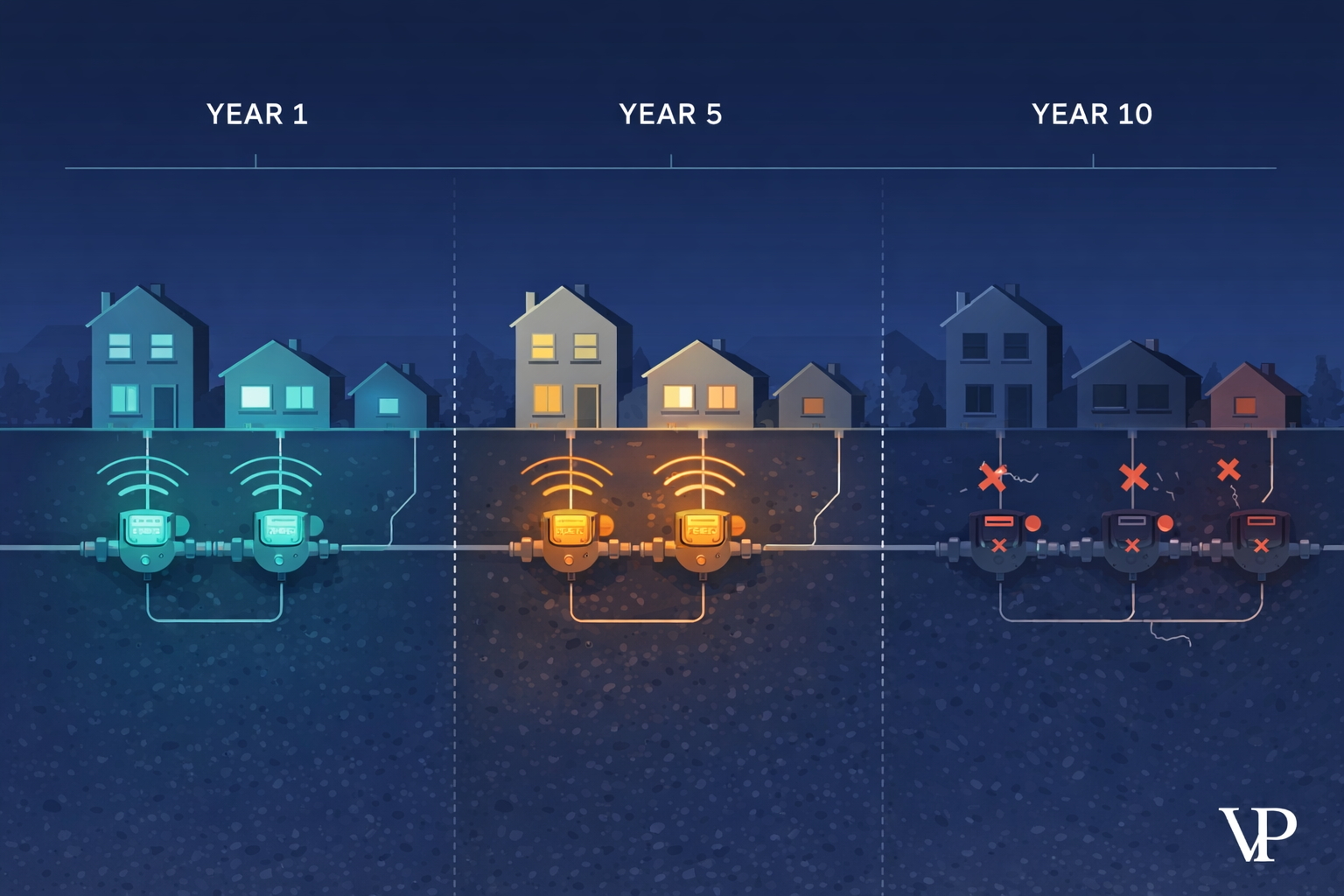
A single firmware update knocked 73,000 smart water meters offline in Plano, Texas. The city had to hire 20 temporary meter readers — at a cost of $765,000 — to do manually what those meters were supposed to do automatically for the next two decades. Plano isn't an outlier. It's a warning. Across North America and the United Kingdom, the smart meters that utilities spent billions deploying are failing years ahead of schedule, and the tools most organizations are reaching for — generic AI built on public APIs — are fundamentally wrong for the job.
We've spent the past year studying what we call Advanced Metering Infrastructure (AMI) fragility: the growing gap between how long smart meters were supposed to last and how long they actually do. The pattern is consistent and alarming. These aren't random hardware glitches. They're systemic failures at the point where software meets hardware — and they demand a class of AI that most vendors aren't building.
A $24 Million Problem Nobody Planned For
Smart meters were sold as 20-year assets. Utilities bought them expecting decades of automated readings, real-time demand data, and lower operational costs. The reality has been brutally different.
In Toronto, 470,000 meter transmitters failed early, costing $5.6 million in initial remediation. In Memphis, an 8% systemic failure rate across the meter network prompted a $9 million repair allocation. And in Plano, what started as premature battery degradation became a full network collapse when a vendor pushed a firmware update that was supposed to fix the problem — and instead bricked the entire communication system.
One firmware update, intended to extend hardware life, became the primary mechanism of its failure.
These aren't isolated incidents. Similar failures involving the same vendor technology have surfaced in Minneapolis and New York City. The UK regulator Ofgem has already responded by mandating automatic £40 compensation payments to customers when smart meter service standards aren't met — rules that took effect in February 2026 and have already driven the repair or replacement of over 900,000 non-functioning meters.
For a detailed breakdown of each failure case and the regulatory landscape, see our interactive analysis of AMI resilience.
Why Smart Meters Die Young
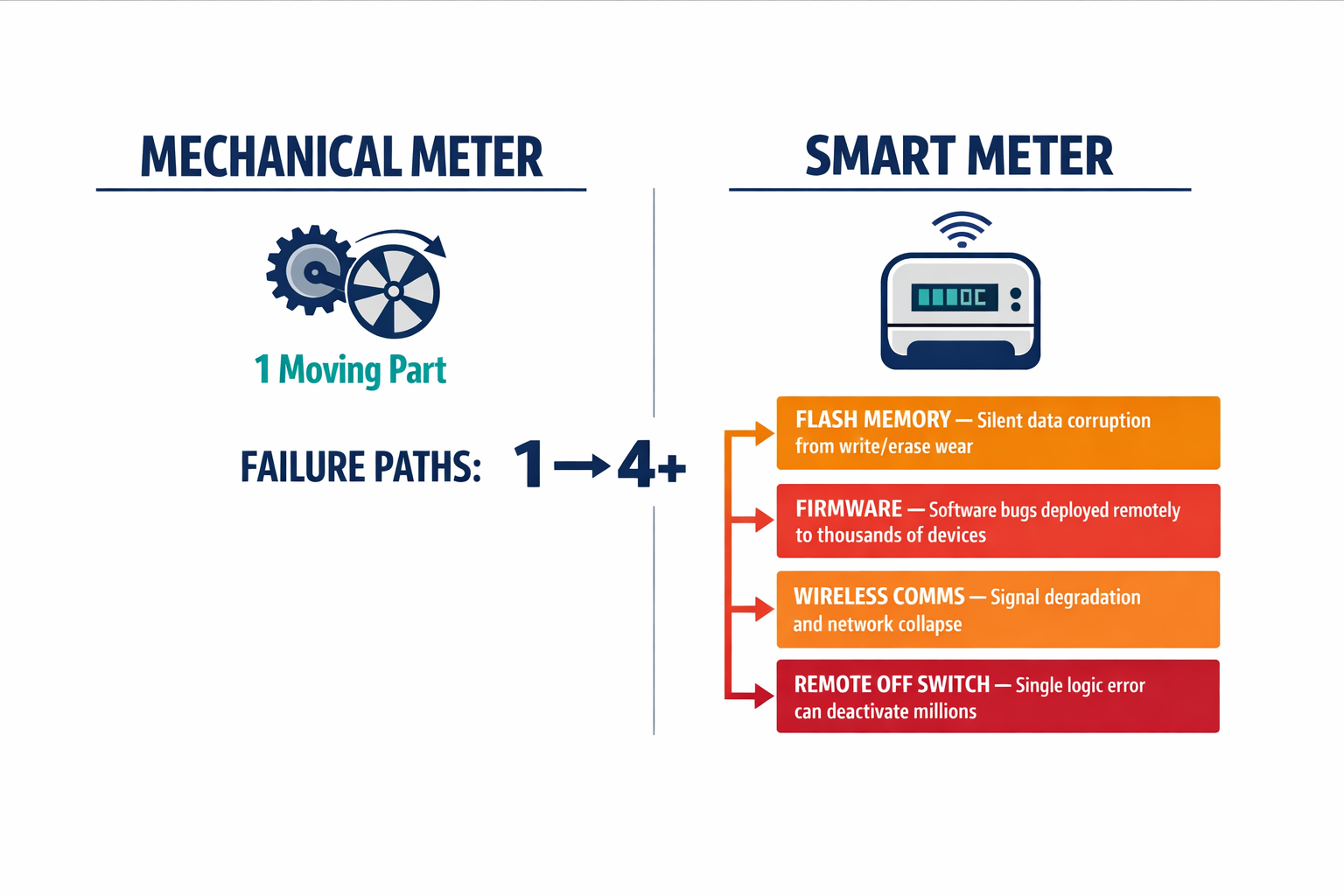
A mechanical water meter is essentially a spinning wheel. It has almost nothing to break. A smart meter is a networked computer bolted to a pipe — with a processor, flash memory, wireless communication, and firmware that gets updated remotely. Every one of those components introduces a failure path that didn't exist before.
The most insidious failures are the quiet ones. Smart meters store data on flash memory (called NAND), which physically degrades every time data is written and erased. After a few years of constant logging, the memory starts corrupting silently. The meter keeps transmitting — but the numbers are wrong. Customers get inaccurate bills. Trust erodes. Nobody notices until the complaints pile up.
Then there's the firmware problem. Software complexity in smart meters has roughly doubled in recent years, outpacing the testing methods designed to catch bugs. A firmware update might work perfectly in a lab but fail in the field when it encounters a slightly degraded battery, weak signal strength, or an edge case nobody anticipated. That's exactly what happened in Plano.
Modern smart meters have a remote "OFF" switch for administrative convenience. A single firmware logic error could theoretically deactivate millions of homes simultaneously.
This isn't hypothetical risk. Research into Software Failure Mode and Effects Analysis (SFMEA) for smart meters identifies logic errors during power-up sequences, data structure defects that corrupt consumption records, and timing mismatches between software and hardware during voltage fluctuations. Each of these is a ticking clock.
The Problem with "Just Add AI"
When infrastructure starts failing at scale, the instinct is to throw AI at the problem. And a growing number of vendors are happy to oblige — by wrapping a thin interface around a public AI model like GPT-4 or Claude and calling it a solution.
For most business applications, that approach works fine. For critical utility infrastructure, it's dangerous for three specific reasons.
Your data leaves the building. Every query to a public AI API sends sensitive information — grid architecture, customer consumption patterns, proprietary firmware code — to a third-party server. This creates what we call "Security Theater": the tool feels like a private enterprise application, but the backend is a shared public service exposed to third-party data retention policies and regulations like the US CLOUD Act.
The AI has no memory of you. Generic models operate within a limited context window. They don't know your specific hardware versions, your legacy codebases, your maintenance history, or the quirks of your regional deployment. Asking a public LLM to verify firmware safety for a specific meter model in a specific geography is like asking a general practitioner to perform neurosurgery — the general knowledge is there, but the precision isn't.
You own nothing. If your "AI-powered firmware diagnostic tool" is really just a prompt layered over someone else's model, you've built on sand. The API provider can change pricing, alter the model, or experience downtime — and your critical infrastructure monitoring goes with it.
Renting intelligence from a public provider is not a strategy for infrastructure that needs to run for twenty years.
What "Deep AI" Actually Means for Utilities
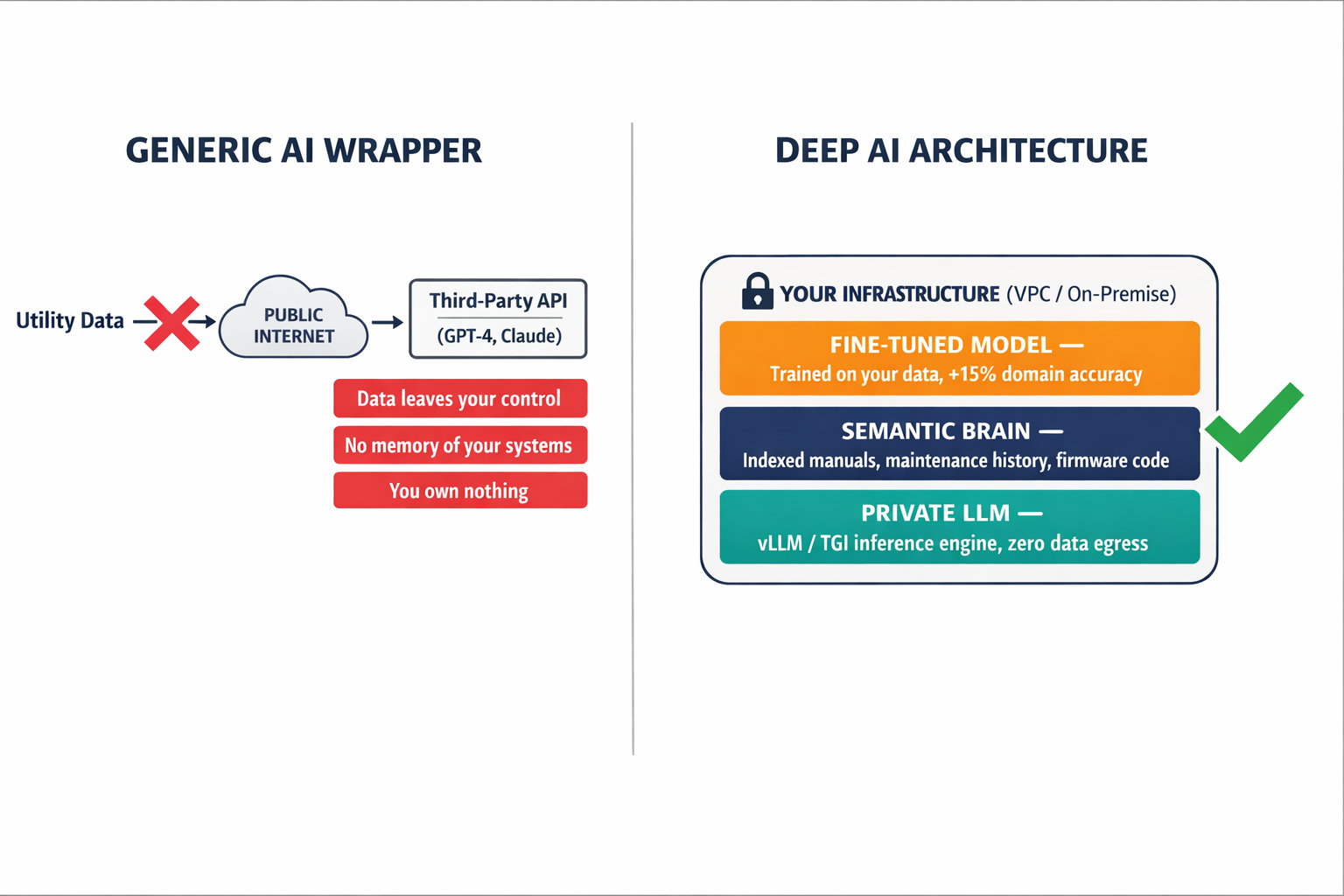
We use the term Deep AI to distinguish a fundamentally different approach from commodity AI wrappers. The core principle is straightforward: the intelligence that governs your critical infrastructure should run on hardware you control, trained on data that never leaves your perimeter.
This starts with deploying private Large Language Models within a utility's own infrastructure — their Virtual Private Cloud or on-premise servers. We deploy the full inference stack, including engines like vLLM and Text Generation Inference, directly onto the client's computing environment. The network configuration physically prevents data from reaching the public internet. No API calls to external servers. No data egress. The AI "brain" lives entirely on hardware the utility owns.
But a private model alone isn't enough. A generic open-source model deployed privately still doesn't understand your specific operations. That's where two additional layers come in.
The first is what we call a "semantic brain" — a system that ingests and indexes a utility's proprietary documents, technical manuals, historical maintenance reports, and even firmware source code into a local knowledge base. When someone queries the AI, it retrieves relevant context from this internal library. Critically, the system respects existing access controls: if an employee doesn't have permission to view a document in the source system, the AI won't surface that information either.
The second layer is model fine-tuning. We take capable open-source models and train them further on a utility's unique data — their specific nomenclature, their legacy systems, their operational patterns. This creates a bespoke model asset that belongs to the client, with accuracy improvements of up to 15% on domain-specific tasks compared to the generic base model.
For the full technical architecture behind this approach, including our firmware verification pipeline, see our detailed research on AMI resilience and Deep AI.
Catching Failures Before They Happen
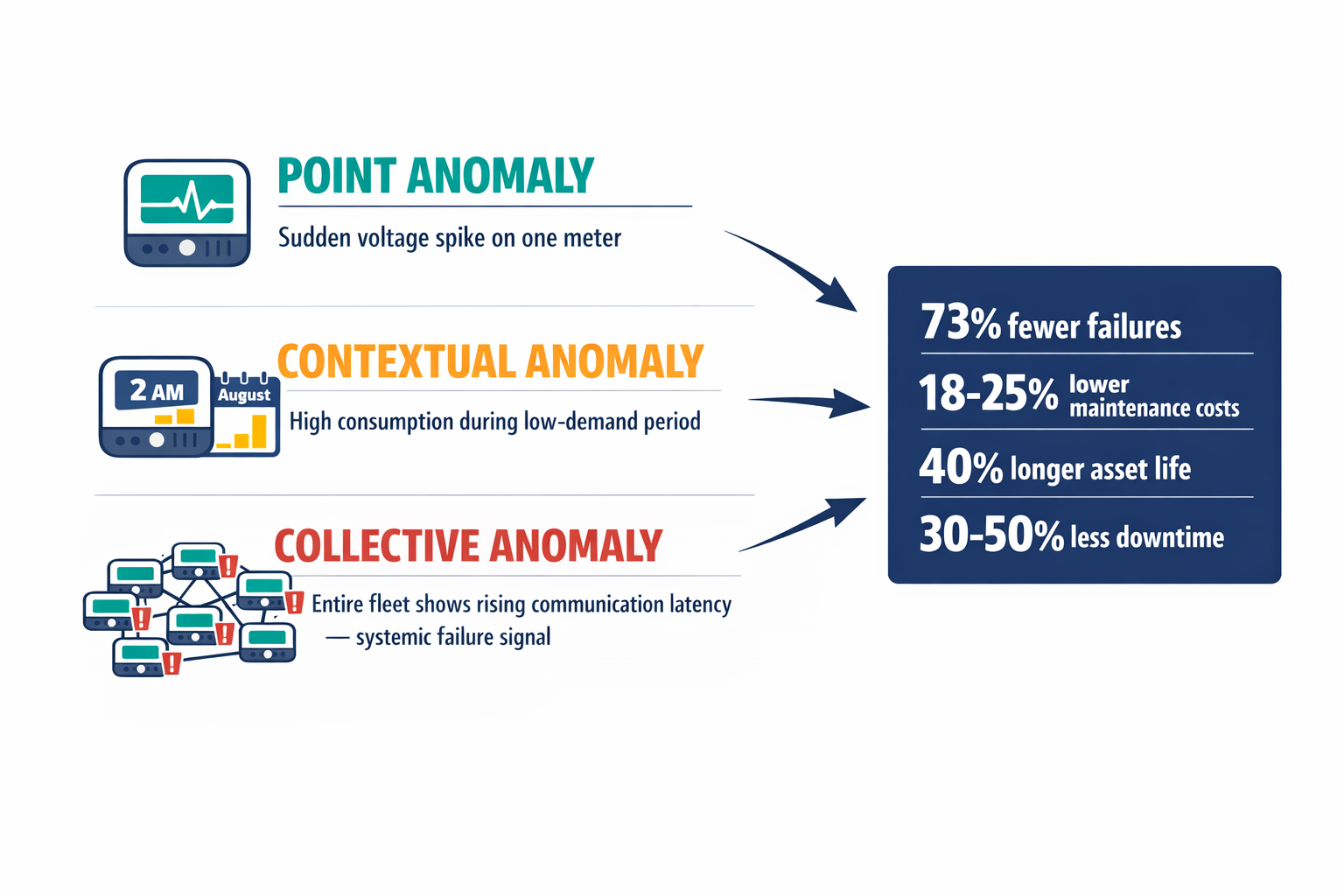
The most powerful application of this architecture isn't answering questions — it's watching for trouble. Deep AI models continuously analyze high-frequency data from IoT sensors to establish what "normal" looks like for every device in the network, then flag deviations before they become failures.
This works at three levels. A sudden voltage spike on a single meter is a point anomaly — one reading that doesn't fit. High energy consumption during a period of historically low demand is a contextual anomaly — normal data in an abnormal context. And when an entire fleet of meters simultaneously shows increased communication latency, that's a collective anomaly signaling a systemic issue, potentially an impending firmware failure like Plano's.
The results across the utility industry are striking. AI-driven predictive maintenance has been shown to reduce infrastructure failures by 73%, cut maintenance costs by 18-25%, and extend asset lifespans by up to 40%. Downtime drops by 30-50%. When you consider that utility outages cost industries an average of $125,000 per hour, the math becomes overwhelming.
Every anomaly detection includes an explanation — generated through explainable AI techniques — so human engineers can verify the finding and provide feedback. The system learns from every confirmation and every false positive, getting sharper over time. This isn't AI replacing human judgment. It's AI making human judgment faster and better-informed.
Stopping the Next Plano Before It Starts
The Plano disaster could have been prevented with one capability: automated firmware verification before field deployment. Our approach treats every firmware update as guilty until proven innocent.
We analyze firmware binaries — even when source code isn't available — using a combination of security analysis tools and private LLMs that examine decompiled code for logic flaws, insecure coding practices, and potential vulnerabilities. The firmware then gets deployed not to physical meters in the field, but to digital twins: detailed virtual replicas of smart homes and grid segments where AI agents use reinforcement learning to stress-test the software under thousands of scenarios.
Testing firmware on millions of physical devices in the field is like testing a parachute by jumping out of the plane. Digital twins let you test in the wind tunnel first.
This approach has been shown to find vulnerabilities 38% faster than random testing methods. For a city like Plano, that could have meant catching the firmware defect in a virtual environment instead of discovering it when 73,000 meters went dark.
What If Our Meters Are Already Failing?
If you're a utility leader reading this and thinking "we might already have this problem," you probably do. Silent data corruption from flash memory wear is, by definition, invisible until someone looks for it. The first step isn't deploying AI — it's auditing your current meter network for accuracy degradation patterns, especially on units more than five years old.
The regulatory direction is also clear. Ofgem's compensation mandate is the beginning, not the end. As smart meter deployments mature globally, expect similar accountability frameworks in North American markets. The cost of maintaining unreliable meters — in customer trust, regulatory fines, and emergency remediation — now exceeds the cost of implementing proactive AI-driven diagnostics.
Does This Require Ripping Out Existing Infrastructure?
No. Deep AI operates as a monitoring and intelligence layer on top of existing meter networks. The meters themselves don't change. What changes is the intelligence watching them — shifting from reactive ("the meter broke, send a technician") to predictive ("this meter's communication pattern suggests firmware degradation; schedule maintenance before it fails").
The investment case is straightforward: utilities that adopt AI-driven predictive maintenance see a 30% reduction in overtime costs from scheduled versus emergency repairs, a 28% reduction in component supply chain delays, and a 40% decrease in safety incidents. These aren't projections — they're benchmarks from real deployments.
The Twenty-Year Question
Smart meters were promised as twenty-year assets. The industry is learning, painfully, that hardware longevity means nothing without software resilience. The meters themselves might last two decades. The firmware governing them needs continuous, intelligent oversight that generic AI tools simply cannot provide.
The utilities that treat their meter networks as living systems — continuously monitored, proactively maintained, and governed by sovereign AI that understands their specific infrastructure — will avoid the next Plano. The ones that keep renting intelligence from public APIs and hoping for the best will keep hiring temporary meter readers.
We'd welcome hearing from utility leaders navigating these challenges. What's your experience been with smart meter reliability, and how is your organization thinking about AI for infrastructure management?