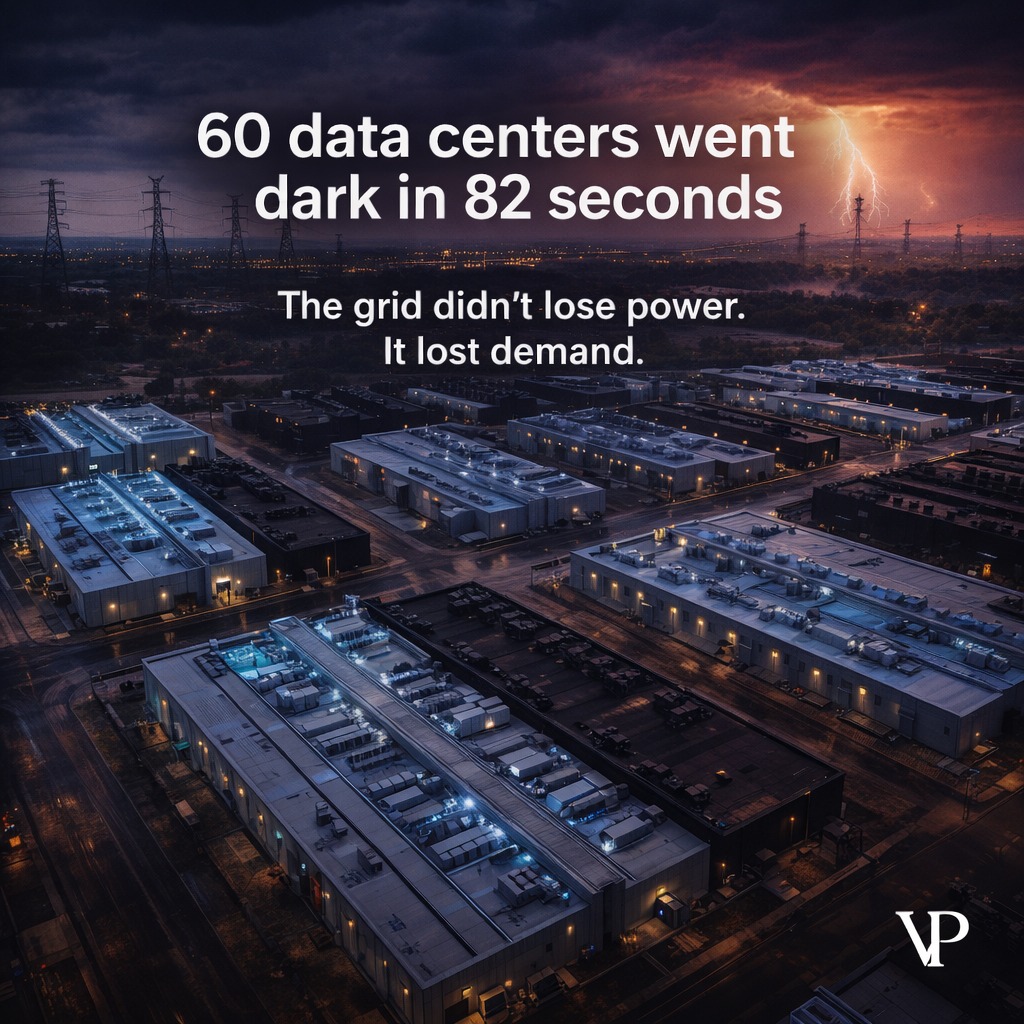
60 data centers disconnected in 82 seconds. The grid didn't lose power — it lost demand. And nobody saw it coming.
Last summer, a single lightning strike in Northern Virginia triggered a chain reaction that knocked 1,500 MW offline instantly. That's roughly the entire electricity demand of a city like Boston — gone in under two minutes.
But here's what makes this different from a normal outage:
The grid didn't lose a power plant. It lost the load. Sixty data centers read a series of voltage dips as a threat, tripped their safety protocols, and cut themselves off from the grid simultaneously.
Frequency spiked. Operators scrambled to manually power down gas and nuclear plants just to keep the system from overloading in the opposite direction.
This is a new category of risk. And it exposed something our team has been saying for a while — rule-based automation and generic AI models aren't built for this level of complexity.
The voltage dips were each within normal range. But the automated "counting logic" inside those facilities couldn't interpret the pattern. It treated a recoverable sequence as catastrophic.
Our latest whitepaper breaks down exactly what happened, why NERC issued emergency recommendations afterward, and how physics-constrained deep learning architectures can close the gap between what the grid needs and what current systems actually deliver.
We're talking about AI that doesn't just predict — it respects the physical laws governing power systems in real time.
The era of bolting a language model onto critical infrastructure and calling it "AI-powered" is over.
Save this if you work in energy, infrastructure, or enterprise AI. Then send it to someone who still thinks grid reliability is a solved problem.
What infrastructure risk keeps you up at night — grid stability, water, or something else entirely?
#GridResilience #EnergyInfrastructure #PhysicsInformedAI #DataCenterEnergy #DeepAIArchitecture