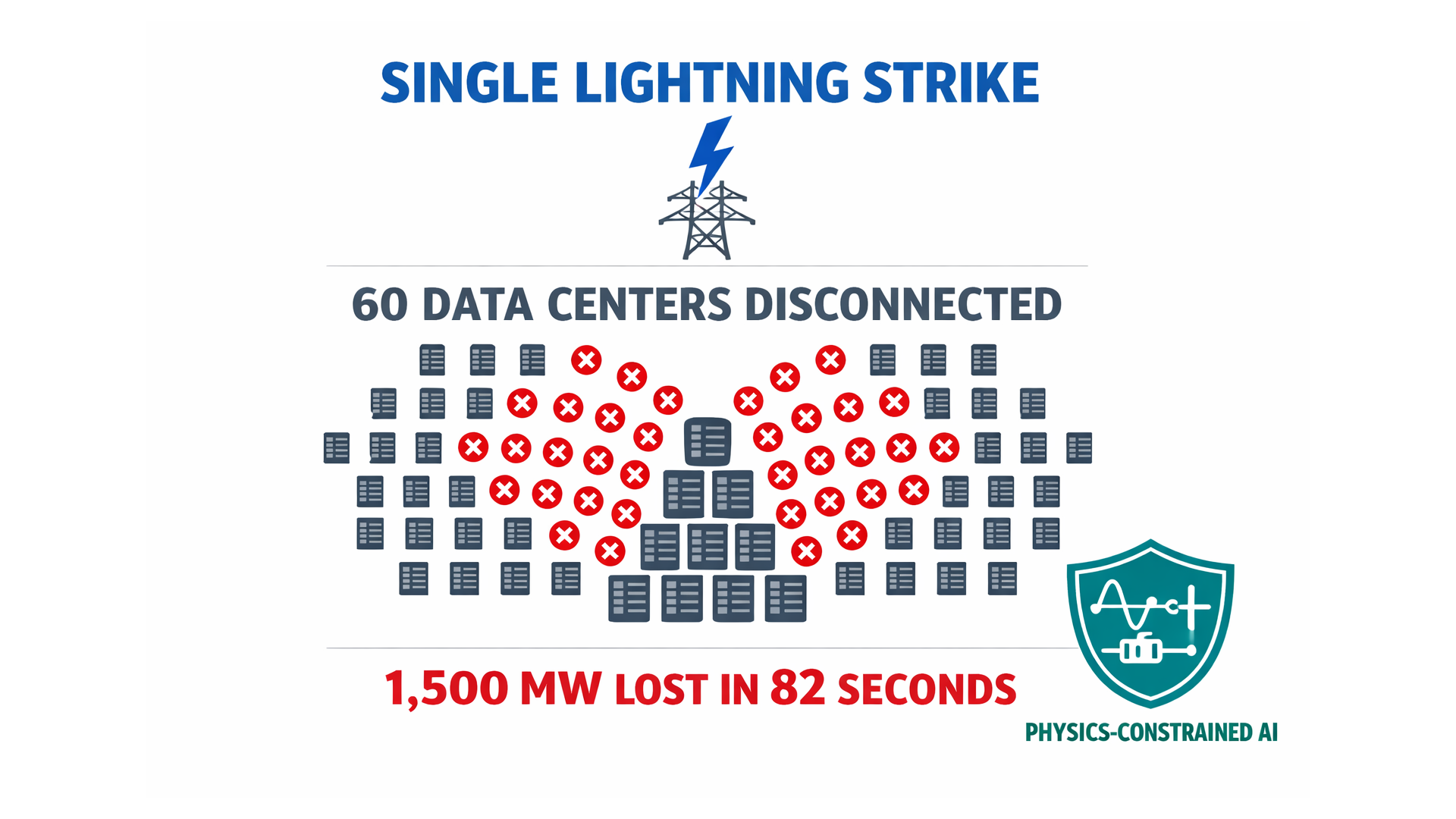
On July 10, 2024, a single lightning strike in Fairfax, Virginia triggered the simultaneous disconnection of 60 data centers, erasing 1,500 megawatts from the grid in under two minutes. That is roughly the entire electricity demand of the city of Boston, gone in the time it takes to send a text message. Federal regulators at the North American Electric Reliability Corporation (NERC) called it a "five-alarm fire for reliability." Our team has spent months analyzing why it happened, why conventional AI would have made it worse, and what physics-constrained intelligence must look like to prevent the next one.
This was not a power plant failure. It was something the grid was never designed to handle: a massive, instantaneous loss of demand. And it exposed a vulnerability that sits at the intersection of two industries racing ahead of their infrastructure -- hyperscale computing and artificial intelligence.
How Did a Single Lightning Strike Break the Grid's Logic?
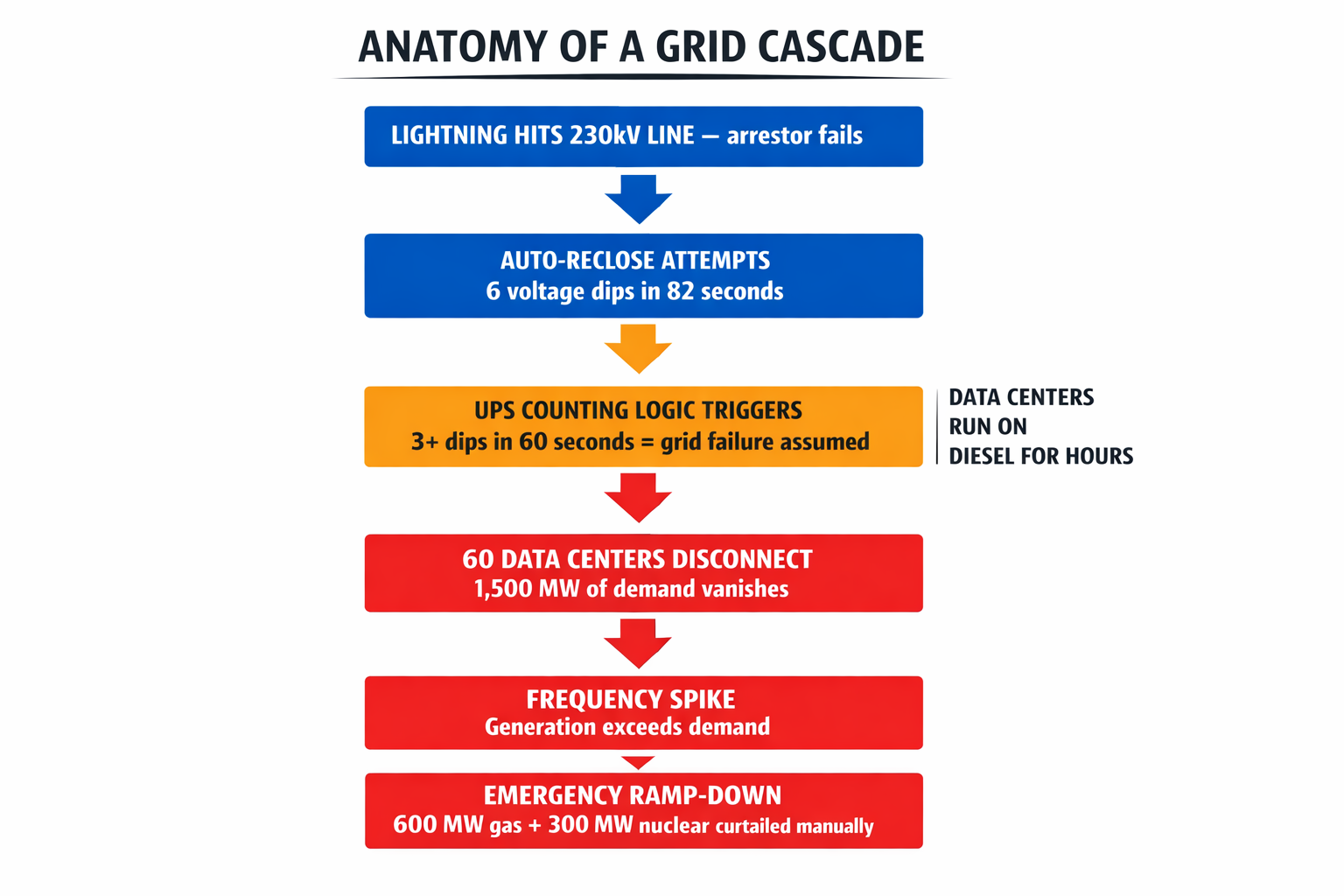
The technical chain of events is almost absurdly simple. A lightning arrestor failed on a 230-kilovolt transmission line. The grid's protection systems tried to auto-reclose the line -- standard procedure -- producing six successive voltage dips over 82 seconds. Each dip was within normal operating range. No single one was dangerous.
But the data centers' Uninterruptible Power Supply (UPS) systems use "counting logic": if they detect three or more disturbances within a single minute, they assume the grid is failing and disconnect to protect server hardware. Sixty facilities hit that threshold almost simultaneously, dumping 1,500 MW of load in a cascading wave.
The grid didn't lose power. It lost demand. And that is a problem no one had planned for.
When generation suddenly exceeds demand, frequency spikes rather than drops. Grid operators had to manually ramp down 600 MW from gas plants in Pennsylvania and 300 MW from a nuclear unit in Virginia just to prevent transformer overloads. The data centers, meanwhile, sat on diesel generators for hours -- each facility burning thousands of gallons of fuel because their automated systems had no way to reconnect without human intervention.
Why Does "Shallow" AI Make Grid Failures Worse?
Our research into this incident led us to a conclusion that applies far beyond the energy sector: the current generation of AI tools -- what we call LLM wrappers -- are fundamentally unsuited for systems where physics matters.
Large Language Models (LLMs) are probabilistic engines. They predict the next most likely word. They optimize for plausibility, not accuracy. When a media company used one to generate content, fabricated articles caused a 27% stock price collapse. In a newsroom, that is a scandal. In a grid control room, the same kind of "confident but wrong" output could trigger a regional blackout.
The standard approach -- Retrieval-Augmented Generation, or RAG -- treats grid data as searchable text. It can find a document about Substation A and a separate document about Data Center B. What it cannot do is understand that they are physically connected by 12 miles of transmission line and that a fault on one directly threatens the other.
Plausibility is not truth. In mission-critical infrastructure, the difference is measured in megawatts and minutes.
We explored this problem in depth in our interactive analysis of structural resilience and physics-constrained intelligence.
What Does It Mean to Teach AI the Laws of Physics?
To manage a system as volatile as the Virginia grid corridor, AI must do more than parse language. It must understand electromagnetism and thermodynamics. Our team works with Physics-Informed Neural Networks (PINNs) -- a class of deep learning models that embed the actual equations governing power flow directly into the AI's learning process.
Think of it this way: a standard neural network learns patterns from data and hopes those patterns hold in new situations. A PINN learns patterns and is physically incapable of violating Kirchhoff's Laws -- the fundamental rules that govern how electrical current and voltage must balance at every point in a circuit. It is the difference between an intern who memorized the manual and an engineer who understands why the manual exists.
The performance difference is measurable. In benchmarks on AC Optimal Power Flow -- the core optimization problem for grid management -- PINN-based approaches achieved 0.64 MW deviation from ground truth compared to 0.73 MW for standard neural networks, with inference latency under 0.7 milliseconds. That speed matters: arresting a 1,500 MW frequency spike requires sub-second response, not the minutes that traditional optimization methods need.
The "Sandwich" That Stops Hallucinations
Physics-constrained models handle the math. But grid operations also involve regulatory compliance, contractual obligations, and operational protocols -- domains where you need logical reasoning, not just numerical precision.
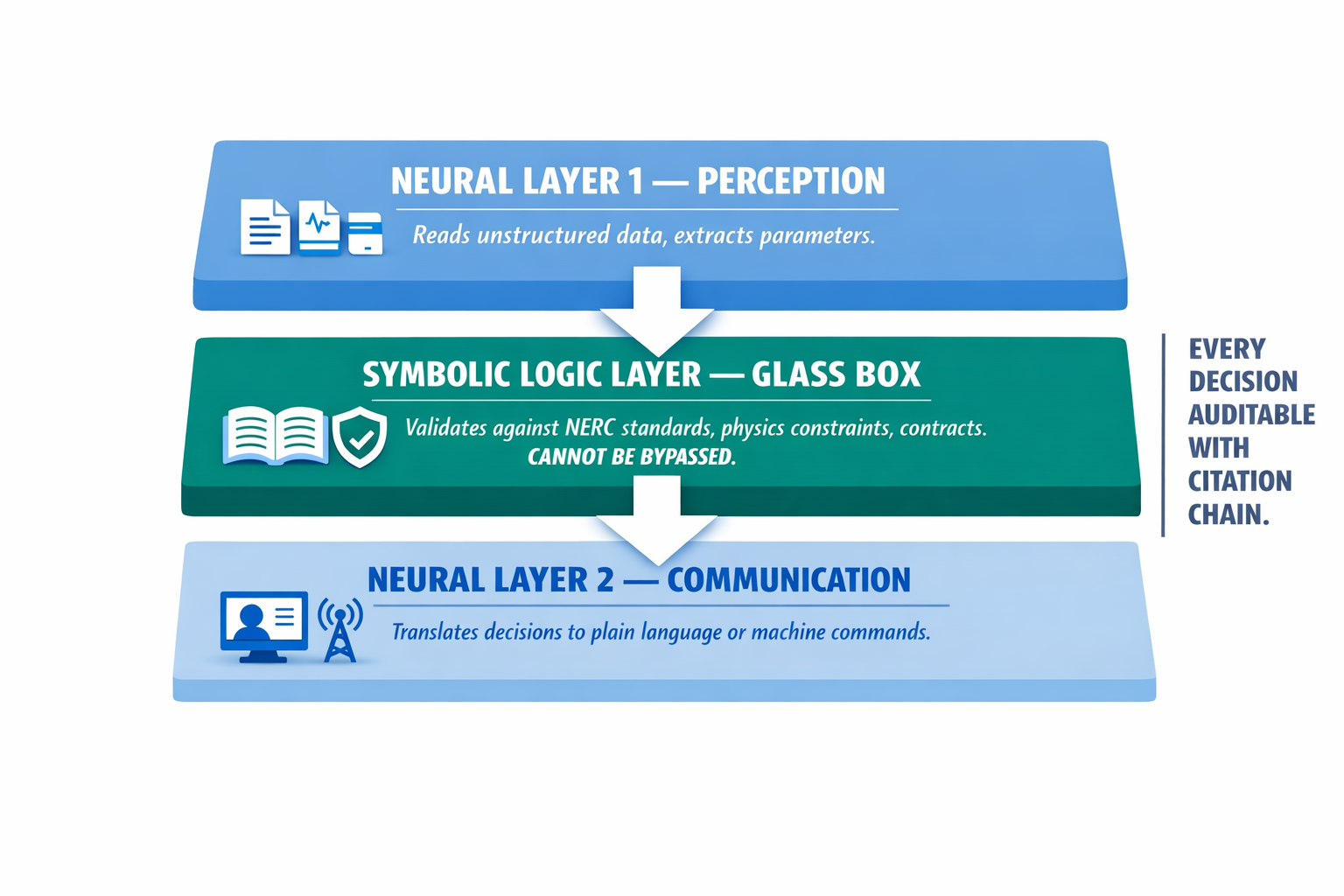
Our approach uses what we call a Neuro-Symbolic architecture, and it works by dividing the job into layers that check each other. The first layer is a neural network trained to read messy, unstructured documents -- interconnection filings, regulatory submissions, operational logs -- and extract the specific parameters buried inside them. Those extracted values then pass through a symbolic logic layer, essentially a rulebook written in code, that validates every number against hard constraints: NERC reliability standards, the physics of the grid itself, and contractual thresholds. No amount of creative prompting can bypass this layer. Once a decision clears that gauntlet, a second neural network translates it into plain language for operators or into machine-readable control signals.
The critical insight is separation of concerns. The AI that reads your documents is not the same AI that makes decisions. The decision layer is rule-based and auditable -- what we call a "Glass Box." Every output comes with a citation chain: "This load ramp was flagged because it violated the N-1 contingency constraint -- the requirement that the grid must keep operating even if any single major component fails -- as defined in NERC TPL-001."
For the full technical methodology behind this architecture, see our detailed research on structural resilience.
Virginia's Looming Infrastructure Crisis
The July 2024 event was a symptom, not an anomaly. Virginia hosts 70% of global internet traffic. Dominion Energy's data center capacity is projected to grow from 4 GW today to nearly 40 GW in contracted capacity. The numbers cascading from that growth are staggering:
Regional capacity prices have spiked 833%
Residential electricity bills are projected to reach $380 per month by 2045
The state has provided $2.7 billion in data center subsidies over the past decade
Virginia needs $28.3 billion in new transmission infrastructure
Without deep AI optimization, the Department of Energy projects outages could spike from 2.4 hours per year to over 430 hours by 2030.
The bottleneck is not generation. It is transmission. Virginia needs 40% more transmission capacity than it currently has, at a buildout pace that state auditors call "very difficult to achieve." Meanwhile, Northern Virginia data centers consumed nearly 2 billion gallons of water for cooling in 2023 and rely on roughly 9,000 diesel backup generators -- generators that the July incident proved are not just backups but a core part of daily operations.
How Can Data Centers Become Grid Assets Instead of Liabilities?
The path forward requires data centers to stop being passive consumers and start actively stabilizing the grid. We advocate for adoption of OpenADR 3.0 (Open Automated Demand Response), a modernized protocol that enables sub-second flexibility using standard RESTful APIs and JSON messaging -- a significant upgrade from the older XML-based version that was too slow and rigid for hyperscale facilities.
Through initiatives like EPRI's DCFlex program, data centers are being recruited into demand response programs. The math is compelling: by curtailing just 0.5% of annual electricity use during peak periods, 100 GW of data center load could be integrated into the grid without building new gas plants. Our AI agents serve as the orchestration layer, dynamically shifting computational workloads between geographic regions or to on-site storage to balance grid frequency while minimizing disruption to operations.
What If the Grid Cannot Be Upgraded Fast Enough?
This is the question we hear most from utility executives, and the honest answer is that physical infrastructure alone will not solve this. Transmission buildouts take 7-10 years. Data center demand is growing now. The gap has to be filled with intelligence -- not the shallow kind that predicts the next word, but the deep kind that respects the laws of physics.
That means physics-constrained models for real-time grid control. It means symbolic logic layers for regulatory compliance. It means Knowledge Graphs that understand spatial and temporal relationships between substations, transmission lines, and load centers -- not just text similarity between documents.
Power reliability is now a board-level variable. If your organization operates, hosts, or depends on data center infrastructure, three things matter immediately: whether your protection logic accounts for cascading disconnection scenarios like Virginia's, whether your AI systems can reason about physics or just about text, and whether your demand response capabilities operate at sub-second timescales.
The next time the grid blinks, the question is not whether your AI noticed. It is whether your AI understood the physics well enough to act before the lights went out. If your team is wrestling with how to bring physics-constrained intelligence into your grid or data center operations, we would welcome that conversation.