On July 10, 2024, a single lightning strike in Fairfax, Virginia triggered the disconnection of 60 data centers in 82 seconds. 1,500 megawatts of electrical demand — the entire power consumption of Boston — vanished from the grid instantaneously. Federal regulators at NERC called it a "five-alarm fire for reliability." And the most unsettling part? Every automated system involved worked exactly as it was programmed to.
That's the sentence that kept me up at night. Not a failure of technology. A failure of design philosophy — the same philosophy that dominates how we build AI systems for critical infrastructure today. We optimize for plausibility when we should be engineering for physics.
I wrote a detailed analysis of this incident and what it means for AI architecture because I believe this event is a preview of the next decade's biggest enterprise risk: the collision between AI-scale compute and the physical limits of the systems that power it.
What Actually Happened in Those 82 Seconds
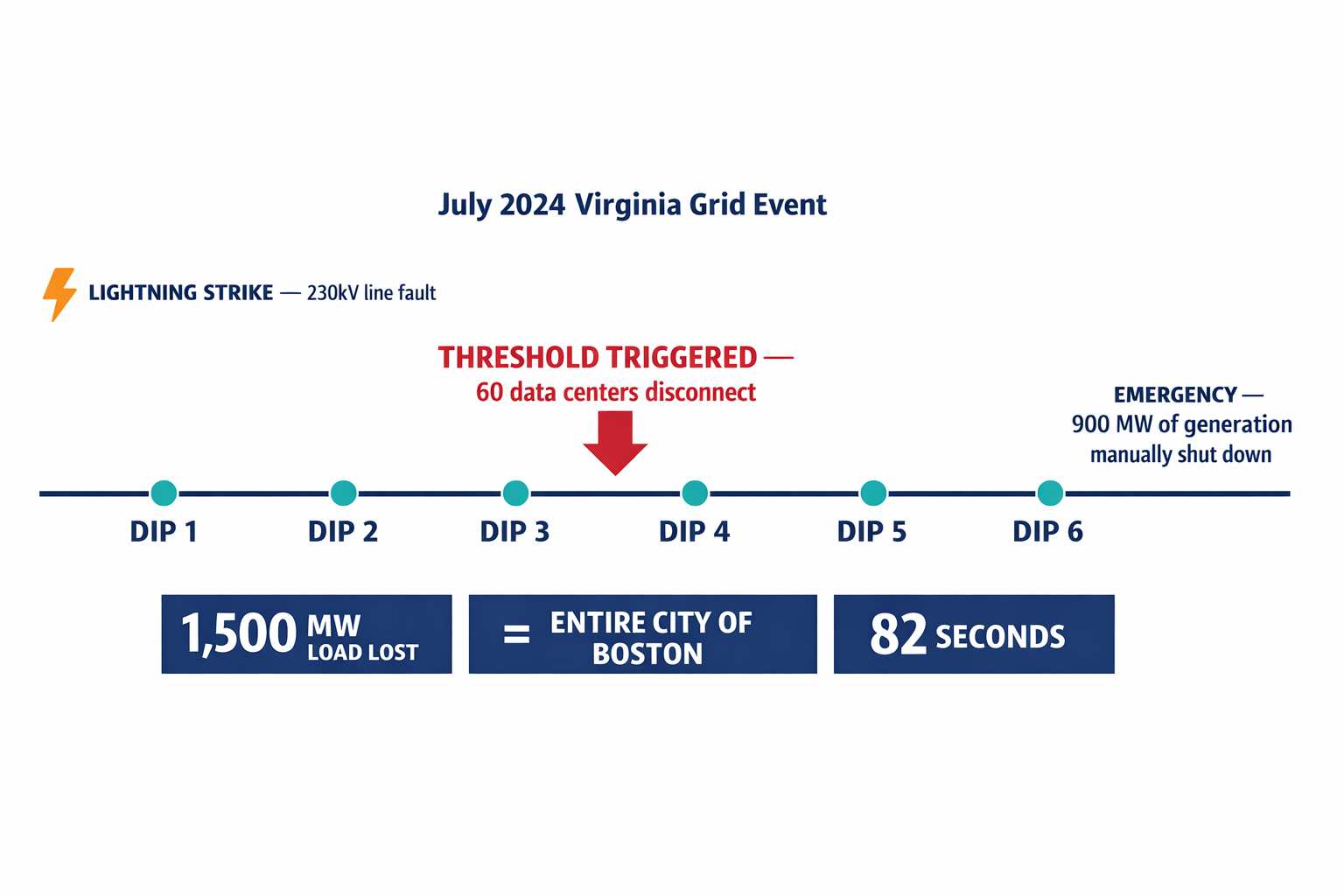
A lightning arrestor failed on a 230-kilovolt transmission line. Routine stuff — the grid handles thousands of faults like this every year. The protection systems did their job: they tried to automatically reconnect the line, failed because the fault was permanent, tried again, failed again. Six voltage dips in 82 seconds.
None of those dips were dangerous on their own. Each stayed within the grid's normal ±10% operating range. But the data centers' backup power systems were counting. They're programmed with a simple rule: if you see three voltage disturbances within a minute, assume the grid is unstable and disconnect.
Three dips happened. Sixty data centers cut themselves off from the grid simultaneously.
The grid didn't lose generation. It lost demand. And that distinction nearly broke everything.
When a power plant trips offline, frequency drops and operators know exactly what to do. But when 1,500 MW of load disappears, frequency surges upward — the electrical equivalent of slamming the accelerator when the car is already at highway speed. Grid operators had to scramble to shut down 600 MW of gas plants in Pennsylvania and 300 MW from a nuclear unit in Virginia just to keep the system from overloading transformers across the region.
The data centers, meanwhile, sat on diesel generators for hours. They couldn't reconnect automatically. Manual intervention was required for each one.
The "Counting Logic" Problem Is an AI Problem
When I explained this to my team, one of our engineers said something that reframed the entire incident for me: "That's just a really expensive version of what happens when you build AI without physics."
She was right. The data centers' protection systems made a locally rational decision — protect the servers — that was globally catastrophic. They had no awareness of what was happening at the other 59 facilities. No understanding of how the grid would respond to their collective action. No model of the physical system they were embedded in.
This is exactly what happens when you wrap a language model around a critical process and call it AI. The model optimizes for the most plausible next action based on its narrow context window. It has no concept of the physical constraints governing the system it's operating in. It can't reason about second-order effects.
Standard AI predicts what seems right. Physics-constrained AI knows what's actually possible.
I've watched the enterprise AI market flood with what I call "wrapper" architectures — thin software layers that route prompts to large language models and return whatever sounds most reasonable. For writing marketing copy, that's fine. For managing systems where electrons move at the speed of light and a wrong decision cascades across 65 million people's power supply, it's reckless.
Why the Grid Can't Wait for Better Prompts
NERC responded to the Virginia event by establishing a Large Loads Task Force, now elevated to a full Working Group. They issued a Level 2 Industry Alert — one step below mandatory — requiring utilities to install high-resolution monitoring equipment, validate their simulation models against real event data, and establish real-time communication protocols between data center operators and grid managers.
The core technical finding was damning: the models utilities use to simulate data center behavior don't capture what data centers actually do during a fault. Traditional load models assume loads behave like motors and resistors. Data centers are walls of power electronics that cease consumption in milliseconds and may or may not reconnect afterward.
NERC endorsed a new modeling approach called PERC1 — Power Electronic Ceasing and Reconnecting — specifically designed to represent this behavior. But a model is only as useful as the intelligence layer interpreting it in real time.
Virginia currently hosts 70% of global internet traffic. Dominion Energy's data center capacity is projected to grow from 4 gigawatts to nearly 40 gigawatts. Regional electricity capacity prices have spiked 833%. Residential bills could hit $380 per month by 2045. The state needs 40% more transmission capacity, and regulators say building it fast enough will be "very difficult to achieve."
Without real-time AI that understands grid physics, the Department of Energy projects outages could spike from 2.4 hours per year to over 430 hours by 2030.
That number stopped me cold. We're not talking about inconvenience. We're talking about a region that powers a significant portion of the global internet becoming unreliable.
Teaching AI the Laws of Physics
This is where my team's work comes in, and where I'll be blunt about what I think the industry is getting wrong.
At Veriprajna, we build what we call Physics-Informed Neural Networks — PINNs — for grid applications. The core idea is deceptively simple: instead of training a neural network purely on historical data and hoping it learns the right patterns, you embed the actual equations governing electrical systems directly into how the network learns.
Think of it like this. A standard AI learns to predict grid behavior the way a child learns to catch a ball — through repetition and pattern matching. It works great until someone throws a ball with unusual spin. A physics-informed AI learns to predict grid behavior the way a physicist does — it understands gravity, air resistance, and angular momentum. It can handle the unusual throw because it knows the rules, not just the patterns.
In practice, the network's learning process includes a penalty for any prediction that violates Kirchhoff's Laws (the fundamental rules of how electricity flows in circuits) or the Swing Equation (which governs how generators maintain stable frequency). The AI literally cannot hallucinate a physically impossible grid state.
Our benchmarks show PINN-based approaches achieve frequency deviation of less than 0.12 Hz with inference latency below 0.7 milliseconds. For context, the Virginia event caused a 0.047 Hz spike that required manual intervention across multiple states. A system that can respond in under a millisecond with physics-guaranteed accuracy changes the game entirely.
For the full technical methodology and performance benchmarks, I've published our detailed research — including how PINNs compare against traditional optimization and standard neural networks on computation time, accuracy, and physical feasibility.
The Architecture That Prevents Hallucination
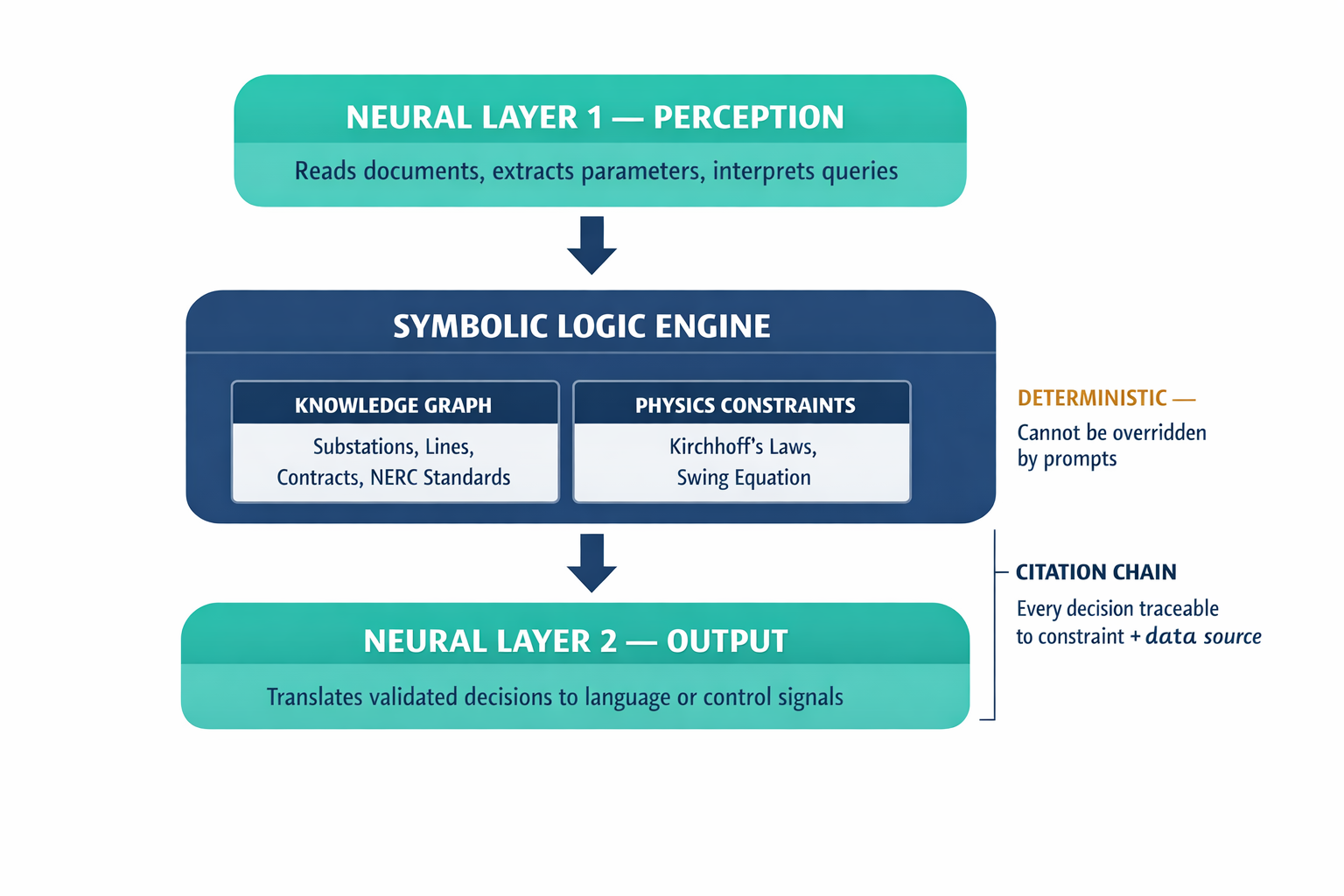
Physics constraints handle the math. But grid management also requires reasoning about regulations, contracts, interconnection agreements, and operational procedures. For this, we use what I call a Neuro-Symbolic Sandwich — and yes, my team groans every time I use that name, but it sticks because it's accurate.
The first neural layer handles perception: reading unstructured documents, extracting parameters from interconnection filings, understanding what a human operator is asking. It's the "ear."
The middle symbolic layer is the critical piece. It's a deterministic logic engine connected to a Knowledge Graph — a structured map of relationships between substations, transmission lines, data center contracts, and NERC standards. This layer doesn't predict. It reasons. It checks extracted information against hard-coded rules and physical constraints. No amount of creative prompting can convince this layer that violating an N-1 contingency standard is acceptable.
The final neural layer translates validated decisions into natural language or control signals. It's the "voice" — but it's only allowed to communicate what the logic layer has already approved.
Every decision has a citation chain. Not "trust me, I'm AI" — but "this was flagged because it violates constraint X defined in standard Y, based on data from source Z."
This matters enormously in regulated industries. When a grid operator makes a decision during an emergency, regulators will want to know why. "The AI said so" isn't an answer. "The system identified that reconnecting Facility 47 would exceed the thermal rating of Line 230-A by 12%, per NERC standard TPL-001, given current ambient temperature and existing load" — that's an answer.
Turning Data Centers from Liabilities into Grid Assets
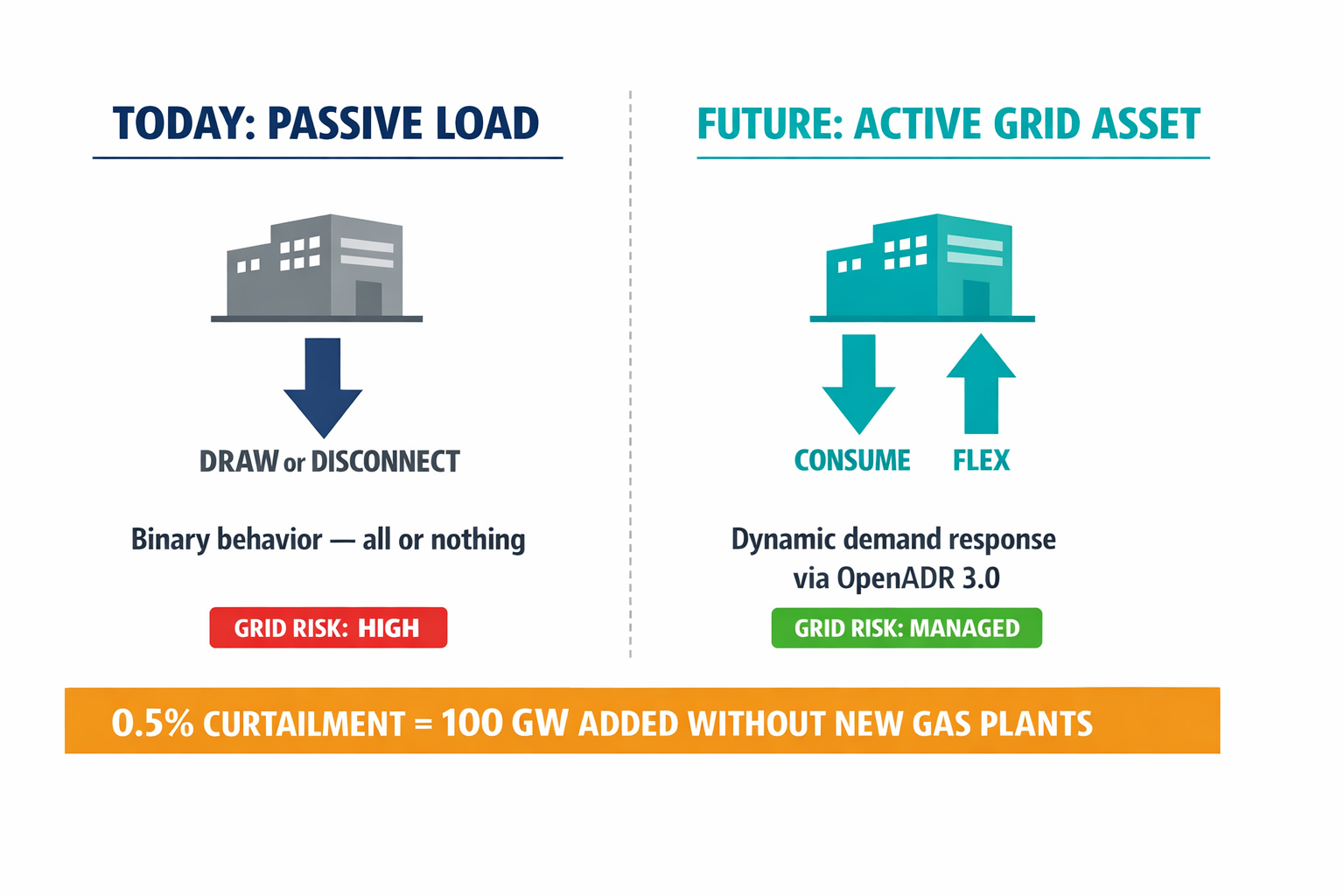
The most promising development I've seen is the shift in thinking about what data centers could be for the grid. Right now, they're passive consumers — enormous, inflexible loads that either draw power or don't. But they don't have to be.
A new protocol called OpenADR 3.0 enables sub-second demand response communication between data centers and grid operators. The older version was clunky — built on XML messaging with minute-scale latency. Version 3.0 uses modern REST APIs and can signal in under a second. That's fast enough to participate in real-time frequency regulation.
EPRI's DCFlex initiative is already recruiting data centers into demand response programs. The math is compelling: by curtailing just 0.5% of annual electricity use during peak periods, 100 GW of data center load could be added to the grid without building new gas plants. Half a percent. That's the equivalent of shifting some batch AI training jobs by a few hours or temporarily throttling non-critical cooling loops.
Our AI agents are designed to be the orchestration layer for this — dynamically deciding which workloads can shift, which cooling systems can temporarily reduce output, and which facilities should absorb load from neighbors experiencing constraints. All while maintaining the physics constraints that prevent the kind of cascading disconnection we saw in Virginia.
What If This Happens Again — But Bigger?
This is the question I keep asking, and I don't think the industry has a good answer yet.
Virginia's data center capacity is growing tenfold. The transmission system that buckled under 1,500 MW of sudden load loss will soon be managing loads an order of magnitude larger. The same "counting logic" that triggered the July 2024 event hasn't been fundamentally redesigned — it's been patched.
Some will argue that better coordination between data centers and utilities solves this. It helps, but coordination assumes you have time to coordinate. The Virginia event unfolded in 82 seconds. Human-in-the-loop decision-making doesn't work at that timescale.
Others will point to batteries and on-site generation. Those help with individual facility resilience but do nothing for the grid-level frequency problem. If anything, they make it worse — more facilities that can instantly island themselves means more potential for sudden, massive load swings.
The only path I see that scales is AI that understands physics at the speed physics operates. Not AI that reads about physics in training documents and generates plausible-sounding responses. AI with physical laws baked into its mathematical foundation, wrapped in deterministic logic that can be audited and verified, connected to real-time telemetry that updates faster than the faults it needs to manage.
Power reliability is now a board-level variable. The companies that treat it as an IT problem will be the ones explaining outages to their customers.
What This Means If You're Making Decisions Right Now
If you're a utility executive, the NERC Level 2 Alert isn't optional in spirit, even if it's technically one step below mandatory. The data center operators in your territory are going to keep building. Your grid models probably don't capture their actual fault behavior. Start with PERC1 modeling and high-resolution monitoring — those are table stakes.
If you're running data center operations, your facility's protection logic was designed for a world where you were one of a few large loads on the system. You're now one of sixty. The "counting logic" that protects your servers can destabilize the grid that feeds them. Demand response participation through frameworks like DCFlex isn't charity — it's self-preservation.
If you're building AI for any infrastructure application, I'd challenge you to answer one question: can your system guarantee that its outputs are physically possible? If the answer involves the words "usually" or "in most cases," you're building a wrapper, not a solution.
The Virginia near-blackout taught us that systems designed to protect individual assets can collectively destroy the infrastructure those assets depend on. That's not just a grid problem. It's the defining challenge of building AI for the physical world.
I'd genuinely like to hear from anyone wrestling with this intersection of AI and physical infrastructure — whether you're on the grid side, the data center side, or building the intelligence layer in between. What are you seeing that keeps you up at night?