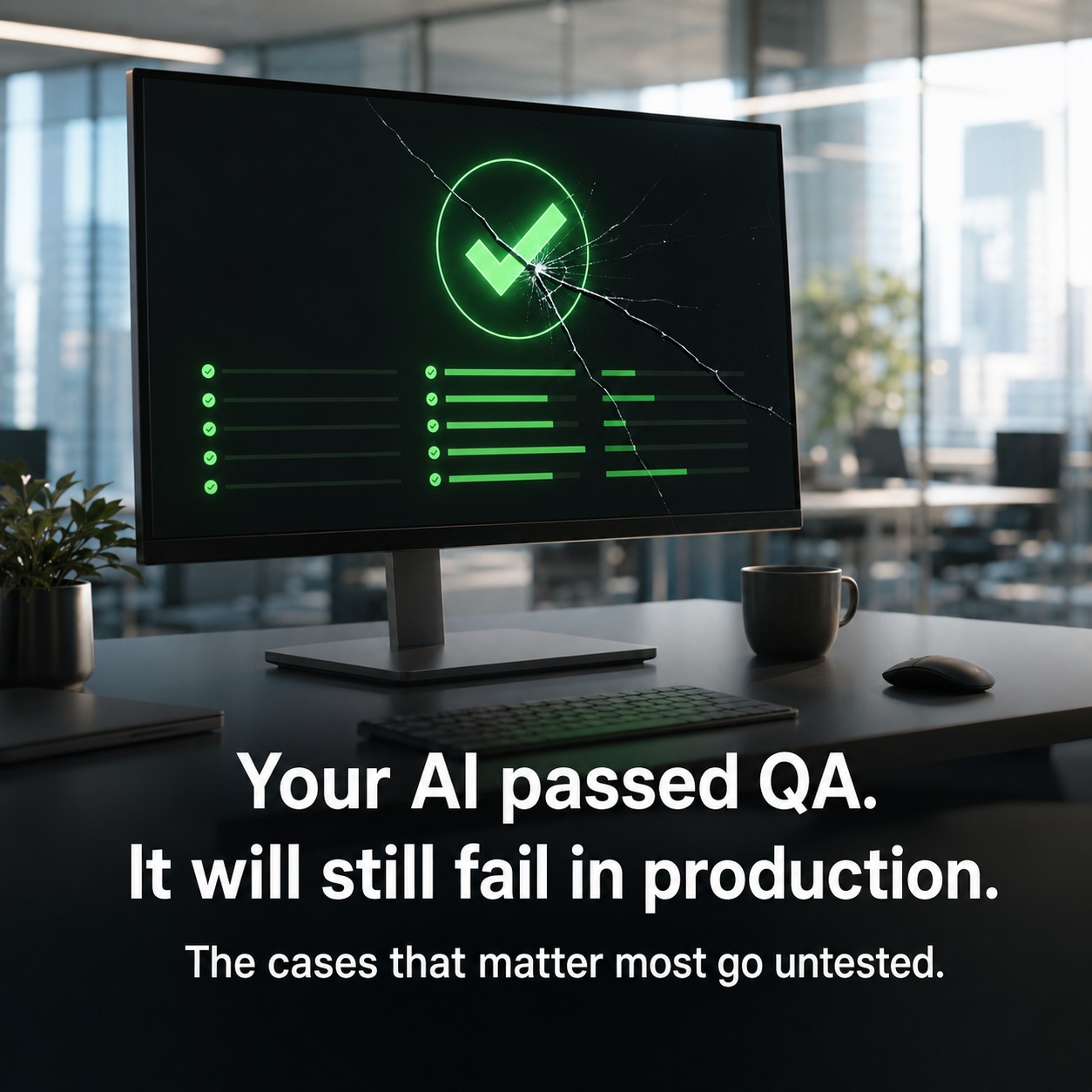
Klarna replaced 700 customer service agents with AI. Costs dropped 40%. Q1 2025 closed with a $99 million net loss.
The AI handled password resets flawlessly. It collapsed on the multi-currency refund tied to a cancelled flight and a disputed charge — the 20% of cases that carry the brand, the compliance exposure, the lifetime value.
Nobody validated whether it could handle those. Within months, Klarna rehired humans.
That's the validation gap, and it's why 70-85% of enterprise AI projects never reach production. The pilot passes QA, then meets the edge cases QA never covered.
Here's what no governance dashboard catches: a toxicity filter won't flag an AI that miscalculates an insurance reserve, cites a repealed statute, or approves a loan that breaks fair-lending rules. On legal due diligence, AI error rates run 69-88%. A green compliance dashboard doesn't mean correct outputs.
Security validation has the same blind spot. An AI hardened against prompt injection can still hallucinate case law: model security stops attacks, not hallucinations.
The stakes are now regulatory. The EU AI Act's high-risk rules go live August 2026, with penalties up to EUR 35M per violation. SR 11-7 already treats any model used for business decisions, LLMs included, as model risk that must be independently validated, documented, and monitored. The bind: that validation must be independent, yet proprietary LLM vendors won't explain how their models work. You're documenting risk for a black box you can't open.
The fix isn't another dashboard. It's domain-specific validation — what we build for regulated enterprises: testing outputs against the truth of your field, before and after production.
If your AI got that wrong in your domain — the misread reserve, the repealed statute, the bad loan — would your current testing have caught it before production? Save this if you're deploying AI in a regulated industry.
#EnterpriseAI #AIGovernance #AIValidation #EUAIAct #ModelRiskManagement