The Klarna reversal hit my inbox in May 2025 and I didn't feel vindicated — I felt something closer to recognition.
They had done everything you're supposed to do. The AI assistant that replaced 700 customer service agents was real: costs dropped from $0.32 to $0.19 per transaction. The 40% cost reduction was real. What Klarna didn't have was a measurement framework for what "working correctly" meant in their domain — not at the level of transaction cost, but at the level of whether the AI could handle a fraud report, a complex billing dispute, an account closure with anything close to the quality of a trained human agent. By Q1 2025, the net loss was $99 million, up from $47 million the prior year, despite 15% revenue growth. Sebastian Siemiatkowski acknowledged publicly that automation at scale had led to a drop in service quality. Orgvue and Forrester subsequently found that 55% of companies that rushed AI-for-human replacement now regret it.
I'd been in enough model risk committee rooms to know how it happens. Not because anyone was reckless — because the measurement gap is real and almost no one has closed it.
The Meeting That Changed What We Were Building
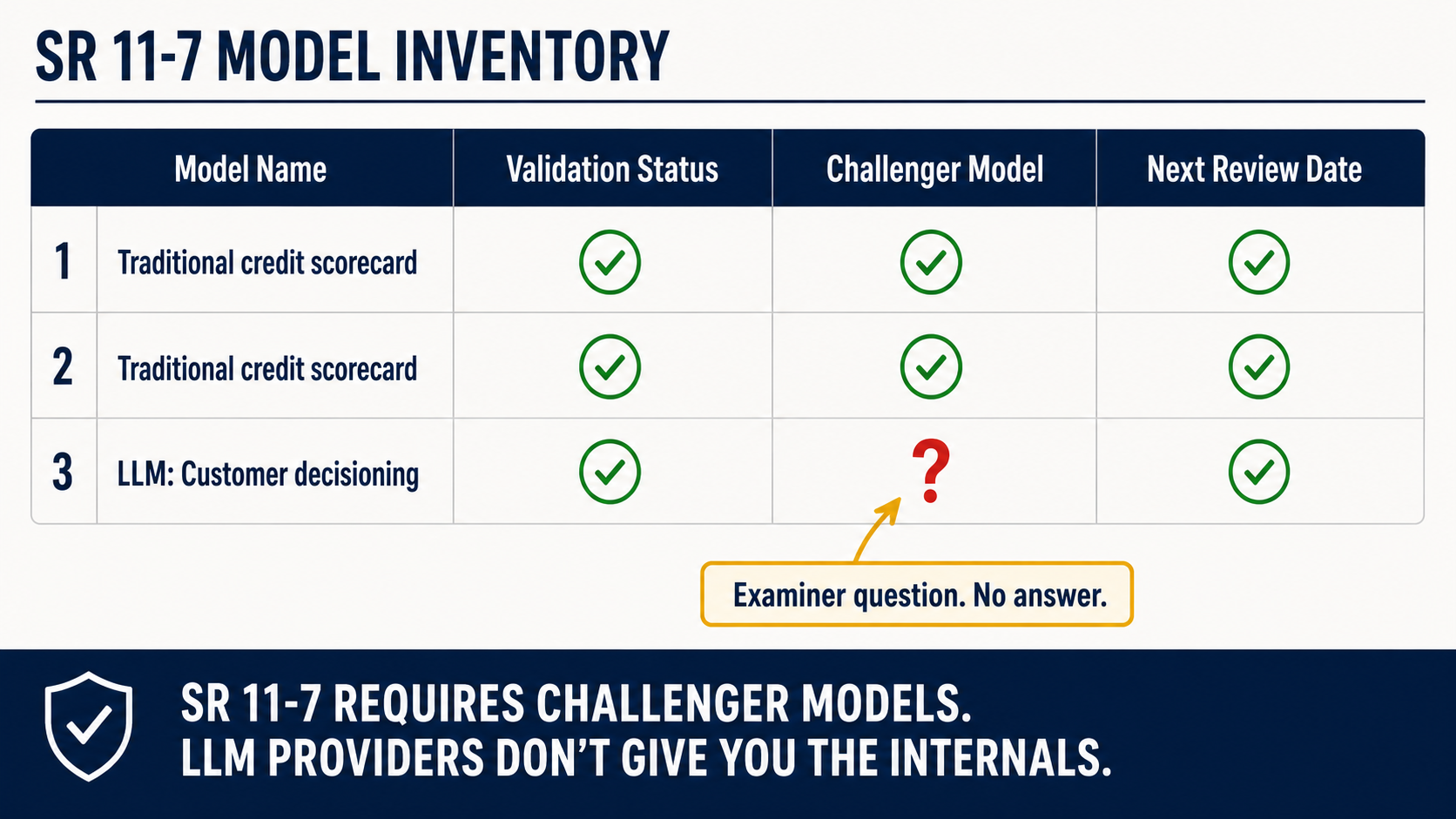
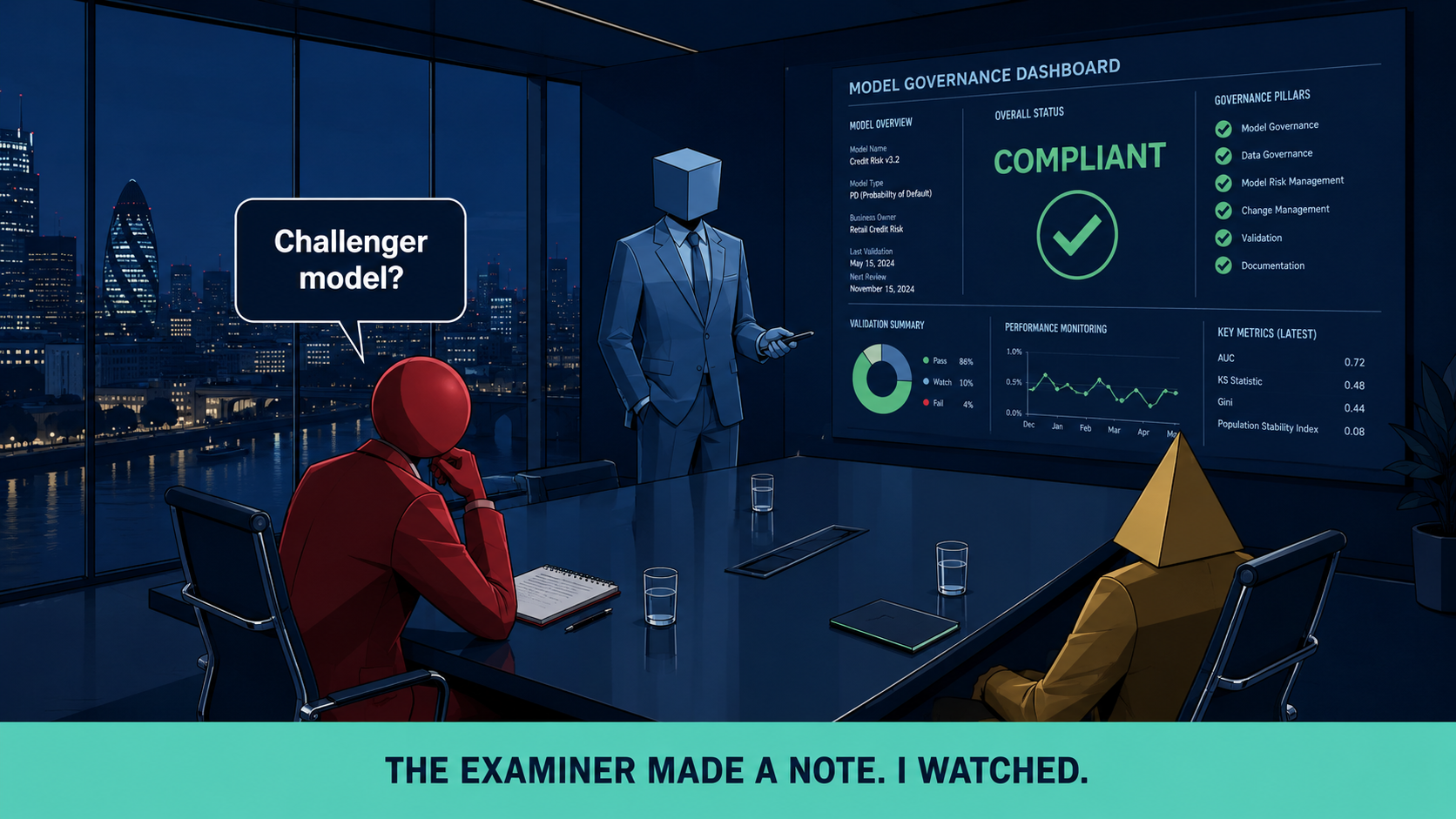
My clearest reference point for understanding this gap is a governance review I sat in at a Tier-1 bank. The quant presenting the new LLM deployment was sharp, well-prepared, and had a complete governance package — policy documentation, lifecycle tracking, a written validation plan referencing SR 11-7's four pillars. What he couldn't answer was the examiner's question about the challenger model.
SR 11-7 — the Federal Reserve and OCC's model risk management guidance from 2011, now explicitly covering any model used for business decisioning including LLMs — requires a challenger model: an independent benchmark that produces statistical performance bounds the primary model has to beat. For a traditional credit scorecard, this is straightforward. For an LLM, the quant explained, they couldn't design a challenger that operated without access to model weights — and the proprietary LLM provider wouldn't give them the internals.
The examiner made a note. I watched the quant realize that his documentation of a validation methodology was not the same as having completed validation. That was when the distinction between a governance program and a validation practice became concrete for me — not as a theoretical distinction, but as something an examiner can expose in about forty-five minutes.
ValidMind and ModelOp have built SR 11-7 documentation workflows for AI systems. Legitimate and useful. What they haven't built is the output-distribution testing methodology that makes the documentation true. The difference between having a challenger model test report and having a governance dashboard that says you have a challenger model process matters to an examiner who's sat through post-mortems.
Why I Stopped Leading With Governance
When I first started describing what we were building at Veriprajna, I used governance as the opening frame. It made intuitive sense — the regulatory hooks were everywhere, the EU AI Act enforcement timeline was real (August 2026 for high-risk AI systems, with fines up to EUR 35 million or 7% of global turnover), the NIST AI Risk Management Framework was becoming the benchmark that other frameworks referenced.
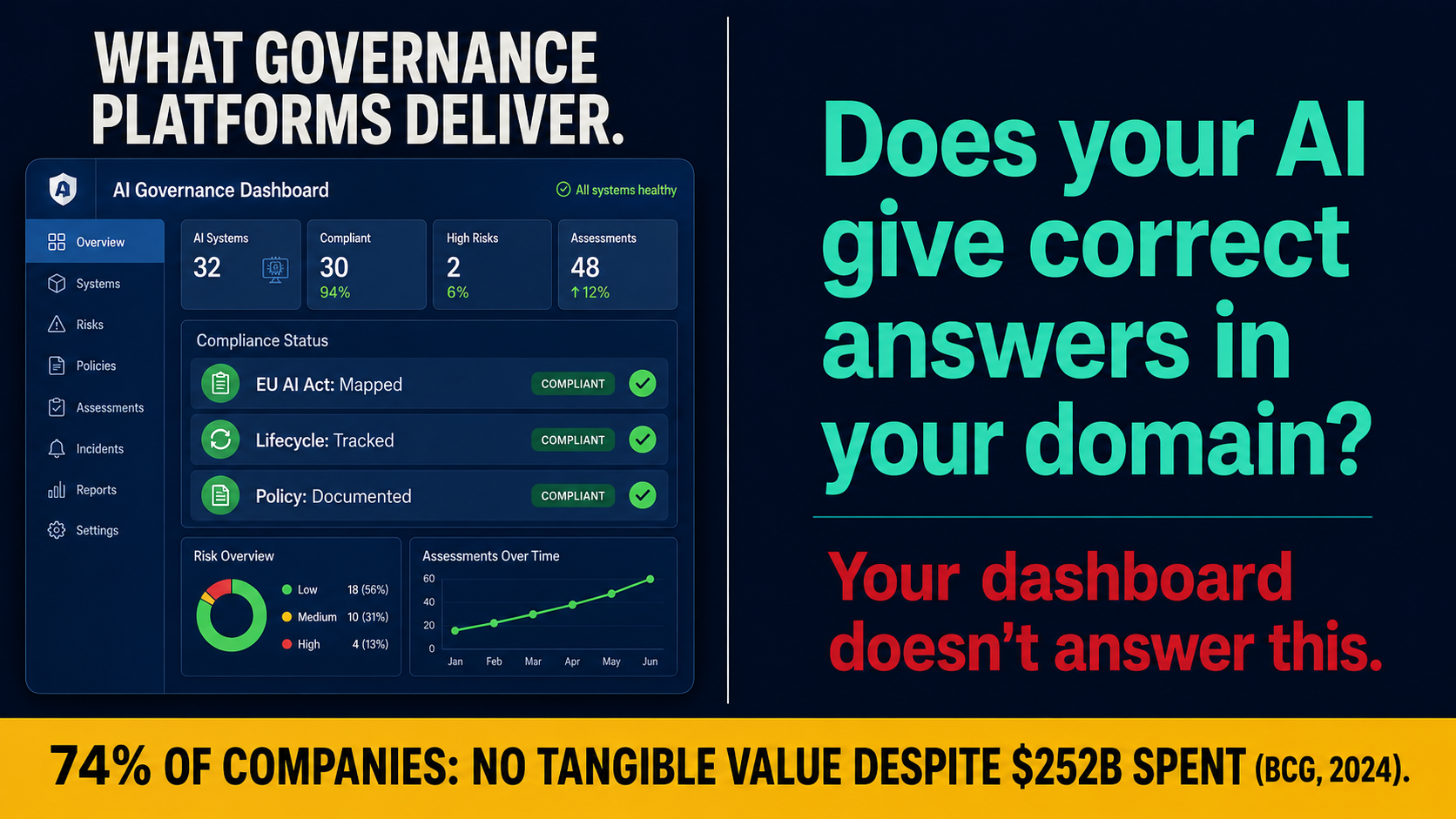
What I kept running into was buyers who already had governance platforms. Credo AI, ranked #6 in Applied AI on Fast Company's Most Innovative Companies 2026, was mapping their policies to the EU AI Act. IBM watsonx.governance was tracking model lifecycle across first-party and third-party systems. Arthur AI was monitoring for drift, toxicity, and PII leakage in real-time. The buyers I was talking to were proud of their governance stack.
My shift was learning to start with a different question: does your AI give correct answers in your specific domain? Not whether the governance dashboard is green. Not whether the EU AI Act Article 9 documentation exists — although Article 9 requires risk-management system evidence before deployment, not at audit time, and most enterprises with green dashboards haven't run the pre-deployment domain testing the Article actually requires. The prior question is whether anyone has measured what "working correctly" means for this AI in this use case.
BCG found that 74% of companies show no tangible value from AI investments despite $252.3 billion in collective spending in 2024. The 70-85% enterprise AI project failure rate documented across RAND, Gartner, McKinsey, and MIT isn't a technology problem. It's a measurement problem: enterprises deploying AI without first establishing what correct looks like in their domain, and without testing against that definition before production.
Once I started leading with that, the governance conversation became more useful — because it had somewhere to land.
The Forensic Gap I Wasn't Expecting
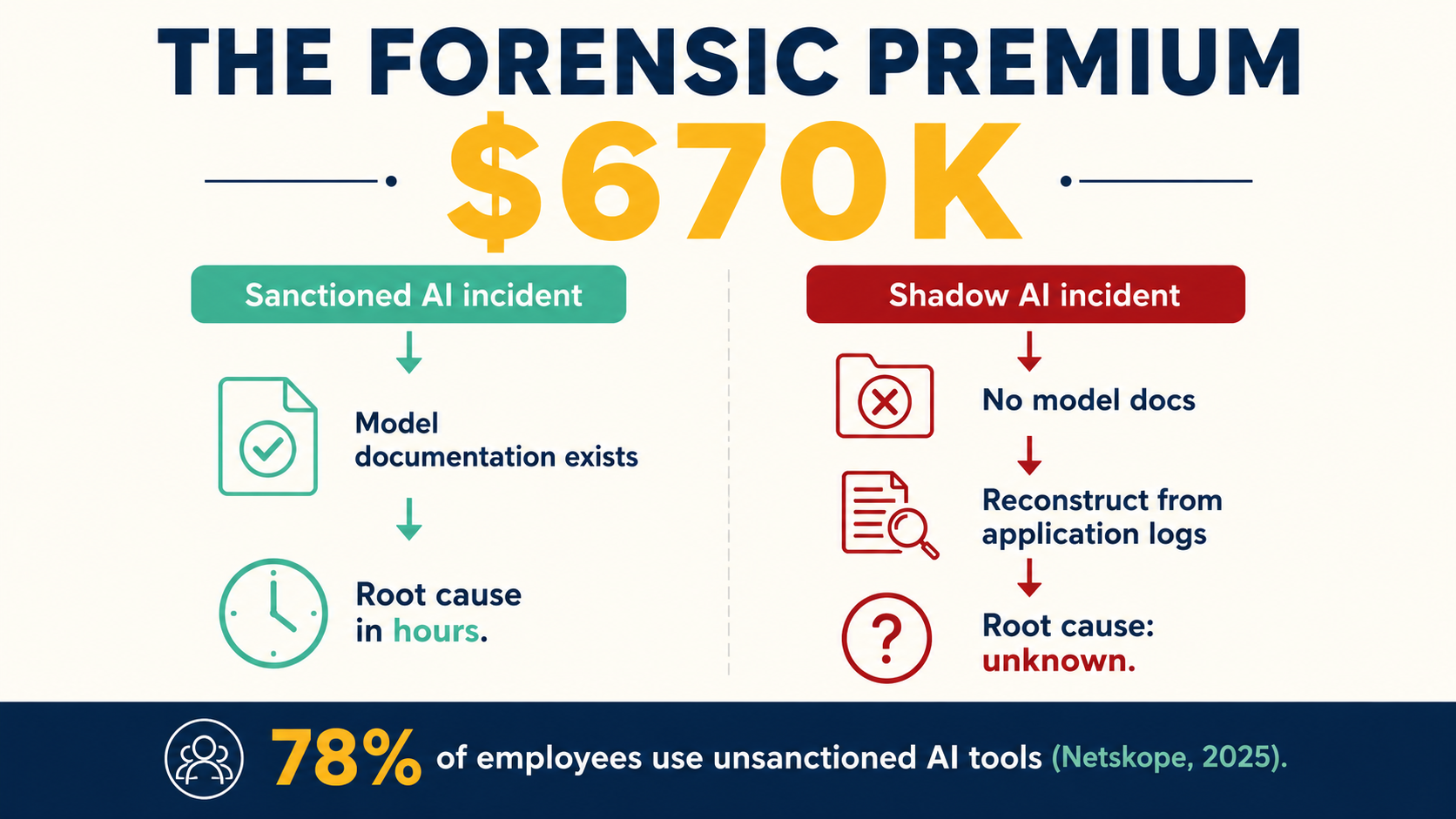
I'd expected the shadow AI conversation to be about security. What I found, working through incident patterns across regulated clients, was that the real problem was forensic — not catching shadow AI in the moment, but being unable to reconstruct what happened afterward.
Gartner's 2025 data puts 69% of organizations at having suspected or confirmed evidence of employees using prohibited public GenAI. Netskope's cloud threat report shows 78% of employees using unsanctioned AI tools, with 77% sharing sensitive or proprietary information with ChatGPT. Samsung and Amazon both discovered proprietary code had been uploaded to public AI tools before policies existed. The $4.63 million average breach cost for shadow AI — $670,000 more per breach than organizations with low unsanctioned usage — reflects what I started to call the forensic premium: when there's no model documentation, incident response reconstructs what the AI processed from application logs that were never designed for that purpose.
What this taught me was that the validation and shadow AI problems are connected at their root. Building rigorous validation discipline for sanctioned AI creates a reference standard — a baseline for what correctly-operating AI looks like in your environment — that makes shadow AI easier to detect when its outputs appear in downstream workflows. Both problems are measurement problems. The shadow AI version just has a higher urgency because the documentation gap shows up under adversarial conditions, not just during audits.
What I'm Still Working Through on Agentic AI
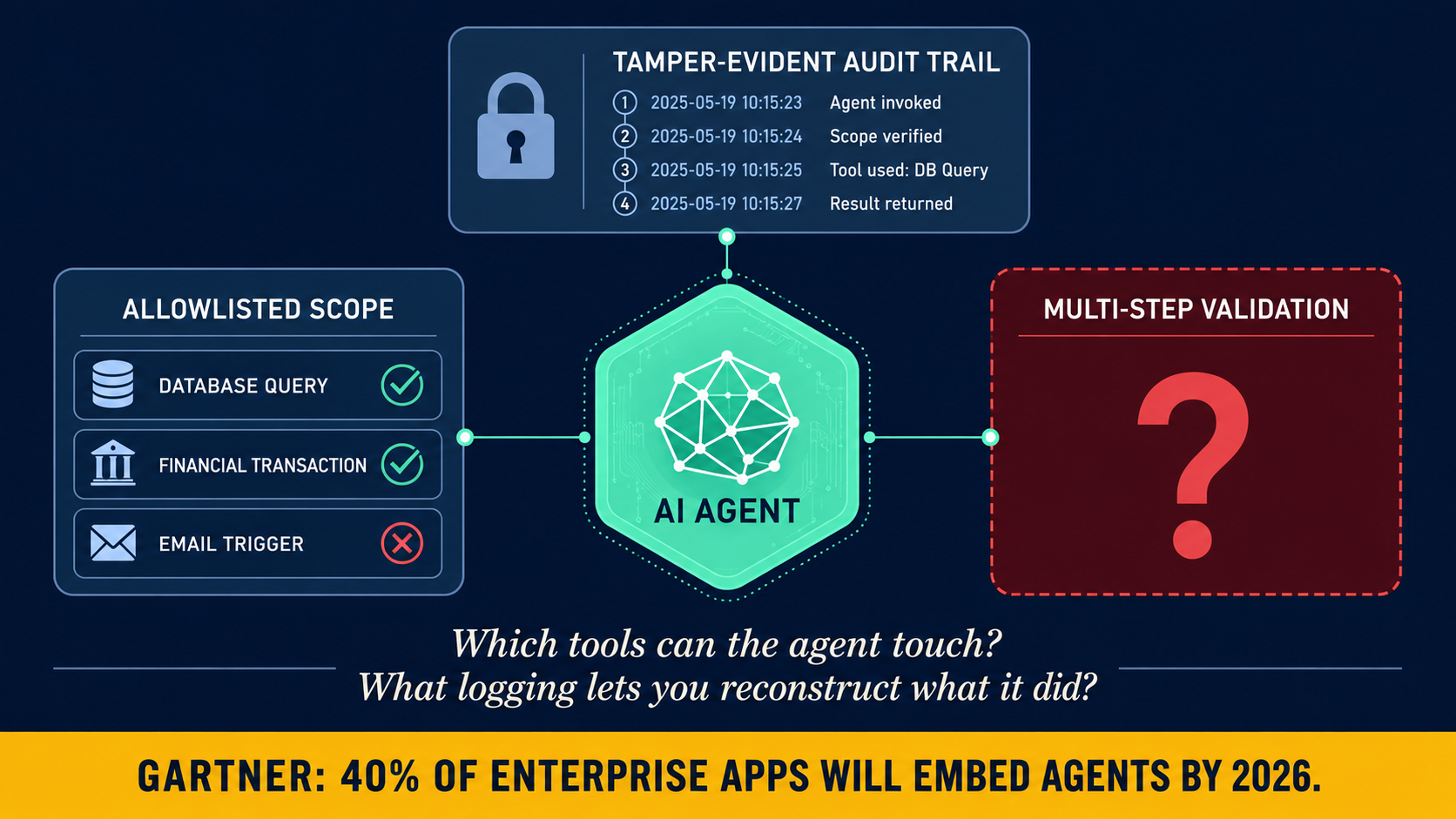
My current unsolved problem lives at the intersection of validation and agentic AI. Gartner projects that 40% of enterprise applications will embed autonomous AI agents by end of 2026, and McKinsey's 2026 research found that only about one-third of organizations report meaningful maturity in agentic AI governance — a gap that's consistent across regions.
For agents that can modify databases, execute financial transactions, or trigger downstream workflows, the validation question shifts from "did it say the right thing" to "did it do the right thing." Cisco spent $400 million acquiring Robust Intelligence in late 2024 to address the security surface of this problem, mapping AI vulnerabilities to OWASP and MITRE ATLAS frameworks — important work, but focused on attack surfaces, not business-logic correctness. The design question I keep returning to is bounded autonomy: which tools and tasks is the agent allowed to touch, and what logging exists to reconstruct its behavior if something goes wrong?
The tamper-evident audit trail that lets a compliance team reconstruct what an agent did — in sequence, with timestamps, with decision-points and the AI output at each step — is the infrastructure that makes agentic AI governable. PagerDuty's 2026 research puts the cost at $1 million or more per hour during AI incidents for a substantial share of enterprises. Without that audit architecture, the post-mortem is guesswork. What I don't yet have is a validation methodology for agentic behavior that scales across complex multi-step workflows without requiring full observability into the underlying model. That's the open problem.
The Question I'd Want Someone to Ask Me
If I were walking into a regulatory examination in 2026 — EU AI Act, Fed model risk, take your pick — the answer I'd want to have ready is about domain-specific error rate. Not the vendor benchmark. Not the governance dashboard. What does the AI produce when tested against our actual use cases, our data, with domain-expert ground truth defining what correct looks like? That measurement, plus an independent challenger model comparison and a tamper-evident audit trail, is what separates a validation program from a documentation program.
That's the practice we've built at Veriprajna. The full architecture is at enterprise AI validation for regulated industries.
The thing I keep sitting with is what it means that enterprises investing heavily in governance have largely skipped this measurement step. The category is being sold as regulatory insurance — something you buy hoping the examiner never actually asks. Measurement is something you use whether or not the examiner asks, because the cost of not having it shows up in your P&L before it shows up in a findings letter.
The field will get there. The examiners are getting there faster than the platforms.