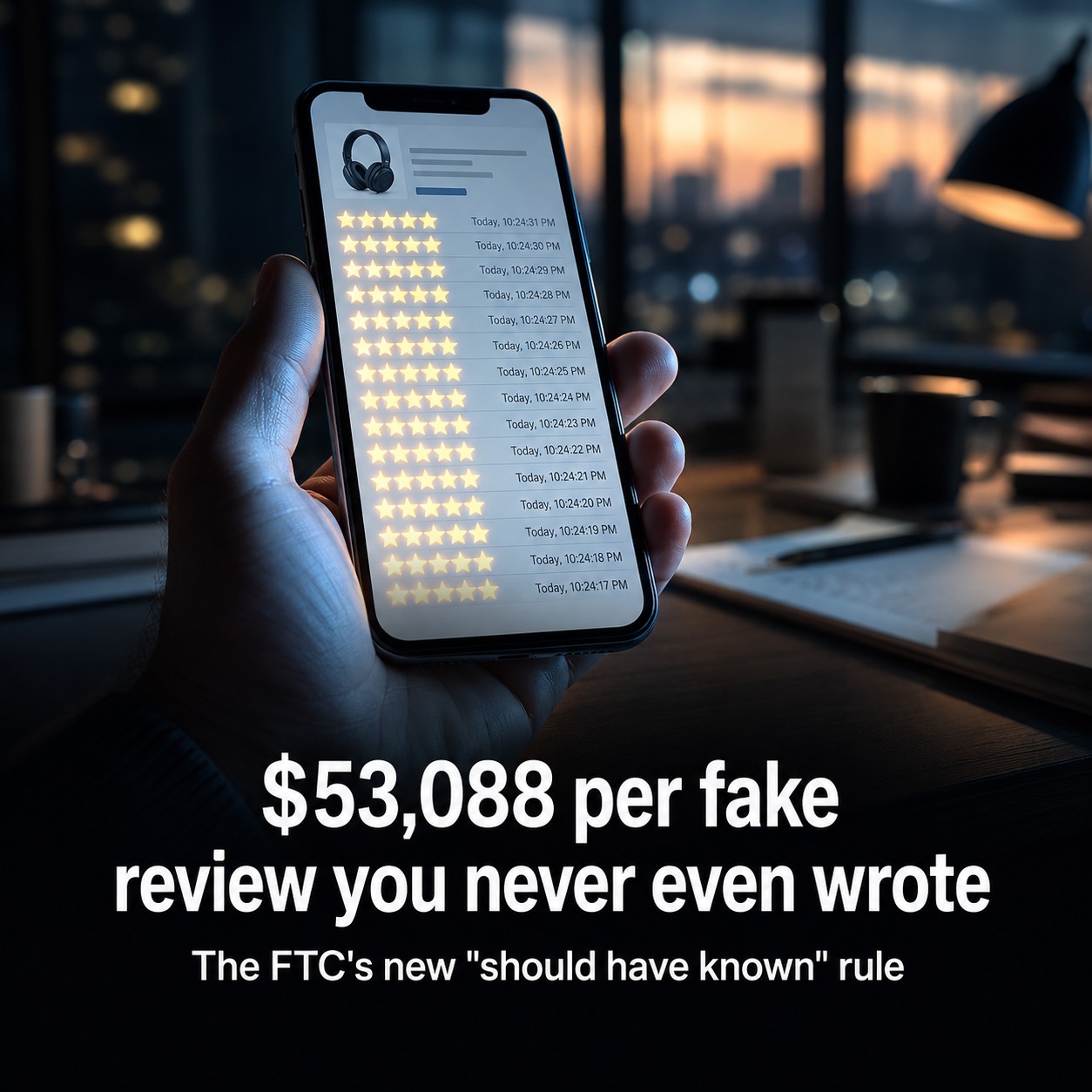
A fake review you never wrote, never asked for, and never saw can now cost you $53,088. Per review.
Since October 2024, the FTC's Consumer Reviews Rule judges brands on a "should have known" standard. If coordinated fake reviews sit on your listings and you have no real detection process, the missing detection system is itself the violation. The FTC sent its first warning letters to 10 companies in December 2025. A 100-review campaign is $5.3M in exposure.
Here's why most brands are exposed without knowing it.
The tools that worked in 2023 are losing. A broker in a 13,000-member Telegram group sells "Verified Purchase" reviews at $5 each — text written by GPT-4, then run through a humanizer to beat perplexity detectors. 47 five-star reviews land over 72 hours from aged accounts staggered across three time zones. Each one looks individually legit — they clear Bazaarvoice's content filters and GPTZero on the way in. Your conversion rate drops before anyone notices.
And the safety net is thinning. Fakespot shut down in July 2025 after nine years. Amazon blocks 275M+ fakes a year with 8,000 people and $500M — and 49% of shoppers still say they've seen fakes there.
The real gap: every platform protects itself, not you. Amazon's signals don't talk to Google's. A fake that clears one network can syndicate across 50+ retailers in 48 hours. No single vendor watches your whole review ecosystem — or generates the audit trail that proves due diligence to a regulator.
That's the system we build: cross-platform fake review detection that survives humanizer tools, plus FTC-ready compliance evidence.
Save this if you own brand or marketplace integrity — the enforcement is no longer theoretical.
#ReviewFraud #FTCCompliance #BrandProtection #SyntheticMedia #Ecommerce