
The conversation that started me building this was with a brand's head of compliance. She'd just walked through their review integrity program — the Bazaarvoice integration, the platform-native fraud flags, the quarterly audits — and her read on the situation was that they were covered. I asked what she meant by covered. Bazaarvoice is protecting Bazaarvoice's network from fraud that would undermine their platform's credibility. That's their job. The brand's liability under the FTC's Consumer Reviews and Testimonials Rule is a different question, and Bazaarvoice's fraud detection wasn't designed to answer it.
That gap is what the Synthetic Content & Fake Review Detection system was built to close.
The Audit Trail I Couldn't Stop Thinking About
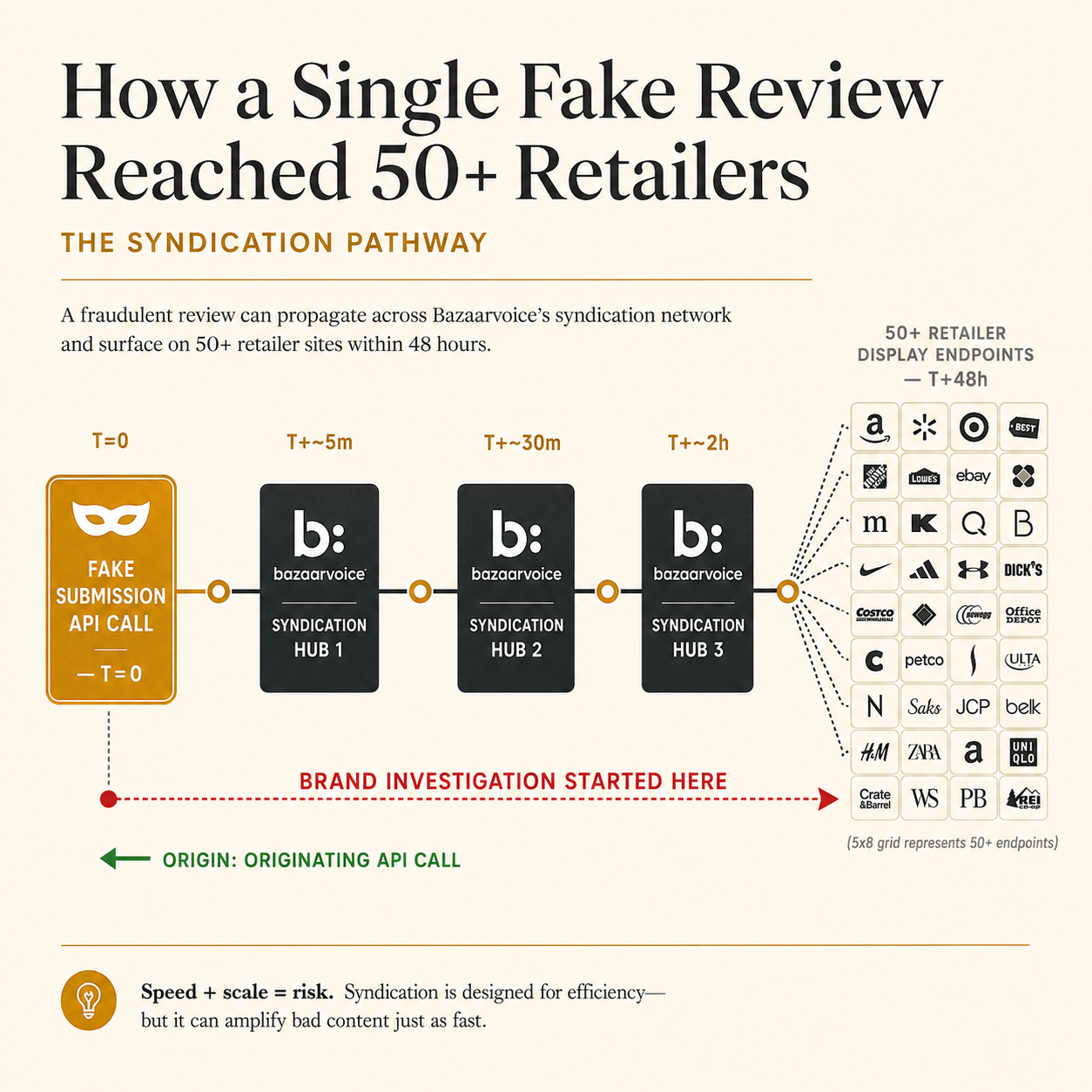
My team ran a review syndication trace that changed how I think about where fake review fraud actually lives. We were working through a brand's Bazaarvoice submission logs — and when you pull originating API call timestamps against downstream syndication records, you can watch where a single submission propagates. One fake review seeded into the network appeared across 50-plus retailers within 48 hours. The brand's investigation had started at a retailer product page — the far end of the chain. They were chasing a copy. The source was at the originating submission call, twelve steps upstream.
That temporal gap — submission timestamp to display timestamp to brand-side investigation starting at the wrong end — is the structural problem. Trustpilot removed 4.5 million fake reviews in 2024, 90% of them automatically. Amazon blocked 275 million. The detection is real. What it doesn't do is give the brand a cross-platform audit trail tied to the originating submission that generated all of them.
Syndication turns one fake into fifty display records. Investigation starting at the display record is like diagnosing a patient from the symptoms that reached the farthest organ.
The Week Fakespot Went Dark
I was traveling when a colleague sent me the news that Fakespot had shut down — officially on July 1, 2025, after Mozilla tried to sustain it following its 2023 acquisition and couldn't. Nine years of operation, discontinued because the consumer-facing economics didn't work.
My first reaction wasn't about the consumer gap Fakespot left. It was that the failure confirmed something I'd been thinking about for several months: enterprise detection is where the sustainable economics live, not consumer-facing tools. A brand carrying ongoing FTC review integrity exposure needs infrastructure that updates faster than the adversary — and the adversary is updating daily with new humanizer releases. Consumer tools can't generate the commercial demand to fund that arms race. A brand with a documented compliance obligation can. Fakespot's closure told me the bet was right, not because we competed with them but because they proved where the market wasn't.
What Testing the Humanizer Ecosystem Changed
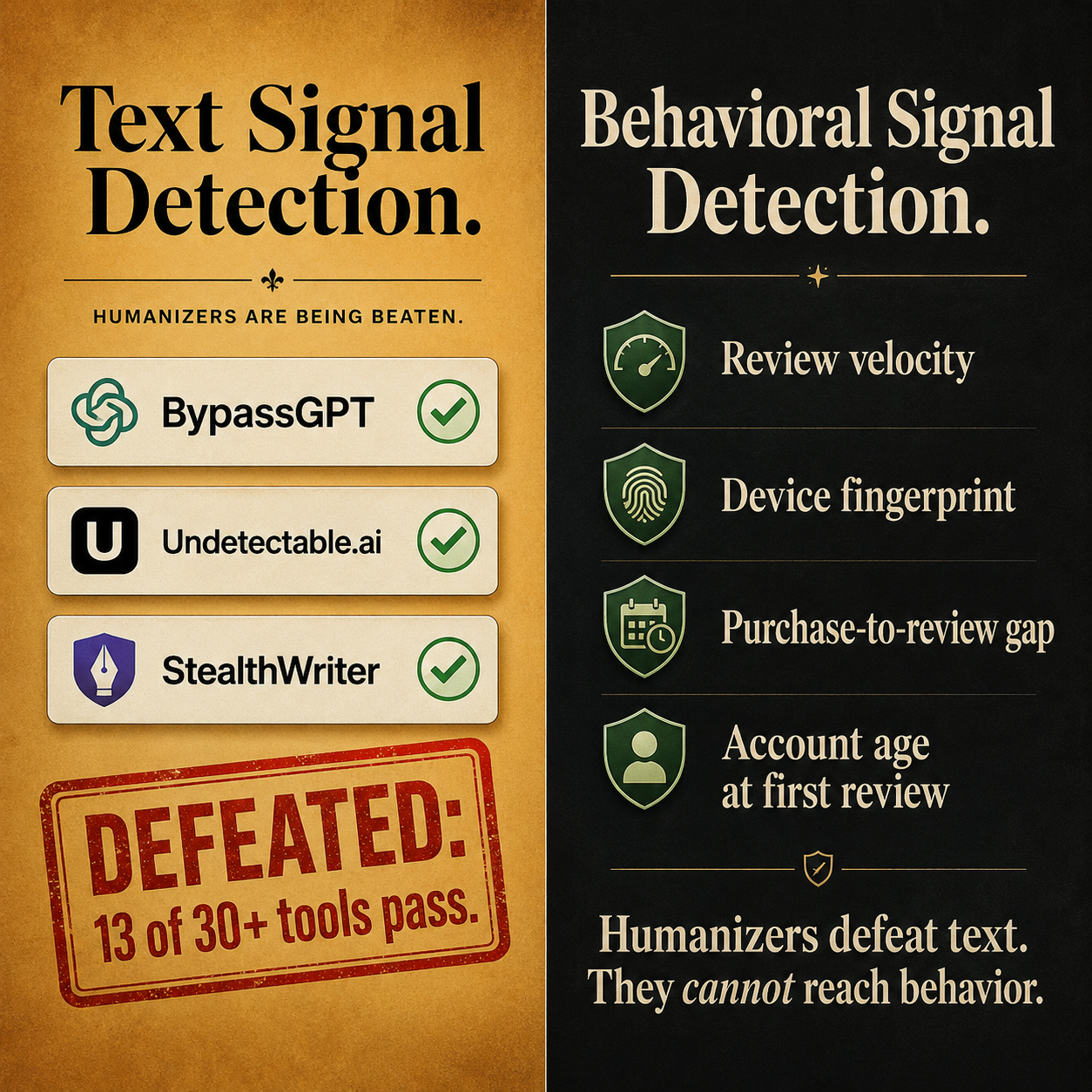
I went through the humanizer tool ecosystem systematically — BypassGPT, Undetectable.ai, StealthWriter, Grubby AI and the rest — mapping what they produced against standard detection pipelines. Roughly 13 of the 30-plus tools reliably produced output that fools perplexity-based detectors. The adversary has largely solved the text signal problem. Basic detectors reading review content are, against sophisticated humanizer output, now unreliable.
What shifted in my architecture thinking was recognizing that the text was never the most durable signal available. Review velocity, device fingerprinting, account age at first-review activity, the gap between a verified purchase timestamp and the review submission — none of those signals live in the text, which means none of them are what humanizer tools were designed to defeat. Behavioral signals had always been a secondary layer in serious detection pipelines. The humanizer arms race has made them the primary layer, not because the text stopped mattering but because the behavioral layer is the one the arms race can't reach.
The FTC Question I Kept Having to Explain
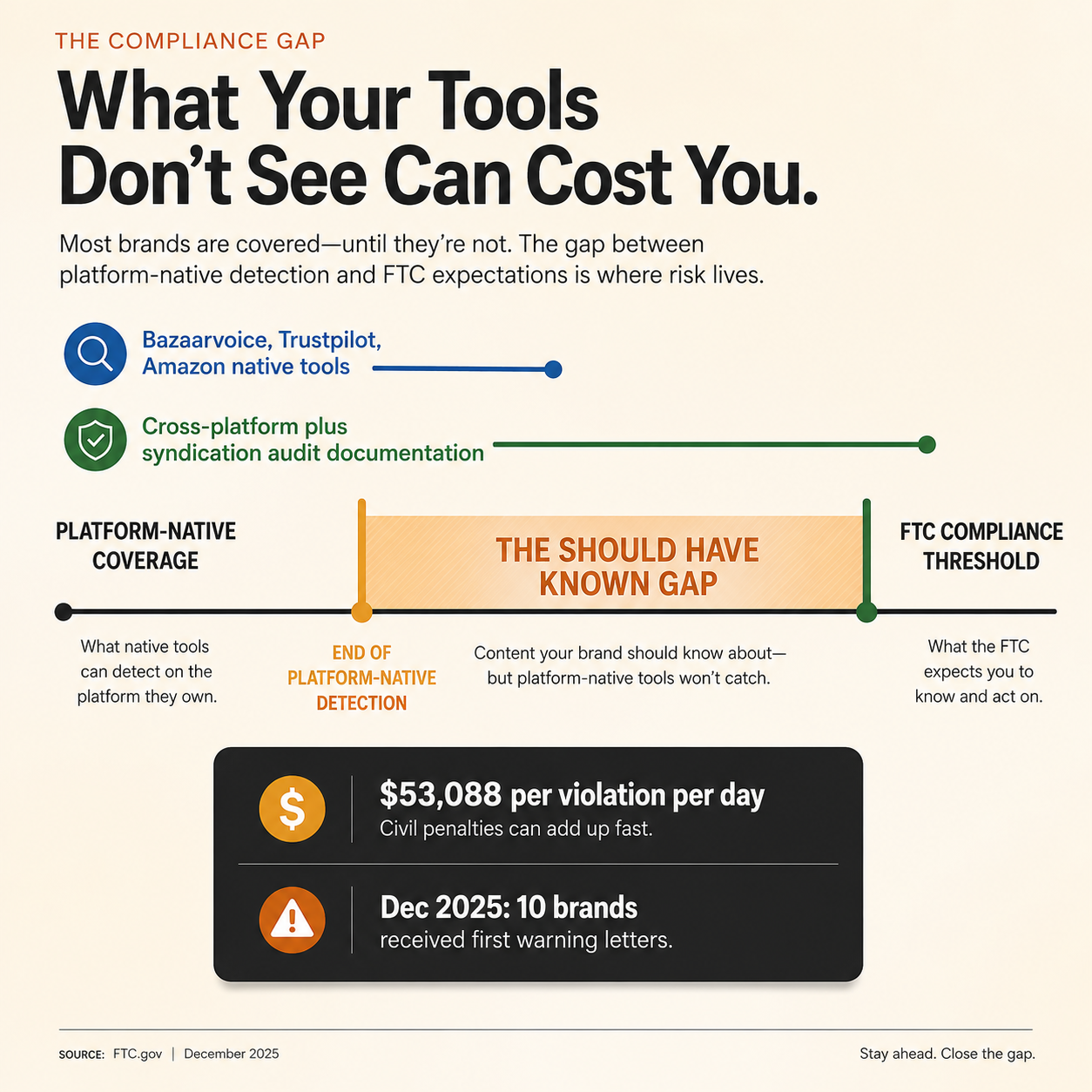
The pattern in my compliance conversations throughout 2025 had a consistent shape. The compliance lead would walk me through their review integrity process, I'd ask about the FTC's Consumer Reviews and Testimonials Rule — effective October 21, 2024, $53,088 per violation, per day — and they'd acknowledge it. Then I'd ask: what does your verification documentation look like for reviews that syndicate in from a partner's network? That's where the conversation would slow down.
The rule's "should have known" standard is the exposure most brands haven't mapped. A brand that publishes reviews syndicated from a partner platform can face per-day liability even when the fakes originated upstream on that partner's network, if a reasonable verification process would have caught them. The brands that received the FTC's December 2025 warning letters — the first ten sent under the rule — were running platform-native tools and treating that as the compliance answer. Their posture was the same as every compliance lead who'd told me they were covered.
The UK's CMA opened five DMCCA investigations in March 2026, including Feefo and Autotrader, with penalty exposure up to 10% of global turnover. EU AI Act Article 50 enforcement for machine-readable AI content disclosure begins August 2026. The brands building their FTC documentation now are building it for two more regulatory bodies that will ask the same underlying question in the next eighteen months.
What the Image Problem Reveals About Where Verification Has to Live
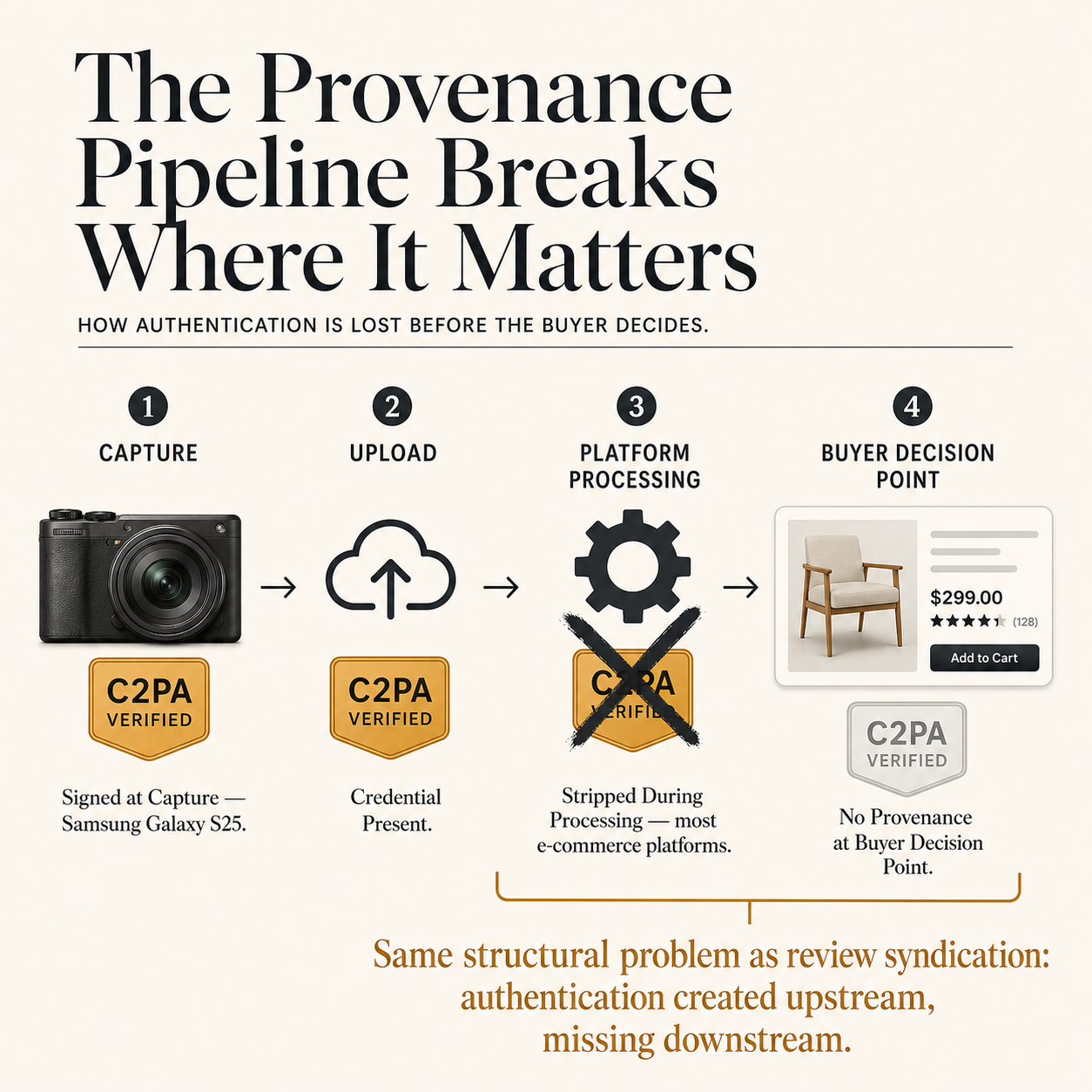
I've had conversations with teams working through the Tripadvisor ghost listing problem — 2.7 million flagged fake reviews in 2024, many tied to AI-generated property images — and the C2PA story should theoretically solve it. The Coalition for Content Provenance and Authenticity has 6,000 member organizations now, Samsung shipped the Galaxy S25 as the first consumer phone with native C2PA camera signing, LinkedIn and TikTok preserve content credentials on upload. The gap is platform image processing: most platforms strip the credential metadata during processing. A provenance-signed image arrives at the product listing without its provenance.
What I keep returning to is that this is the same shape as the review syndication problem. Authentication metadata gets created at the source — at image capture, at review submission — and then stripped or ignored at the point where it would matter most, which is the display endpoint where buyers make purchase decisions. Solving both problems requires moving verification upstream, to submission, not display. That's the architecture constraint that drives both sides of what we built.
Where This Actually Leaves Us
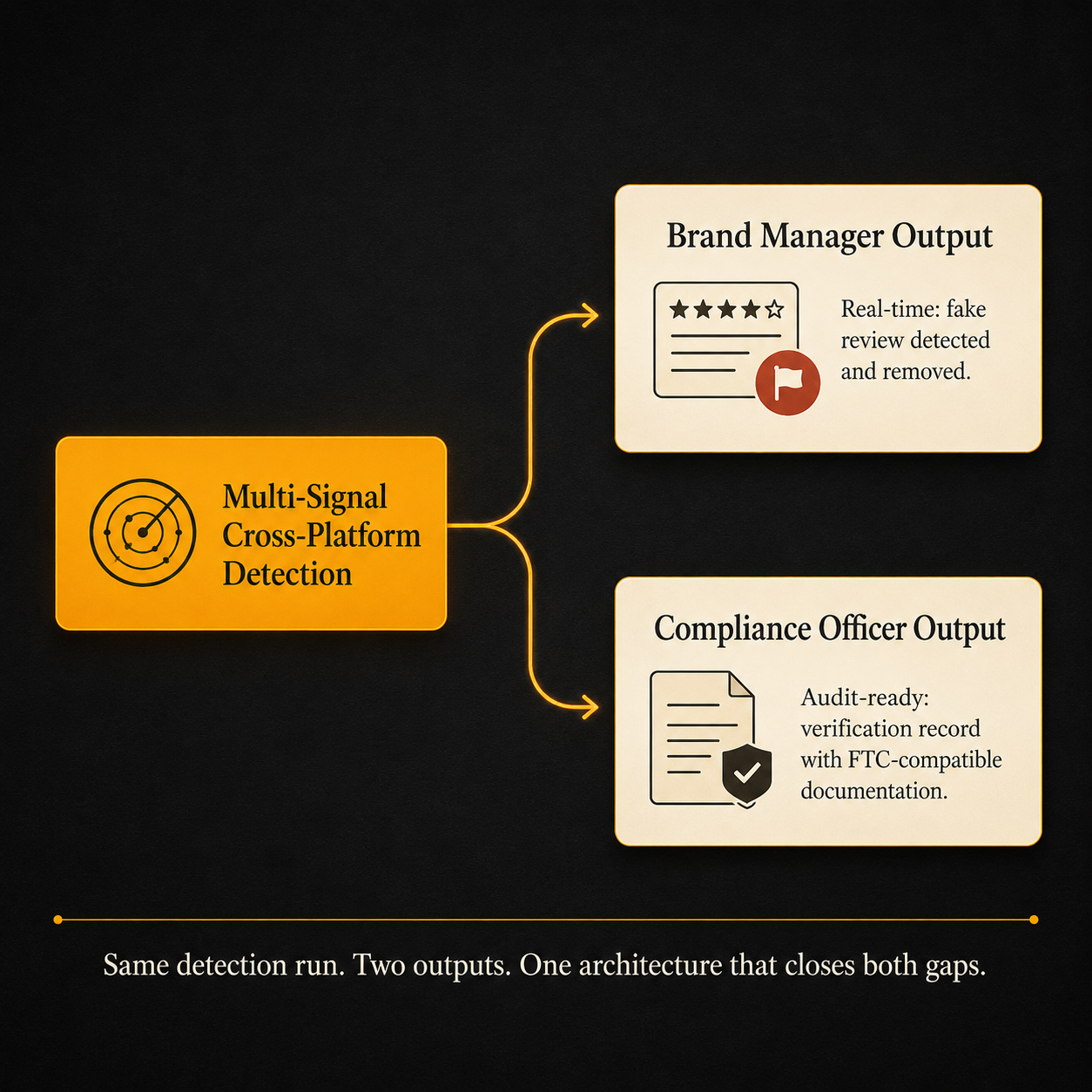
My team built the Synthetic Content & Fake Review Detection architecture around the compliance officer's question, not the brand manager's question. The brand manager wants to know if a review is fake. The compliance officer wants documentation that demonstrates the brand exercised reasonable verification. Those are different outputs from the same detection run, and the platform-native tools weren't built to produce the second one.
Capital One Shopping's 2025 analysis traced $787.7 billion in unwanted consumer purchases to fake review influence. A 2025 trust study put the brand-side impact at a 26% trust drop and 20.5% purchase intent drop for consumers who suspect fake reviews — numbers that attach to the brand's credibility, not to any individual fake review. The cost of getting the compliance infrastructure wrong isn't just a fine. It's the credibility discount that accumulates in the time between the first fake review and the last.
What I'm still thinking through is the syndication footprint problem. Most brands don't have a clear map of which reviews from which source platforms are appearing on which retailer sites, through which APIs, with which delay. That map is where the "should have known" analysis actually runs. If you're building that map for your brand, I'd genuinely like to compare notes on what you're finding.