
Amazon blocked 275 million fake reviews in 2024. Trustpilot removed 4.5 million more. Bazaarvoice runs 1,000 proprietary fraud-detection rules across 2.3 billion shopping sessions a month. None of that infrastructure was built to protect your brand. It was built to protect their platforms. And the FTC's October 2024 Consumer Reviews and Testimonials Rule now holds your brand accountable for what those platforms don't catch — including the fakes that originated on a partner network and syndicated to yours.
That gap — between platform-level detection and brand-level exposure — is where most review fraud now lives.
The Syndication Multiplier
The operational reality of review fraud in 2026 isn't a lone bad actor writing a few fake reviews on one platform. Telegram groups with 13,000 members coordinate campaigns across Amazon, Google, Yelp, Trustpilot, and Tripadvisor simultaneously, for roughly $0.50 per manipulation. The cross-platform spread is the point. Platform-native tools each catch their slice. No single tool sees the combined pattern.
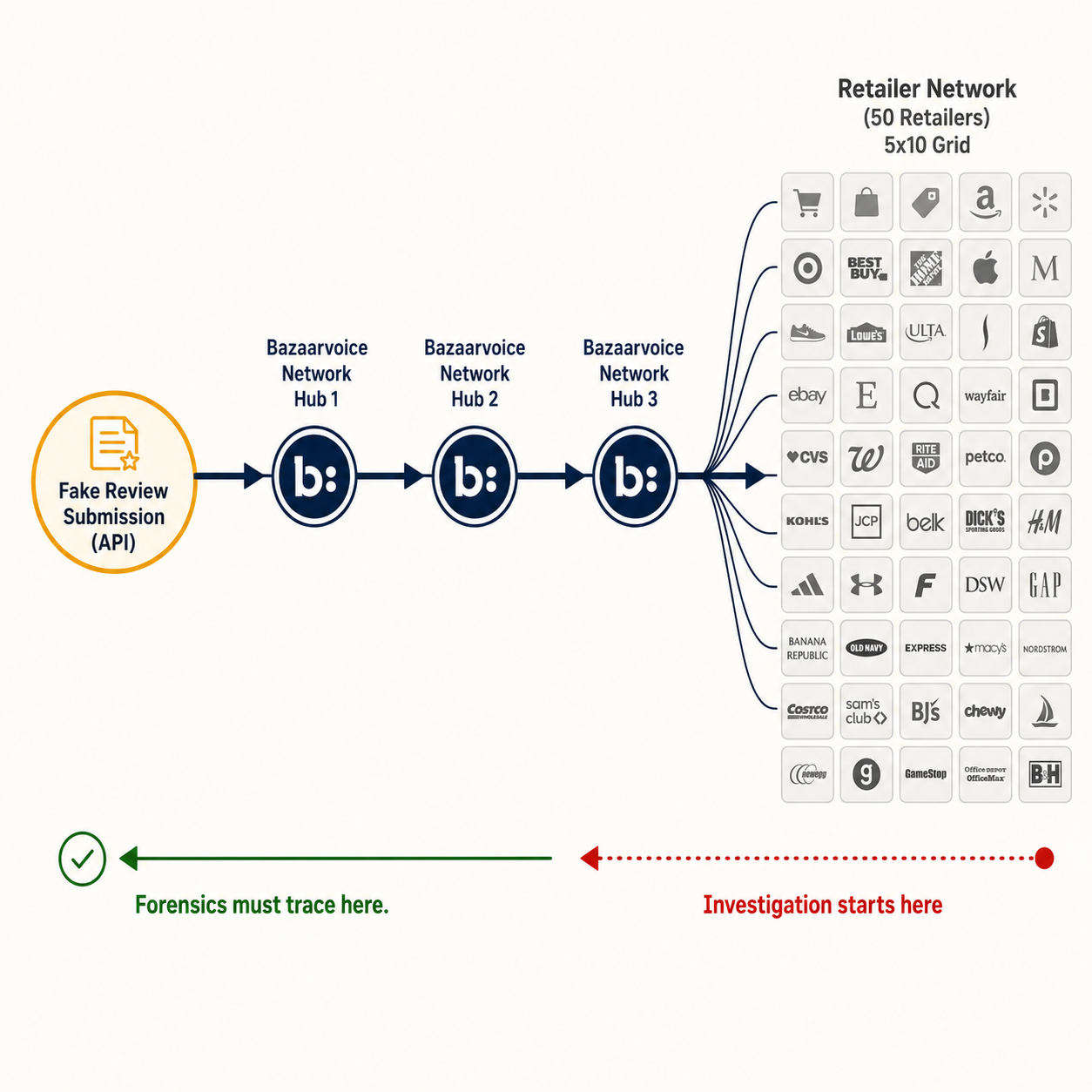
What makes the Bazaarvoice syndication network specifically dangerous is the amplification dynamic. A single fake review seeded at the submission API propagates to 50-plus retailers within 48 hours. When that fake appears across multiple retail sites, brands typically begin their investigation at the display endpoint — the product pages where the fraud is visible. The source is the originating API call, not the display; any forensic trace that doesn't go back to submission will reach a dead end.
Review syndication turns one fraudulent submission into fifty. An investigation that starts where the review appears is already looking in the wrong place.
What "Should Have Known" Actually Requires
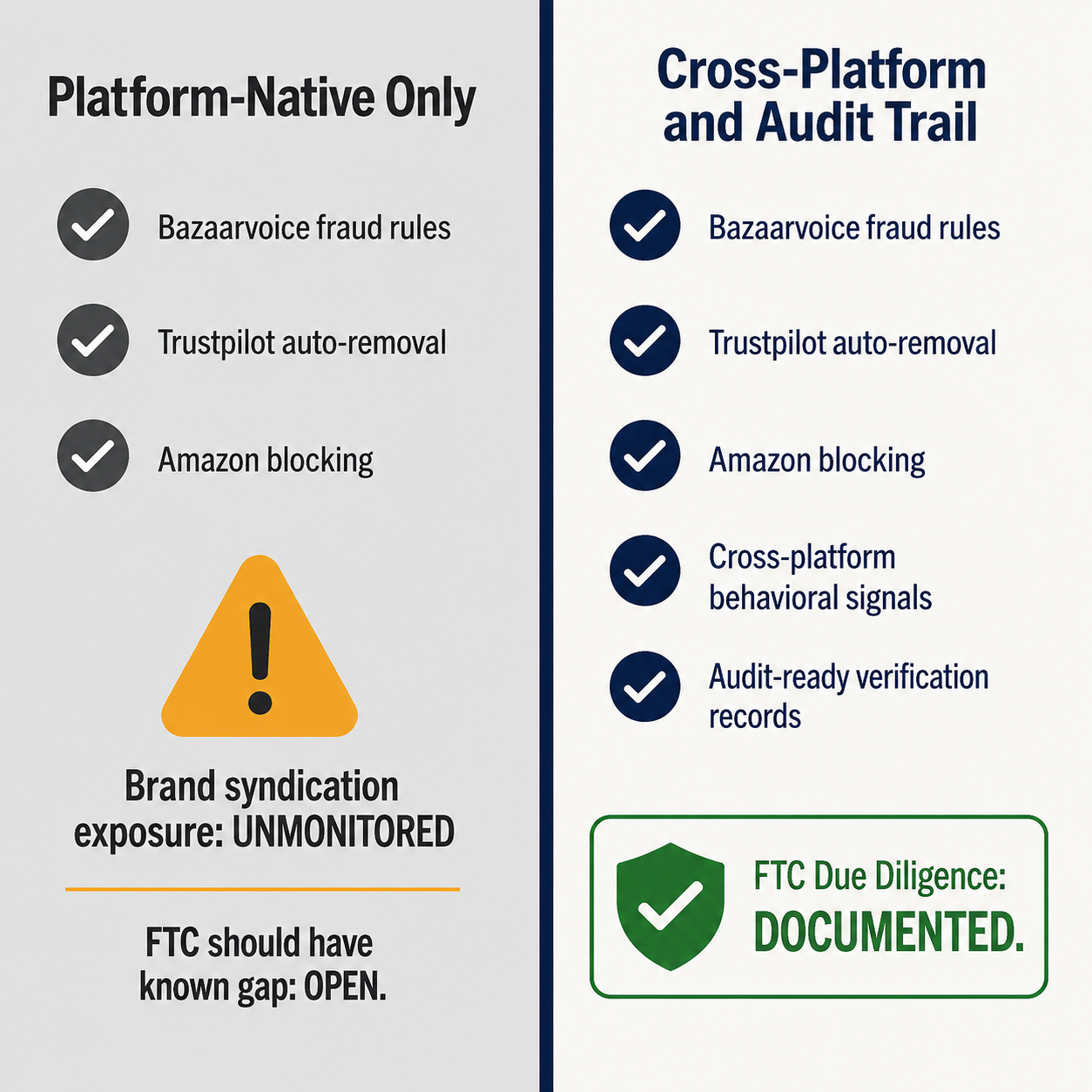
The Consumer Reviews and Testimonials Rule took effect October 21, 2024, with penalty exposure of $53,088 per violation — and each day of ongoing violation counts separately. The critical phrase is "should have known." A brand that publishes syndicated reviews without documented verification protocols can face per-day liability even when the fakes originated on a partner's platform, provided a reasonable authentication process would have caught them.
The FTC sent its first enforcement wave — warning letters to ten companies — in December 2025. The UK's Competition and Markets Authority, moving concurrently under the DMCCA, opened five investigations in March 2026 (including Feefo and Autotrader) with penalty exposure up to 10% of global turnover.
What counts as sufficient verification documentation is still being defined by each enforcement action. What's already established is that the brands in the first warning-letter cohort were running platform-native tools and treating that as sufficient.
The Detector Arms Race
The platforms' fraud detection pipelines are genuinely sophisticated. Trustpilot's neural-network system auto-removed 90% of its 4.5 million flagged reviews in 2024, 53% more than the prior year. Amazon runs deep graph neural networks correlating thousands of data points across seller-reviewer-product relationships. The investment is real.
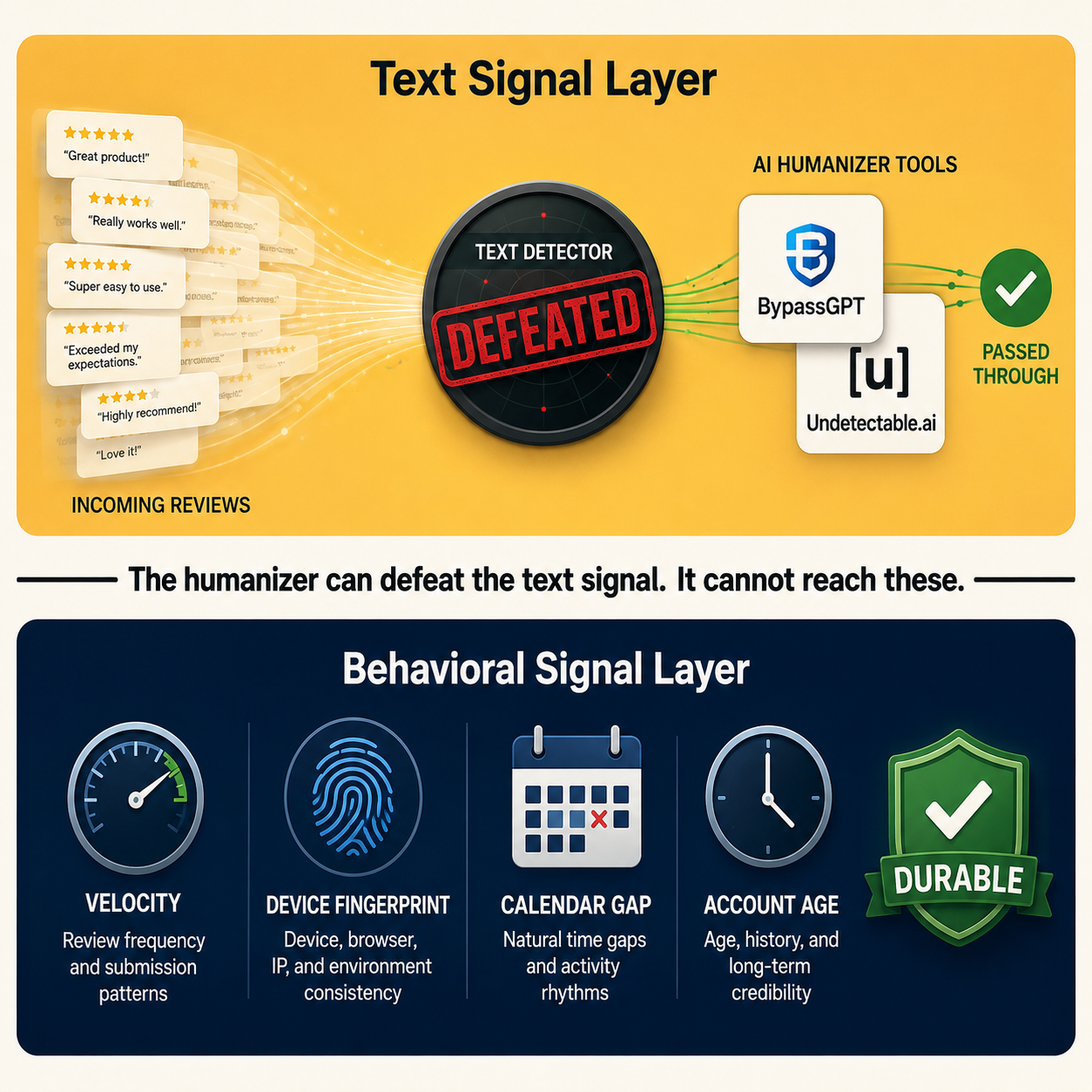
The problem is the arms race against AI humanizer tooling. Thirty-plus services — BypassGPT, Undetectable.ai, StealthWriter, Grubby AI — now produce content specifically engineered to defeat perplexity-based detectors by adjusting comma density, replacing AI-typical vocabulary, and targeting the lexical entropy signatures that basic detection models look for. Testing of the humanizer ecosystem found roughly 13 of the 30-plus services reliably produce output that fools standard detectors.
Behavioral signals survive the humanizer race because they don't care about the text. They care about the account — its velocity, its device fingerprint, the gap between purchase and review, the age of the profile at first submission.
Review velocity, device fingerprinting, account age relative to first review activity, and the temporal gap between purchase and submission are what remain robust against humanization. These signals require building detection pipelines that operate at the behavioral layer, across platforms, rather than within a single platform's content stack.
The Gap Fakespot Left
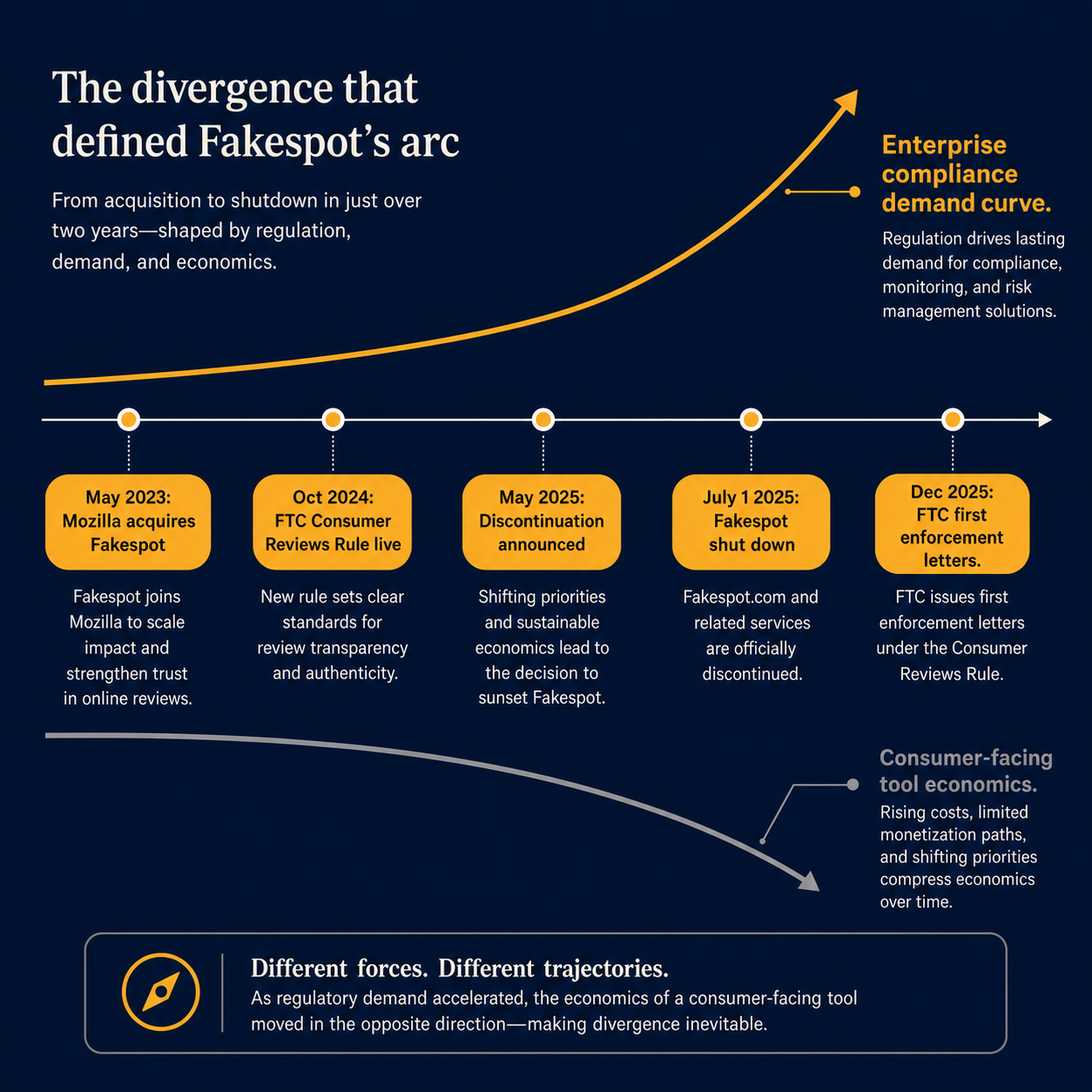
The consumer-facing side of fake review detection had one household name: Fakespot, which Mozilla acquired in May 2023 and integrated into Firefox. Mozilla discontinued it in May 2025; it shut down entirely on July 1, 2025, after nine years. The stated reason was the difficulty finding a sustainable business model at the consumer layer.
Fakespot's closure is instructive less as a market gap than as a signal about detection economics. Consumer-facing tools can't generate the commercial demand needed to fund continuous model updates against an adversary updating daily. Enterprise brand-side detection — where the client carries ongoing review integrity exposure and audit-ready documentation requirements under FTC and CMA enforcement — is where the investment can sustain the arms race.
Building for Auditability, Not Just Detection
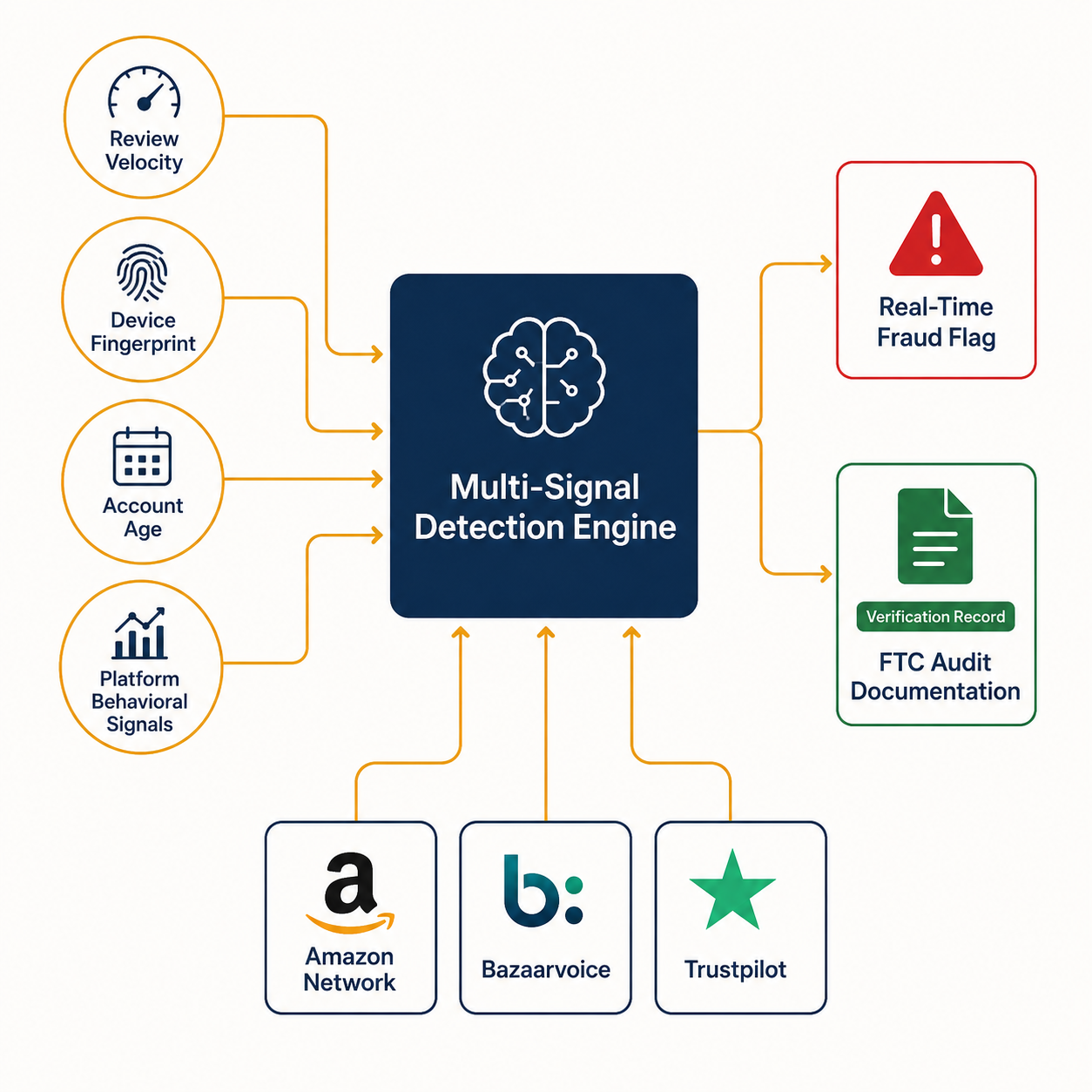
The Synthetic Content & Fake Review Detection system we built at Veriprajna starts from the compliance question the FTC's rule actually asks: not "did you block fake reviews?" but "did you have reasonable verification processes in place?" The architecture runs multi-signal detection across platforms — behavioral patterns, linguistic analysis, temporal signals, cross-platform account correlation — and generates audit-ready evidence of each review's verification status.
That dual mandate — catching fraud in real time while building the evidentiary record that documents due diligence — is what platform-native tools weren't built to do. Their job is to protect their network. Yours is to protect your brand's compliance position.
Image Authenticity: The Overlooked Surface
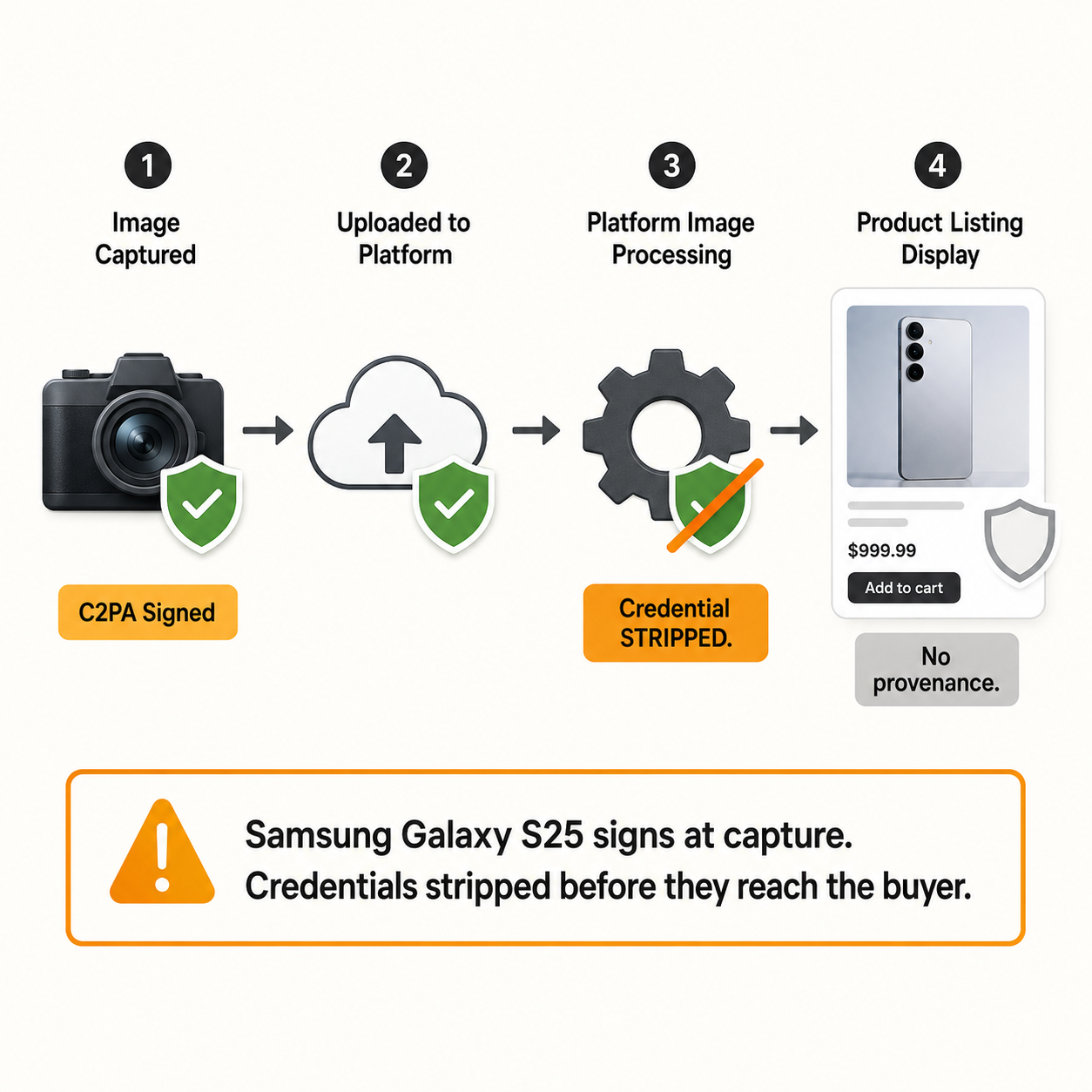
Review fraud isn't only text. Tripadvisor flagged 2.7 million fake reviews in 2024, many tied to ghost hotel listings built from AI-generated imagery. The Coalition for Content Provenance and Authenticity has made real progress in 2026 — 6,000 member organizations, Samsung's Galaxy S25 shipping as the first consumer phone with native C2PA camera signing, platforms including LinkedIn and TikTok now preserving content credentials. But there's a structural gap specific to e-commerce: most platforms strip C2PA metadata during image processing. A photo submitted with authenticated provenance arrives at the product listing without it.
Until platform image pipelines universally preserve content credentials through processing — or until verification moves upstream to the submission point — image-based listing fraud remains a detection surface that metadata verification alone can't close.
The Cost Math
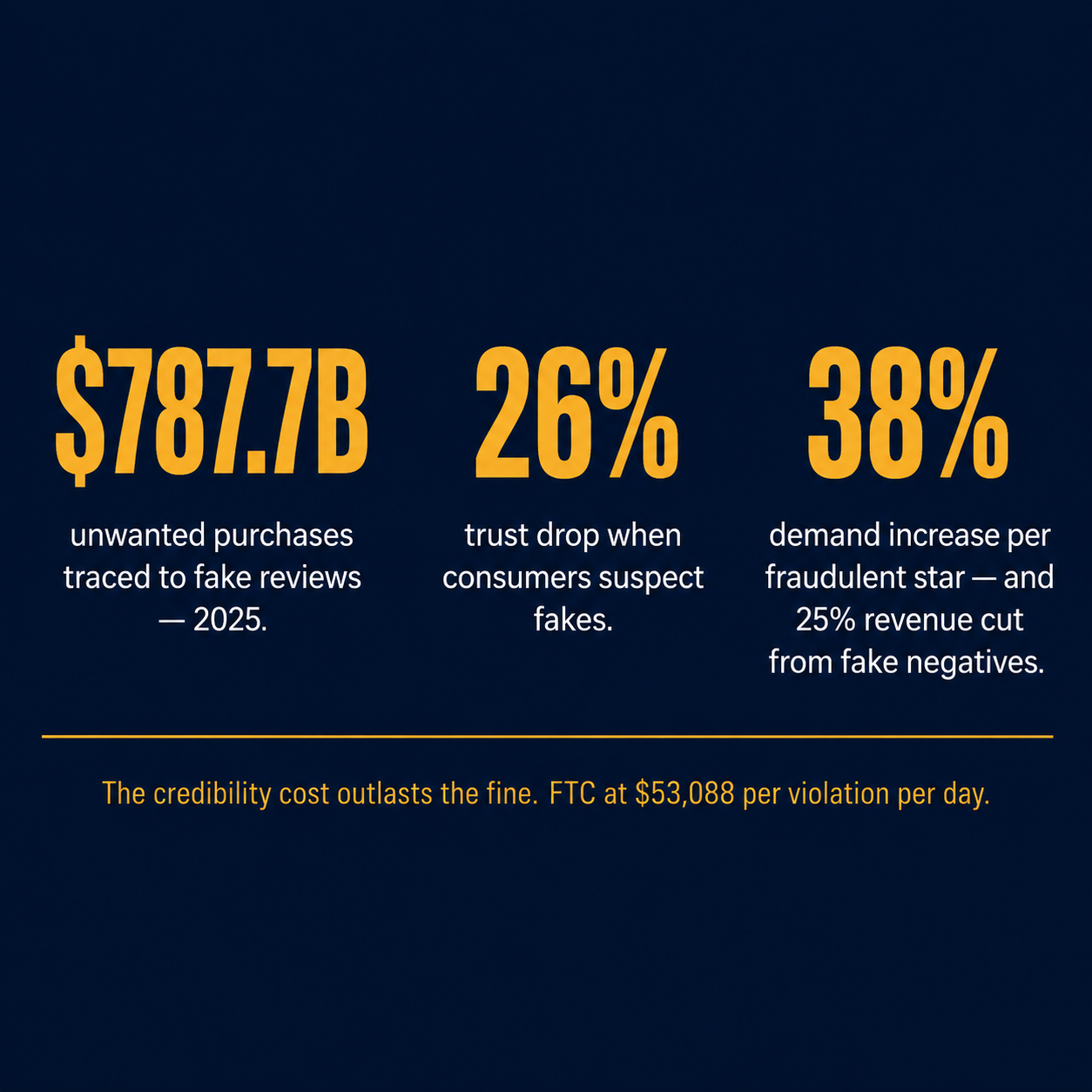
Capital One Shopping's 2025 analysis estimated $787.7 billion in unwanted consumer purchases traceable to fake review influence. A 2025 trust study found that consumer exposure to fake reviews drives a 26% trust drop and a 20.5% purchase intent drop — numbers that apply not to the fake review itself, but to the brand whose review ecosystem it appeared in.
The asymmetry cuts both ways. Fake positives can boost sales 12.5% in the first two weeks — until buyers realize the review signal can't be trusted and the credibility discount becomes permanent. An extra fraudulent star's worth of fake-positive reviews can drive 38% demand inflation; a competitor running fake negatives against your listing can cut revenue by up to 25%.
The detection infrastructure that protects brand credibility is structurally identical to the infrastructure that generates FTC compliance documentation. They're the same architecture, solving both problems at once.
The Veriprajna Synthetic Content & Fake Review Detection page lays out what that architecture looks like in practice. We're actively building cross-platform review authentication programs for brands that are ahead of the enforcement curve — and we'd genuinely like to hear from teams mapping what "should have known" looks like in their specific syndication footprint. The compliance gap is clearer than most review integrity programs expect it to be.