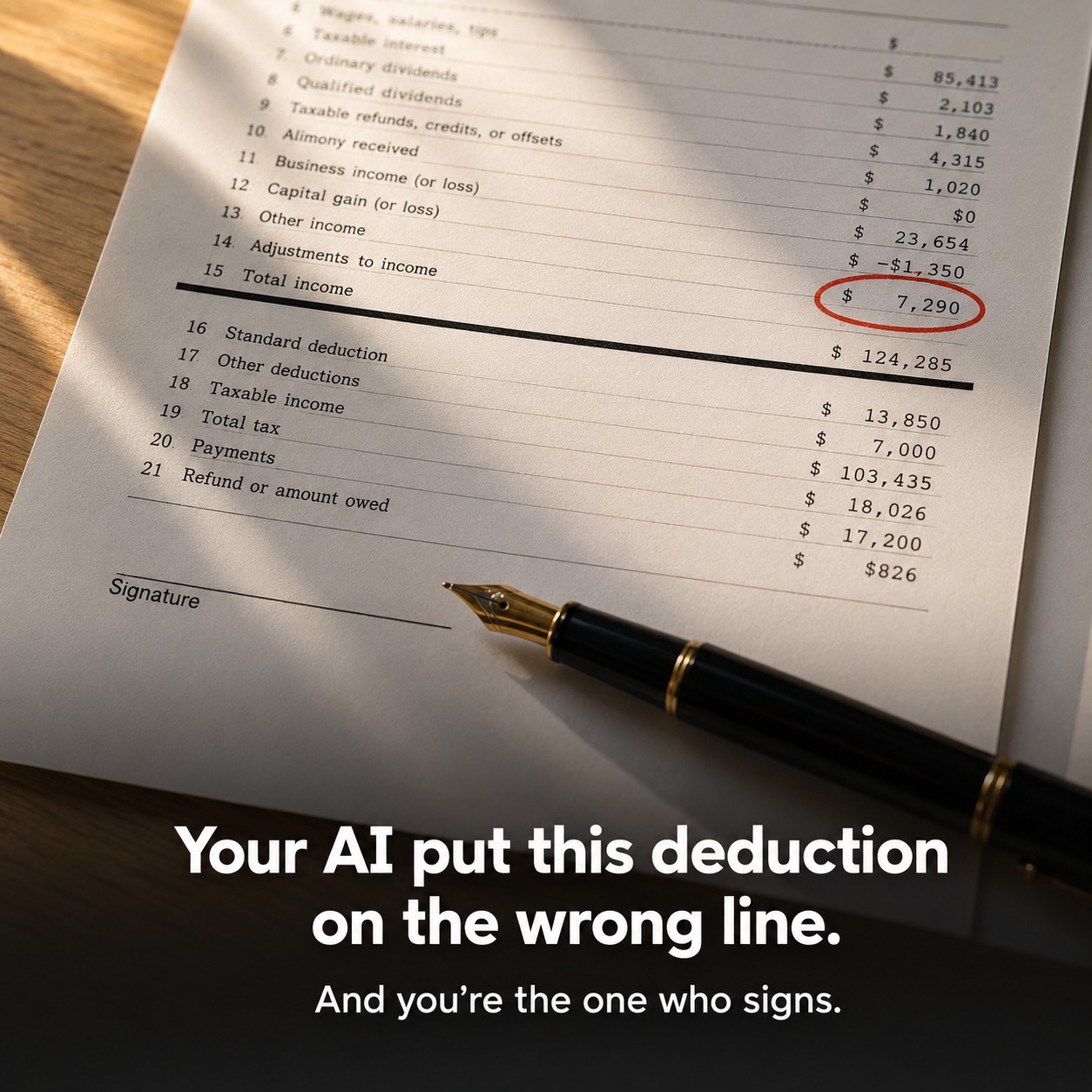
H&R Block's own website calls the new car-loan interest deduction "above-the-line." It isn't. And the tax AI just learned the wrong answer.
The OBBBA created a deduction for qualified passenger vehicle loan interest. Congress put it in Section 63(b)(7): it reduces taxable income, not AGI. That makes it below-the-line.
But thousands of blog posts and content farms repeat the "above-the-line" label. So when a large language model is asked about it, it reproduces the error with total confidence — because the wrong version appears in its training data orders of magnitude more often than the actual statute. And you can't prompt it away: feed the model the real statute through retrieval and it still misreads the amendment language, because it's a probability engine, not a logic solver.
Here's why that one misclassification is expensive: it cascades. Treat it as above-the-line and it incorrectly lowers AGI, distorts AGI-coupled state taxes, fakes a Medicare IRMAA premium reduction, moves the 7.5% medical-deduction floor, and false-qualifies income-driven student loan repayment. One provision, five downstream errors. The IRC has thousands.
And the 20% accuracy penalty doesn't land on the algorithm. It lands on the human who signed the return.
The preparation problem is being solved — Thomson Reuters auto-prepares 1040s, CCH Axcess Expert AI is embedded across 10,000 firms. Verification isn't. Every incumbent checks its own output against its own rules; no one verifies the AI's tax position across all of them, deterministically.
That gap is what our team builds: a vendor-neutral verification layer that catches AI tax errors before they reach the IRS — and, post-Heppner, keeps the reasoning inside a privilege-safe, closed system, not public chat tools.
Go check how your own AI classifies the OBBBA car-loan deduction — right or wrong? Save this for the next time someone says "the AI already checked it."
#TaxCompliance #TaxTechnology #AIGovernance #TaxAI #EnterpriseAI