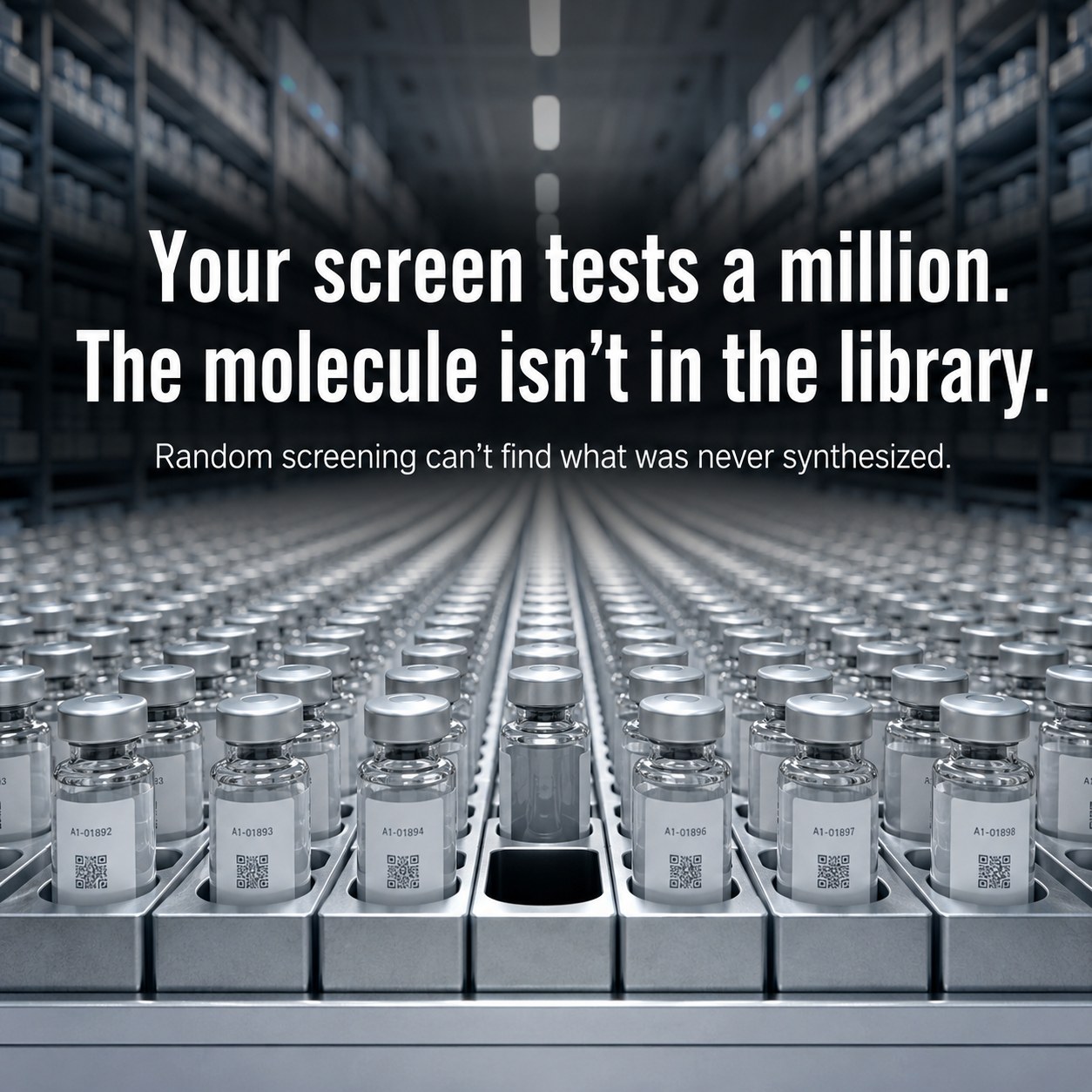
A large high-throughput screening campaign tests a million compounds. The drug-like chemical space holds 10⁶⁰ of them.
That single ratio is the premise of HTS collapsing. Testing 10⁶ when the space is 10⁶⁰ covers a fraction so vanishingly small it rounds to zero. For novel material classes — lead-free perovskites, multi-element alloys — the optimal composition almost certainly isn't sitting in any library on Earth. You're searching for it by exhausting a pre-made shelf that never contained it.
This is Eroom's Law in practice: R&D productivity falling while spend rises. Drug development now costs over $2B per asset (Deloitte, 2024), against a ~90% clinical failure rate.
Self-driving labs invert the search. Instead of random screening, Bayesian optimization picks the next experiment that teaches the model the most — closing the loop between make, test, and analyze with no human in the critical path. Berkeley's A-Lab synthesized 41 novel materials in 17 days that way — at a 71% synthesis success rate, the closed loop fails forward, re-planning the 29% that don't instead of waiting on a human. Cost-Informed BO has cut reagent spend by up to 90% (ChemRxiv, 2024). The result: reaching the target in 10–50x fewer experiments than brute force.
The catch nobody sells you on: the hard part isn't the AI. It's SiLA 2 integration across instruments that each speak a proprietary dialect — Hamilton VENUS, Tecan FluentControl, Agilent — plus GxP audit trails (ALCOA+) that most self-driving-lab platforms still don't support natively. That's custom engineering you own — not a platform that licenses your lab back to you and keeps the data.
If your lab is still running a 21st-century version of Edison testing filaments one at a time, the bottleneck isn't your scientists. It's the search strategy.
Save this for the next R&D budget conversation.
#MaterialsDiscovery #SelfDrivingLabs #BayesianOptimization #LabAutomation #DrugDiscovery