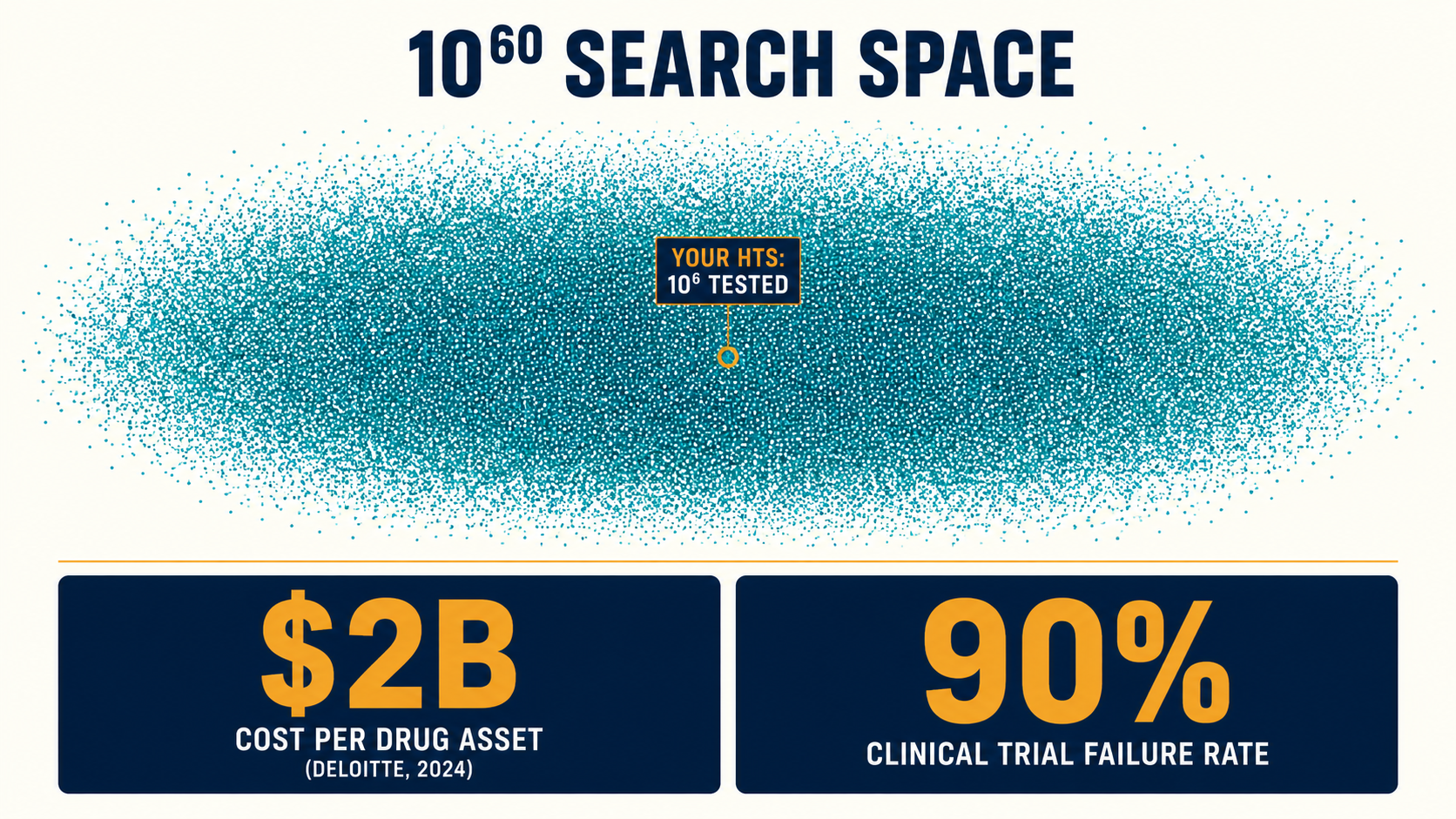
The chemical space available to drug discovery contains an estimated 10^60 pharmacologically relevant small molecules. Your HTS campaign tests 10^6. The algorithm to close that gap — Bayesian optimization with GNN surrogate models — is real, well-published, and achieves the composition-space coverage in 80-120 targeted experiments that random screening doesn't approach in 500. That is not the open problem anymore. The open problem is the instrument integration layer that every self-driving lab platform either ignores or keeps for itself.
We've been studying the autonomous lab market since 2024 — analyzing where the optimization science is mature, where the deployment gap sits, and why mid-size R&D labs can't access what academic systems and hyperscale facilities already run. The pattern is consistent: the math closed. The engineering didn't.
The Cost of Running Edison's Method in 2026
Thomas Edison tested thousands of carbon filaments empirically because theory lagged behind experiment in his era. In 2026, R&D labs are running economically similar campaigns — and the economics have gotten worse, not better.
Drug development cost per asset now exceeds $2B (Deloitte, 2024). The clinical trial failure rate hovers at 90%. Pharma IRR hit a 12-year low of 1.2% in 2022 before recovering to 5.9% in 2024, driven largely by GLP-1 outliers, not by a structural improvement in R&D productivity. This is Eroom's Law — productivity declining despite rising spend — and it's been in force for two decades.
In materials science, the ledger reads differently but the pattern holds. A search for a lead-free halide perovskite with specific bandgap and stability properties spans roughly 10^8 viable compositions once cation options, anion combinations, and stoichiometry ratios are combined. A postdoc synthesizing three to five compositions per week at $150 per run — precursors, substrate preparation, characterization — spends $78,000 over a year covering 520 compositions. That's 0.00052% of the space. The global optimum almost certainly isn't in any library on Earth.
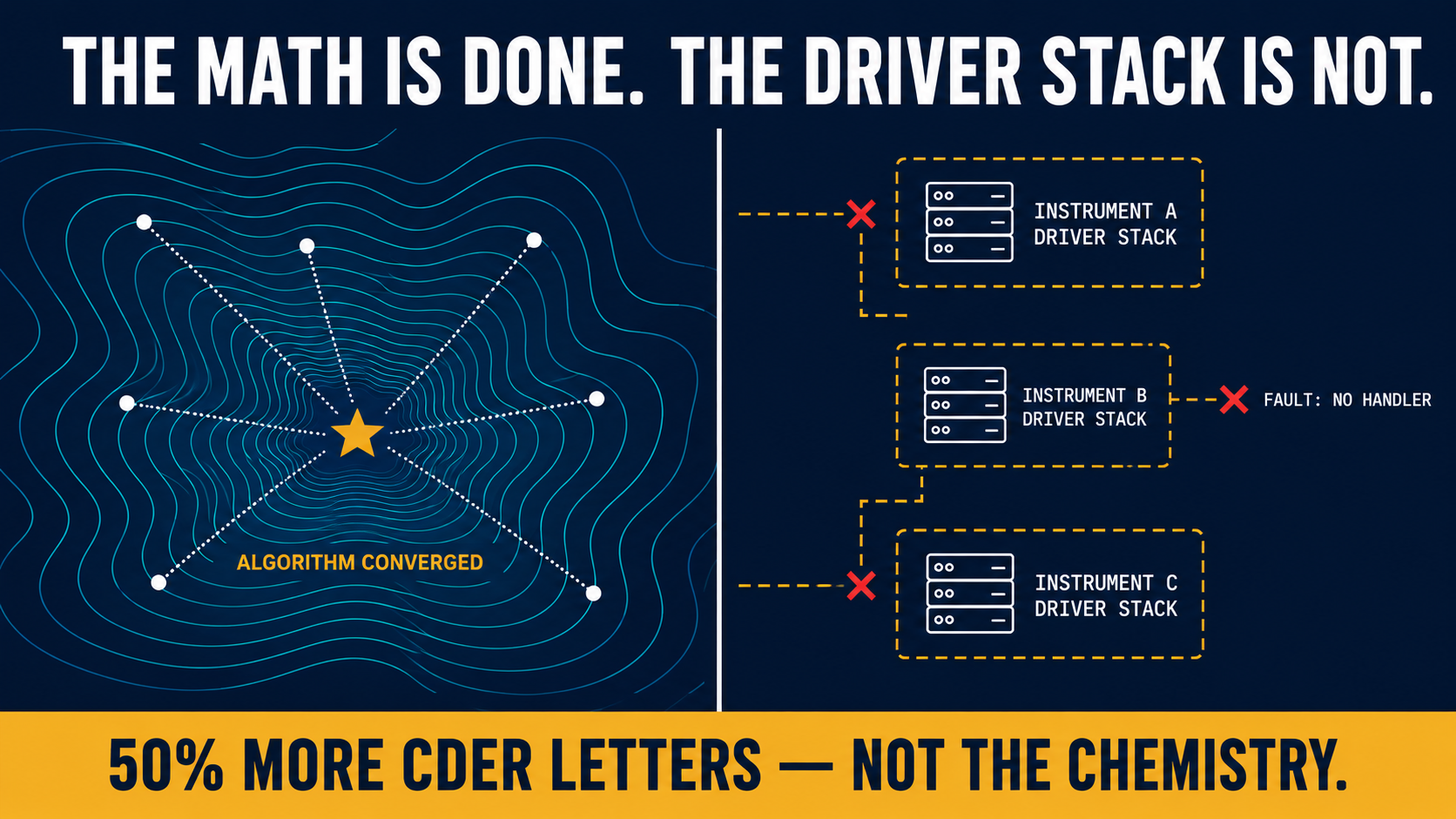
What makes the failure cost worse than the experiment count suggests: most of those failed experiments are undocumented. FDA ALCOA+ compliance requires that failed experiment data be captured, attributable, and traceable. A liquid handler that throws an error mid-synthesis and gets restarted without logging the abort event isn't recoverable in a GxP audit. Most SDL orchestration software drops those exception events rather than logging them — and that gap shows up in data integrity citations when auditors arrive. CDER warning letters jumped 50% in FY2025, with data integrity issues accounting for more than 30% of citations.
What the Platform Market Offers — and What It Keeps
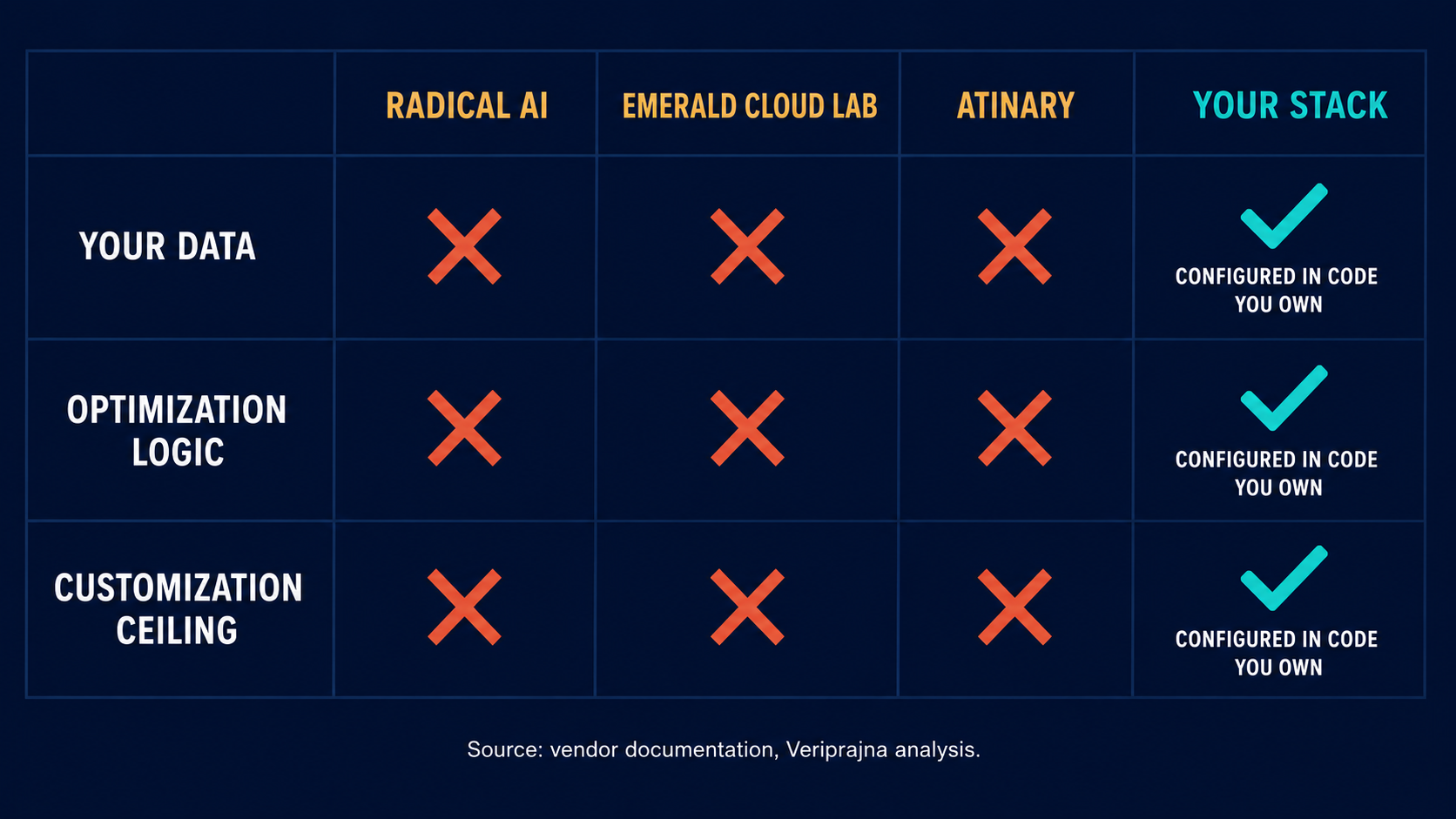
The self-driving lab space has consolidated around a set of platforms that all solve the optimization problem and share the same structural assumption: your workflow adapts to their stack.
Radical AI operates the Brooklyn Navy Yard facility at 25+ alloys per day, 100 experiments per day, backed by $55M from RTX Ventures and NVIDIA NVentures in July 2025 and a subsequent $60M Series A. Governor Hochul's January 2026 launch event confirmed the ambition and the scale. But Radical AI is metallurgy-focused, and the optimization logic runs on their infrastructure. Your data, your acquisition function configuration, and your discovery history belong to the platform, not to you.
Emerald Cloud Lab brings 200+ automated instruments at Carnegie Mellon with a GxP enterprise tier. Subscription costs can approach the annual price of a single instrument. The model is compelling for labs that want access to instrumentation they can't afford to own. It solves a different problem than a lab that already owns Hamilton or Tecan equipment, synthesizes on-premises, and needs an optimization layer that integrates with what's already there.
Atinary launched its Boston "Scientific Discovery Factory" in 2025, running DMTAL (Design-Make-Test-Analyze-Learn) cycles with a growing instrument list and a capable ML optimizer UI. Customizing the acquisition function or kernel beyond what the UI exposes requires engineering engagement with their team, not a configuration change on yours.
The mid-size pharma lab or materials startup that wants to keep its existing instruments and add a Bayesian optimization layer over them — without its data and optimization logic living on a vendor's stack — has no good off-the-shelf option.
Lila Sciences, UC Berkeley's A-Lab, and the broader academic SDL literature show what the ceiling looks like when the full optimization-to-synthesis loop closes: A-Lab synthesized 41 novel materials in 17 days with a 71% synthesis success rate, autonomous recipe correction included. NC State's flow-driven SDL technique collected 10x more data than previous techniques at record speed (Nature Chemical Engineering, July 2025). The Matbench Discovery benchmark's best model achieved a 6.1x discovery acceleration factor. That's the performance envelope the tools enable. The question is whether your lab can access it without becoming a tenant on someone else's platform.
What SiLA 2 Integration Actually Costs
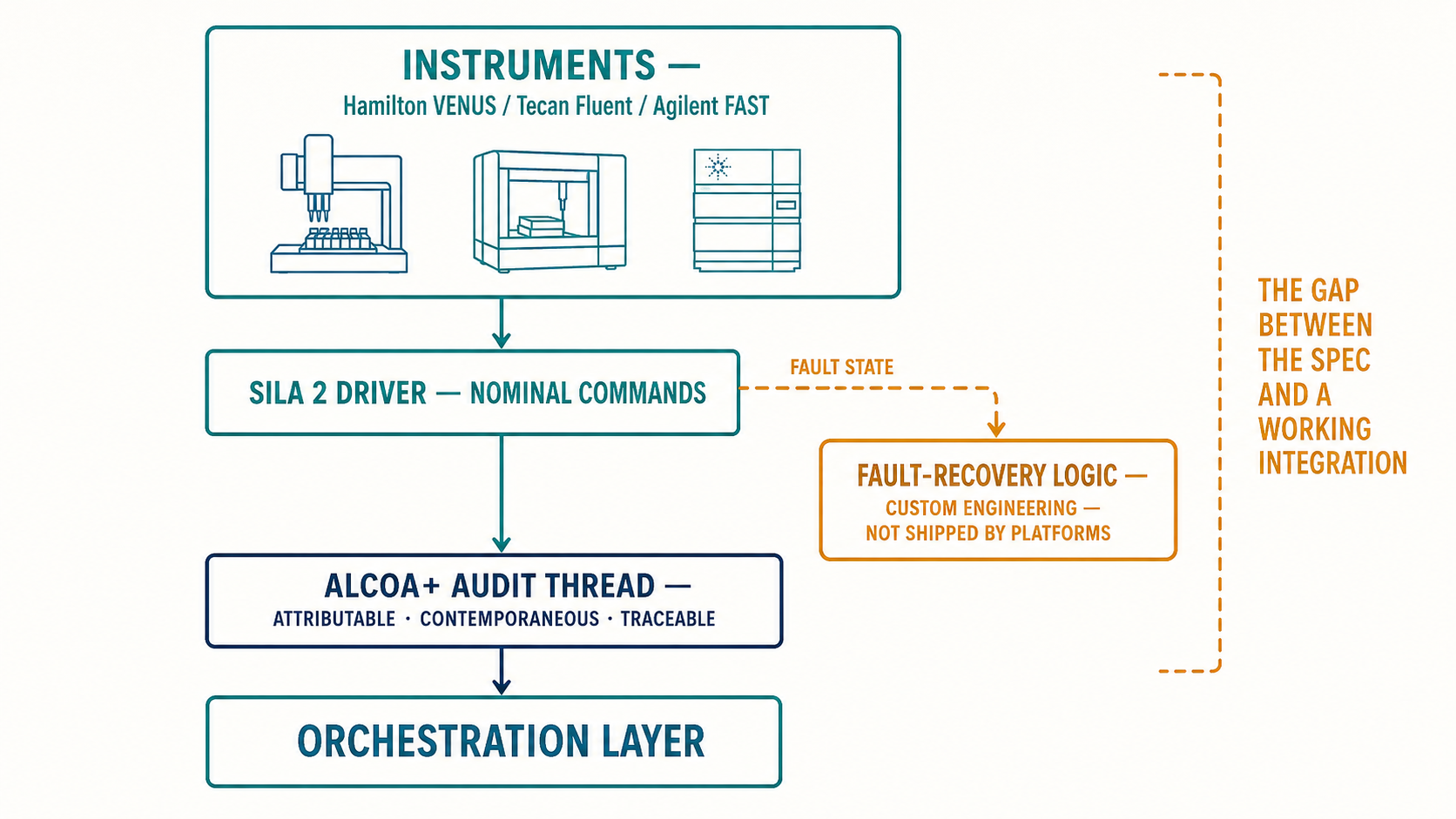
SiLA 2 is the communication standard for lab automation — the protocol that lets an orchestration layer send commands to a Hamilton VENUS liquid handler, a Tecan Fluent, or an Agilent FAST system and receive status back. The standard defines the nominal command-response structure. What it does not define is exception handling.
That gap is where the engineering cost lives. An instrument encountering a low-reagent warning mid-synthesis completes its current command and returns a status code. What the orchestration layer does next — whether it pauses the campaign, flags the experiment for exclusion from the training set, logs the abort event in an ALCOA+-compliant audit trail, and queues the retry or corrective action — is logic that must be written per instrument, per protocol. Platform vendors don't ship it, because they can't — the exception semantics are different for every instrument from every vendor in every synthesis context.
A lab running a heterogeneous instrument set — three vendors in the same synthesis campaign — is running three different error dialects against a single orchestration layer. Each requires its own retry logic, its own fault-recovery branch, its own definition of "this experiment failed cleanly and the data is valid" versus "this experiment failed uncleanly and the training set should exclude it." The SiLA 2 driver spec is the starting point, not the finished work.
The FDA and EMA's joint publication of 10 Guiding Principles for Good AI Practice in Drug Development, released in January 2026, formalizes the governance requirements that make getting this right non-optional: data governance, full documentation, lifecycle management, human oversight. The warning letters to Tyche Industries and Jagsonpal Pharmaceuticals in February 2025 were not about the chemistry. They were about the records.
The BO and GNN Layers: Mature Science, Expert Deployment
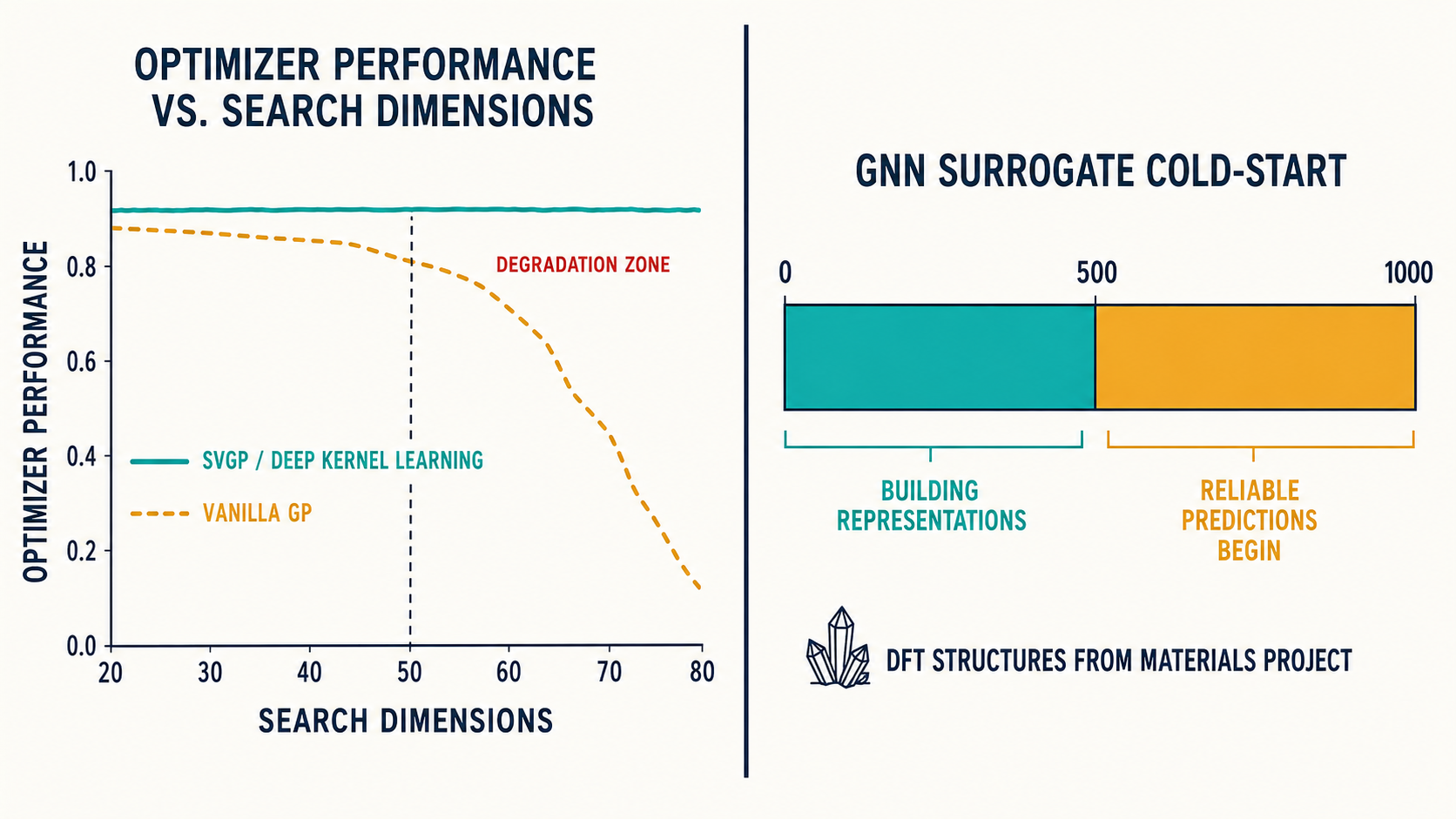
Bayesian optimization with Gaussian Process kernels is available in open libraries and well-understood in the research literature. What's not automatic is applying it to a specific materials domain at scale.
Standard GP-based BO is computationally intractable past roughly 50 dimensions. A lab optimizing multi-element alloy compositions with 60+ parameters, or a formulation space with 80+ component ratios, needs Sparse Variational GP approximations (SVGP) or deep kernel learning to maintain tractable inference. The selection between approximation strategies depends on the dimensionality, the sampling budget, and the correlation structure of the materials domain — not on a platform UI setting.
The GNN surrogate model problem sits earlier in the pipeline. A GNN pre-trained on DFT-calculated structures from the Materials Project can predict bandgap and formation energy in milliseconds once trained. Reaching that model requires identifying which material families in the Materials Project are structurally relevant to the target search, filtering by data quality, running transfer learning to adapt from general-purpose weights to domain-specific ones, and meeting the cold-start threshold — typically 500 to 1,000 high-quality structures before predictions become reliable. Cost-Informed Bayesian Optimization (CIBO), which incorporates per-experiment synthesis cost into the acquisition function to deprioritize expensive compositions until high-information regions are identified, cuts optimization costs by up to 90% (ChemRxiv, 2024). Getting that reduction requires knowing how to set the cost weighting relative to the expected information gain for a specific materials system.
These are practitioner judgment calls per project, not platform configuration screens.
What We Build, and What Stays Yours
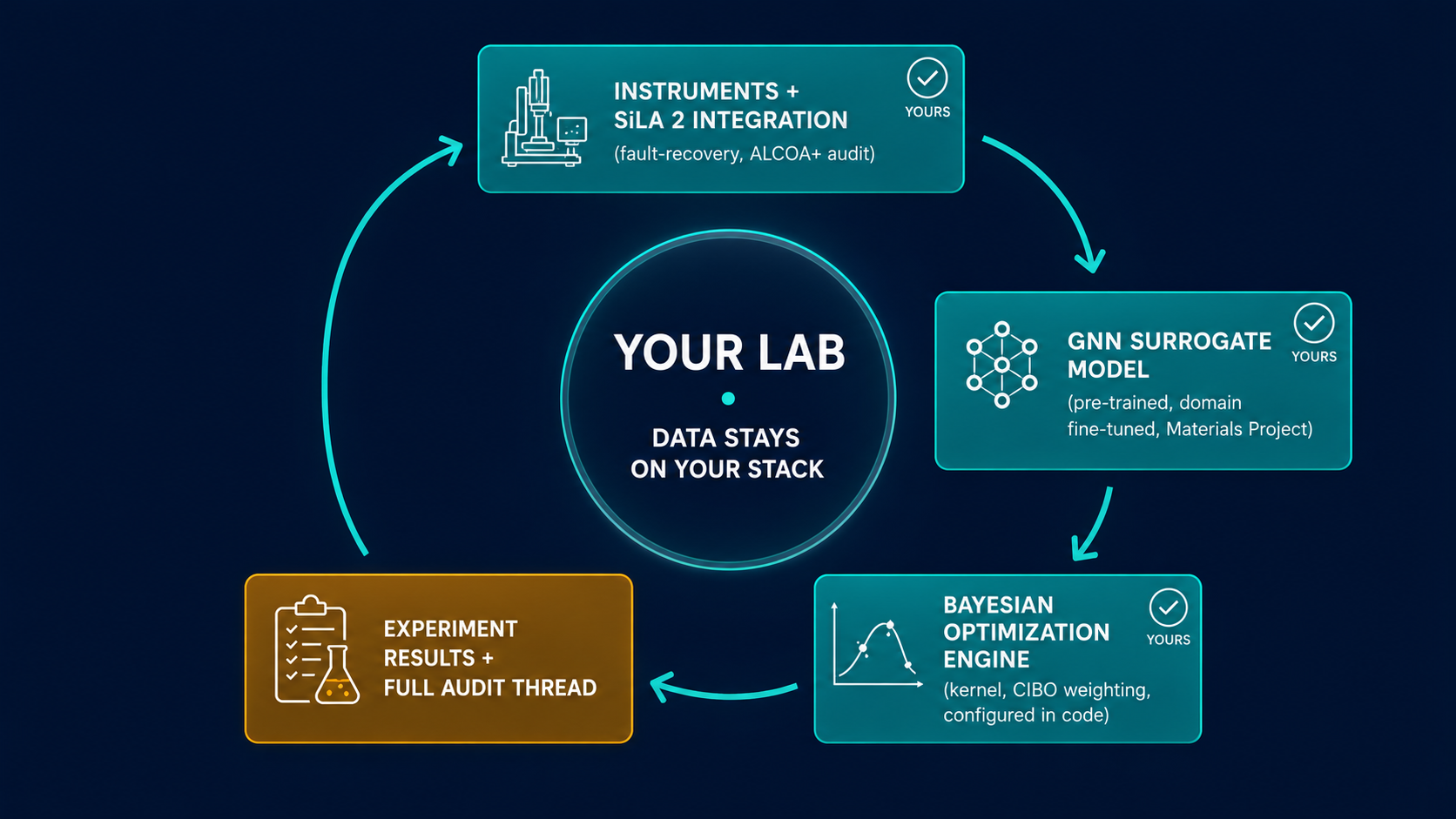
The Autonomous Lab AI: Self-Driving Laboratory Design for Materials Discovery architecture we've built sits between platform lock-in and full in-house development. The logic is yours. We build the Bayesian optimization engine — acquisition function, kernel configuration, CIBO cost-weighting calibrated to your synthesis costs — the GNN surrogate model stack with transfer learning from Materials Project structures or domain-specific DFT calculations, and the SiLA 2 integration layer: device drivers, fault-recovery logic, and the ALCOA+-compliant audit thread that captures failed experiment data as real data, not missing data.
The equipment stays in your facility. Synthesis data stays on your stack. The optimization code is yours to modify, inspect, and extend as your materials program evolves.
If your team is navigating the gap between what your instruments run today and what the SDL literature shows is achievable — or if you're evaluating platforms and finding the custom-integration question never quite gets answered — we've documented the component decisions and the failure modes on the solution page. The optimization science is solved. The integration isn't optional, and it isn't generic.