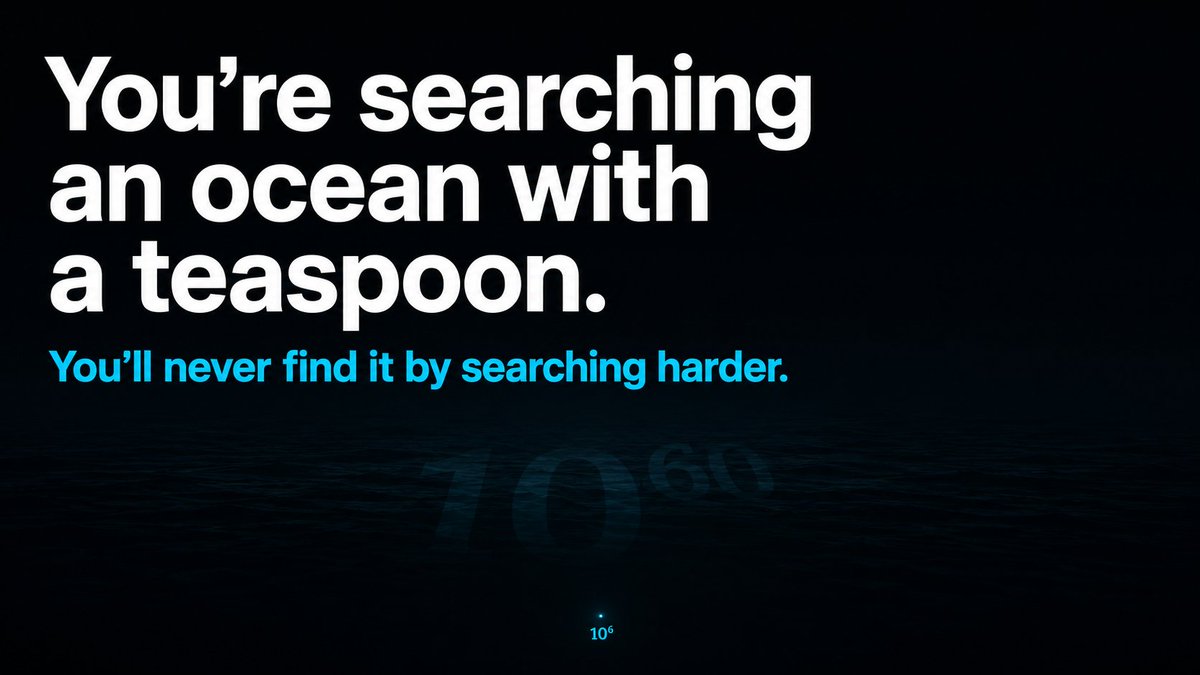
- Drug-like chemical space is ~10^60 molecules. A large high-throughput screen tests 10^6. That's effectively 0% of the search space. In 2026 most R&D still brute-forces it — Edison's filament method with better robots. The math says it cannot work. 🧵
- Extend to biologics and multi-element alloys and the space hits ~10^100. There are ~10^80 atoms in the observable universe. You're not searching a library. The molecule you need was never synthesized and isn't in any catalog on Earth.
- This is Eroom's Law: R&D productivity falling as spend rises. Drug development now costs $2B+ per asset (Deloitte, 2024) at a ~90% clinical failure rate. Pharma IRR hit a 12-year low of 1.2% in 2022. Screening harder is not the fix.
- The fix is to stop searching randomly. Self-driving labs run closed make-test-analyze loops: a model proposes the next experiment, a robot runs it, results retrain the model, repeat. Bayesian optimization reaches target in 10-50x fewer experiments than random screening.
- This isn't theory. Berkeley's A-Lab made 41 novel materials in 17 days at a 71% synthesis success rate — autonomously rewriting its own failed recipes mid-run. Radical AI now runs 25+ alloys and ~100 experiments a day at its Brooklyn Navy Yard facility.
- The catch nobody advertises: GNN surrogates need 500-1000 DFT structures before they're useful, and standard GP-based BO is O(n^3) — it chokes past ~50 dimensions. Done wrong, the loop runs slower than a postdoc. The engineering is the moat.
- The economics run in your favor. Cost-Informed Bayesian Optimization cut reagent costs up to 90% (ChemRxiv, 2024). Autonomous rigs run 24/7 vs 30-40% utilization for human-staffed instruments. Fewer experiments, cheaper experiments, around the clock.
- So why doesn't every lab have one? Integration. Every instrument speaks its own dialect — Hamilton VENUS, Tecan FluentControl, Agilent FAST. Labs become human middleware, re-keying data between systems that won't talk. SiLA 2 integration is custom engineering, not a product.
- The other wall is lock-in. Radical AI, Emerald Cloud Lab, Atinary all want you on their stack, their cloud, owning your data and workflow. For regulated pharma add GxP: most SDL software has no ALCOA+ audit trail, and CDER warning letters rose 50% in FY2025.
- Our take: a mid-size lab shouldn't have to pick between DIY and lock-in. Keep your instruments. Keep your IP and your data. We build the BO/GNN optimization engine, the SiLA 2 integration layer, and the ALCOA+ compliance trail around the lab you already own.
- Honest question for R&D and lab-automation folks: where does your closed loop actually break — the optimization, or the boring instrument integration nobody wants to own? That's the real bottleneck. #SelfDrivingLabs #MaterialsDiscovery
- We wrote up how we design autonomous discovery systems on existing lab hardware — optimization, integration, and compliance — here: https://veriprajna.com/solutions/autonomous-lab-ai