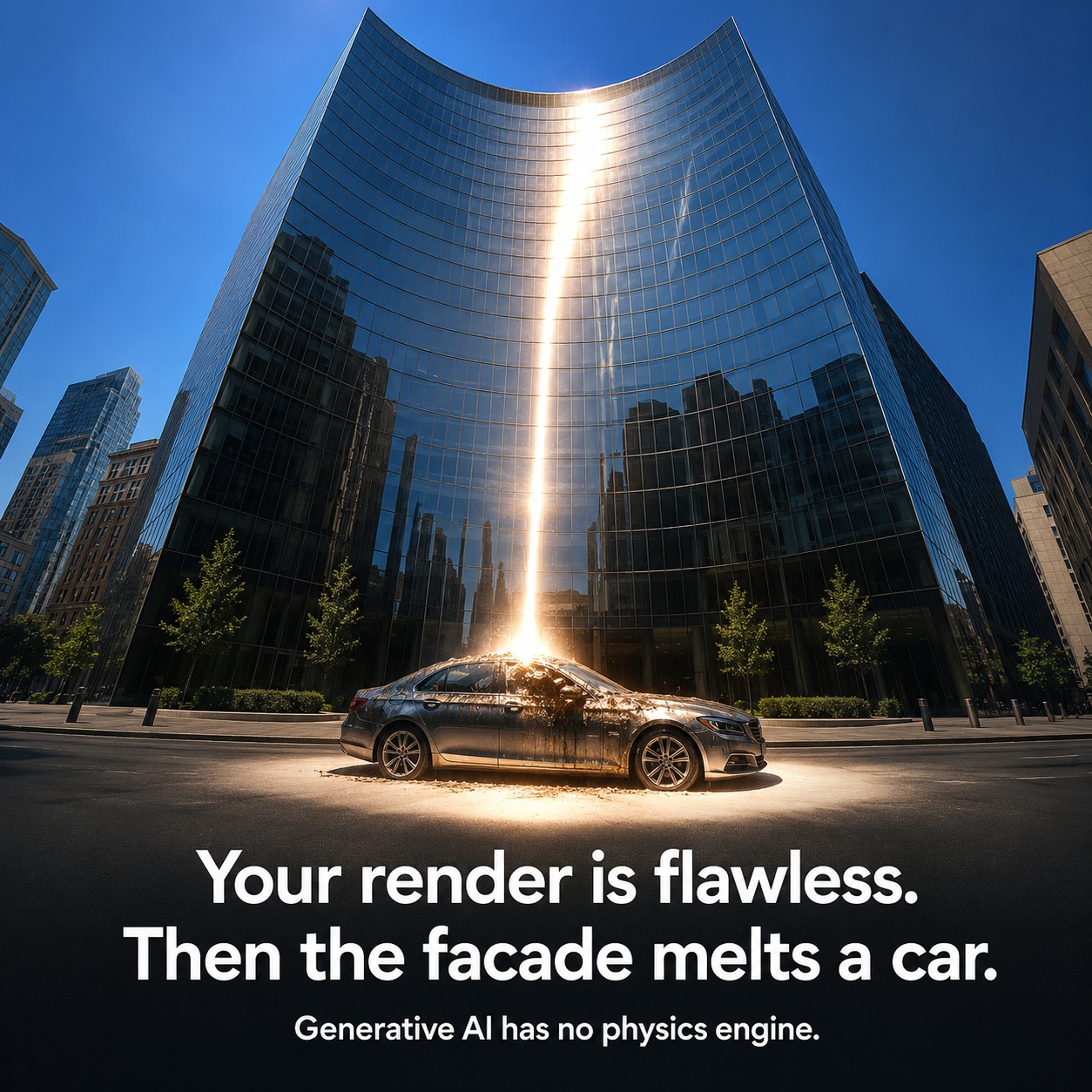
A glass facade that focused sunlight hot enough to melt a parked Jaguar — and the same architect designed the same failure twice.
The Vdara hotel in Las Vegas did it first — its crescent facade turned the pool deck into a solar oven, melting plastic chairs and singeing guests' hair. Then the "Walkie-Talkie" tower in London repeated it on the street below — same gap in the design process.
A ray-tracing check at the concept stage would have caught both in milliseconds. But the tools generating these forms have no physics engine. They produce pixels, not load paths.
That gap is widening. Generative AI makes curved geometry trivial to draw — and concentrated solar, wind tunneling, and acoustic focusing scale right with it. Stunning concept in seconds; the structural team then spends weeks proving it can't be built.
The cost is not abstract. 80% of construction cost deviation traces to design changes, not construction mistakes — roughly $177B in annual rework. Steel rose 11.9% in 2025, so a non-standard section dropped into a render quietly becomes a 16-week lead time and a value-engineering crisis 60 days later. And the geometry itself bites: double-curved glass runs $100-500/sq ft against $18-25 for flat tempered — a facade 3x over budget before anyone touches the steel.
We mapped the AEC AI landscape — Autodesk Forma, Altair, TestFit, Stru.ai — and found the same gap everywhere: tools generate massing, or they automate analysis, but none closes the loop between a render and a verified, buildable, procurable structure.
That loop is the whole game. Physics-informed pre-screening while the concept moves, structural optimization against real steel availability, and BIM-to-analysis pipelines that don't lose half the model in translation.
Save this for your next design-technology review. And for the engineers: what concept got value-engineered into something unrecognizable on your watch?
#StructuralEngineering #GenerativeDesign #AEC #ConstructionTech #BIM