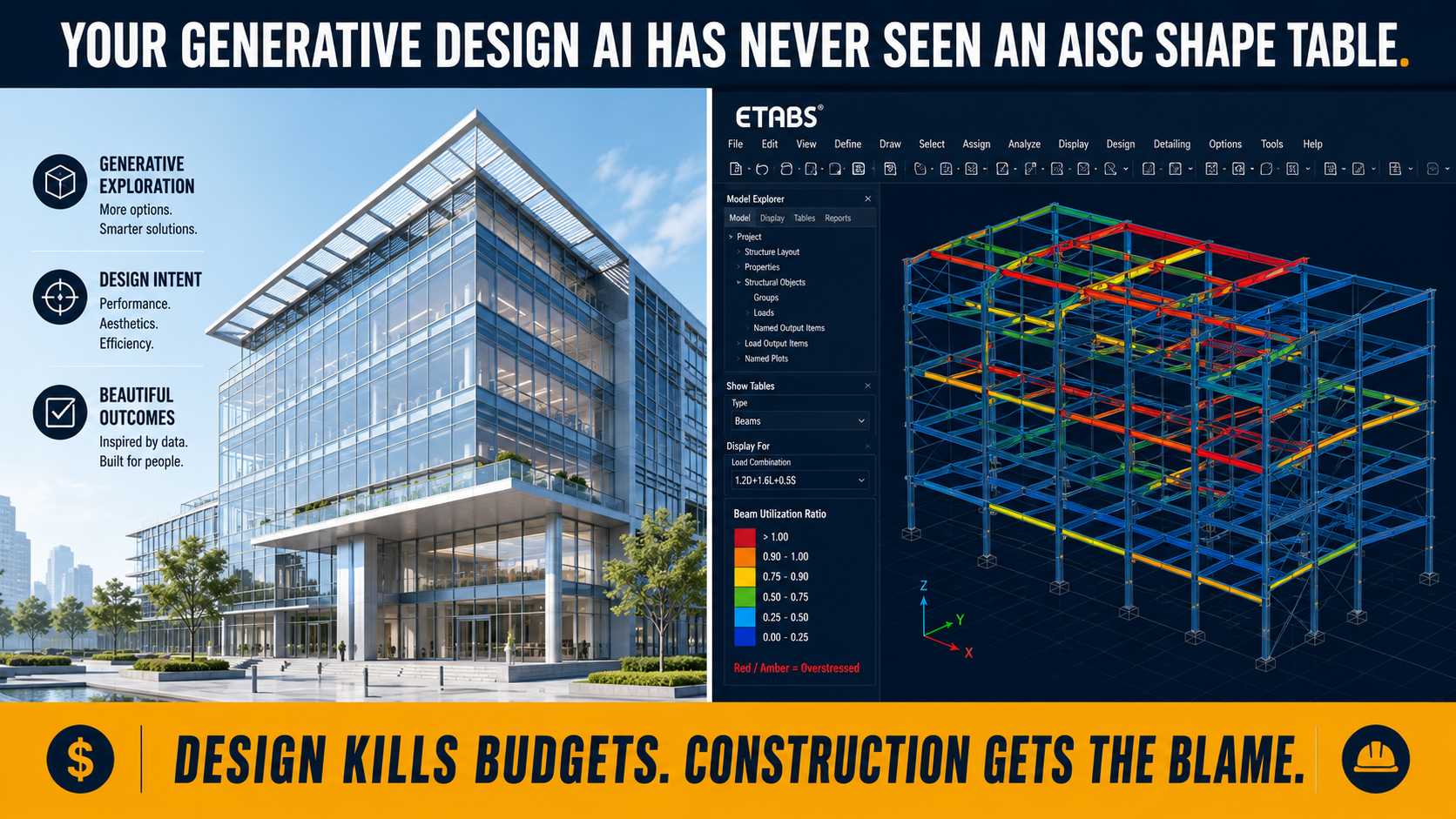
The $177 billion in annual construction rework isn't a construction problem — it's a design pre-screening failure, and AI tools are making it worse. Every generative design platform now entering AEC produces more unbuildable concepts faster than any previous generation of software. Autodesk Forma, Hypar, Spacemaker, a dozen more: they all optimize for spatial quality. None of them ask whether the structure they just generated can be built at current steel prices, standard section availability, or ASCE 7-22 compliance.
According to Trimble's research, 80% of cost deviation in construction comes from design changes, with only 17% attributable to construction activities. That ratio has held for decades. It has nothing to do with render quality. It's a feedback-loop timing problem: the structural analysis that would catch unbuildable decisions runs at the end of schematic design, not at the beginning of conceptual design. The gap between those two moments is where the $177 billion lives.
The VE Crisis on a Predictable Cadence
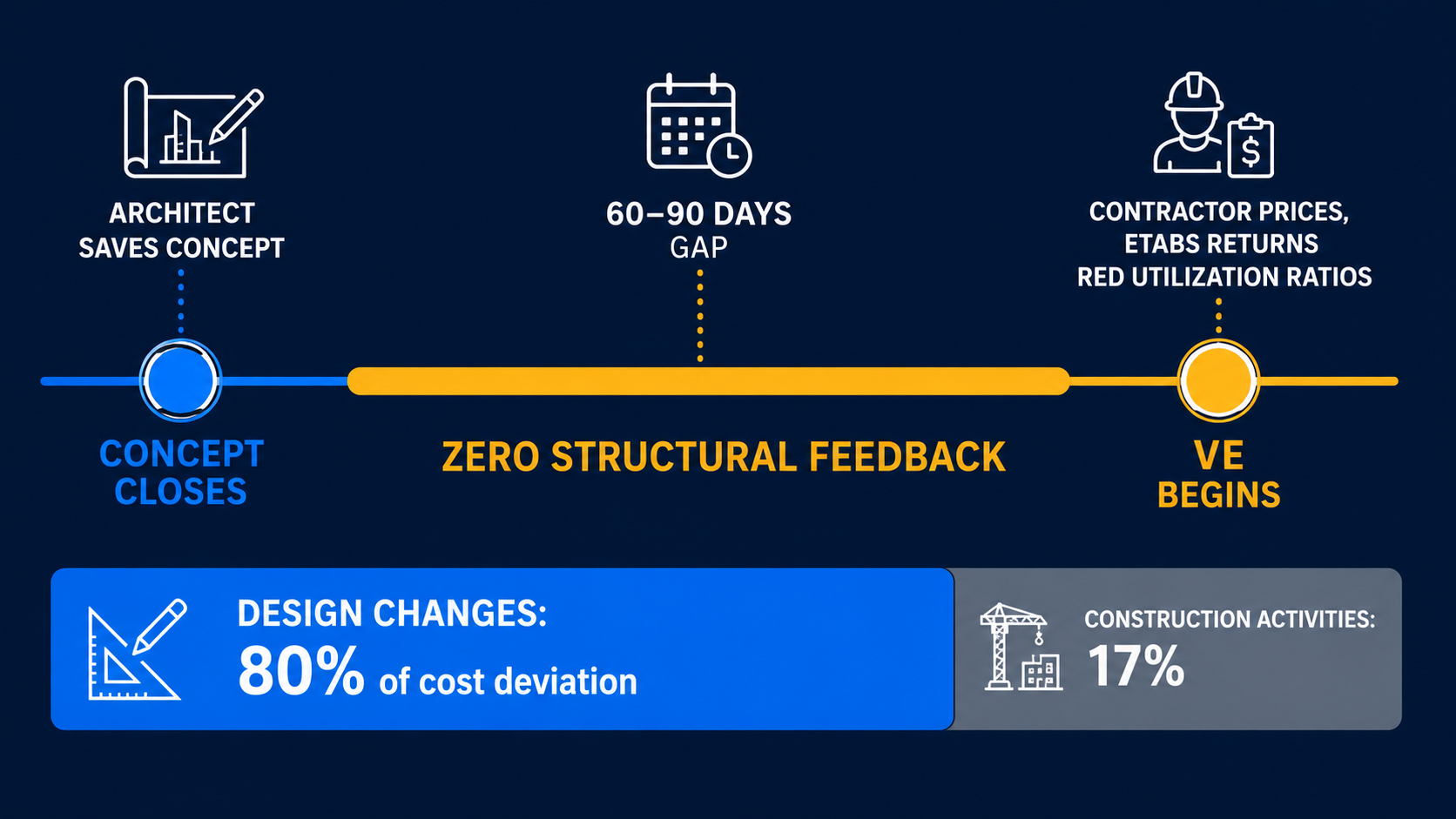
Value engineering (VE) crises follow a pattern most AEC principals have experienced more than once. Schematic design closes. The concept is compelling. Then, 60 to 90 days later, a contractor prices it and the structural team runs full finite element analysis. ETABS or SAP2000 returns a model with member utilization ratios in red. Non-standard steel sections that would require mill orders — sometimes months of lead time at minimum tonnage thresholds — appear throughout the framing plan. The design begins its second life as a series of compromises over what to cut.
The VE crisis is almost entirely predictable. It's the consequence of running structural validation after design commitment. The further into schematic design a team goes before structural feedback enters the loop, the more expensive the recovery.
Eighty-five percent of construction projects over the past 70 years experienced cost overrun, averaging 28% over budget. Only 8.5% of projects over one billion dollars were completed on time and within budget. Those numbers predate generative AI; with faster concept generation and more concept iterations, the window for catching structural failures early is getting shorter, not longer.
Why the Incumbent Vendors Haven't Bridged the Gap
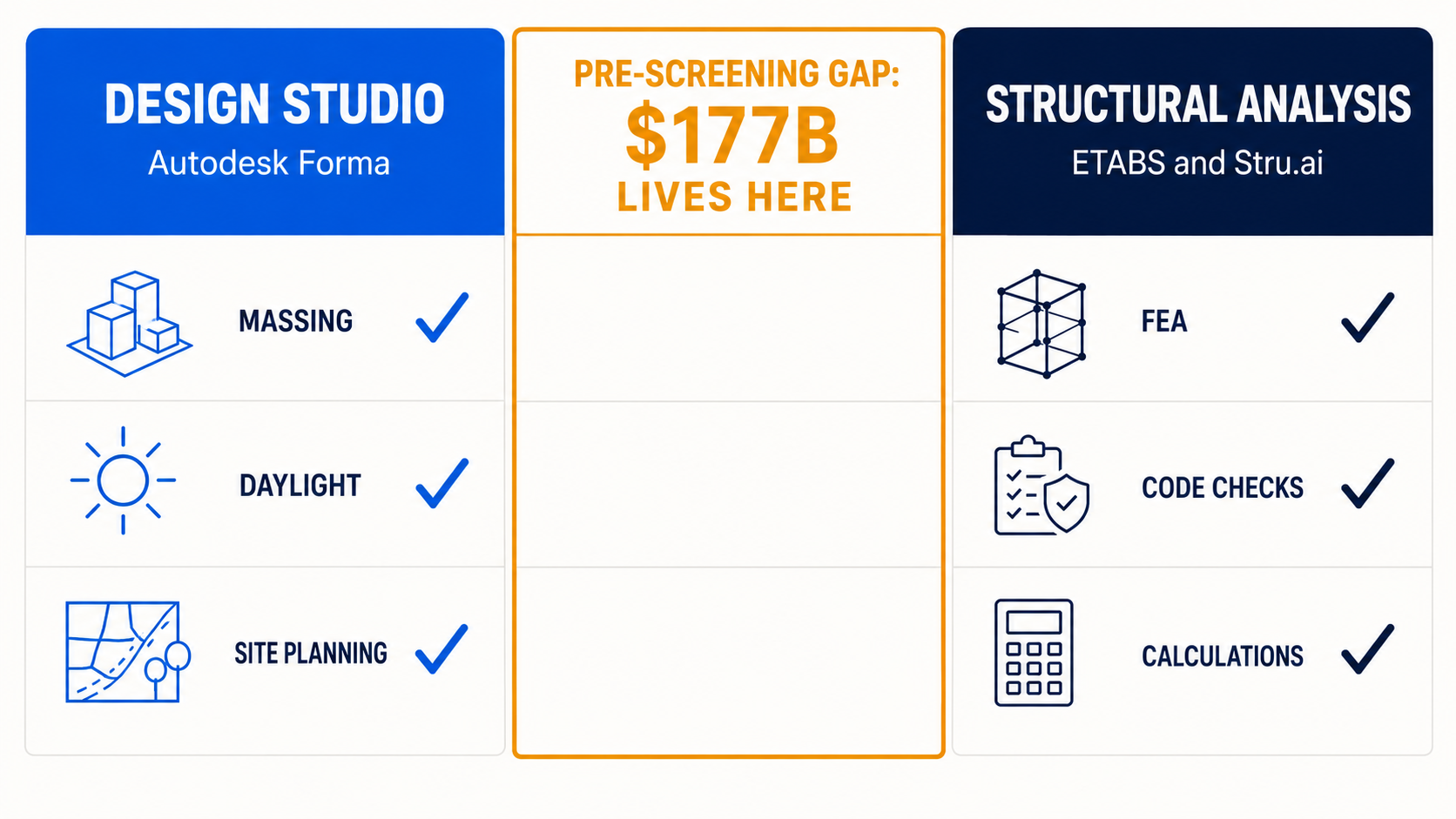
Autodesk Forma launched Neural CAD for Buildings in 2025, described as the first AEC-specific AI foundation model. It handles massing, site automation, daylight and carbon analysis, and Revit integration at LOD 200/300. Its gap is precisely stated in Autodesk's own positioning: Forma operates at the massing and site-planning layer. What it doesn't do is structural member sizing, cost optimization against current procurement, or physics-based load-path feedback during conceptual design — which is exactly the layer where the VE crisis originates.
Hypar 2.0, released in January 2025, shifted to space planning — building masses, structural grids, columns, furniture layout. TestFit is operational at scale, processing 80,000 units per week across 650-plus deals, focused on multifamily site planning. Stru.ai automates ETABS and SAP2000 workflows and claims 40% time savings — it generates Mathcad and Excel calculation sheets with ACI and AISC code references, which is genuinely useful. But Stru.ai is an automation wrapper around existing finite element analysis. You still need the massing model, the preliminary framing plan, and the structural configuration before it can run anything. It accelerates what structural engineers already do; it doesn't move structural feedback earlier in the design timeline.
The pattern across the landscape is consistent: each tool is optimized for one discipline's workflow. Autodesk Forma for the design studio, ETABS and SAP2000 for the structural team (augmented now by automation tools like Stru.ai), Tekla Structures for fabrication detailing downstream. The VE crisis lives in the gap between the design studio and the structural team, and it has remained unbridged because architecture and structural engineering have always been separate professions with separate tool vendors and separate workflows.
What Physics-Informed Pre-Screening Actually Means
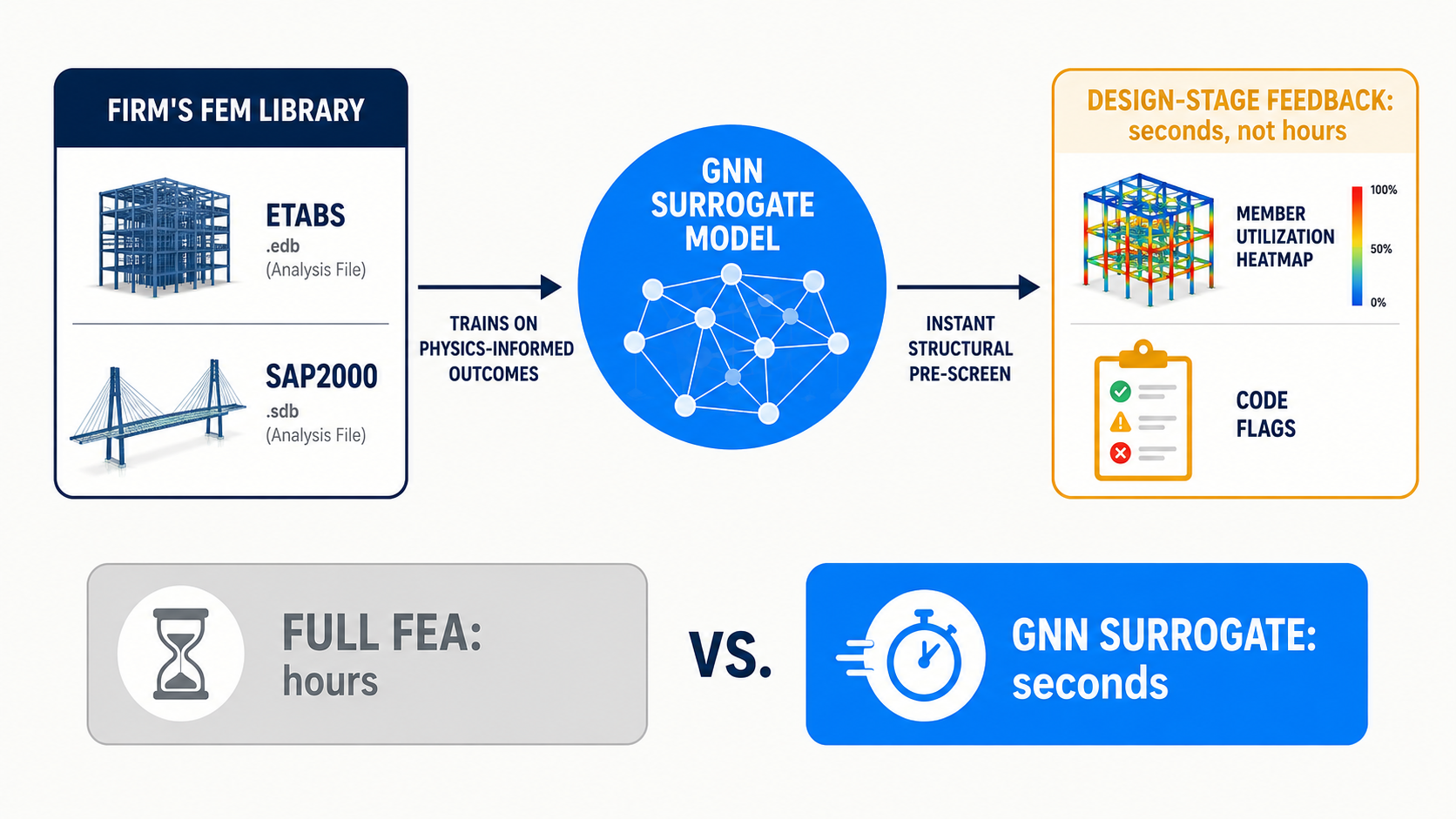
Full finite element analysis on a mid-size building model takes hours. That's not a software performance problem; it's the physics. Solving thousands of differential equations for load distribution, deflection, and stress under multiple load combinations requires the compute time it requires. You can't accelerate the solver without changing what the solver is.
The change that academic research has produced in the last two years is graph neural networks (GNNs) trained on structural behavior. StructGNN, published in 2024, demonstrated greater than 99% accuracy predicting displacements, moments, and shear forces on frame structures, including 96% accuracy on unseen taller structures outside its training set. A 2025 study on GNN-based modular structural surrogates showed that replacing iterative FEA with a trained surrogate reduced optimization time by 81% — with a 5.7% reduction in carbon emissions, because the designs the surrogate recommended were structurally lighter by constraint.
A GNN surrogate trained on a firm's own building typologies inherits the physics-informed rigor of the FEA data it was trained on. It delivers structural feedback in seconds, not hours, because it has learned the structural behavior of this class of buildings — not approximating physics from first principles each time.
This is the pre-screening layer we built into Veriprajna's AI for Architecture & Structural Engineering: a GNN surrogate model pipeline that trains on a firm's completed structural analysis library (steel moment frames, composite deck systems, or the specific typologies the firm builds most), then delivers structural feedback — overstressed members, deflection warnings, code-check flags against ASCE 7-22 — at conceptual design stage, before the first full FEA run.
The structural engineer still runs the full FEA. The pre-screening layer changes how many red-flagged utilization ratios come back from that first run.
The Procurement Problem the Structural Screen Doesn't See
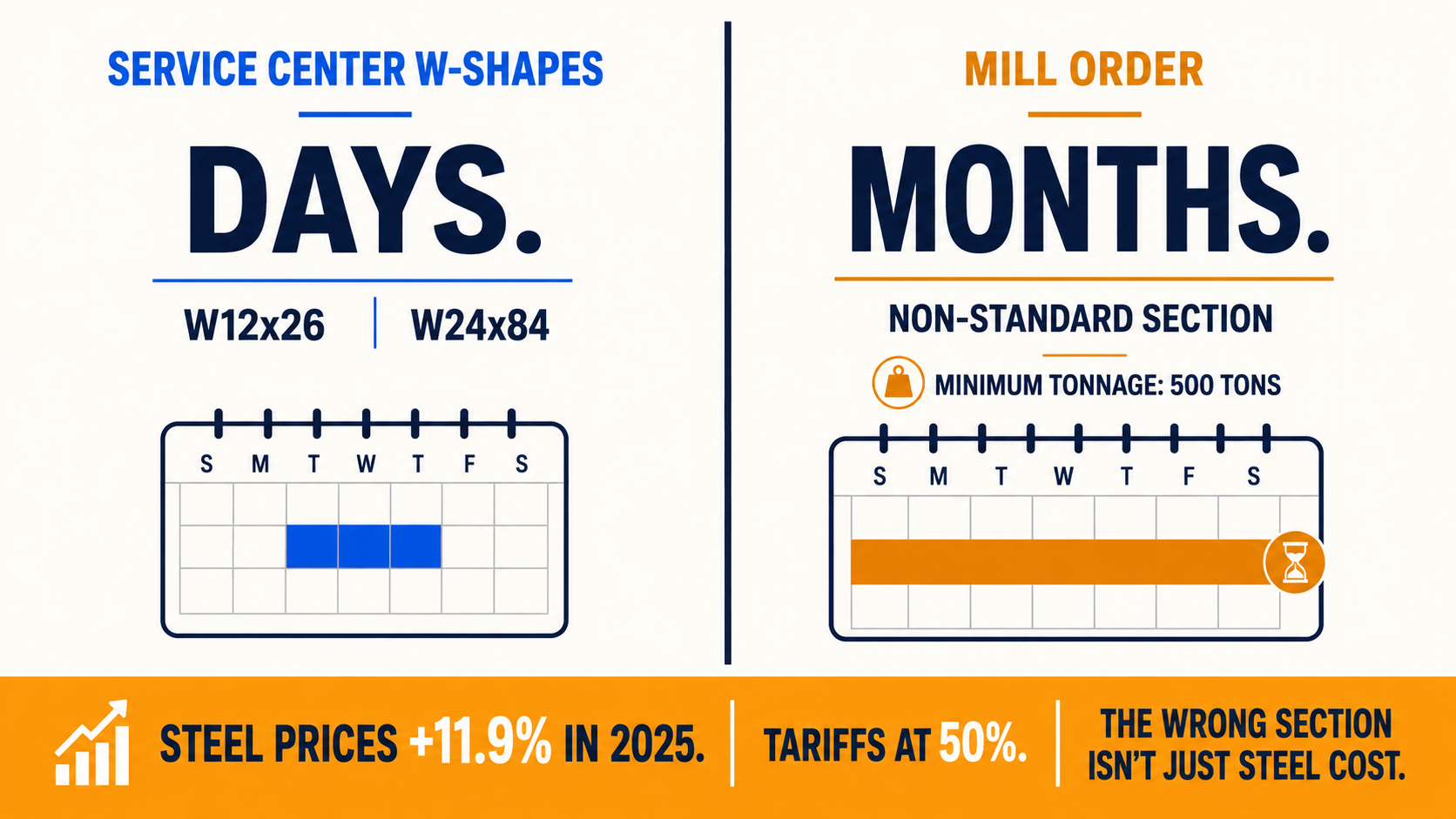
GNN-based structural pre-screening catches load-path issues. It doesn't catch the steel procurement problem — and that's where the other substantial fraction of VE pain originates.
The AISC maintains a real-time steel shapes availability database at aisc.org/steelavailability. Service centers stock common W-shapes — W12x26, W24x84, and the standard catalog — with lead times measured in days. Mill orders for less-common or non-standard sections require high minimum tonnage and lead times that can extend months, with specific shapes rolled only quarterly.
Service center stock is a days decision. Mill order is a months commitment. When a framing plan specifies a non-standard section, the procurement impact doesn't surface until a fabricator prices the job — by which point the design has often already been stamped and submitted.
With steel prices up 11.9% year-over-year through end of 2025 (ENR 20-city average) and tariffs on steel and aluminum hiked to 50% mid-year, the cost of a non-standard section isn't just the steel. It's the schedule delay, the structural re-analysis, the permit revision, and the engineering fee for the revision cycle. A structural AI that optimizes member sizing without a constraint layer on procurement reality is optimizing the wrong objective function.
We added a procurement constraint layer to the pre-screening output that cross-references AISC availability data before recommending a section, so the result isn't just structurally defensible — it's a standard section available at service-center lead times.
The BIM-to-Analysis Pipeline Is a Custom Problem
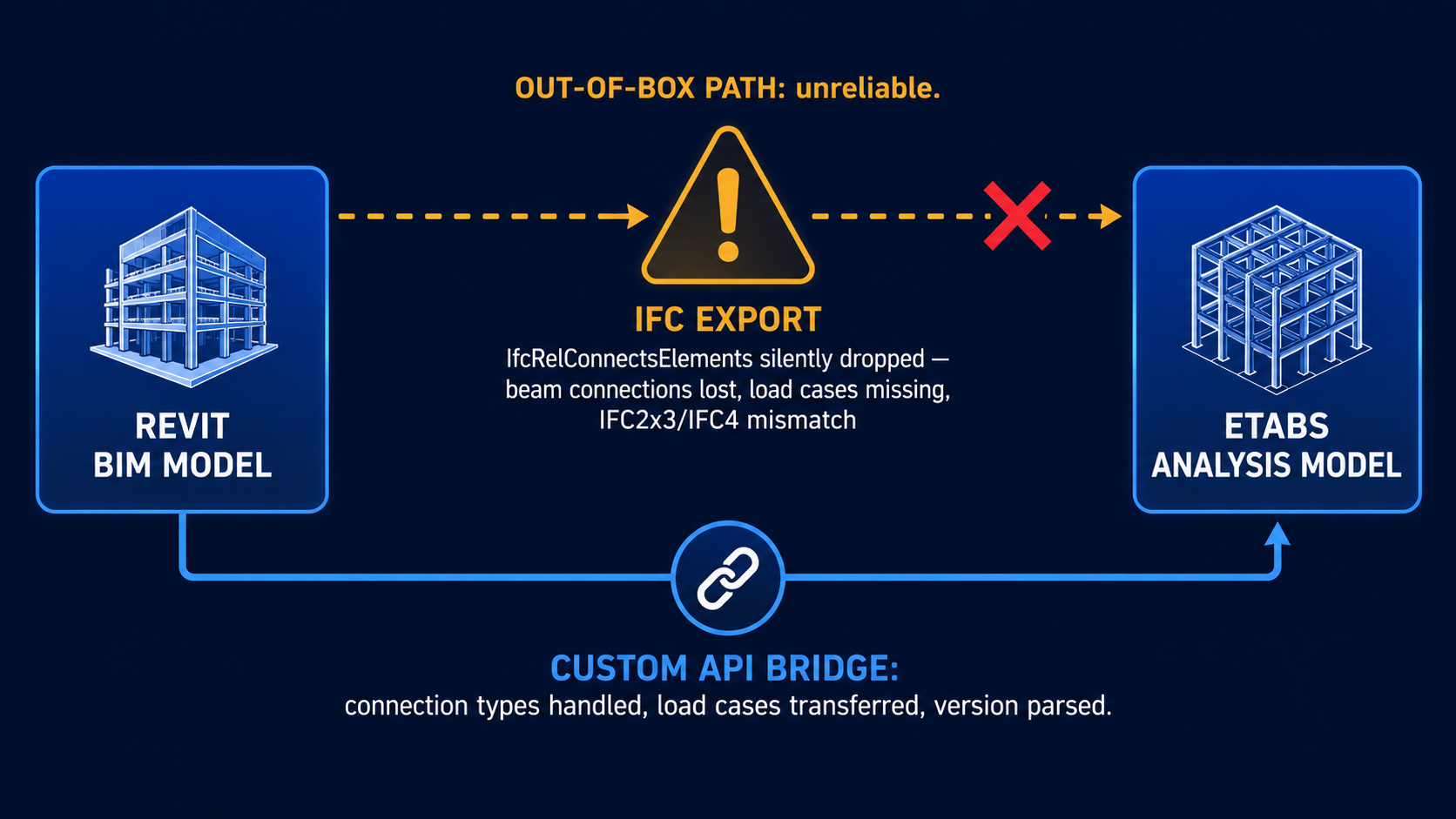
Between the design model and the analysis model sits a fragile data handoff that most AEC firms have learned not to trust. IFC (Industry Foundation Classes) is the standard for BIM data exchange between platforms. The out-of-box IFC quality between Revit and structural analysis tools is poor enough that Graphisoft's own documentation for the Archicad-Revit IFC exchange add-in describes the result as inadequate without customization.
IFC version fragmentation compounds the problem. IFC2x3 and IFC4 are in active parallel use across firms, and the translation between them causes alignment failures where beam connections silently drop from the export. The specific failure mode — dropped IfcRelConnectsElements between BIM authoring tools — means an analysis model built from an automated export may be missing structural connections without any visible error message. IFC5 may eventually address this for digital twin workflows, but IFC2x3/IFC4 fragmentation is the live condition.
The fix isn't waiting for a new standard version. It's building a custom pipeline at the Revit API and analysis-tool API layers that handles the specific connection types, load case transfers, and parsing that out-of-box IFC silently drops. This requires deep familiarity with both BIM authoring tools and structural analysis tools — not generic automation competency.
The PE Stamp Doesn't Move
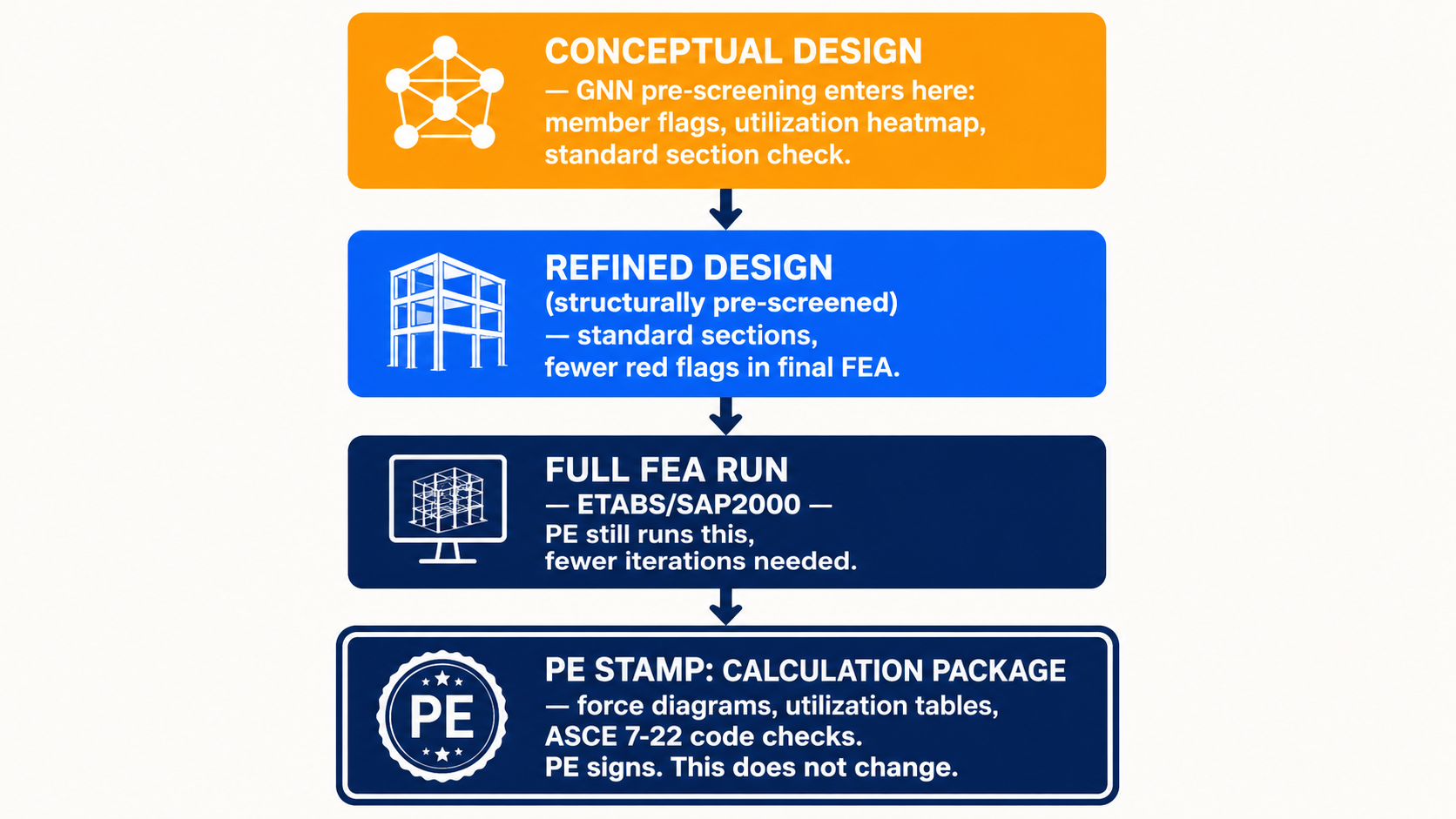
Any practical discussion of AI and structural engineering requires addressing the liability question directly, because it's the first thing any licensed structural engineer will raise — rightly.
AI use does not change a Professional Engineer's legal obligations. No building department accepts a GNN pre-screening output as the basis for a structural permit. The PE stamps the final calculation package: force diagrams, member utilization tables, and code-check documentation demonstrating compliance with ASCE 7-22 as adopted into IBC 2024, with its significant changes to multi-period response spectra, non-structural anchorage equations, and snow load maps. The pre-screening layer is not a substitute for that package; it's a filter that ensures the designs reaching final FEA have already been evaluated for load-path integrity, standard section availability, and preliminary code compliance.
Only 27% of AEC professionals report using AI in operations (ASCE survey, December 2025), and only 8% of architecture firms have implemented AI solutions (AIA research). That's not because the technology doesn't exist — StructGNN, GNN-based surrogates, and IFC pipeline automation all exist and have demonstrated results. The gap between research and production is the integration problem: connecting academic capability to the actual AEC workflow in a form that works with Revit, respects PE liability boundaries, and constrains output to what's available in current steel inventory.
The teams that have moved fastest on this problem tend to start with a single structural typology — typically something the firm builds repeatedly, where a surrogate model can be trained on completed FEM data and validated against known-good analysis results before it sees a new project. That's usually where the diagnostic question is sharpest: for the last ten projects of this type, how many VE cycles were triggered by structural decisions that could have been screened at concept stage?
If your firm is working through that question — or through the BIM-to-analysis pipeline problem specifically — we'd be interested in how the friction points present from the structural engineering side. The teams closest to solving this tend to have a very specific view of where their own loop breaks. That's where the conversation at Veriprajna usually starts.