
I've been in a lot of AEC demos over the past two years, and there's a moment I've started watching for. The architect finishes showing the concept — generative design tool, stunning massing, Midjourney-quality output — and somewhere in the room a structural engineer goes quiet. Not skeptical-quiet. Somewhere-between-resigned-and-calculating-quiet. They're already running the value engineering math in their head.
That silence is where the $177 billion in annual construction rework lives. Trimble's research puts 80% of construction cost deviation in design changes, not construction activities. The VE crisis isn't a contractor problem. It's a feedback-loop timing problem — the structural analysis that would catch unbuildable decisions runs at the end of schematic design, not at the beginning of conceptual design. The gap between those two moments is what I've been trying to close.
What the Structural Director Told Me About the Script
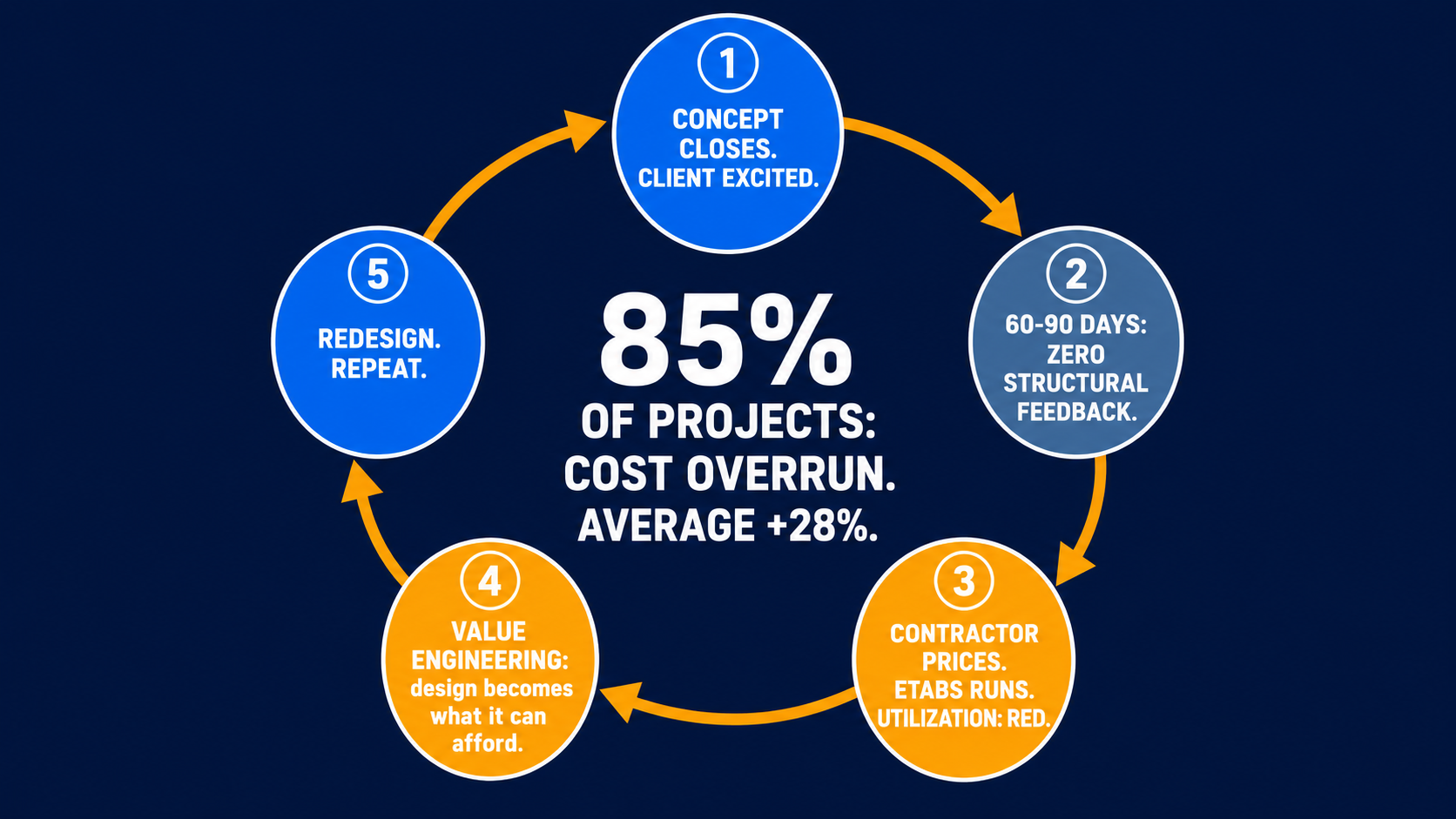
The clearest description of the VE crisis I've heard came from a structural director who had been through it enough times that he described it the way you describe a commute. Concept closes. Client is excited. Sixty to ninety days later, contractor prices it. The structural team runs ETABS or SAP2000. Member utilization ratios come back in red. Non-standard steel sections throughout the framing plan — some of them requiring mill orders, months of lead time, high minimum tonnage. The design begins its second life as a negotiation over what to cut.
The way he put it was that the VE crisis doesn't transform a design — it reveals what the design could afford to be from the beginning. That's the outcome of running structural validation after design commitment. Eighty-five percent of construction projects over the past 70 years experienced cost overrun, averaging 28% over budget. Only 8.5% of projects over a billion dollars finished on time and within budget. Those numbers predate generative AI. Faster concept generation means more concepts committed before structural feedback enters — the window for early interception is getting narrower.
Why I Stopped Being Impressed by the Vendor Landscape
When I started looking at what the AI vendors in AEC were building, my first reaction was that the problem was basically solved. Autodesk Forma has Neural CAD for Buildings, described as the first AEC-specific AI foundation model. Hypar 2.0, released in January 2025, generates building masses and structural grids. TestFit is processing 80,000 units evaluated per week across 650-plus deals. Stru.ai automates ETABS and SAP2000 workflows, generating Mathcad and Excel calculation sheets with AISC and ACI code references, claiming 40% time savings.
Then I looked at what each tool actually hands off. Forma operates at the massing and site-planning layer — no structural member sizing, no cost optimization against procurement reality. Stru.ai accelerates what structural engineers already do, but you still need the massing model and the preliminary framing plan before it runs anything. It doesn't move structural feedback earlier in the timeline. Hypar, TestFit, Tekla Structures: each is optimized for one discipline's workflow.
What none of them do is give a structural engineer feedback on a concept the architect finished twenty minutes ago. That's the gap I kept coming back to, and it was clearer once I understood why it existed: architecture and structural engineering have always been separate professions with separate tool vendors and separate procurement relationships. Nobody was incentivized to build the bridge.
The GNN Paper That Changed My Understanding of What Pre-Screening Could Be
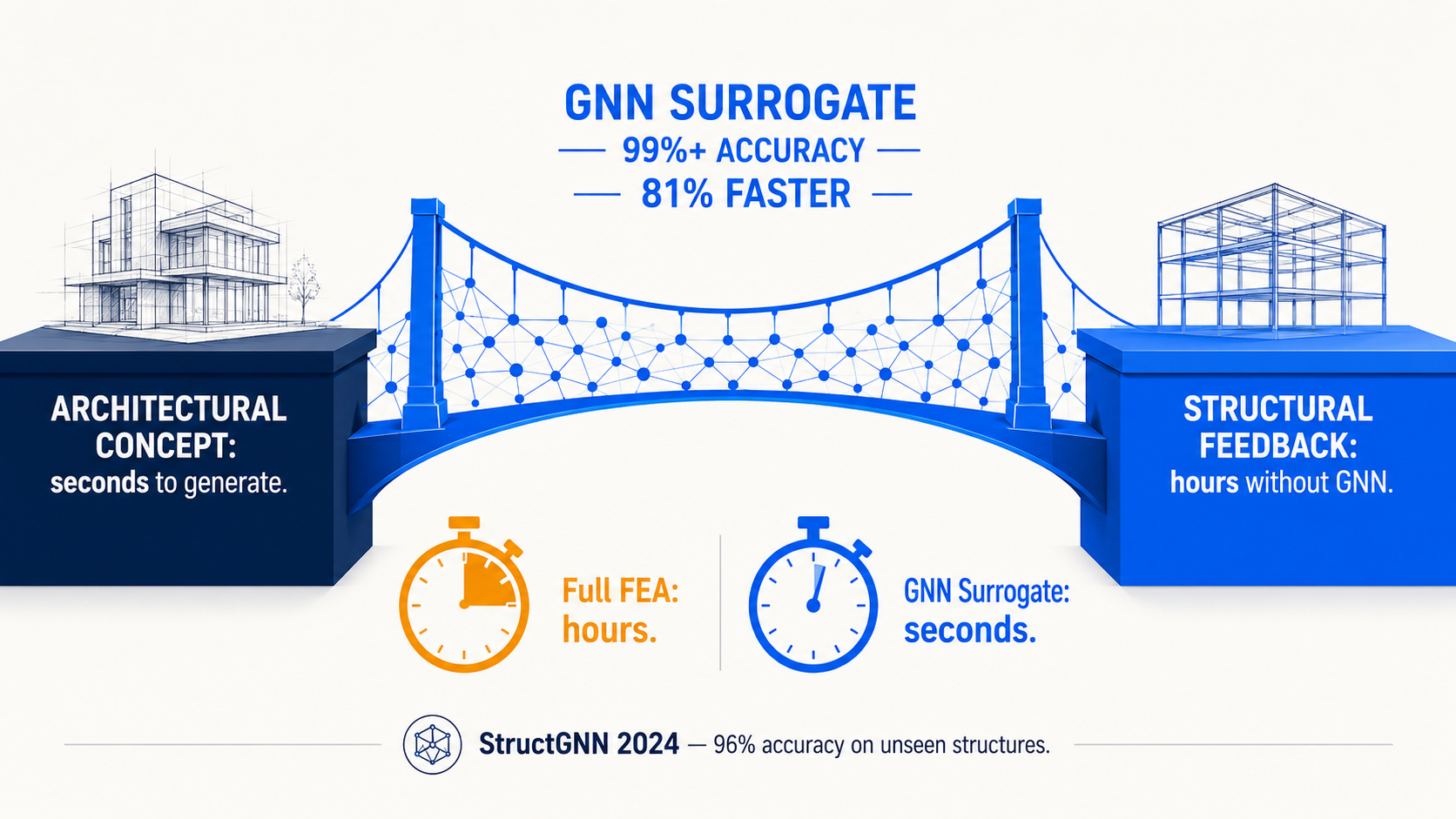
The research that shifted my thinking came from two directions at once. StructGNN, published in 2024, demonstrated greater than 99% accuracy predicting displacements, moments, and shear forces on frame structures — including 96% accuracy on unseen taller structures outside the training distribution. A 2025 study on GNN-based modular structural surrogates showed 81% reduction in optimization time and a 5.7% reduction in carbon emissions, because designs the surrogate recommended were, by constraint, structurally lighter.
These aren't approximations of finite element analysis. A GNN surrogate trained on a firm's completed structural analysis library has learned the structural behavior of that class of buildings. It delivers feedback in seconds because it's pattern-matching against physics-informed outcomes, not solving differential equations fresh each time.
What struck me about those results wasn't the accuracy numbers. It was the implication for timing. Full FEA on a mid-size building takes hours — that's not a software performance problem, it's the physics of solving load distribution and deflection equations across thousands of degrees of freedom. A GNN surrogate that delivers 99% accuracy in seconds means structural feedback can re-enter the design loop at concept stage, not at the end of schematic design.
That's what I built into Veriprajna's AI for Architecture & Structural Engineering: a GNN surrogate model pipeline that trains on a firm's completed structural analysis library and then runs at design speed — flagging overstressed members, deflection issues, and code compliance gaps against ASCE 7-22 before the design has committed to its core geometry.
The Procurement Constraint Nobody Adds
One thing I got wrong early was treating structural pre-screening as purely a physics problem. The physics is necessary. It's not sufficient.
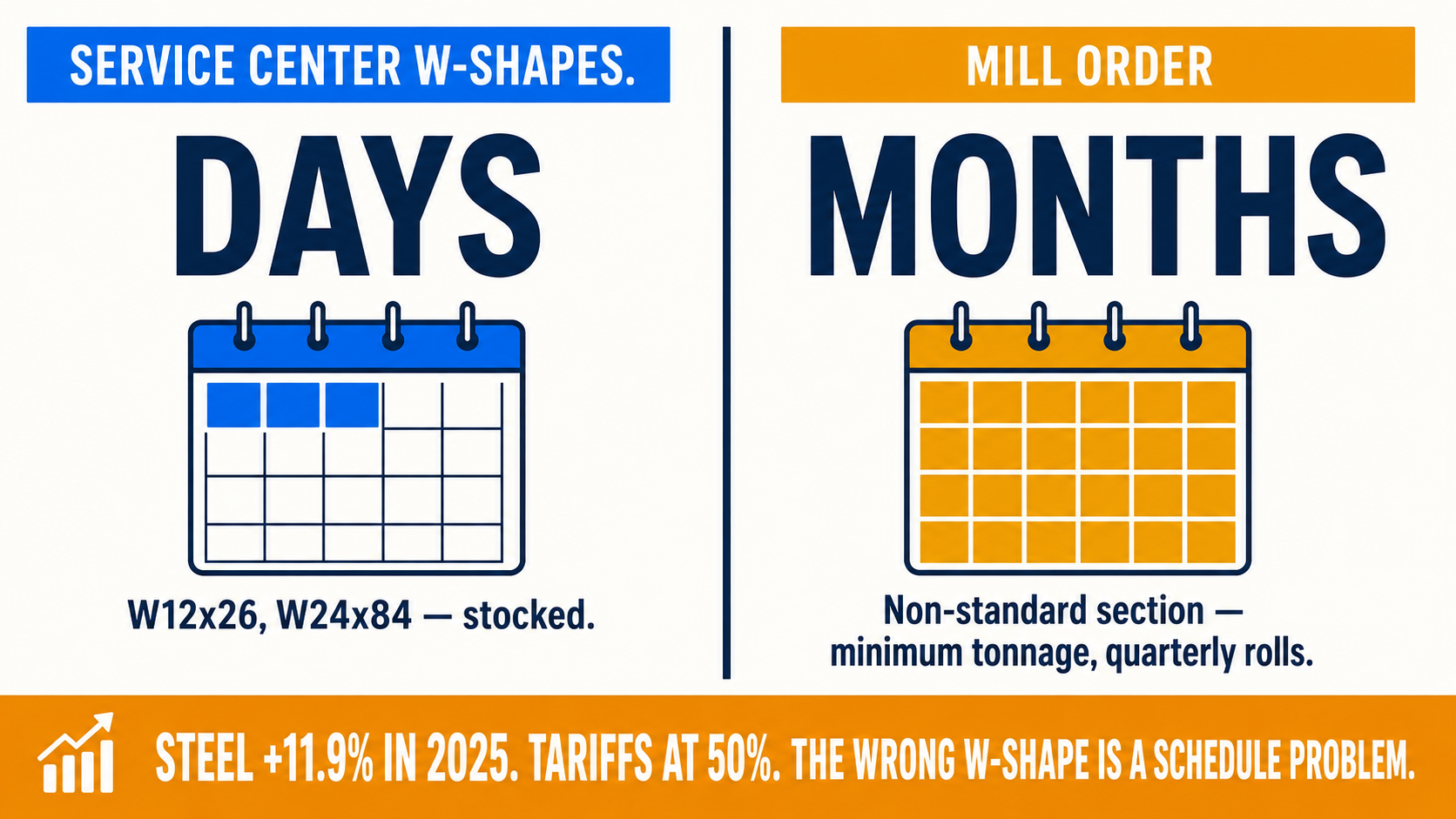
The AISC maintains a real-time steel shapes availability database at aisc.org/steelavailability. Service centers stock common W-shapes — W12x26, W24x84, the standard catalog — with lead times measured in days. Mill orders for less-common sections require high minimum tonnage and lead times stretching months, specific shapes rolled only quarterly.
Service center stock is a days decision. Mill order is a months commitment. A framing plan with non-standard sections looks structurally elegant until a fabricator prices it.
With steel prices up 11.9% year-over-year through end of 2025 (ENR 20-city average) and tariffs on steel and aluminum hiked to 50% mid-year, the cost of the wrong W-shape isn't the steel — it's the schedule delay, the structural re-analysis, the permit revision. A structural pre-screening tool that optimizes member sizing without a procurement constraint layer is optimizing the wrong objective. We added a constraint engine that cross-references AISC availability data before recommending a section, so the output is not just structurally defensible but a section available at service-center lead times.
What Breaking the BIM Export Taught Me
The week that clarified the BIM-to-analysis problem was a week I spent trying to get a clean analysis model out of a Revit export. IFC (Industry Foundation Classes) is the standard. The theory is that you export from Revit, import into ETABS or SAP2000, and the structural model is ready to analyze.
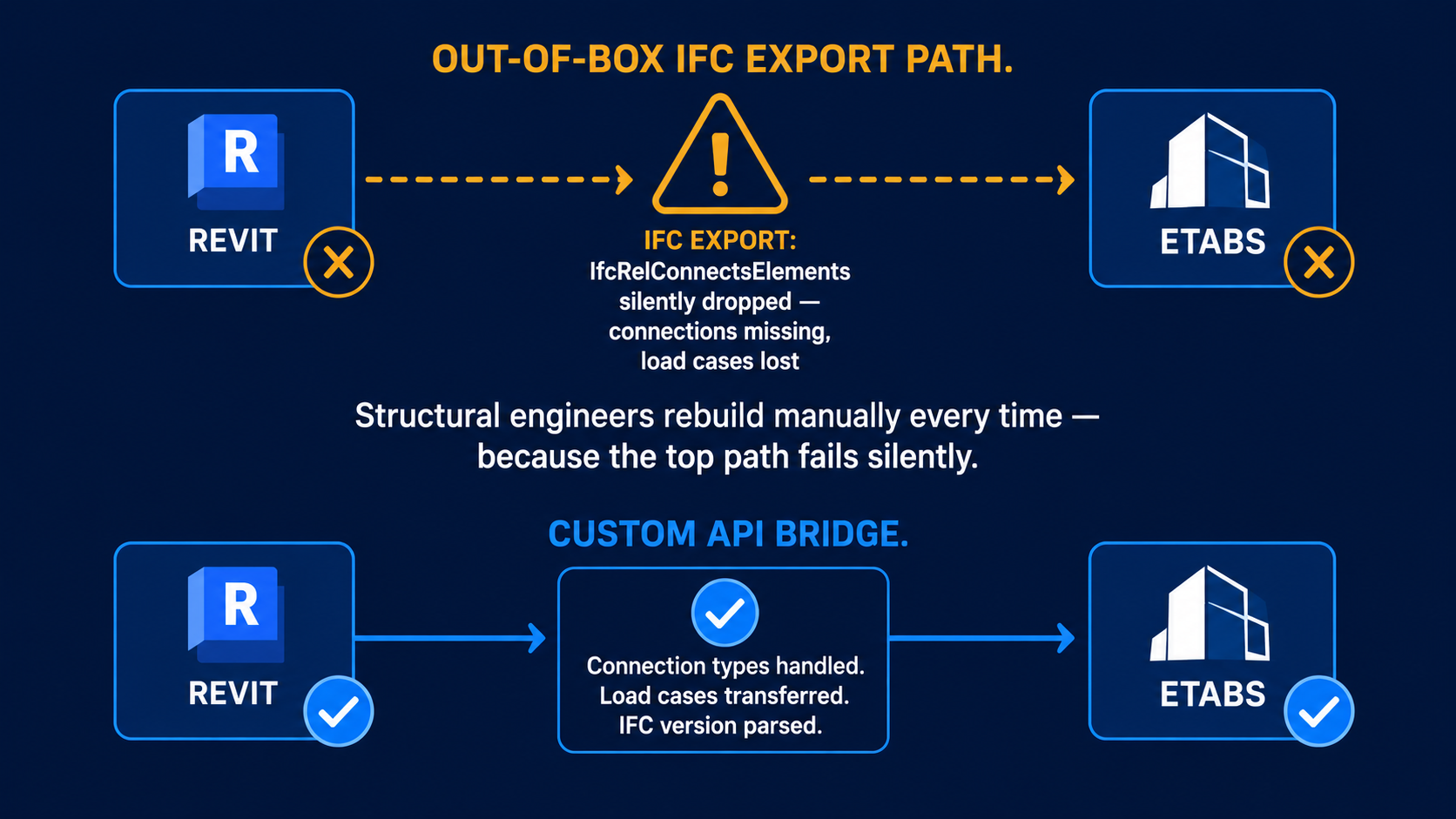
What actually happened: beam connections were missing with no error message. Load cases dropped. IfcRelConnectsElements — the IFC schema element that represents structural connections — was silently lost in the translation. Graphisoft's own documentation for their Archicad-Revit exchange add-in describes the out-of-box result as inadequate. IFC2x3 and IFC4 are both in active use, and the version mismatch creates alignment failures that the exporting tool doesn't report.
We built the bridge at the Revit API and analysis-tool API layers ourselves — handling the specific connection types, load case transfers, and IFC parsing that out-of-box export drops. That's the only reliable path. It requires deep familiarity with both BIM authoring tools and structural analysis tools, and the knowledge that generic IFC export will silently fail in ways that don't announce themselves until the structural engineer rebuilds the analysis model and finds connections missing.
That's not a problem a new IFC version will solve for projects running today. It's a custom pipeline problem, and it's the reason structural engineers still rebuild analysis models manually after receiving architect files.
The Part the PE Stamp Makes Non-Negotiable
I want to be precise about what physics-informed pre-screening is and isn't, because the liability question is the first thing any licensed structural engineer raises — and rightly so.
AI use does not change a Professional Engineer's legal responsibilities. No building department accepts a GNN pre-screening output as the basis for a structural permit. The PE stamps the final calculation package: force diagrams, member utilization tables, code-check documentation against ASCE 7-22 as adopted into IBC 2024, with its significant changes to multi-period response spectra, non-structural anchorage equations, and snow load maps. What the pre-screening layer changes is not who signs — it's how many red-flagged utilization ratios come back from that first full FEA run.
Only 27% of AEC professionals report using AI in operations (ASCE survey, December 2025), and only 8% of architecture firms have implemented AI solutions (AIA research). The gap between academic capability and production deployment is the integration problem: connecting GNN surrogates and IFC pipeline automation to the actual engineering workflow in a form that works with Revit, respects PE liability, and constrains output to standard steel inventory.
The quiet in the room when the structural engineer sees the render isn't about skepticism toward AI. It's about the specific experience of knowing that beautiful concepts and buildable structures are two different engineering problems — and that every tool in the room solves one of them. We built for the space between.
If you're working through this problem — either the pre-screening gap specifically or the BIM-to-analysis pipeline friction — I'd be curious where in the cycle the cost shows up most visibly for your team. That tends to be where the architecture of the solution becomes clearest.