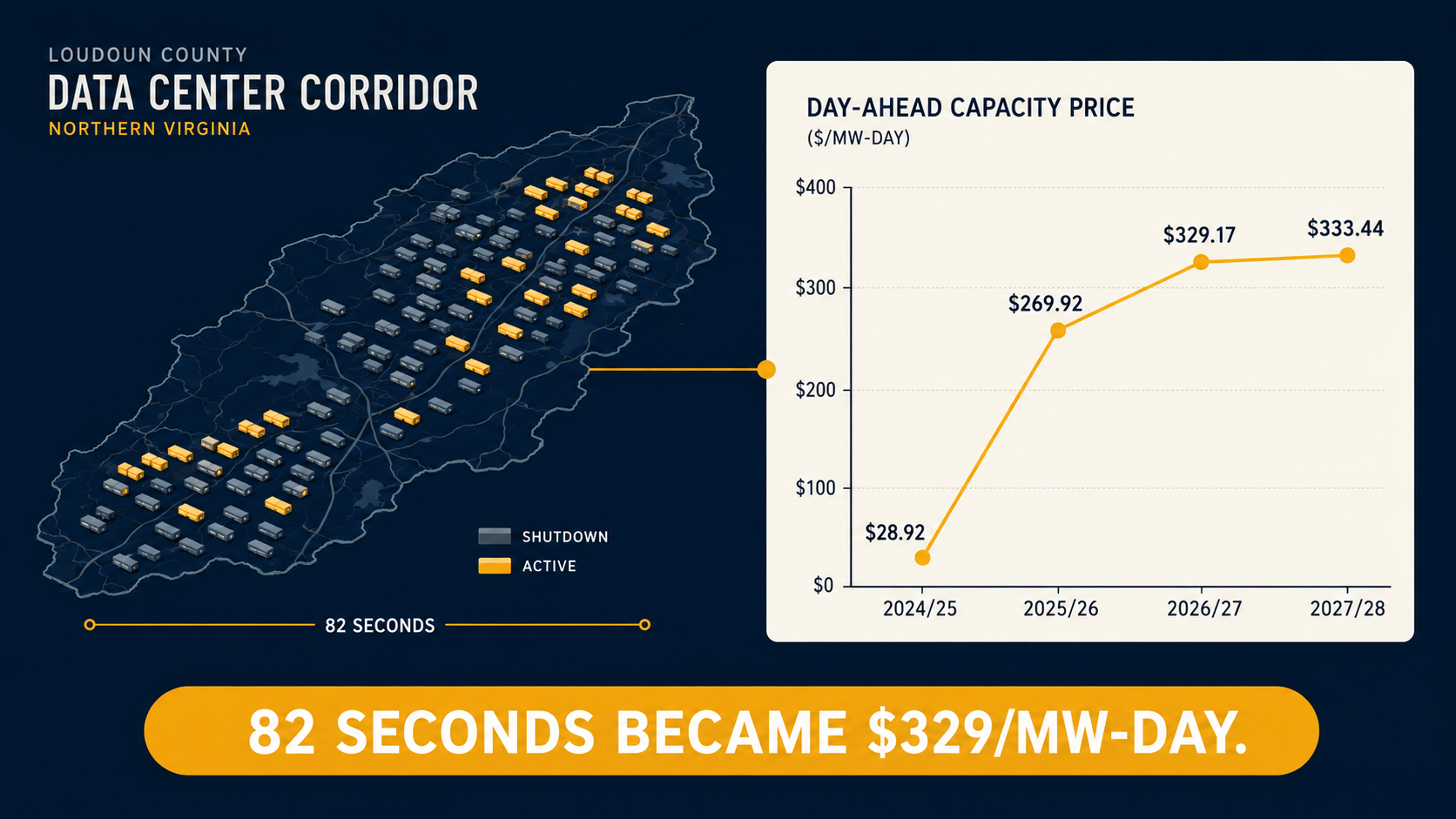
The July 2024 Virginia "byte blackout" was not a power problem. It was a disclosure problem dressed up as a power problem, and the bill is now arriving in PJM's capacity market.
Within roughly 82 seconds, a 230 kV transmission fault and three reclosing attempts caused about 60 data centers in the Dominion zone of PJM to simultaneously shed near 1,500 MW of load — the equivalent of nearly one third of every household in Virginia falling off the grid at once. The mechanism was not exotic. It was a counting register inside each facility's UPS firmware that PJM had no record of, no model for, and no standard requiring its disclosure. Two delivery years later, PJM's capacity price has gone from $28.92/MW-day in 2024/25 to $329.17/MW-day in 2026/27 — a tenfold escalation in twenty-four months, with the cap effectively reached at $333.44 in 2027/28. The two facts are the same fact at two timescales, and our team at Veriprajna has spent the last year building the layer that connects them.
We work on this question end-to-end at veriprajna.com/solutions/data-center-grid-interaction: a workload-aware grid interaction system for data centers that bridges OpenADR 3.0 signals, GPU and inference scheduler APIs, thermal storage dispatch, and capacity market position management — designed for the colocation operator who does not own the workloads, not just the hyperscaler running NVIDIA's own AI factory blueprint.
What the UPS Was Actually Counting
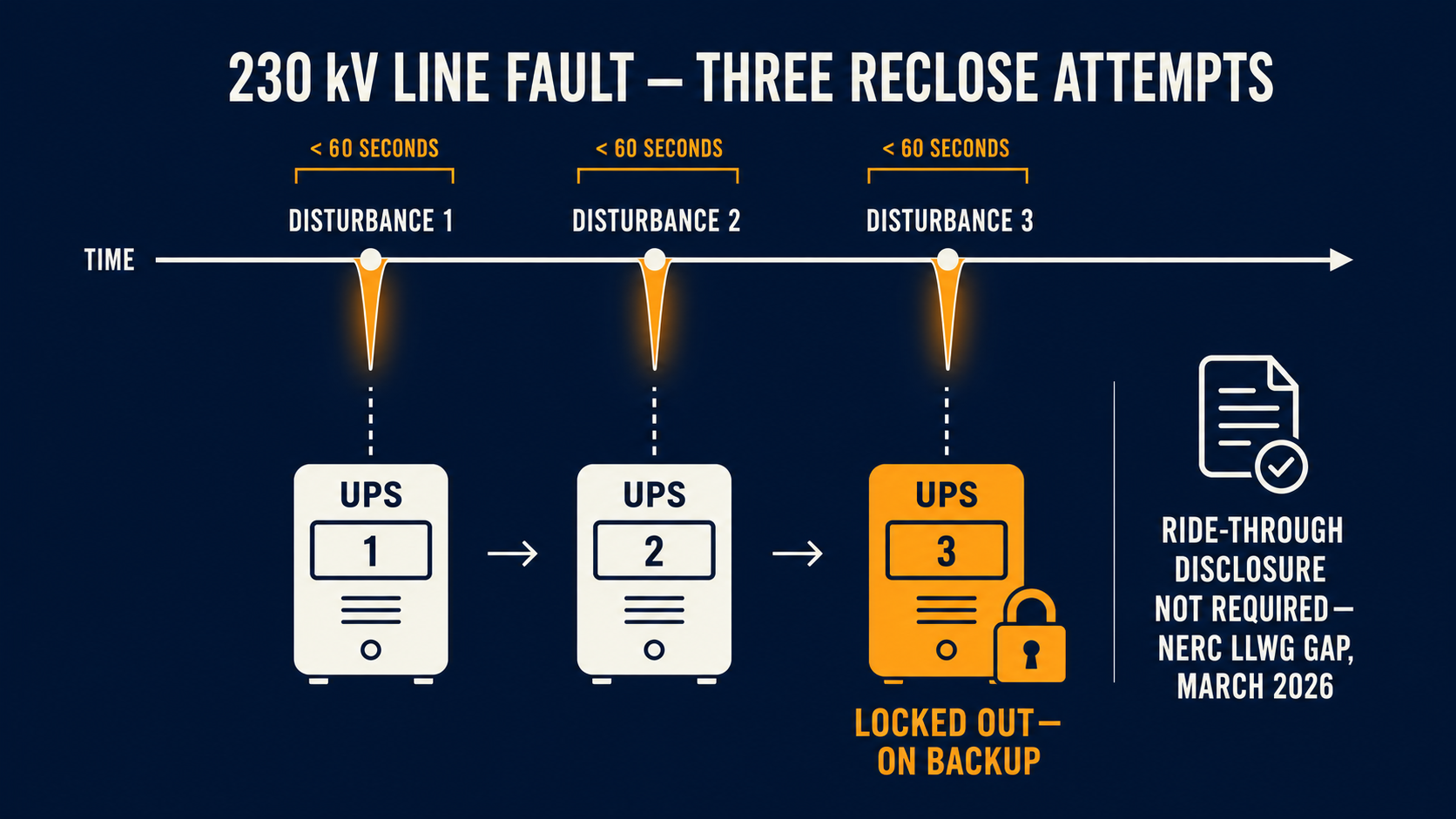
The mechanism that took 1,500 MW off PJM in July 2024 is now well-documented in NERC's incident review, but it is still under-modeled in every transmission planning study we have looked at. Static UPS systems and diesel rotary UPS units sold into hyperscale and colocation facilities for the last decade carry voltage disturbance counting schemes. When three transient disturbances arrive inside roughly a minute — the precise threshold varies by vendor — the UPS locks out grid supply and transfers the facility entirely to backup, and it stays there until a human walks to the relevant switchgear and reconnects.
The third reclose attempt on the faulted 230 kV line in Loudoun County aligned, by accident of timing, with the third counted voltage depression at the affected substations. Sixty-some facilities transferred to backup within the same 82-second window. Static UPS sites came back quickly once the transient cleared. The DRUPS-equipped sites — and Northern Virginia has a lot of them — did not. NERC's incident review made clear that grid operators had no prior visibility into this behavior, no standard requiring its disclosure, and no validated load model that would have flagged it in planning studies.
The NERC Large Loads Working Group, sitting under the Reliability and Security Technical Committee, published its first gap assessment whitepaper in March 2026. Disturbance ride-through for data center loads is named explicitly as a priority gap. PERC1 — the Power Electronic Reconnecting and Ceasing load model presented at the NERC Load Modeling Task Force webinar in November 2025 — exists in the planning toolkit, but the empirical data needed to parameterize it for any given data center cluster is not being collected from facility BMS and DCIM systems by any commercial vendor we have surveyed. PERC1 is a slot that will not fill itself.
The July 2024 cascade was not caused by a failure of the grid. It was caused by sixty data centers behaving exactly as their UPS firmware told them to behave, with no one upstream knowing what that behavior would be.
The Bill Arrives in the Capacity Market
The market consequence of the same opacity is now legible on every capacity invoice in the PJM footprint. Auction clearing prices ran from $28.92/MW-day in 2024/25 to $269.92 in 2025/26 to $329.17 in 2026/27, with 2027/28 hitting the $333.44/MW-day cap. IEEFA's analysis attributed roughly 63% of the 2025/26 increase to data center demand — the rate-impact case sitting in front of the Virginia legislature is the political version of the same number.
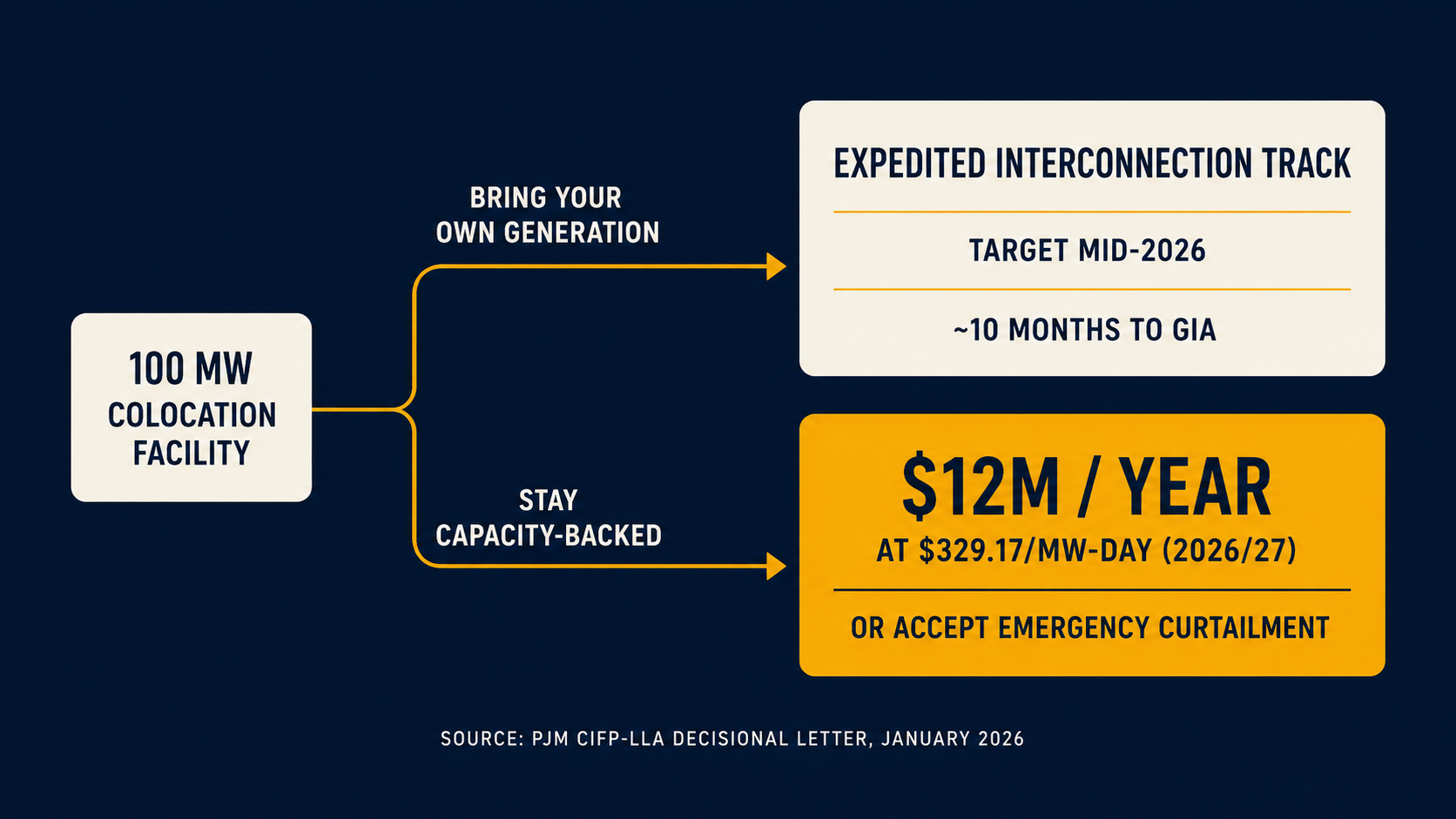
For a 100 MW colocation facility, the math is unambiguous: roughly $12 million per year in capacity obligation at current clearing, if the load is treated as fully capacity-backed. The PJM Board of Managers' January 2026 CIFP-LLA decisional letter set the alternative explicitly: bring your own new generation under the Expedited Interconnection Track PJM filed on February 27, 2026 (target operational mid-2026), or accept that service will be interrupted during high-demand emergency periods. PJM's Non-Capacity-Backed Load proposal was panned and pulled; the substitute is Price-Responsive Demand, which only earns its value when curtailability is automated and verifiable.
EPRI's DCFlex coalition demonstrated in Phoenix on May 3, 2025 — with NVIDIA, Oracle, and Salt River Project — that a real production AI workload could sustain a 25% power reduction over three hours during a grid stress event, with the results peer-reviewed in Nature Energy. The 15-minute ramp down, the three-hour hold, the ramp back up without overshoot of baseline: every step was orchestrated by software that does not exist as a shipping product for the colocation market. Schneider Electric joined DCFlex in March 2026; EPRI launched the Flex MOSAIC classification framework the same month. The framework is new enough that no commercial implementation has shipped to a multi-tenant facility we know of.
The Vendors Who Almost Reach It
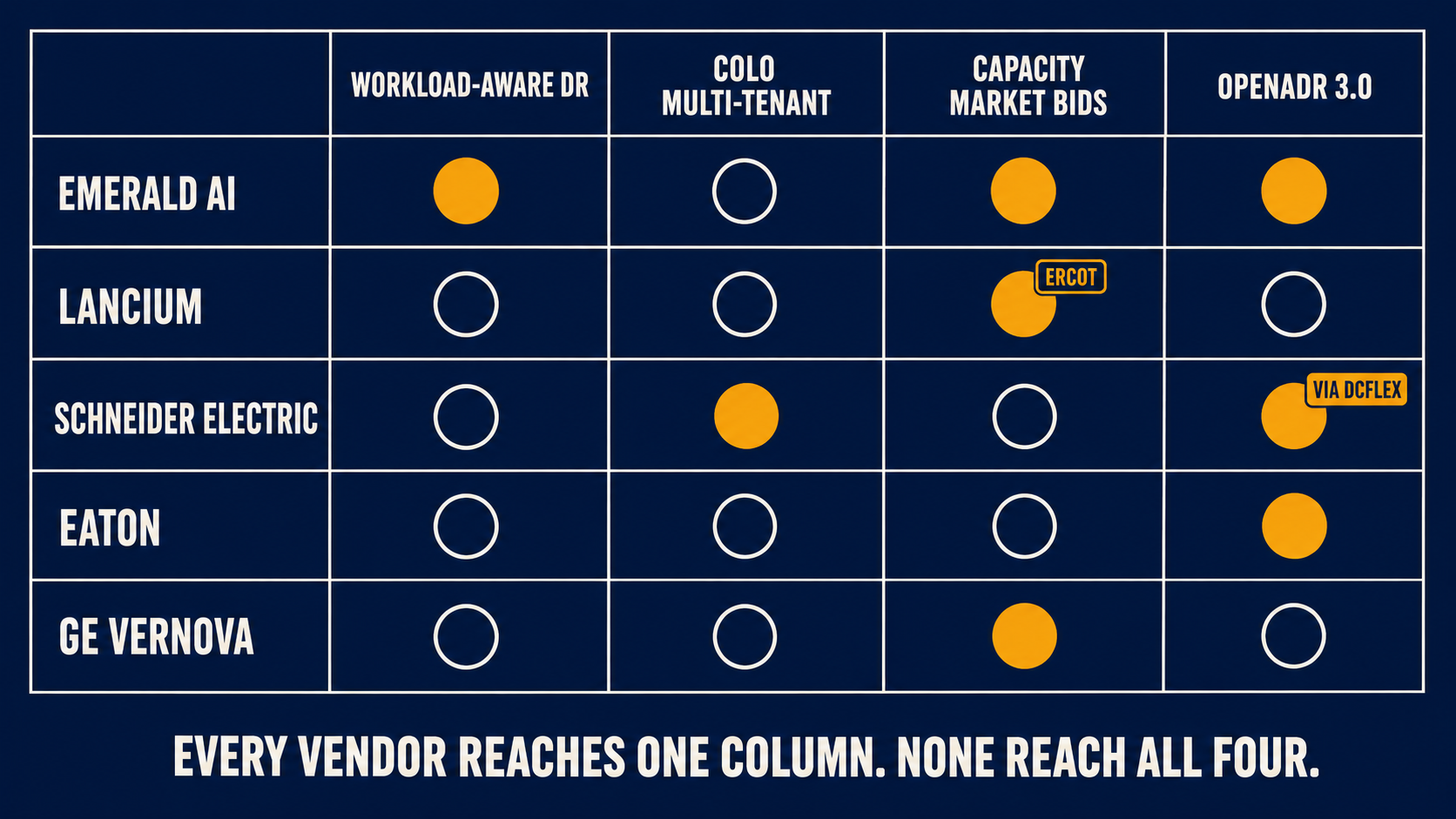
A useful way to read the competitive landscape is by what each vendor stops short of doing.
Emerald AI is the clearest specialist in the space — $68 million raised in sixteen months, including a $25M round led by Energy Impact Partners in March 2026 with NVIDIA's NVentures, Eaton, and GE Vernova among the strategics (alongside Radical Ventures, Salesforce, Samsung, Siemens, and IQT — the CIA venture arm — in the same round). The Emerald Conductor platform orchestrates on-site energy resources alongside computational flexibility, and the fourth DCFlex demonstration is scheduled mid-2026 at NVIDIA's 96 MW Vera Rubin AI Factory Research Center on PJM. What Emerald has shipped is impressive; what it has chosen not to ship is also a tell. The NVIDIA partnership privileges hyperscaler-grade AI factories and the GPU scheduler APIs that come with them. Colocation operators with mixed-vendor accelerators — AMD MI series, Intel Gaudi, custom ASICs — and with tenants whose workloads they do not control are not the buyer Emerald is optimizing for.
Lancium is operating, not pre-revenue, but operating in ERCOT. Their Smart Response platform qualifies facilities as Controllable Load Resources under ERCOT protocols, and the 1.2 GW Stargate site in Abilene runs on it. Two facts limit Lancium's relevance to a PJM colocation buyer. The platform is closed and tied to Lancium-operated facilities; there is no software-as-a-service offering for third-party operators. And the flexible-cluster model — separating critical compute from deferrable batch jobs — works for crypto and offline AI training but not for the latency-sensitive inference tenancies that fill most colo cabinets.
The broadest installed infrastructure footprint in the room belongs to Schneider Electric. EcoStruxure connects power, cooling, racks, and management. Fast Frequency Reserve technology lets data centers disconnect for up to thirty seconds to support grid stability via UPS. The One Digital Grid Platform sits on the utility side of the meter. Schneider's February 27, 2026 blog post "Making Data Centers Grid Friendly" is a clear public statement of intent, and the company joined the EPRI DCFlex initiative the following month. The gaps are equally clear: FFR is reactive at thirty seconds, not strategic at the three-hour scale EPRI proved; there is no workload-aware demand response; there are no capacity market participation tools; and EcoStruxure does not, today, integrate OpenADR 3.0.
Eaton has chosen the smartest hardware play in the room. Their bidirectional UPS architecture turns a previously dormant asset into a distributed energy resource. The Beam Rubin DSX platform, announced as part of the NVIDIA Vera Rubin reference design, is a serious end-to-end power architecture for AI factories. Eaton's $50M Virginia manufacturing investment for static transfer switches and PDUs, beginning 2026, is a credible bet on this market continuing to scale. The choice that tells us where Eaton sees its own boundary is the Emerald AI investment: Eaton is building the silicon and the steel and is buying its way to the software layer through someone else's company.
On the other side of the meter, GE Vernova's GridOS coordinates the utility's view — generation, transmission, distribution, markets, edge devices, up to 70% renewable penetration without inertia management failure. The Data Fabric integrates OT/IT plus weather, wildfire, and emergency-services feeds. GridOS is a remarkable product for the operator on the other end of the interconnect. It is not a data center side counterpart, and GE Vernova's investment in Emerald AI says, in dollars, what GE Vernova thinks of building one themselves.
Google's January 2026 announcement of 1 GW of integrated demand response capacity across Entergy Arkansas, Minnesota Power, and DTE Energy — including 350 MW of a 2.7 GW contract covered specifically by DR — is the proof at scale that workload-aware curtailment can buy a hyperscaler faster grid connection. Microsoft's first-half 2026 commitment to "pay its way" framework in new and expanding US markets sets the rate-recovery baseline. The Data Center Coalition reversed its prior position and now supports voluntary flexibility programs. The market signal is that workload-aware DR is now non-optional for hyperscalers. The market gap is that the tooling that earned Google its 350 MW DR commitment is proprietary, in-house, and not for sale.
What OpenADR 3.0 Does Not Know
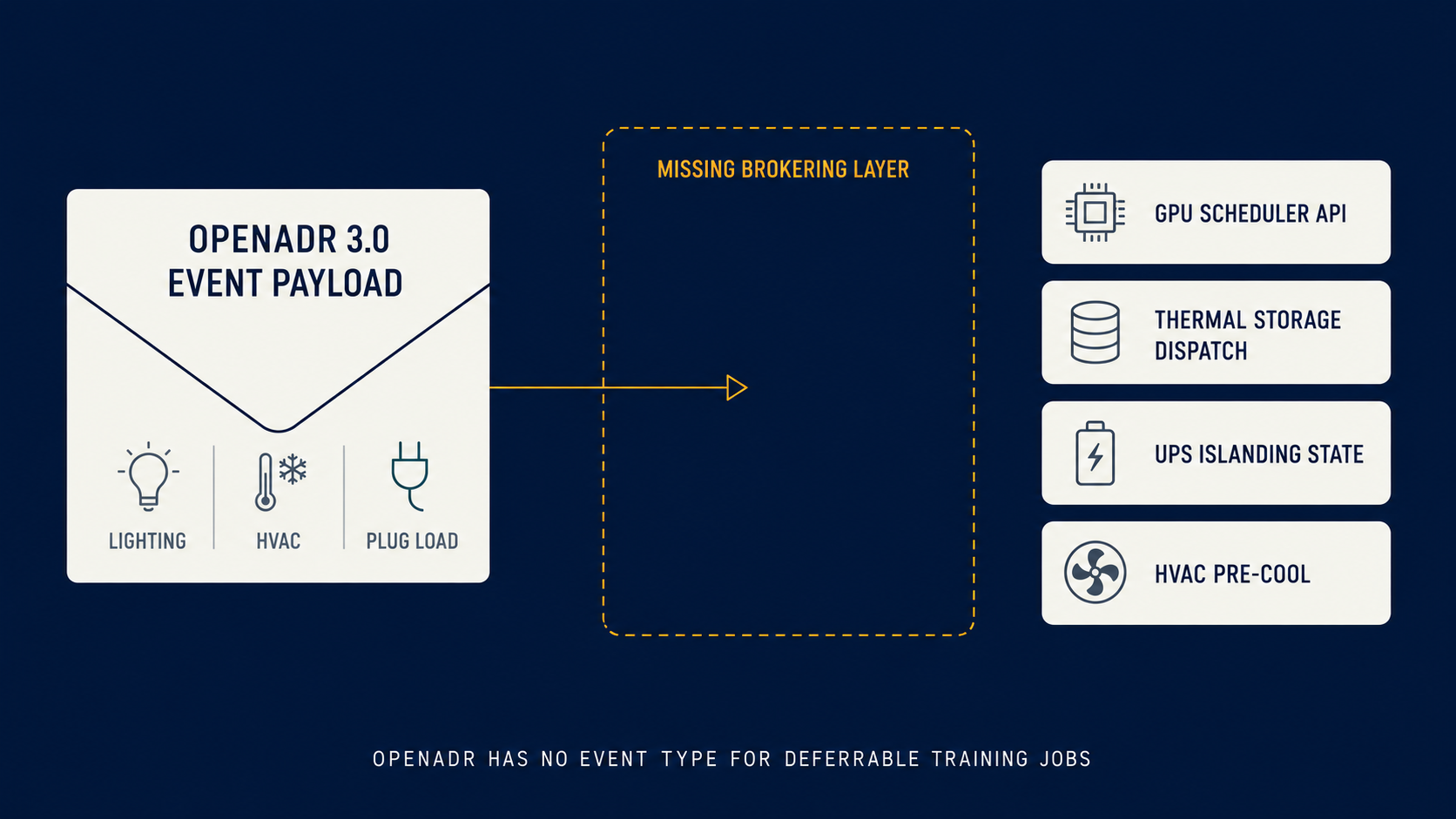
OpenADR 3.0 is the protocol the industry has settled on for automated demand response — REST-based, replacing the XML-heavy 2.0b, with a maintained open-source Rust implementation (OpenLEADR) funded through 2026. We have spent real engineering time inside the OpenADR 3.0 event payload schema. It is building-centric. It does not distinguish a deferrable ML training run from a latency-sensitive inference request. It has no event type for GPU cluster curtailment, no concept of cooling thermal shift, no representation of UPS islanding coordination. The protocol cannot tell whether the data center being asked to curtail can shave 200 kW of HVAC load for forty minutes while finishing the in-flight inference SLA, or whether it needs to bleed off twelve racks of training-mode GPUs.
That gap matters because curtailment-before-emergency-DR is the hierarchy PJM is migrating toward, and Price-Responsive Demand only earns its capacity-payment value when the operator can verify in real time that the right workloads are being shed against the right signals. A workload-aware controller that brokers between an OpenADR 3.0 event and the actual scheduler APIs running on the facility's compute fabric is the missing layer. EPRI's Flex MOSAIC framework, launched in March 2026, attempts to standardize how flexibility is classified across large electric loads. It is a classification scheme. It is not a controller.
The thermal-storage vector that EPRI's DCFlex demonstration leaned on — 40% of total data center energy goes to cooling, by NREL's accounting — is also under-served. Cold underground thermal energy storage, chilled water tank pre-cooling, ice storage, phase-change materials: each is well-understood in commercial buildings and badly integrated into data center demand response orchestration. NREL's 2025 research on UTES for data center peak cooling demand confirms the headroom; no integrated controller coordinates thermal dispatch against grid DR signals and workload scheduling simultaneously, for any operator we have reviewed.
The Disclosure Problem Is Now a Compliance Problem
FERC's Advance Notice of Proposed Rulemaking on large load interconnection, opened October 23, 2025 under Docket RM26-4-000, is the layer that will harden flexibility into a regulatory artifact. The scope is loads above 20 MW connecting to the interstate transmission system. The questions under consideration include whether flexible and curtailable large loads should receive expedited interconnection studies completed within 60 days, how grid upgrade costs should be allocated, and how co-located generation should be treated. FERC's final action deadline is April 30, 2026; ANOPR is followed by Proposed Rulemaking, then Final Rule.
The implication for operations: the next eighteen months will turn voluntary disclosure of UPS ride-through behavior, voluntary participation in DR, and voluntary capacity market bidding into the price of admission for interconnection. NERC's Large Loads Action Plan targets registration, definition, and initial standards development for completion by year-end 2026. Virginia's SCC GS-5 rate class for loads ≥25 MW takes effect January 1, 2027, and Senate Bill 253's framework for shifting capacity and grid-connection costs onto high-load users sits one legislative session away from enactment. The Piedmont Environmental Council is pushing publicly to end data center tax breaks. The Virginia General Assembly stopped short of a moratorium in the 2026 session but deferred the question to next year.
A data center that cannot describe its own ride-through behavior, dispatch its own thermal storage on demand, and bid its own capacity market position is, by 2027, a facility with a license-to-operate problem, not just an energy bill.
Where the Architecture Has to Live
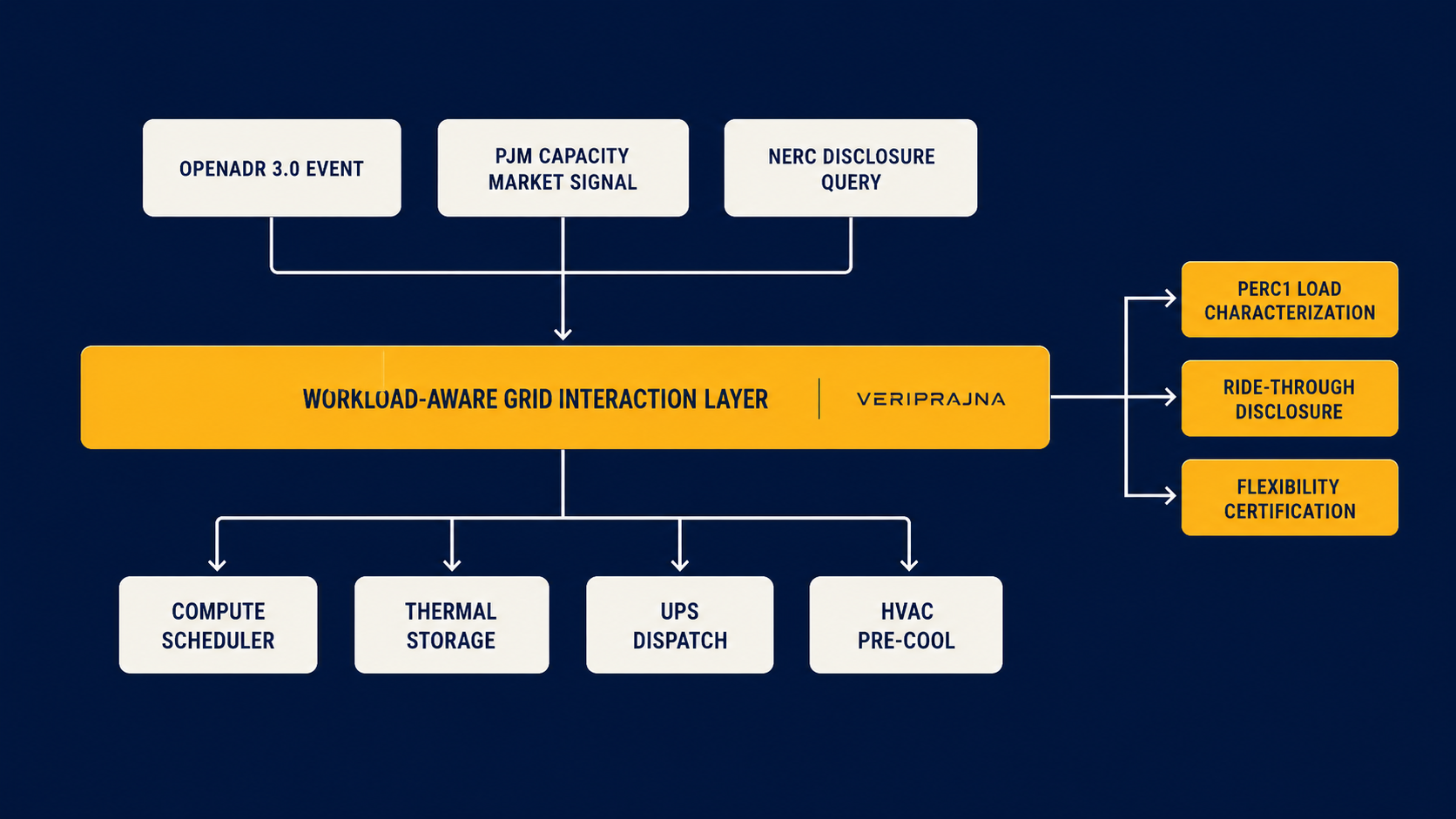
The seven gaps we have spent the year sizing — colocation orchestration software, capacity market bid optimization, NERC PERC1 compliance automation, integrated multi-vector orchestration, vendor-neutral GPU workload flexibility, UPS ride-through behavior disclosure, and flexibility certification for FERC expedited interconnection — are not seven products. They are facets of one missing layer.
Our architecture at Data Center Grid Interaction AI starts from the assumption that an operator does not own the workloads, does not control the GPU mix, has DRUPS or static UPS units it inherited from the build, and is now being asked simultaneously by PJM, NERC, FERC, the state SCC, and its own community to behave in ways the building was never wired to behave. The system reads OpenADR 3.0 events, translates them into facility-side dispatch decisions across compute scheduling, thermal storage, UPS state, and HVAC pre-cool, and emits the verification artifacts a transmission operator now needs — PERC1-relevant load characterization data extracted from existing BMS and DCIM systems, ride-through behavior documentation, capacity market bid evidence, and the audit trail that FERC's flexibility certification regime will demand.
The 96 MW Aurora AI Factory will be the highest-profile test bed for hyperscaler-grade orchestration. The colocation provider in Loudoun County with mixed tenancies and a DRUPS fleet it cannot rip out has a different problem with the same shape, and that is the buyer we are built for.
Where We'd Like to Compare Notes
The byte blackout was a one-time event. The capacity bill is the recurring version of the same event. The compliance regime that NERC, FERC, and the state SCCs are building over the next eighteen months is what makes both expensive forever, for any data center that cannot prove its grid behavior — or affordable forever, for one that can.
If you are running operations at a colocation provider, sitting on a utility large-load interconnection team, or thinking about how to keep your Virginia or PJM footprint operable through the regulatory wave, we'd like to compare notes on what the orchestration layer actually has to do. The architectures that will survive the 2027 capacity year and the FERC final rule are still being argued out, and the operators with the most useful field data on UPS counting logic, thermal storage dispatch ceilings, and tenant-workload curtailment latency are not the ones doing the talking yet. We think they should be.